Showing posts with label clouds. Show all posts

Friday, March 23, 2018

Personal Panoramic History, Part 2: 2009

Last time we looked at panoramas from Jordan, from 2008. In this post we'll skip forward to August 2009 (since apparently I didn't take any photos for a year and a half) when I moved to Hawaii at the tender age of twenty after completing two years of community college (and an Associate's Degree in Science) in order to finish my Bachelor's Degree at the University of Hawaii at Hilo. This year was a real life-changer! Moving out of my parents' home for the first time, coming to Hawaii where I would ultimately spend the next eight years, and being introduced to Mauna Kea and Mauna Loa, my two favorite volcanoes—lots of stuff happened. So let's jump into…

August


I don't have any pictures until August of 2009, but that's when I moved to Hawaii and I made up for by taking a pretty good number. And among them are three panoramas that I don't think I've ever shown before! When I flew out to Hawaii my mom came out with me for a week and we did some sightseeing, including my first trip to Volcanoes National Park, where these panoramas come from.

Puhimau Crater.
First up: a pit crater called Puhimau Crater found by the side of Chain of Craters Road in the park. It's not a particularly inspiring panorama, but I was obviously struck by the size of this giant gaping hole in the ground and tried to capture it in three photos. This panorama was only created while writing this post—it turns out that black lava rock plays havoc with your white balance and exposure, so I never bothered trying to stitch these together manually. Hugin, on the other hand, manages it amazingly well.

Kīlauea pali.
At the end of Chain of Craters Road, where it terminates in a lava flow after descending the steep pali (cliffs), I turned around and snapped this ambitious panorama (seven pictures!) of where we had just come from. If it looks hazy, that's because it was; Kīlauea was out-gassing significantly that day, so those aren't water clouds, that's sulfur dioxide and other fun gasses that volcanoes like to emit. I like this panorama (which like the one above was only made while writing this post) because it once again captures the immense flatness and and sheer breadth of Hawaiian volcanoes.

Kīlauea caldera.
Finally, another ambitious panorama of six photos, this one overlooking Kīlauea caldera itself, with Halemaʻumaʻu Crater just right of center spewing out noxious chemicals. This panorama I actually created manually all the way back in 2009, the day after taking the photos, though for some reason I omitted the left-most photo (with the fence and ʻōhiʻa tree); perhaps I found it too much work to integrate with the rest. Hugin had no problem with it, though, so that's the version you get today!

October


September was apparently spent mostly settling in given its dearth of photos, but on October 9th I had my first opportunity to ascend Mauna Kea to the Visitor Information Station. I vividly remember the trip up that afternoon, because it had been cloudy and overcast in Hilo and all the way up until about maybe 7,000–8,000 feet, where we entered a thin layer of thick cloud for a bit only to suddenly explode out of it into a land of brilliantly beaming sunshine. The effect of that contrast was incredible, and the impression on me, indelible. In my many, many trips up Mauna Kea since then I've experienced the same thing two or three times, and it is awesome every time it happens.

I don't have panoramas from that first trip, but near the end of October, on the 26th, I had what I believe was my first chance to get to the summit of Mauna Kea.

Mauna Loa.
On the way up whoever was driving stopped the car on the side of Mauna Kea access road, allowing me to get out and snap this two-photo panorama Mauna Loa. Although I made these photos into a panorama manually a few days later, I don't think I was really thinking of it at the time or I'd definitely have taken at least a single additional photo on the left. Still, this one is right up there among my favorite panoramas I've ever taken. The serene calm of Mauna Loa beneath a few scattered clouds and cerulean sky, the green grass on the slopes of Mauna Kea, and right near the center of the image little Puʻu Huluhulu—he nani nō ia! (It's a wonderful thing!)

I'm often reminded, while looking at these panoramas later, of Isaac Watts' apropos hymn verse:
Lord, how Thy wonders are displayed, where'er I turn my eye,
If I survey the ground I tread, or gaze upon the sky.

Keck II and Maui from Mauna Kea.
The weather was cloudier at the summit where I took this small two-photo panorama, my first from the summit region of Mauna Kea. (I should clarify that when I say the “summit” of Mauna Kea I usually mean the large, relatively flat area near the actual summit—I've lost track of the number of times I've been to the summit area, while I believe I've only been to the true summit thrice, and only one of those times did I have a working camera with me.) This is actually a perspective I don't think I revisited, looking north from near the Keck observatories over the north plateau with Maui in the background on the horizon to left of center.

November


November I continued my trips to Mauna Kea, and many of my pictures from that month reflect that. (The rest are a whole bunch of flowers—I guess because of the novelty of seeing flowers in bloom in November?—and a whole bunch exhaustively documenting my first attempt to cook a breadfruit into nachos.)

Hale Pōhaku, with Mauna Loa in the background.
Speaking of never-repeated perspectives, I think this is the only panorama I've taken from what I deduce must be the balcony outside the dining room at Hale Pōhaku. If you look closely you can see that the ridgeline of the building in the middle has a discontinuity—the two photos that make up this panorama were not enough, and quite divergent in exposure, so this is the best Hugin could do. I debated whether or not to put it up at all, but other than that glitch the image is pretty neat (well, it's overexposed on the right, but I like the view). The three buildings on the left are various dormitories for resident workers on the mountain to stay in, while the Visitor Information Station can be seen right of center.

The hill on the right is part of a series of three known as Puʻu Kalepeamoa, a Hawaiian name that means “cinder cone (puʻu) [that looks like] the comb of the chicken (ka-lepe-a-moa).” The summit of that hill is a popular spot for viewing the sunset, perhaps a quarter of a mile's hike from the VIS. It turns out, however, that that hill is merely the highest point in the rim of a large cinder cone, the second-highest point of which is visible here as the slightly lower hill in the middle of the image. The entire things is so large that I only first noticed its form while looking at the area on satellite imagery; in fact, the Access Road goes right through it just before reaching the VIS!

Mauna Kea summit observatories.
And here's my first panorama from the summit (region), of the summit (region, the true summit is behind the hill on the left). This is actually a hand-crated panorama which I literally cannot remake in Hugin, because some of the photos have gone missing since I made it. (I'm not sure if I deleted some of the less-interesting ones after making the panorama in a misguided effort to save storage space or what, but they're not there any more.) This panorama was taken from in front of the Keck observatory, and shows (at least a bit) of all the summit observatories there at the time. From left to right, we have the NASA Infrared Telescope Facility, the Canada-France-Hawaii Telescope, Gemini North, the United Kingdom InfraRed Telescope, Hōkū Keʻa, the Caltech Submillimeter Observatory (currently being decommissioned, last I heard), the James Clerk Maxwell Telescope, the control building for the SubMillimeter Array, Subaru, and the tiniest glimpse of the dome of Keck I.

December


We round off 2009 with two more manually-created panoramas that I cannot reproduce due to missing images. I'm not sure why I decided to delete various source images after making a panorama, but I'm not happy with past me! Anyway, here are two panoramas from around dusk on December 13th:

Hale Pōhaku.
Another panorama of Hale Pōhaku from across the road at the end of the trail to the summit where it connects. Not much else to say other than that, no, those holes in the blue road sign are not bullet holes (as I was occasionally asked), they're there to protect the sign from the occasionally gale-force winds at this elevation. Also I love the background of the irenic sea of clouds. That above-the-clouds perspective is definitely one thing I miss in Australia.

Sunset from Mauna Kea.
My first attempt at a sunset panorama, and for being manually created I'm pretty happy with this one. To the left stands majestic Mauna Loa; in the foreground, mighty Mauna Kea; and, barely visible on the horizon, Hesperian Hualālai beside the setting sun. Very tranquil.

And with that we bid farewell to 2009! Join me for the next part covering 2010, where I don't make a whole lot of panoramas, but make a few decent ones with a bit of practice. A hui hou!

Sunday, September 10, 2017

A Moving Day Approaches!

Well, things are getting pretty busy for me over here! I've finally got my airplane tickets, for the 27th—which is just over two and a half weeks at this point, a fact I'm alternately trying to forget, and remembering and freaking out about. I've got one more week of work with ASIAA, and have been busy cleaning, organizing, and making preparations for the past few weeks. I'll probably be even more busy for the next couple of weeks and I don't know how much I'll be able to post, so have a pretty picture of the YTLA open with Mauna Kea in the background.

We were probably looking at Jupiter when this photo was taken.
(Fun fact: I put this picture up on Google Maps for the YTLA and it's proved surprisingly popular, with almost 4,000 views in under a month!)

Wednesday, March 22, 2017

A New Job at the YTLA!

So, it's been a little while since I posted last, and that's partly due to the fact that I accepted the job offer with the Yuan-Tseh Lee Array (formerly known as the Array for MIcrowave Background Anisotropy, or AMiBA), started work last Thursday, and have already been up Mauna Loa twice this week and will be going up again tomorrow. I love the view up there, but I can't deny it's pretty exhausting!

Mauna Kea with scattered clouds about its head, seen at quitting time yesterday. Pau hana!
So yes, I'm once again working full-time, and I'd forgotten how tired that tends to leave one at the end of the day. My job title is YTLA Telescope Test/Operator, and there's a chance I might start doing night-time operations on Mauna Loa as early as next week (though for the moment my work hours consist of a mixture of helping out up on Mauna Loa during the day and being in the office down in Hilo).

A panorama showing Mauna Kea with the YTLA on the right; the telescope is inside the tan fabric shelter while the white shipping containers are the control room and the operator quarters.
There's lots more I could say about my new work, but it's getting late and I need to be up early again to prepare for going up tomorrow, so I'll keep this post short. Though I just realized I can now truthfully tell people that I work on an active volcano. Awesome. A hui hou!

(You know you work at an amazing place when you can seriously ask your supervisor, “So if the volcano suddenly starts erupting, is the preferred course of action to get in the car and gun it down the mountain, or stay put and wait for the emergency evac helicopter?”)

Edit 3/23/17: Just a few more pictures I took today. It was cloudy and foggy today for the first time, and I got a nice picture of Mauna Kea brooding beneath the clouds:

Mauna Kea seen on a more cloudy day.
I also had the bright idea to take a panorama inside the YTLA enclosing structure, allowing me to better capture it in its entirety:

The outer structure looks weird because the panorama distorts it, but you can see its exterior two photos up.
I also learned today that there's a large empty cavity beneath the telescope, inside the white cone structure beneath the platform in the picture above. It has a hatch to enter that looks a lot like an early space flight capsule door:

The telescope is not actually secretly a spaceship, sadly.

Wednesday, May 4, 2016

Rendering the Earth

I recently came across a neat tutorial for Blender on how to create a realistic Earth image using real land and cloud images from NASA. Well, all right, we hit “realistic” about half way through the tutorial and went on to “slightly stylized,” but I like how it came out so I thought I'd share it here.


…and looking at it now, I realize you can't actually see any of the land textures because they're all on the dark side of the planet (except Hawaii, which should be visible, but I can't find it even in the full-size image). Huh. Not the greatest composition ever, is it? I do love the night lights effect though, that's pretty neat.

While I could have added a realistic starry backdrop, I was focused on finishing the rest of the tutorial and instead went for a simple random noise texture stretched to get stars. While playing around with different noise textures for the background I found the Voronoi noise texture and thought it was cool enough to save a picture of:


(Incidentally, in this picture you can actually see the land textures…)

Anyway, I now have a fairly simple (minus the stylized parts) way of rendering a pretty realistic Earth, and I bet NASA has similar textures for other Solar System bodies, so I may have to do something with that in the future…

Friday, November 8, 2013

A Hawaiian Sunset

Monday evening we had an absolutely gorgeous sunset here in Hilo. The clouds were unusually high in the sky, allowing the setting Sun to light them from beneath in a breathtaking fiery display.


Usually the clouds around here are a lot lower in elevation, and especially with the combined mass of Mauna Kea and Mauna Loa in the way to the west the Sun usually can't get beneath them to light them up like this. Since the summit of Mauna Kea is visible (to the left of the lamp-post on the right), these clouds must be higher than 14,000 feet (or 4,200 meters). Lovely sight, anyway. A hui hou!

Sunday, February 10, 2013

Weather in Hilo

One of the nice things about living in Hilo is getting to see weather displays like the one below from time to time.

This comes from the Sun going down above the roof of the building next to where I work. It had been raining off and on all day, and on my way to work in the morning I was actually trying to get pictures of the puddle-reflection of a vibrant rainbow that was in the sky. None of them really came out well enough to post, sadly. Maybe next time. It sure made a pretty reflection in the puddle, shivering each time a drop of water well from the power line above or a passing car stirred the surface in its wake.

Saturday, November 5, 2011

Telescopes and Snow

This past Thursday my Observational Astronomy class got to go on a field trip to Mauna Kea, where we were treated to tours of three of the observatories up there: the Gemini North facility, the NASA Infrared Telescope Facility, and Hōkū Kea, the telescope that will eventually be for undergraduate students at UH Hilo when they finish fixing it.

We've had quite the storm system washing over the island this past week, so there was actually snow on Mauna Kea when we went up -- and not just "small piles in places the sun hasn't melted yet", but "a pretty good covering". Since I could probably count the number of times I've been around snow on my fingers and toes, it was pretty impressive to me.

Puʻu Hau Kea (Cinder Cone of White Snow)

Looking back whence we came.

Puʻu Makanaka (the large one. I don't know what Makanaka means, perhaps a proper name)

From left to right: Canada-France-Hawaii telescope, Gemini North, the UH 88-inch, the United Kingdom Infrared Telescope, and Hōkū Kea. All looking very cold.

Part of the Sub-Millimeter Array, standing staunchly amidst the cold.

Having gotten all those distracting pictures of frozen water out of the way, I can proceed to describe the actual objects of our tour. Our first stop was the Gemini North telescope, one of two identical 8.1-meter (that's 27 feet) telescopes built and operated by a consortium of countries. The other, Gemini south, resides in Chili, so that between them the two observatories cover almost the entire night sky. The two domes are identical, and are an imposing sight close up:

The Frederick C. Gillett Gemini Telescope dome, up close.

It's hard to capture the sheer size of a telescope that has more area than the floor of my room in one shot, but I tried. The Gemini telescope is similar in many ways to the Subaru telescope, which is almost the same size. For some reason, they're even painted suspiciously similar shades of blue. I did my best here:

The Gemini North telescope. It is huge.

Since it can be hard to appreciate something when you have nothing mentally to compare it to, have another shot with some crew members working in it (that big box they're standing around is an instrument they're about to put on telescope, and yes, it's so big that they're standing on it):

Removing one instrument and swapping in another.

From Gemini we moved to the NASA Infrared Telescope Facility, a 3-meter (9.8 feet) telescope built exclusively for infrared viewing (many of the optical telescopes on Mauna Kea such as the Keck twins, Gemini, Subaru, etc. have the capability to do some limited infrared observing, but IRTF is one of the two telescopes built exclusively for it). IRTF was originally built to support the Voyager missions and to this day at least half of its observing time is taken up by planetary research. Because of this it has a somewhat unusual mount called an English yoke equatorial mount. It's something like two tuning fork stuck with their open ends together, with the telescope free to rotate in between. The advantage of this design is that it is much easier to observer objects that are very near the zenith than would be possible on a regular alt-az mount such as most of the large telescopes on Mauna Kea have.

The NASA Infrared Telescope. Note that same shade of blue paint at the bottom.

Here's another shot from below showing the telescope nestled between the two arms of its yoke:

Showing off the telescope's unusual mount design.

Finally, we ended our time on the summit with a brief tour of Hōkū Kea. It's a mere 0.9 meters, and the entire dome area is probably smaller than Gemini's mirror. It's also apart for maintenance at the moment with the mirror being down for some work, so I didn't get any interesting pictures. There wasn't much to see besides the empty tube, although it too was painted that same shade of blue. I actually asked people at each telescope if there was a reason for the color, but all I got were blank stares so I still don't know. Maybe it was just cheap.

Anyway, after our frosty tour we left to return to the warmth of Hilo, but not before I captured one more snowy landscape in memory:

Looking to the south-west, Hualālai is visible off in the distance through the clouds.

Addendum: If you've read this far you must like pictures, so you may like to check out the post directly before this one. I re-reduced my Andromeda Galaxy picture, and I think it came out a lot nicer. I added it to the post, so you can see both of them and compare. A hui hou!

Tuesday, May 31, 2011

Heavenly Island in a Sea of Cloud

Sunday Jonathan and I went up to Mauna Kea as volunteers to help with the summit tour. It seems each time I go to see the silverswords I find another great photo opportunity. Someone created this pretty rock pattern around one particularly large and healthy plant:


A couple visiting Hawaiʻi showed up while we were there, so I pointed out some of the silverswords, and, when they seemed interested, shared a few of the things I've learned about them -- and was promptly asked if I was a botanist!

“The Botanist”
The wind at the summit was downright bone-chillingly frigid. I don't remember ever being so cold up there before. It was actually warmer inside the Keck telescope dome (or at least it felt like it)! Strangely, despite the Arctic weather up top, it was surprisingly mild and warm down at the Vis, even into the night. Jonathan and I went to catch the sunset from a cinder cone near the Vis, and the experience, sans wind, was much more pleasant than the last time we tried it. It was clear enough that we could actually see Hualālai to the west, a rare occurrence:

Hualālai: Ke Mokupuni Lani i ke Kai Ao (Heavenly Island in a Sea of Cloud).
All in all, a most pleasant day. I should probably end this post and get to bed, however. A hui hou!

Thursday, February 24, 2011

Clouds a-flame.

In my last post, I put up some incredible pictures from Mauna Kea from an arduous journey through a hostile environment (the summit of Mauna Kea is not friendly towards humans even at the best of times). But today I was reminded that beautiful sights can come to you when you least expect it, sometimes without even leaving your living room. This afternoon I looked up from my computer to see this amazingly scenic sunset taking place over Hilo:


We had quite a thunderstorm last night, so the local weather patterns might have had something to do with it.

Edit (3/1/11): Turns out this is my 150th post! I didn't realize I have that many already...

Wednesday, December 22, 2010

Home again, home again.

Well, sorry for my tardiness in posting to say that I made it home safely, it's been a nice couple of days of relaxing for me here. There was quite the rainstorm in Honolulu when I flew in. Turns out O'ahu is very pretty in the rain, though it's obvious they don't get it much there. Like the Hilo airport, the Honolulu one is open to the weather, and in many places there was water pooled on the floor, and I noticed a couple strategically placed buckets catching the occasional drop. Plus my entire suitcase was thoroughly damp when I picked it up. But the view of the O'ahuan hills with the clouds collecting among the gulleys was quite beautiful.

I tried to watch the total lunar eclipse Monday night, but clouds started rolling in just as the total eclipse stage started at around 10:30. They were patchy, so the moon was still visible for about an hour, which let me see the earth's umbra covering about half the lunar face, at least. After that the clouds thickened to the point where I couldn't even tell where the moon was with certainty. Both my sister and I got some pictures, and if I find the opportunity I'll post some up here. I shipped off my computer to HP this afternoon, so it might take me a little longer working from other people's computers (though hopefully I'll have mine back in working order soon after Christmas).

Wednesday, November 10, 2010

Oh! What a Day, Oh! What a Night!

Wow.

Observing on the mountain is intense.

It's not so much the lower atmospheric pressure, at least for me. The temperature and dryness of the air are far more pressing issues, to my mind. I don't like being cold at the best of times, and the sharp pain in my nasal passages accompanying each breath reminded me of agonizing winters spent in California where the humidity was so low my nose would hurt for days at a time. Though, having said that, I did have a good time and I'm glad I went.

Hualālai visible in the background.

After I posted last time, I had supper, then the four of us drove up to Subaru with the telescope operators. Our purpose was not to observe (that was Monday night) but to get some time up at the summit in order to acclimate better. The sunset was quite beautiful, as you can see in the picture. The mountain peak in the distance is Hualālai, the third most active of the five volcanoes that make up the island of Hawaiʻi. I was delighted to see it, because it is almost always covered in clouds, and I've only been able to see it clearly once or twice before. Cloud cover was relatively low Sunday night, allowing me to get this picture of Maui and the west Kohala coast.
Haleakalā on Maui visible on the horizon.
We didn't stay up at the summit very long Sunday night, instead coming down to Hale Pōhaku and staying up late so we could get in good naps on the morrow.


That morning (Monday), I discovered that the heater in my room very definitely did not work, as after leaving it on all night the temperature was a balmy 59.6 °F in my room when I woke up (thank goodness for the electric blanket on the bed!). The outside temperature, however, turned out to be surprisingly warm (except for a brisk wind), so after breakfast I and the two other students went on a hike in order to tire ourselves out so we could sleep well in the afternoon.

Hiking around on Mauna Kea is something I've long wanted to do and only rarely been able to. We hiked up to the summit of a puʻu (cinder cone) west of Hale Pōhaku and got some great pictures, such as the 360° panorama of Mauna Kea, Mauna Loa, and Hualālai below. You'll need to click on this one to really be able to see it, and in fact this copy that I've uploaded is a mere 20% of the size of the original on my computer, which is a whopping 10258 x 1299 pixels!

Edit (3/6/18): I've remade this panorama with Hugin, changing the original layout around and swapping the positions of Mauna Kea and Mauna Loa. You can now mouseover the image to see the original panorama.

From left to right: Mauna Loa, Hualālai, and Mauna Kea.


There are all kinds of strange rocks to be found on Mauna Kea. I took pictures of these two that I thought looked exceptionally strange. The first reminds me of a giant clam, and the second made me think of an armadillo. I also found one that I initially thought was an out-of-place granite, until I turned it over and found the characteristic rough brown exterior of Mauna Kea rocks. Sometimes you find rocks from deeper down in the crust that look very different from the usual surface rocks on the mountain.

From the vantage point afforded by the puʻu, I was able to look down and snap this idyllic shot of Hale Pōhaku and the Vis:
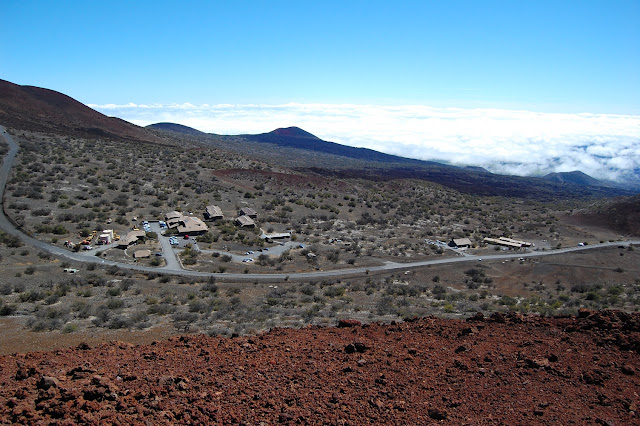
Little House on the Big Mountain.
And the clear mid-morning skies allowed me get another picture of Hualālai over the tops of the māmane trees growing on Mauna Kea's slopes.
Subalpine māmane forests of Mauna Kea, Hualālai in background.
Māmane trees (Sophora chrysophylla) are a kind of plant in the pea and bean family found only on the Hawaiian isles. They have very pretty yellow flowers that I don't usually get to see. I think the reason for their heavy flowering may have to do with the fact that the area around the Vis recently received some moderately heavy rainfall. I also got to see some of the native, endangered palila (a type of honeycreeper) that live in the māmane forests and are only found on the upper slopes of Mauna Kea between 6,500 to 9,500 feet. They have a pretty coloration, although I didn't get to see one up close.

Māmane tree, looking south-east towards the Saddle.

While climbing (or more accurately, sliding) back down to Hale Pōhaku for lunch the three of us had a somewhat strange experience where we all smelled a strong sulfurous smell for a short time. It lasted for no more than a minute at most, and its source is currently unknown, although the simplest explanation may be that Mauna Kea is not quite extinct yet, and that pockets of gas may make their way to the surface from time to time.

After lunch and a very disorienting nap (now I remember why I don't sleep in the daytime!), it was time to ascend the summit and begin our night of observation in earnest. Since the data we were getting was not the kind I have been working with, I had no real responsibilities, and was simply able to watch and learn. The experience was quite interesting – I don't think I'd be able to observe on my own after one night watching, but I definitely feel I'd be able to learn. After some trouble getting the telescope focused at the beginning of the evening, the rest of the night passed pretty much uneventfully, with exposure after exposure flowing in from the instrument we were using (an infrared spectrometer called MOIRCS [Multi-Object Infrared Camera and Spectrograph]).

Actually, there was one rather cool event that happened, and that was that I got to use night-vision goggles for the first time. Subaru keeps a few pairs on hand in case of necessity, and the telescope operator let us try them out. It really is true what they say, that you can't see the stars as well from the summit as you can from lower in elevation (due to lack of oxygen, which your eyes need in large amounts in order to function at peak performance). However, night-vision goggles clear that all up, and then some. We first tried them out about 9 `o clock, and were able to observe several meteors that would have been too faint for the naked eye to see. The ones we saw seemed to be coming from the direction of Taurus, which had just barely climbed above the horizon, so we decided to wait and try again later when it had risen higher.

We pretty much forgot until about 5 o’ clock in the morning when I went out again. By this time, Orion and Taurus where optimally suited for viewing from our small balcony, so I turned the goggles' wide field of view on them and simply watched. And then, oh the sights! Auē, as you would say in Hawaiian. The sheer number of meteors was astounding. It seemed like every few seconds I'd see another one whizzing by. They were coming from all directions, shooting and sparkling in the night sky like cloud trails from the energetic decay of a radioactive atom in a cloud chamber. Sometimes I'd see more than one at once. I rapidly lost count of their number, as I sat, enthralled, paying no attention to my rapidly-cooling extremities. And the satellites! I counted fifteen different satellites in the same time period, more than I've ever seen in one night (usually I'm lucky to see three from the Vis).

It's a good thing someone finally came out and checked on me, as before I knew it half an hour had passed, and I was starting to lose sensation in my fingers and nose. I hardly noticed nor cared, though – every good astronomer knows to ignore personal bodily discomfort when spectacular sightings are visible (the correlation between the two is a sad necessity of the job). And that certainly ranks right up there with the coolest experiences I've had. I doubt I'll ever have the disposable income to get such a pair of goggles for myself (at $4,000 a pop, they're not cheap), but, well…a guy can dream…

Finally, as always happens, dawn arrived and we had to pack up. Our friendly telescope operator opted to stay a little later and give us a tour of the telescope, which was a very cool experience. The last time I came, we got to see the room under the telescope where the mirror is stripped of its aluminum coating and re-coated. This time, however, the elevator to the dome was broken, so instead of simply zipping up the several floors to the dome, we climbed up the back way. We passed through the area between the aluminizing room and the dome floor, where the base of the rotating dome rests. It's open to the outside, and the morning light filtering through the cracks left between the dome wheels gave it an awesome, indescribable, feeling. I felt it must be akin to the feeling one would get standing in one of the great European cathedrals as the light of the rosy-fingered dawn bursts through the stained-glass windows in overwhelming brilliance. I really wish I had been able to capture the feeling in a photo.

After that experience, we headed up to the dome itself, where I was able to get the full-telescope picture that eluded me the last time I tried to take it:


To give you some idea of the size of this behemoth, I wouldn't be able to reach the blue circular area at the bottom even by stretching to my full height. The jumble of parts below the mirror, right above the floor is the instrument we were using, a cube nearly two meters to a side. This is a big telescope.

After our tour it was time to head back down to Hale Pōhaku, which granted several opportunities to snap more great photos. One of the most amazing for me was the shadow of Mauna Kea stretching away to the north-west. If you look closely, the peak of Kohala is visible to the right of the shadow. The shadow at sunset is a splendid sight, but I think the shadow at dawn is even grander, accompanied as it is by the feeling of wonder that comes with the morning.

I also managed to grab a picture of the twin Keck telescopes, gleaming in the light of day:

Keck II on the left, Keck I on the right.
This early in the morning, the western Saddle was once again cloud free, letting me take even better pictures of Hualālai:

From the summit (Pu‘u Poli‘ahu on left, Pu‘ Pōhaku on right)…
…and on the way back down.
 (If I seem to have a bit of a thing for Hualālai, it's because it has always been mysterious to me, a shadowy mountain perpetually robed in clouds, invisible to the eye except for rare glimpses of the peak. Seeing it in its entirety gave me a better appreciation of the geography and scale of the island, and was just a pretty cool experience in general.)

 And that's pretty much it. After an uneventful nap and lunch, we headed back down to Hilo, back to warmth and humidity, two things I missed very much at the summit. I am a warm weather person; that's one reason I came here to go to college. That's not to say that I don't get hot like everyone else. But every so often, when I am tempted to complain about the heat, I like to remind myself that there really are much worse things than being hot and sweaty, and trips to Mauna Kea fit the bill perfectly. And having said that, I really am done with this absurdly long post.

A hui hou!

Tuesday, February 16, 2010

General Busyness

Well, the post I wanted to write yesterday never happened, due to running out of time and having to work on homework. This post will be short for the same reason. I got my paper and USB cord for my printer today, so I was able to set it up and get it running. I haven't had much reason to use it yet, but it seems to be working just fine.

My trip to the Vis on Saturday went fine, although there weren't many people from the UAC there. Which was not a problem, because the local amateur astronomy club was there with several extra telescopes set up. Which was good, because I could not believe how many people there were up there! We probably had crowds getting up into the 70's or 80's for quite a while, and though it got quiet later on, it never completely slowed down (usually, we might have 20-40 people on any given night at our busiest).

One of the guys who works at the Vis commented as we were setting things up at the beginning of the evening on the clouds rolling down the mountain like water, and how he would like to make a time lapse movie of it some time. Well, I had my camera on hand, and as soon as everything was set up, I set it up on the balcony and proceeded to take a hundred shots over about five minutes, which I plan to put together into a really cool movie showing the clouds flowing down the slopes of Mauna Kea when I have time. It's an amazing thing to watch, and easily visible to the naked eye if you look for more than a few seconds. It happens fairly often at the beginning of the evening, when the cooling air causes the moisture to condense and move down the mountain. I'll have to see about linking to the video of it when I have time...