Showing posts with label supernovae. Show all posts

Saturday, August 18, 2018

An August Astrobite

Grad school and other things have kept me intensely busy this past week, which is why I'm just posting about an Astrobite I wrote on the 8th. I'll say upfront that I don't think this is my best work; not that it's particularly bad or under my standards for writing, I just realized over the course of writing it that I wasn't quite as interested in the subject matter as I thought when I started.

It's still reasonably interesting however, the subject matter being that when the authors examined a baker's dozen supernovae type Ia (that's “type one-A,” not “type eee-AA!”) which had been caught very early in their brightening stage they found evidence for two distinct populations when looking at the color of their spectra. “Color” in this case is an astronomical term for summing up the flux in two different filters that cover different spectral ranges and subtracting them, leaving a single number to represent the color. Most commonly the “Blue” and “Visible” filters are used to get what's known as a \(B-V\) color (visible here meaning roughly “green”), but any two filters in any part of the spectrum can work. Basically, some of the supernovae looked “red” and some looked “blue,” though the differences disappeared after about four or five days since the explosion.

Most supernovae aren't caught this early, which is why they had so few to work with despite there being hundreds of known type Ia supernovae. Interestingly, in a bit of a personal connection to the paper, one of the supernovae they looked at was SN 2011fe—which I actually got a picture of while in Hawaii! I didn't realize this until after I'd chosen the paper and started writing it up.

Messier 101 with SN 2011fe marked with the green dots.
If there's one thing I learned while doing background research on supernovae type Ia for this Astrobite, it's that we still have much to learn about these enigmatic explosions. A hui hou!

Tuesday, January 28, 2014

Snagging a Supernova (SN 2014j)

Last week Tuesday, January 21, an astronomer at the University of London Observatory was teaching some undergraduate students how to run the CCD imager on a 14-inch telescope during a short break in the clouds. At about 7:20 PM local time, they noticed a new star in the nearby galaxy Messier 82. This star did not show up in archival images of the galaxy, and after using a second set of equipment to make sure it wasn't an artifact they realized they were dealing with something very real. It turned out to be the closest type-Ia supernova in 42 years, and was duly designated SN 2014j.

Messier 82 is a funny-looking galaxy located at a distance of about 11.5 million light-years away, close to another galaxy called Messier 81. They're practically next door in galactic terms – only 6 times further away than the Andromeda Galaxy – and are easily visible in moderately sized telescopes.

I know this personally both because I've seen them before at the Vis, and because I went up there Sunday night in order to try to get an image of the supernova. When I got there I discovered some bad news: I couldn't get the telescope mount to connect to the control software on the computer (probably a cable went bad). The telescope mount still had its built-in control software, so on a whim I polar-aligned it as best I could then told it to go to Capella, the brightest star close to M82. Amazingly, when I took a short exposure with the CCD Capella was visible on the first try. I then tried sending it to M82, and while that wasn't visible in the resulting image, its neighbor M81 was. Finally, after some touch-and-go work manually directing the telescope with its built-in directional controller I was able to get both M81 and M82 (supernova easily visible) in the same frame.

Having miraculously overcome the first major hurdle of finding the target, I was left with the sad reality that without being able to connect the mount, I couldn't get auto-guiding going, which meant that exposures longer than about 12 seconds started to show unmistakable signs of star trails. This kept me limited to short exposures. The resulting picture is hideous, not helped at all by Blogger's re-scaling of the limits. I'm a bit embarrassed to be showing such a poor piece of work, but it's a supernova, I simply can't refrain from talking about and showing it. Here's the picture I got, with M81 the blur at the top, M82 the blur at the bottom, and SN 2014j marked by the tiny straight lines.


I looked back through my blog and saw that I've never imaged this pair of galaxies before, so for the record M81 is actually a lovely face-on spiral galaxy, while M82 is...odd. It's apparently a spiral galaxy too, but it's almost edge-on to use, and it has these really weird filaments of dust in front of it in optical light. (You can kind of see the thickest of them in the image near the middle of the galaxy, as a dark bar that bisects it.) These filaments often make it look as though the galaxy is exploding in long exposures, and it has the amusing nickname of the Cigar Galaxy due to its shape in small telescopes.

I hope to get a better picture of these beautiful galaxies and perhaps the supernova that graces one of them, but my near-future plans have been put on hold by the arrival of a large storm system bringing snow and cloud cover to Mauna Kea. The forecast is bad through the weekend at the moment, but, as always, we shall see...

Tuesday, October 30, 2012

The Veil Nebula

Today, instead of pictures of spiders and caves, I have a picture of the lovely celestial object known as the Veil Nebula. Now, I'll have to be more precise than that: you see, the Veil Nebula as a whole refers to a humongous supernova remnant about 1,470 light-years away in the constellation Cygnus, the Swan. This nebula is quite large: it can be traced for almost 3 degrees in the sky, making it 6 times wider than the full Moon (and about the width of the Andromeda galaxy), while covering 36 times the area. Because it is such a diffuse ball of gas spread over such a large area (nearly a hundred light-years), it is easiest to see around the edges.

There are a few places where those edges are thicker and easier to see, and it is one of those edges that I have for you to see today. This part is known as the Western Veil nebula, and is one of the two brightest portions of the nebula. Because the nebula is so tremendously huge on the sky compared to most objects, different parts of it have actually been assigned their own numbers in the New General Catalogue (NGC). This part is known as NGC 6960.

The Western Veil Nebula, NGC 6960, in Cynus. The bright star is an unrelated foreground star, 52 Cygni.
So in this picture, you can see part of the outer arc of the supernova remnant where it's a bit thicker than average. The original explosion site was to the right and slightly below this picture, and if you look closely to the right of the bright part of the nebula you can see very faint and wispy filaments of gas. The nebula looks sort of purple-ish to me; the blue light comes from doubly-ionized oxygen, and I suspect that the red light is your basic hydrogen-alpha.

Monday, September 10, 2012

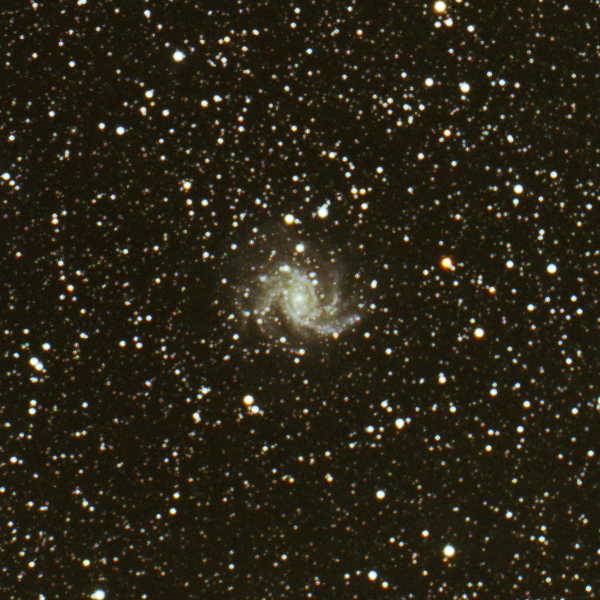
The Fireworks Galaxy

Today I have something besides another globular cluster picture for you: a picture of a galaxy. This galaxy is officially named NGC 6946, though it unofficially goes by the name of the Fireworks Galaxy. It is located on the border between Cepheus and Cygnus, which puts it very close to the plane of the Milky Way. This fact means that it is obscured rather heavily by the dust in our galaxy, making it appear much fainter than it otherwise would.

NGC 6946 is located about \(22.5\pm7.8\) million light-years away, which actually makes it one of the closest galaxies outside the Local Group. As you can see from the picture below, it's fairly large, with a diameter of about 11.5 by 9.8 arcminutes. This gives it a physical size of about 75,000 by 63,000 light-years, about two-thirds to three-quarters the size of the Milky Way galaxy. You can easily make out several spiral arms wrapping around the core, and what appears to be a faint ring around the nucleus.

NGC 6946 (the Fireworks Galaxy) on the border between Cygnus and Cepheus.
NGC 6946 currently holds the record for the largest number of supernovae observed in a galaxy (and earns it nickname in the process): nine so far, in 1917, 1939, 1948, 1968, 1969, 1980, 2002, 2004, and 2008. Typically in a galaxy this size you'd expect to see one every fifty years or so on average, which gives you an idea just how extraordinary this galaxy is.

Sunday, April 1, 2012

Supernova Hat Trick.

The last year has really been pretty good for astronomers studying supernovae. I glossed over it in my post about them, but there is still much we don't know about supernovae. This is mainly because they're so rare. Basically, the more massive the star, the fewer of them there are. Stars large enough to go supernova make up only a tiny fraction of the stars in a galaxy, much less than 1%. (For comparison, our own Sun, often called a fairly average star, is still larger than 80% of the stars in the universe, and star don't really go supernova until they're nearly ten times more massive than that.) Typically in a spiral galaxy like the Milky Way one supernova will go off on average every fifty to a hundred years. However, there a lot of galaxies out there, so if you watch enough galaxies frequently enough you should catch one going off eventually. This is the basis behind all systematic supernova hunts, which can image tens of thousands of galaxies night after night.

This sounds like good news for supernova hunters, but the hidden catch is that many (most) of these supernovae are very, very far away, simply because the majority of galaxies in the universe are very, very far away. This makes them hard to study and analyze because they're hard to see well so far away. It's not often that we get supernova within a few dozen million light-years or so, but in the space of the last ten months we've had three of them go off within 40 million light-years, all three in bright galaxies on the Messier list. And no, despite the date of this post, I'm not making this up.

In June we had SN2011dh go off in M51, 23\(\pm\)4 million light-years away, then in September SN2011fe went off in M101 at 20.9\(\pm\)1.8 million light-years. Finally, on March 16, supernova SN2012aw was discovered in M95, about 32.6\(\pm\)1.4 million light-years away.

I wasn't able to get a picture of it before due to bad weather, but last Thursday the stars finally aligned for me (or, rather, the clouds finally got out of the way) and I was able get the picture you see below:

Messier 95 (bottom, with SN2012aw) and Messier 96 (top) in Leo. North is to the left.

At the top of the picture you can see Messier 96, a galaxy close to M95. At the bottom you can see M95, with SN2012aw marked. Remember, every other star you see in this picture is part of the Milky Way, and SN2012aw is outshining many of them, despite being over three thousand times farther away. That's how powerful a supernova is (not to mention that it's still putting out an amount of light comparable to the rest of M95, two weeks after it went off).

Also, I just wanted to mention that I think the central detail on M95 is really pretty. That's a pretty nice ring of star formation there around the central bar.

Sunday, March 25, 2012

Supernova Remnants, and the Pulsars that Light Them

Last week I showed you a picture of what happens to small stars (those less than ten times more massive than our Sun) when they run out of fusible hydrogen in their core. Today, let's take a look at what happens to a big star.

Upon running out of hydrogen to fuse, large stars initially proceed very similarly to their less weighty brethren. They begin to fuse the helium produced by hydrogen fusion into heavier elements such as carbon, oxygen, and neon, but unlike smaller stars they have enough mass and gravitational force in their cores to continue. Neon gets fused into heavier elements such as silicon, magnesium, and calcium, slowly working up the periodic table until the star starts making iron in its core. Iron is an interesting element because its nucleus has the highest binding energy per nucleon of any element. (Though certain isotopes of nickel have virtually the same binding-energy that iron does.) What this means, practically, is that you cannot get any energy from iron by either fusion or fission, either by fusing it into more massive elements or by splitting it apart.

Once a star arrives at iron in its core, it's done. It can't squeeze any more energy out of its core, so all that is left supporting the star against its own great weight is electron degeneracy pressure in a slowly-growing iron-nickel core. Electron degeneracy pressure is a quantum mechanical effect with no real analog in classical mechanics. Simply put, electrons exert pressure because two fermions (a class of particle of which electrons, protons, and neutrons are a member) cannot be in the same place and the same quantum mechanical state at the same time. Squeezing them together causes all the low-energy states to be taken, so the electrons vigorously resist any further compression, which would require large amounts of energy to raise electrons into high-energy states. However, there is a limit to how much pressure electrons can exert; if the mass of the core exceeds the Chandrasekhar limit of about 1.38 solar masses, electron degeneracy pressure catastrophically fails and the core collapses in on itself.

At this point, if the star is less than about 20 solar masses there is only one mechanism that can save the star from collapsing into a black hole: neutron degeneracy pressure. Similar to electron degeneracy pressure but involving neutrons, the star's core collapses into a neutron star, a sphere of neutrons packed as tightly as an atomic nucleus and about the size of a city.

As the core collapses into a neutron star, the star's outer layers fall inward tremendously fast, at speeds up to 23% of the speed of light. The neutron star at the center, however, is already packed as tightly as it possibly can be, so the infalling material rebounds off the core in a colossal shockwave to produce what we see as a supernova.

(There is a lot more going on at the same time, of course – supernovae are incredibly fascinating events where relativity and quantum mechanics are both in play, and I'm giving you merely the barest overview of all the processes happening.)

If the star in question started off heavier than about 20 solar masses, even neutron degeneracy pressure will be unable to support the core and nothing in the universe can prevent it from continuing to collapse into a black hole. However, I'm going to focus on neutron stars in this post because the picture I have for you today contains one. The story behind this particular supernova is ancient and varied, so settle in...

The story starts about a thousand years ago, in Anno Domini 1054, when a new star appeared in the constellation Taurus. As was customary, Chinese and Japanese astronomers noted the appearance of a "guest star" and recorded its location. It was also apparently observed by as least one person in the Arabic world. This star was apparently bright enough to be seen in the daytime for a period of several weeks, after which it slowly faded over a period of about two years and finally disappeared, whereupon it dropped out of history.

In 1731 a mysterious nebula (one of the first discovered telescopically) was discovered just off the tip of one of the horns of Taurus by one John Bevis. In 1758, while searching for the return of Halley's comet, Charles Messier stumbled upon this nebula and initially mistook it for his quarry. After watching it for a few weeks he realized that it wasn't moving, and came up with the brilliant idea to publish a catalog of objects that looked like comets but weren't, so that other amateur comet hunters wouldn't be fooled as he had. Thus, this nebula became the first object on what would become his now-famous list of not-comets: Messier 1.

In 1844, almost a hundred years later, the nebula was sketched for the first time by William Parsons, 3rd Earl of Rosse, whose love of astronomy and independently wealthy nature led him to build the largest telescope in the world at that time ("the Leviathan of Parsontown", 6 feet in diameter). His sketch reminded him of a crab, and so he gave our nebula the whimsical name the Crab Nebula. It remained a popular object of observation with astronomers, both amateur and professional.

In 1921 the American astronomer Carl Lampland noted changes in the Crab Nebula which implied a small size for it. In the same year, another astronomer demonstrated that the nebula was expanding. Several astronomers noticed its proximity to the "guest star" of 1054, but nothing was made of it until 1928 when the venerable Edwin Hubble definitively proposed that the nebula be associated with the star. However, it wasn't until later, when the theory behind supernovae had been worked out, that Nicholas Mayall showed that the Crab Nebula was nothing less than the remains of the supernova that exploded into the sky nearly 900 years earlier.

Although the association of the nebula with a supernova was now clear, it wasn't until the 1960's that neutron stars were first predicted by Franco Pacini. A few short years later, in 1968, a neutron star was detected in the center of the Crab Nebula, which made it both the first neutron star ever known and a shining confirmation of Pacini's hypothesis. It also explained why the nebula was so much brighter than a 900-year-old supernova remnant was expected to be.

The neutron star that lurks at the center of the Crab Nebula – known as the Crab Pulsar – is a fascinating beast by terrestrial standards. It is about 25 kilometers (about 15.5 miles) across, and makes a complete rotation every 33.08471603 milliseconds – 30 times a second! As the neutron star spins, it sends out a constant stream of electromagnetic radiation all across the electromagnetic spectrum (including visible light) from both poles of its extremely powerful magnetic field. The axis of its magnetic field is not the same as its rotational axis (much like the Earth, though a bigger offset), and as it spins around it sends off a powerful beam that appears to "blink" on and off as seen from Earth, much like the beam from a lighthouse. The neutron star is thus known as a pulsar, a portmanteau of pulsating star.

This electromagnetic energy being given off comes from the rotational energy of the Crab Pulsar, which is slowly slowing down by 38 nanoseconds per day. The energy being given off along with the star's powerful magnetic field (thousands of times more powerful than the Earth's) being spun through the Crab Nebula 30 times a second causes it to light up. Electrons are accelerated to nearly half the speed of light and spiral along the magnetic field lines of the pulsar, giving off synchrotron radiation as they do, which create a blueish glow visible in the center of the Crab Nebula in long exposures.

Now, after all this background, I suppose I should show you the picture you no doubt read this post for. I hope you can now better appreciate just how amazing this object is, even if my picture cannot do it justice. Here it is, the Crab Nebula:

The Crab Nebula, Messier 1, in Taurus.
While the Crab Pulsar itself is quite invisible in a small telescope such as the imaging telescope, you can easily see the remnant of that titanic explosion 958 years ago. Within that shell of gas exist fantastic filaments and mysterious structures, brought about by electrons powerfully accelerated to relativistic speeds by the pulsar's magnetic field. Despite being around 6,000 light-years away it is persistently the strongest source of X-rays and gamma rays from outside the solar system. The central neutron star itself is a sphere of ultra-dense matter more massive than the Sun compressed into an area smaller than New York city and spinning over 30 times a second. This matter (commonly called "neutronium") is so dense that a single thimble-full would weigh over 100 million tons. I could go on and on at length about how fascinating this single member of the group of objects know as pulsars are, but you get the idea.

I hope this post has given you a sense of the wonder and excitement I get when I study astronomy and physics. Learning more about the incredibly varied denizens of our universe never fails to amaze and astound me, and I enjoy nothing more than bringing that feeling to others. If this post made you stop and think at all, then I will feel I have succeeded. A hui hou!

Monday, September 26, 2011

More Thoughts on the Possibility of Superluminosity

My last post on the possibility of neutrino superluminosity rather surprised me with the amount of feedback it got, considering I put it together on the spur of the moment and hadn't really had time to think about it too much. But it's a good kind of surprise, because it shows people are interested in physics, and that makes me happy. Because really, how can you not be interested in physics? It's so fascinating! But I digress...

Anyway, this post is just intended as a bit of an expansion on my previous post, with some things I've thought of or had introduced to me in discussion over the weekend. It's important to keep in mind the way the experiment was conducted: basically, the Large Hadron Collider at CERN produces bursts of neutrinos which are detected at the OPERA detector about 730 kilometers away. These neutrinos are produced in bursts when protons slammed at high speeds into a target create pions and muons that then in turn decay after a random time into neutrinos. It's these bursts that OPERA actually detects. The time between the emission of a burst and its detection is then divided into the distance between the LHC and the detector, and the answer comes out to be about 60 nanoseconds (that's 60 billionths of a second) shy of the time it would take light in a vacuum to travel the same distance. Let's analyze this setup a little closer...

1. Distance measurement. The distance between the points of emission and detection is not the kind of distance you go out and measure with a meter stick. As stated before, it's about 730 kilometers from one to the other, and that's as the crow flies. In reality, the straight distance between them is through the Earth's crust, so you have to take that into account, along with the fact that the Earth is not spherical, nor even smoothly deformed, but a complicated shape called a geoid. Finally, both the LHC and OPERA are quite a ways under the ground, so that needs to be kept track of, and the standard way to measure large distances -- using GPS -- doesn't work that far underground, so you have to measure from a point on the surface, and work your way down. Now, in 60 nanoseconds light travels almost exactly 18 meters, so the two would need to be about 18 meters closer than currently thought for this explanation to account for the discrepancy (at least, it would need to be that much is this is the only explanation; in reality it may be a combination of factors). On the one hand, when you're measuring a distance of 700 kilometers, it would be easy to miss 18 meters; on the other hand, the scientist appear to have done a lot of work measuring using some precise equipment, and claim to know their relative location much better than 18 meters. This is definitely something that could stand to be reviewed. Finally, as I mentioned before, the neutrinos are produced at random lengths along a tunnel at the LHC; while the scientists claim that it makes very little difference at what point in the tunnel the neutrinos are produced, I think a careful review of the math may be in order.

2. Time measurement. This is where it gets a bit hairy, in my opinion. Time is a notoriously tricky concept in relativity, especially coordinating time between two observers. Two events may be seen to happen simultaneously or sequentially, all depending on the relative motion between the observer and the events. Remember, the time difference we're talking about is tiny, only 60 nanoseconds. The scientists at OPERA claim to be have resolution down to 10 nanoseconds (plus or minus a few), but that's an awfully tiny number. There's another twist I've seen pointed out: GPS satellites use general relativity in order to be as accurate as possible, but if these neutrinos truly are moving faster than light, it indicates that there is something wrong with relativity as we know it, so how much can we actually trust the satellites?

The first two points were some of the ways I could see the measurements being off. These next points are various tests I thought of that would go a long way to determining what exactly is going on.

3. Measuring with light. One of the best tests I can think of would be send a light beam along the same path as the neutrinos and measure how long it takes. If your light beam ends up faster than it should be, it rules out that the neutrinos are traveling superluminally. It would indicate one of two things: either the measurements of either time or space are off, or there is some sort of strange spacial-temporal disturbance going on in the Earth's crust between CERN and OPERA (which I'll perhaps expand on in a later post, as this one is long enough already). Unfortunately, this test is out of the question because the path of the neutrinos is through solid rock, not vacuum.

4. Measuring the energy of a neutrino. This is one I'd really like to see, because instead of taking the estimated time of flight for the neutrino and dividing it into the distance to get the presumed speed, you could take the energy of a neutrino and from there directly calculate its speed. If that turns out to be a hair under the speed of light, as it most likely would, then you know for a fact that a) the neutrinos were not moving superluminally and b) that either your time or distance measurement is off. Sadly, I don't know if OPERA is capable of detecting the energy of a single neutrino -- in fact, I'm not sure it's currently possible at all. This test would certainly do a lot to eliminate the possibility of superluminosity, though.

5. Two-way measurements. This would also help a lot. One-way measurements of speed are difficult because of the relativistic effects I mentioned earlier. It's a lot more reliable to measure the speed of something going away and back, and simply dividing twice the distance by the time. Yet again, this test is impossible due to the way neutrinos interact with matter. To put it mildly, they don't. Hardly at all. In fact, billions of neutrinos from the Sun's core are passing effortlessly and unobtrusively through your body as you read this sentence, regardless of the time of day or night. You'd need a bar of lead over a light-year in length before you'd have a 50% chance of any one neutrino interacting with it. The only reason OPERA is able to detect the emitted neutrinos is because there are so many of them -- and it still probably misses more than 99%. For this reason, you can't fire a beam of neutrinos at a mirror and have them bounce back, like you can with light, making this yet another test that can't be performed. In its absence, simply firing a beam of neutrinos back along the same path would have to do, but even that can't be done, as there are only a few places on Earth capable of creating neutrino bursts, and they tend not to coincide with the locations of the detectors capable of detecting said bursts.

Any of the three tests proposed above would do quite a bit towards resolving what's really happening here, whether that be simple mis-measurement or a whole new era of physics. Of course, none of them are likely to be done anytime soon, although personally I think that measuring the energy of a neutrino would probably be the most likely and easiest. There is, however, one test that has, in a sense, already been done. When supernova SN1987a went off in the Large Magellanic Cloud in 1987, we detected a burst of neutrinos coming from it a few hours before the light became visible. While this might at first glance seems to support the superluminal neutrino theory, it is actually easily explained by our current theories of supernovae (when the core of a supernova collapses and initiates its destruction it releases a burst of neutrinos that have no trouble getting out through the outer layers of the star, while the energy and light from the explosion take a few hours to work their way to the surface). The neutrinos in the experiment, if they were traveling faster than the speed of light, were only going about 1 part in 40,000 faster. The LMC is about 160,000 light-years away, so if the neutrinos from that event exhibited the same behavior, they should have arrived 4 years before we saw the light from the supernova. This doesn't entirely disprove the superluminal velocity theory (there were only a few [two?] neutrino detectors working at the time, and it might not have been noticed), but it does seem to go against it. It would be amazingly useful to have another supernova go off somewhere visible within the Local Group so we could see if there were any detectable neutrino bursts from it that would fit with this, but this is, yet again, depressingly unlikely to happen in the near future (although it can't be ruled out! There's always hope...).

Of course, I don't want to end this post on such a depressing note. While none of these tests can be done at the moment, I wouldn't put it past some brilliant mind out there to think up some test that could be done, and which will help resolve the question (put a neutrino detector and mirror array out in space, then simultaneously fire a laster and a neutrino burst, maybe). Really, whatever happens will be interesting; either Einstein is proven correct yet again and relativity stands vindicated, or we enter the brave new world of post-Einsteinian physics, which I can only imagine would be just as exciting as the introduction of relativity and quantum mechanics. Speaking of QM, I haven't mentioned it at all in this post, but not because I haven't been thinking about it in relation to this experiment. But you'll have to wait for another post for that, I need to get some sleep now. A hui hou!

Saturday, September 17, 2011

Yet Another Supernova!

This summer has been really good to supernova aficionados in the northern hemisphere, with two supernovae visible in low-power telescopes going off fairly close to each other within two months. You can see my picture of SN2011dh in Messier 51 in an earlier post in June and further down in this one, because today I have a picture of the more recent SN2011fe which showed up in Messier 101 on August 24th (though the picture is from September 2nd).
SN2011fe in Messier 101, the Pinwheel Galaxy.
Compare the above picture with this one I took of M51 and SN2011dh back in June:
SN2011dh in Messier 51, the Whirlpool Galaxy.
These pictures are fairly similar in terms of exposure time, both using several stacked exposures of 5 minutes each for the three color filters, although the second one used 5 minutes for the luminance filter while the first used only 1:40. And yet even with those slight differences, you can still see that the Whirlpool Galaxy is much more concentrated and easier to see than the Pinwheel, which has actually been stretched a bit to differentiate it from the background.

It would appear from a comparison of the pictures that SN2011fe is a bit brighter than SN2011dh. This may have something to do with the fact that the Pinwheel Galaxy is a little closer to us (21 million light-years instead of 24), but the imprecision in our knowledge of the distance to the Whirlpool Galaxy (plus or minus 3 million light years) means they could actually be at very similar distances to us. It's likely that SN2011fe is intrinsically more luminous than SN2011dh, and that has to do with the fact that they are two distinctly different types of supernovae.

SN2011dh was a type IIa supernova, which means it's the last dying gasp from a star several times the sun's mass. In contrast, SN2011 was a type Ia supernova, which means it came from a white dwarf in a binary system, with a mass known almost exactly: about 1.4 times the mass of the sun. The reason for the vast difference in energy output is because in a type IIa typically only a small percentage of the star's mass is ejected as debris, perhaps a few solar masses' worth. The remaining material is left behind as a neutron star, or, in some cases, a black hole. In contrast, a white dwarf undergoing a type Ia supernova explodes, completely, utterly, and finally. There is no stellar remnant left behind after one of these goes off. The uniformity in their masses before explosion make supernovae Ia valuable as standard candles in the universe for estimating distances to far away objects, and the fact that we now have one to study right in our backyard, as it were, is a great opportunity for astronomers.

Friday, June 24, 2011

Supernova picture! This time with color!

After my nearly one-subject posts the last week or two you guys will probably never want to see another supernova, but I'm quite proud of myself for figuring out how to get color working. I originally thought it was as simple as “put red image in red channel, green image in green channel, blue image in blue channel, et voila!”. Turns out it's not, and I got discouraged when I ended up with a bizarrely colored image looking nothing like what I thought it would. However, it turns out the process is not much more difficult than that, merely requiring iterative manual adjustment of the color curves until it looks the way you want it.

Supernova SN2011dh in M51.
In this picture you can clearly see the spiral arms of M51 outlined by the blue light from hot young stars with dark dust lanes obscuring parts of it, the same kind of dust lanes that are responsible for the dark patches seen in our own Milky Way. I'm not a hundred percent sure about the color balance, but this represents the kinds of color you might be able to see if you could let light accumulate on your retina for 5 minutes at a time, instead of refreshing many times a second.

Friday, June 17, 2011

More supernova pictures.

Hello everyone, I know it's been a while since I last posted, I've been busy helping out with VBS every night. Also, I was hoping to have a color image of that supernova for you, but I'm still working out how make one. So in lieu of that you get another gray-scale one. I took this one last Saturday night.

Messier 51 with supernova visible in the upper-right area. See the post below for an exact pointer.

If you think it looks very similar to the picture in my last post, well, you're right. I don't know if it is possible to tell by comparison, but when blinking between the two images the supernova is noticeably brighter in the later image (this one) than the earlier one. Not much, but a noticeable amount. I'll try to get another shot of it sometime next week, and see if it has started to fade at all by that point. Pretty interesting stuff!

Friday, June 10, 2011

Supernova! For real this time!

Remember that image I mentioned in my last post? Well, I reduced it, and it came out pretty nice. Unfortunately, it's in gray-scale because clouds came in and covered the galaxy before I could get the color exposures, but it still shows remarkable detail.

Messier 51 with supernova SN2011dh. Companion galaxy NGC 5195 at bottom.
I'd like to draw your attention to just how remarkable this star is. Every other individual star you see in the picture is within the Milky Way Galaxy - that bright one on the right might just be visible with the naked eye (I'm not sure it's the same star, but I can just make one out in the area where M51 is). Each of these Milky Way stars is, at most, a few tens of thousands of light-years away. Supernova SN2011dh is around 25 million. And it's as bright as or brighter than many of the stars in the picture. Now factor in the fact that the brightness of an object (which is what is represented here) decreases as the square of the distance increases, and that's one seriously bright star. (For comparison, none of the other stars in M51 can be made out individually in this picture - the ones that appear to be part of it are really foreground Milky Way stars.)

In fact, when this supernova first exploded, it was emitting as much energy individually as the rest of the hundreds of billions stars in M51 combined. The reasons it doesn't appear as bright as the rest of the galaxy are 1) it was about five days old by the time I took this picture, so it had begun to fade a little. And 2) most of that energy is not in the visible portion of the spectrum. Remind me sometime when it's not so late to explain the details behind a supernova type IIa.

As an aside, you can't see them in this picture because of the exposure settings I chose, but I caught two extremely faint satellite trails in my exposures, one of which neatly passed diagonally from lower-left to upper-right between M51 and the star on the right.

Wednesday, June 8, 2011

Classes!

There are two things exciting me today, so I decided I'd write about both of them. First of all, to resolve yesterday's cliffhanger, yes, I was able to see the supernova. Not by eye, but I was able to capture an imager of it using the imaging telescope at the Vis (another volunteer there told me he'd spent the night before trying to see it visually with the largest telescope at the Vis and had no luck, so I didn't bother looking for it visually).

I haven't had time to reduce the image yet due to the other thing exciting me, but hopefully I can show you all pretty soon what it's like to see a single star putting out more energy than an entire galaxy 25 million light years away.

The other thing exciting me is that I suddenly learned how to use classes in Python, my favorite scripting language. Classes are basically user-defined objects, and a definite step up in the abstraction department. The reason I'm so excited about it is because of the way it happened.

Now, before Tuesday, I'd never used a class in Python, nor did I understand them. I'd read the documentation introducing them before two or three times, but couldn't really make heads or tails of it. Then, Tuesday, as Dr. Takamiya and I were trying to pin down an unrelated bug in my code, I became painfully aware just how convoluted my data was getting in my script. Lists were stacked in other lists, which were stacked in still more lists, and it was becoming a nightmare remembering what was what while executing the script.

Finally I took a little break to think, and the thought popped into my mind “I think I need to use a class for this”. Remember, I had zero prior experience with classes up to that point. However, since we weren't really getting anywhere the way we were going, I went home to do some quiet thinking and see if this idea would pan out.

And did it ever! I found and read the documentation on classes again, and it's as if everything had clicked into place in my mind. I understood everything perfectly clearly. I had to run off to go up to Mauna Kea soon afterwards, but I had the same experience today when I took it up again. It still feels somewhat surreal, as if someone just flipped a switch in my mind. I see it as another case of the fact that sometimes, at least for me, I need to figure out something on my own before I can effectively learn it. I essentially came up with the idea, “I need to be able to do this in Python”, and lo and behold, there exists a method to do this. I'd never appreciated it before because I hadn't really needed like I did recently, but when I finally did, it came practically like second nature. (If you're interested, classes are basically what I said before, user-defined objects. You can use them as containers to store arbitrary data, which is mostly what I was using them for, but they're much more versatile than that. Hard to explain in a few sentences. Let's just leave it that they're really useful and handy.)

Tuesday, June 7, 2011

Supernova!

This evening I'm heading up to Mauna Kea for a really exciting chance to see a supernova with my own eyes!


Err...the “exploded-star giant-kaboom!” kind of supernova, not a bottle of one of my favorite flavors of Mountain Dew. This newly-discovered supernova is in the Whirlpool Galaxy, M51, which is just off the handle of the Big Dipper, so it's nice and visible from Hawai‘i this time of year. If I'm extremely lucky, I may even be able to get a picture of it, although the chances of that pretty low, realistically. Still, if I can manage to find it, I'll be sure to give you a description.

Here's a picture of the Whirlpool Galaxy from Hubble, by the way. This is one of the galaxies I used for inspiration in my picture I posted  two weeks ago, incidentally. You can judge for yourself how good my efforts to emulate it were.

Messier 51, the Whirlpool Galaxy, and companion elliptical galaxy NGC 5195.

Saturday, April 3, 2010

Forrays into movie criticism.

Although I neglected to mention it in my last post, I spent part of yesterday evening watching the latest Star Trek movie (mostly because Josh and Jonathan put it on while I was doing homework). I am not a movie critic, so I will not critique the movie (although it had way too much lens flare for my liking), but I am a physicist, so I will critique the physics. And let me tell you, if the level of astrophysical knowledge displayed in the movie was in any way indicative of the general populace's knowledge of the subject, I will suddenly understand where some of the odd questions we get at the Vis now and then come from.
Let's start with the big one: General Relativity. Where is it? I'm not going to critique such things as faster-than-light travel because that's part of the willing suspension of disbelief, and I'm willing accept it. But the black holes were completely unrealistic! In reality, you would never see something fall into a black hole like that. This is because, in GR, curved space time causes time dilation, and infinitely curved space (a.k.a. a singularity) causes infinite time dilation. If you watched something fall into a black hole, you would never see it hit the event horizon and pass beyond -- it would simply become dimmer and redder, forever. In addition, gravitational tidal forces would stretch it into spaghetti long before it reached the event horizon, especially with a small black hole (counter-intuitively, large black hole have small tidal forces and vice-versa).
And all that part about the singularity consuming a planet in a matter of seconds. Come on! If the planet had any amount of rotational motion when it happened (virtually certain), the Conservation of Angular Momentum would spin it up into a rapidly rotating accretion disk which would take a very long time to lose its angular momentum through frictional heating before it could pass beyond the event horizon (admittedly, still not optimal for the inhabitants).
Plus, you have to worry about Hawking radiation. In essence, the intense gravitational energy around a black hole constantly switches between being energy and matter, creating virtual particle/antiparticle pairs in the vicinity of the black hole. If one of the pair happens to fall into the black hole, the other can escape, taking with it a tiny amount of the black hole's mass. Over time (tens of billions of years for a typical few-solar-mass black hole) the black hole would evaporate if it received no additional matter. But the picture is very different for smaller black holes. In fact, if you were to create a black hole with the mass of a massive atom, it would evaporate in such a short time you'd never even know it was there. The Large Hadron Collider may have already created such tiny black holes, and we wouldn't be able to tell (so now you know how to refute those people who think it's going to create a black hole that will engulf the world).
And then there's the whole matter of the supernova engulfing the Romulan planet. Where to begin with that? For a supernova to actually engulf and destroy a planet like that, it would have to be the star that the planet was orbiting in the first place (barring some weird globular cluster configuration, which didn't seem to be the case). And yet they have no idea that the star is going to go supernova? Stars undergo enormous changes in temperature and physical size before the end of their life, changes that make it quite obvious that they're going to blow. We know of several stars in the Milky Way that are candidates for popping off at any time (Betelguese and Eta Carina are two I can think of off the top of my head). Granted that we can't predict exactly when, it certainly doesn't happen overnight. You'd think the Romulans would have evacuated their planet at the first sign of their sun going supernova. There are certainly very real dangers from supernovae, even at great distances, such as gamma ray bursts, but this obviously wasn't such an event.
I should probably stop speaking my mind and picking nits like this, and point you to the Bad Movie Physics entry for the movie, which brought up a bunch of points I hadn't considered. I hope, that if you enjoyed the movie, this doesn't decrease your enjoyment of it. Though the physics may be bad, I find it a subject more for laughter than anything else (and I did break into laughter a few times at odd points).
A hui hou! (until next time)