Today I have something besides another globular cluster picture for you: a picture of a galaxy. This galaxy is officially named NGC 6946, though it unofficially goes by the name of the Fireworks Galaxy. It is located on the border between Cepheus and Cygnus, which puts it very close to the plane of the Milky Way. This fact means that it is obscured rather heavily by the dust in our galaxy, making it appear much fainter than it otherwise would.
NGC 6946 is located about \(22.5\pm7.8\) million light-years away, which actually makes it one of the closest galaxies outside the Local Group. As you can see from the picture below, it's fairly large, with a diameter of about 11.5 by 9.8 arcminutes. This gives it a physical size of about 75,000 by 63,000 light-years, about two-thirds to three-quarters the size of the Milky Way galaxy. You can easily make out several spiral arms wrapping around the core, and what appears to be a faint ring around the nucleus.
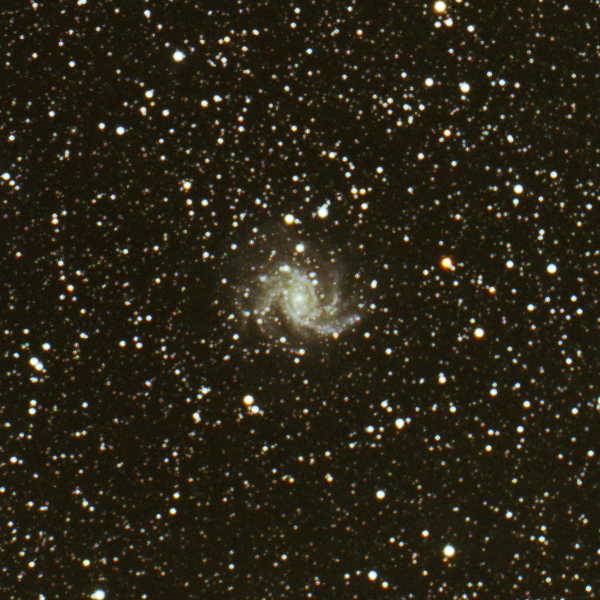 |
| NGC 6946 (the Fireworks Galaxy) on the border between Cygnus and Cepheus. |
NGC 6946 currently holds the record for the largest number of supernovae observed in a galaxy (and earns it nickname in the process): nine so far, in 1917, 1939, 1948, 1968, 1969, 1980, 2002, 2004, and 2008. Typically in a galaxy this size you'd expect to see one every fifty years or so on average, which gives you an idea just how extraordinary this galaxy is.
