Showing posts with label Milky Way. Show all posts

Saturday, March 6, 2021

Solar twins and Chinese calligraphy

I've just finished my latest painting, and I'm especially happy with how this one came out and excited to share it. Now, back in 2018 when I first started painting, I gave two of my advisors each a small painting (though I'm embarrassed at their quality now). I decided recently that I'd like to do so for the other two people on my advisory team, and it's one of these paintings which I've just finished.

My advisor Fan is from China, and is an expert on solar twins, so I decided I wanted to paint a scene of a binary pair of solar twins with a Milky-Way-like background of stars. I started working on it in early February, and after just a few sessions (maybe 2 hours in) it was already looking pretty good:

As I like to with my painted stars, the disks have some texture medium (I think synthetic resin sand) mixed in to give them some “pop” on the canvas. The stars are all hand-dappled—I didn't want to risk getting paint around my desk where I paint at home by spattering, although it occurs to me that I could've done it outdoors. Something to keep in mind for the future, I suppose.

Anyway, after a few sessions of individually painting background stars in an attempt to get that feeling of the innumerable stars of the Milky Way, I had a spur-of-the-moment idea that worked out really well: I took tiny drops of iridescent medium (which has tiny flakes of mica in it to make it sparkle), and spread it out as thinly as I could over the background. As you can see in the picture below, this came out looking phenomenal!

You can see some little star spots I painted on best in this photo.

(It also gave me inspiration for a completely different painting, but I'll get to that in due time.) For the name, in the spirit of my “Sonne Doppelgänger” painting for my fellow student from Germany, I wanted to call it “Solar Twins” in Chinese. I got a friend of mine from Hong Kong to help me with the translation, and used my best calligraphy to write it out in the traditional top-to-bottom, right-to-left orientation on the canvas:

“太陽孿生兒 (Solar Twins)”, 10×8 inches, acrylic on canvas.
Overall I'm extremely pleased with how this painting came out. This photo doesn't quite do it justice, but the shade of red I picked really sets off the yellow of the stars and the black of the background incredibly well. I also put a lot of work into those characters, and am pretty happy with how they came out. If you're curious, they literally translate to something like “extreme yang (sun) twice born child (twin),” which I thought was pretty neat. I'm planning on giving it to Fan this week, and can hardly wait to see his reaction. (Edit: He loved it!)

For being such a quick, simple painting I actually learned a few things from doing it which will doubtless come in handy in the future. Much like my—uh, fiery planet painting? I realized I never officially finished it and gave it a name*—I experimented with mixing other colors directly into the black background, in this case the star's extended yellow coronae. I realized later that this meant painting the stars (which should be in the background) on top of them, so I'll have to think more carefully about doing it in the future, but I think it looks pretty nice here. And I mentioned the iridescent medium thinly applied for the background Milky Way effect already. All in all a short and sweet painting (probably less than ten hours all told), and one I'm really happy with. I've got one more canvas of the same size (last of something like an 8- or 10-pack I bought all the way back in 2018) and one last advisor to gift, which will involve something other than stars for once. But that'll be for another post! A hui hou!

*Which I should do, since I finally brought it home from my desk last month.

Saturday, October 27, 2018

Painting a Volcano Is Like Making a Volcano: Layers Upon Layers

Last month I teased a project I've been working on for a while, and having finished it this week I'm finally ready to reveal it:

I've taken up painting (with acrylics)! And I've finished my first painting!

I mused about taking up painting in this post back in June, having found the experience of painting my YTLA model at the beginning of the year to be very soothing and enjoyable. Back in August we restarted our weekly art workshops at Swinburne with our artists-in-residence Pam and Carolyn, and I decided to go for it—and I'm ultimately really glad I did, as I've found it to be incredibly rewarding.

For my first painting, I wanted to paint a picture that I've had in my head since at least 2012, back when I was working at the Visitor Information Station on Mauna Kea. It was inspired by my reading about how Mauna Kea and Mauna Loa used to host year-round glacial ice caps, and also erupted underneath those glaciers. A picture came into my mind of the summit of Mauna Kea, snow-clad, looking south towards Mauna Loa similarly covered in ice, at night with the (northern hemisphere) summer Milky Way rising majestically above while a fountain of lava erupts from Mauna Kea's summit through a crack in the ice.

I'd originally wanted to do this using Blender, like some previous projects of mine, but I just never got around to it after I started working full time so I decided I'd try doing it as my first painting project. Probably far too ambitious for a beginner like me, but you can judge how it turned out for yourself. Since I enjoy seeing the creative process I took a bunch of photos throughout the entire three-month creation period, so you can watch the entire process as it unfolded.


Here it is, my first swatch of paint applied to canvas, August 21, 2018. (Though I also spent two weeks before this applying two coats of gesso—essentially a primer layer of white paint mixed with chalk which serves as a good base for future paint layers.) Not much to look at yet, but you can see the outline of Mauna Loa and Hualālai (on the right) starting to take shape already. There's a curious thrill of trepidation that comes when holding a loaded paintbrush poised over a blank canvas; the feeling of permanence and lack of an undo option combine to make it a bit nerve-wracking even when doing nothing more complicated than a flat black night sky!


Next, I added the glacier atop Mauna Loa. The glaciers were probably the most difficult part of this project for me, as I've never seen one personally so I had to rely on photos and my own ideas of how ice looks. I think this one atop Mauna Loa came out pretty well, at least.


Of course, even personal familiarity with a subject doesn't guarantee I'll paint it well. I painted a lot of the early stages from my mental picture without reference photos, and I definitely could've done a better job with the slopes of Mauna Loa and Hualālai with some visual references. Still, this session was interesting for mixing a few different colors to play with. I'm not using pretty much any colors straight from the tube (other than the black background, and maybe some of that gray), rather I'm mixing them to start to get a grip on color mixing theory as it applies to acrylic paint.


Moving into September I finished off the slopes of Mauna Loa and Hualālai. I mixed even more shades of colors this time and started layering them over older ones, which led me to the striking realization that making a volcano and painting a volcano are very similar processes; just layers upon layers!


Almost immediately upon actually putting paint to canvas at the beginning I realized I was enjoying the process far too much to wait for weekly workshop sessions, so I quickly started working on my own throughout the week. I had a short time available for this session so I added a cloud on the left approaching from the east and crossing the Saddle. (Spoilers: I wasn't happy with it almost immediately upon finishing it, so it'll change later.)


Next session, I tackled the snow-covered summit of Mauna Kea in the foreground. A sharp-eyed inspection of this photo will reveal that it's upside-down, as I rotated the canvas on the easel so that I could paint along the bottom edge of it. It turned out to be an interesting artistic exercise, actually; I painted the smaller cinder cone on the left entirely upside-down, and am still happy with how it came out. I wasn't very happy with the glacier as a whole though, so you'll see it getting reworked.


Case in point: here I've gone over most of the foreground to try to both merge it more naturally from side to side and also introduce some feeling of contours to help define the shape. The cinder cones got some working over, too. They're actually based on real cinder cones still extant at the summit, though I didn't copy them particularly closely. The large one on the left is Puʻu Wēkiu, the eastern rim of which is today the highest point on Mauna Kea; the one behind it is Puʻu Haukea, a relatively recent cinder cone going by its not-yet-significantly-weathered dark gray color; and the one on the right is Puʻu Poliʻahu, named after one of the Hawaiian goddesses of snow. It's very close to the present-day location of the JCMT, and has a much more weathered and irregular profile now than I've painted it here.


At this point I finally started looking up references for what Mauna Kea looked like when snow-covered nowadays, and realized that photos usually showed black rocks sticking out from the snow, especially around rims and ridges. I went a little overboard with it here (and dialed it back later), but I think it definitely helps to define parts of the space better.


I was never entirely happy with the cloud I'd added, nor the center part of the foreground glacier, so in one session I redid both of them. I think it was around now that I started realizing that the composition didn't really have space for a lava fountain like I'd originally intended, but I was still on the fence about including one eventually at this point.


Instead, I decided to expand! Pam encouraged me to add a second canvas to the sky to better capture the Milky Way, and I'm really glad I took her advice. Actually painting the Milky Way was an interesting and exhausting process, as I did it by spattering paint on the canvas to make stars. (I blocked off the foreground beforehand so it wouldn't be affected.) In what's turning out to be a recurring theme, I wasn't happy with the initial look of it and spent a few sessions reworking it…


Coming into October, I went back and spattered more stars on the canvas, though I made the same mistake as before and tried to paint in the Milky Way's dust lanes from my head rather than from a reference. You might have noticed that the quality of these photos, especially regarding glare, changes a lot; it depended on if I took them in the evening after working on them under electric light, or in the morning the next day when there was daylight. Large expanses of black like the night sky here were especially difficult to properly represent the darkness of.


It's not easy to see in the photo, but I've gone and hand-painted in all the brightest stars that one could reasonably see with the naked eye based on the perspective and time of year. The center of the Milky Way roughly coincides with the center of the top canvas, so Sagittarius, Scorpius, and Corona Australis are all visible, with a bit of Lupus on the right and a few other constellations having one or two stars appearing. And being the stickler that I am, I actually painted them with colors corresponding to their spectral types. This session turned out to be surprisingly grueling, trying to put the stars in the right places based on a star map using Stellarium. I also added a few nebulae as well; the largest pink patch near the center is the Lagoon Nebula, while just above it is the Trifid Nebula. You can also see that I've subtly whited out bits of the black rims of the cinder cones to make them blend in a bit more.

I was worried that the hand-painted stars wouldn't stand out all the much from the background splatter stars, until a few days later when I noticed an interesting thing: up close to the canvas you can see all the faint background stars, but step back a few paces and it all disappears into the blackness of the night, leaving the hand-painted stars as the only ones to be seen! I definitely didn't plan that, but it works really well, and is an interesting lesson in how a painting can be seen differently at different distances; a dynamic I hadn't really appreciated from my previous experience doing artwork on a computer where you generally only look at something from a fairly fixed, nearby distance.


Finally, in one mammoth two-and-a-half-hour session I went over the Milky Way again by hand, adding gossamer stars clouds and actual dust lanes from reference photos. I spent so long looking at the Milky Way, in fact, that I now immediately recognize structures in the dust lanes in other photos from having painted them. There are still some factually incorrect dust lanes in there, but it's much more realistic now. And at this point I realized that I was satisfied with it. I could keep tinkering with it and adding more details, but I was also fine with calling it finished (I also finally decided against adding any eruption activity). I did one last session on Pam's suggestion to add a bit more color to reflect the color of the Milky Way in the ice and to push Mauna Loa more into the background, and the result is:


My first painting is complete! I varnished it just this week. The lighting on this photo is, once again, pretty terrible, but it gives a decent idea of what it's like. Together the two canvases are 80×80 centimeters (31×31 inches), so it's reasonably large. I call it “Mauna Kea a me Mauna Loa ma lalo o ka lani hōkū (Mauna Kea and Mauna Loa beneath the starry heavens).”

It feels amazing to have finally finished it, and I've received lots of nice comments on it from people. I've really dived into painting, as I've found it to be way more fun and engaging than I had expected. I've picked up a number of tubes of paint and brushes, and even a palette knife which looks like a tiny trowel and reminds me of doing archaeology! I've been reading up on techniques and painting terms, and checking out the paintings of famous painters with a new eye. (I'm thankful for a decent amount of art history in my education, but I'm learning there are so many painters I've never even heard of!)

Now that I've finally cleared that picture from my head I find another one has arisen to take its place. People have also given me some ideas for others (like a series of planetary landscapes around the solar system), so we'll see what comes next. But one thing's for sure: I expect this to be a hobby for years to come. A hui hou!

Saturday, July 14, 2018

Another (Unexpected) July Astrobite! Structured Satellite Galaxies

So just a few days after my previous Astrobite summarizing the ASA meeting I got a surprise when I woke up to an email from the Astrobites scheduler saying that he'd posted my Astrobite I wrote for the queue back in February. This one deals with an interesting problem I'd never heard of before called the “Satellite Planes of Galaxies problem.” Observations of he Milky Way, the Andromeda Galaxy, and Centaurus A show that a significant fraction of the satellite galaxies around them tend to orbit in correlated planes. Yet similar-looking structures are vanishingly rare in simulations, to the point where it would be exceedingly unlikely to find them around three galaxies so close to each other. It's pretty interesting as while we've had hints of theses planar structures around the Milky Way for a few decades and Andromeda for a little less it's only recently that we've really been able to confirm them and discover the one around Centaurus A.

Something amusing I found in this paper was the name for the structure around the Andromeda Galaxy, which is called the “Great Plane of Andromeda.” This sounds like a reference to a very old name for the Andromeda galaxy, several hundred years ago when it was known as the Great Nebula in Andromeda. I just like the idea that anything associated with the galaxy becomes known as the “Great ____ in/of Andromeda.” A hui hou!

Friday, March 30, 2018

Personal Panoramic History, Part 3: 2010

In the previous post in this series we looked at 2009 and a couple of my first attempts at taking panoramas of certain volcanoes. In 2010 I refined my technique a bit by taking panoramas of the same volcanoes—several times—but also experimented with some new things as well.

May


My first panorama of the year comes from May, when the University Astrophysics Club at UH Hilo was given a tour of the Subaru telescope. I had the chance to do a little hiking around Hale Pōhaku while we were waiting to acclimatize which I used to take the following panorama from the top of Puʻu Kelepeamoa (a popular sunset-viewing spot nearby):

Mauna Loa and Mauna Kea.
This was my first full 360° panorama. Actually, it went slightly more than a full turn around and when I first stitched a panorama together from the photos I refused to drop any of them, leading to a rather weird image with Mauna Kea in the center and the summit of Mauna Loa showing up twice, on either side. Hugin luckily can work out a full rotation and stop there, and also allows you to rotate your endpoints around, so I've made it a bit nicer looking by scooting Mauna Kea over to the side and no longer splitting Mauna Loa in twain. If you follow the link above you can see the original version by mousing over the panorama (which is now this new one) in the original post it came from.

June


Mauna Kea summit area.
In June I had another opportunity to visit Mauna Kea's summit (probably helping with a summit tour) and used it to snap this panorama. This one is taken from a totally different perspective than the one in part 2 which was taken from in front of the Keck building, which is the two identical domes near the center of the image. From left to right, you can see UKIRT, CSO (just barely), JCMT, SMA, Subarua, Keck I and II, IRTF, CFHT, and Gemini North.

July


In July I created this, my first and so far only astronomical panorama. This one's another hand-made image, as Hugin couldn't manage it. This is because the image is made up of twelve different images, each of which was a thirty second exposure in order to collect enough light. While thirty seconds is short enough that the star trails induced by the earth's rotation aren't too noticeable in each individual image, the entire sky would have moved pretty appreciably between the start and end of the series of exposures. I'm not entirely sure how I managed to wrangle this into a panorama myself—with a lot of effort, I suspect—and looking at it now I sometimes think I see some duplicate bits, but I'm still pretty happy with this view of the northern hemisphere summer Milky Way from the area near the Visitor Information Station on Mauna Kea. (You can see the glow from Hilo in the center of the image.)

August


In August 2010 while I was back home for vacation during the summer my family went on a two-day road trip around some parts of northern California, including the coast and through the redwood forests. This let me experiment with a vertical panorama:

The Chandelier Tree in Leggett, California.

This is a hand-made panorama, as I just couldn't get Hugin to make a good looking result. It probably has to do with the unusual way the perspective changes from standing on the ground and rotating the camera up to get pictures. It's an interesting challenge though; maybe I should try more vertical panoramas in the future.

November


In November 2010 I had my first chance to observe on Mauna Kea at Subaru while working as a student research assistant. Since we spent a day and a night at Hale Pōhaku acclimatizing before going up I had some time to hike a round and take a few panoramas:

Mauna Loa, Hualālai, and Mauna Kea.
You'd be forgiven for thinking I'd accidentally posted the same panorama from May again here. While writing this post I had to carefully double-check to make sure that I hadn't, as they both look pretty similar in the tiny preview thumbnails (this one has more cloud cover on the left, at least). While they do look very similar (and were taken from locations very close to each other on the top of Puʻu Kalepeamoa), the layout seen in both of them was created in this one and retroactively used for the May version when I was remaking both with Hugin. I like this layout a lot better, and I like to think it shows that I was getting a bit better at framing panoramas by this point.

Mauna Loa.
The previous panorama was taken from the summit of Puʻu Kalepeamoa, which is the hill in the foreground on the left of this image, which was taken from a cinder cone (or puʻu) slightly higher up Mauna Kea's flank. (Well, technically, “ka lepe a moa” means “the comb of the chicken”, and Puʻu Kelepeamoa is so named because it's a range of three or four rusty-red cinder cones that could be seen as a cock's comb, and I was technically still on [another part of] it while taking these pictures. The name is typically mostly used to refer to the hill lowest on the mountain and closest to the VIS, though.)

Mauna Loa and Hualālai.
This panorama was taken from a bit further up the flank of Mauna Kea again. In the foreground on the left you can see the summit of Puʻu Kalepeamoa again as well which helps give a sense of the movement between pictures. On the right side of this image you can see some more of the gigantic cinder cones (or puʻu) near the Visitor Information Station. These final two panoramas I'd never even created until writing this post so they're both completely new, which is a shame because I really like the last one—going through and creating these huge panoramas of gorgeous landscapes I just keep thinking “This would make a great picture to get printed and hang on my wall where I could actually enjoy it all at once, at full size.” Maybe in another decade or two when I can start to think about settling down and not moving every few years.


And that's it for 2010! I spent some time refining my panorama technique with the same choice of targets that year (you're probably sick of Mauan Loa panoramas from the north by now), but for the next part covering 2011 I'll have a few unique panoramas which, for various reasons, I've never repeated. A hui hou!

Monday, February 12, 2018

Fundamental Constants: Do They Actually Vary?

I can't remember if I've mentioned it on this blog before, but since the middle of December I've been planning on entering a competition among Australian universities for students or early-career scientists for videos that best showcase and explain your research. It's called the Pitch It Clever competition, and the idea is to make a one- to two-minute elevator pitch video. I decided on a live-action format as being easiest, finally got my filming done on Saturday, spent much of Sunday editing the resulting footage, and submitted it today!


I haven't written much here about what my Ph.D. research will actually encompass, partly (mostly) because I wasn't sure for a while. During the application process the idea was that I'd be working on fundamental constants, but looking at quasars. However, in the several months between accepting the university offer and actually moving here my supervisor came up with an idea of applying the same methods to solar twins instead, and offered me the choice to work on that when I arrived. Despite never having much interest in stars prior to this I found this idea more interesting (surprisingly), so that's what I chose.

The video says it pretty shortly and sweetly (I hope!), but just as a quick overview in case something I said wasn't clear:

All our modern theories of physics—known by the incredibly boring name of the Standard Model—rely on a number of quantities known as physical constants. Their values can't be calculated from within the theories themselves, but can only be measured. We call them ‘constants’ because we've never measured them to change but this is fundamentally an assumption, and one that has remained a niggling worry in the back of physicists' minds for around a century now.

The fine-structure constant, usually denoted with the Greek letter alpha (α), is one of these constants which characterizes the strength of electromagnetic interactions. It has a value of \(\alpha\approx1/137\) (but not exactly \(1/137\)!), and unlike some of the other constants is dimensionless meaning it has the same value in all systems of units. (Other constants, such as the speed of light, have units ‘built-in’ so to speak—the speed of light is, well, a speed, and has units as such: m/s or mph or whatever.)

Anyway, if the fine-structure constant were to vary, we can calculate the effects that this would have in the energy required for electrons to make quantum transitions between different atomic orbitals. (Well, we won't actually be doing those calculations, we have some collaborators who'll be doing that bit for us.) It turns out that transitions react differently—some require more energy, others need less, and some are barely affected at all.

The energy required for an electron to jump between orbitals is related to the energy of the photon of light it emits or absorbs when doing so. This means that we can potentially measure changes in the fine-structure constant by looking for changes in specific absorption lines in various spectra. By looking at pairs of lines that react oppositely, we can increase our confidence that a measured shift is caused by a varying alpha and not something else.

For the spectra I'll be looking at stars very similar to the sun, which are known as solar twins. There's no actual general definition for precisely what makes a star a solar twin, but intuitively it's just a star that's close to the sun in a number of ways. Since we can study the sun so well we can apply all that knowledge to solar twins too, again allowing us to have more confidence that any shifts we might see are truly due to alpha and not some other unknown process in stars very different from the sun.

And that's basically it. Actually measuring a change in alpha would be a truly remarkable undertaking (though it would likely take years to follow up on and be confident that it wasn't a fluke). Realistically, it's pretty unlikely to happen, but null results are also important in science. While alpha's been measured on earth and in various high-redshift quasars, it hasn't been measure very much on the scale of the Milky Way galaxy, and this would give us more knowledge about where this particular constant is constant, which is valuable in its own way.

It's been a late couple of nights working on this video so that's it for now (but feel free to ask questions in the comments if something I said was unclear)! A hui hou!

Thursday, August 1, 2013

Science Clock Series: Part VIII

Today's number comes from astronomy, and is given by:

\[\approx\text{distance to center of Milky Way (kpc)}\]
This one is pretty straight forward, though it requires a fair amount of exposition. The Milky Way, of course, is the galaxy within which we all live. As far as we can tell from our inside perspective, it is a barred spiral galaxy, like many others throughout the universe. 

The letters "kpc" stand for "kiloparsec," an astronomical unit of distance. "Kilo" is the SI prefix for a thousand, so we're dealing with a thousand parsecs. Just what is a parsec, though? A parsec is defined as the distance at which an object has an astronomical parallax of one arcsecond. Parallax is the way objects appear to move when you look at them from two different positions, when compared to even more distant objects.

(To see this effect, close one eye and line up your thumb at arm's length with an object across the room. Now switch eyes, and notice how your thumb is no longer in line with the object. This is the reason we have two eyes, in fact; our brain takes the slight differences in the angles between them and interprets it as distance. If you can measure the parallax of an astronomical object, you can mathematically work out its distance in a similar manner.)

An arcsecond, as I've discussed here before on this blog, is a unit of angular measurement (and a very small one at that). For comparison, there are 60 arcseconds per arcminute, and the full Moon (and Sun) are about 30 arcminutes in angular diameter. Thus an arcsecond is about 1/1800 the width of the full Moon.

This is a pretty small amount. And yet, there are no stars within 1 parsec of the Sun, so every star in the sky has a parallax smaller than 1 arcsecond. This is much, much too small to be noticed with the naked eye, and it wasn't until 1838 that the first measurement of a star's parallax was made by the German astronomer Friedrich Bessel. (The closest star to the Sun, Proxima Centauri, is 1.3009 parsecs away, or 4.243 light-years.)

Anway, that's how you define a parsec, but what does it mean in units your or I might be more familiar with? When you do the math a parsec works out to be approximately 3.26 light-years, or 30.9 trillion kilometers, or 19.2 trillion miles. A kiloparsec, then, is a massive 30.9 quadrillion kilometers, or 19.2 quadrillion miles, or 3,260 light-years.

This...is a long way. It is simply too large a distance for me to truly comprehend it. And yet we need such large units to meaningfully talk about our galaxy, which is around 31-37 kiloparsecs across (100,000-120,000 light-years). It's hard to put a solid number on it since the galaxy has no hard edge, but rather fades out around the edges. This gives it a radius of about 15-18 kiloparsecs, and as far as we can tell, the Solar System is located between about 8.0 and 8.7 kiloparsecs from the center of the galaxy (roughly 26,000 to 28,000 light-years), putting it about halfway out, nestled between two of the Milky Way's spiral arms.

Check back next time for a number from chemistry! Click here to jump directly to it.

Monday, September 10, 2012

The Fireworks Galaxy

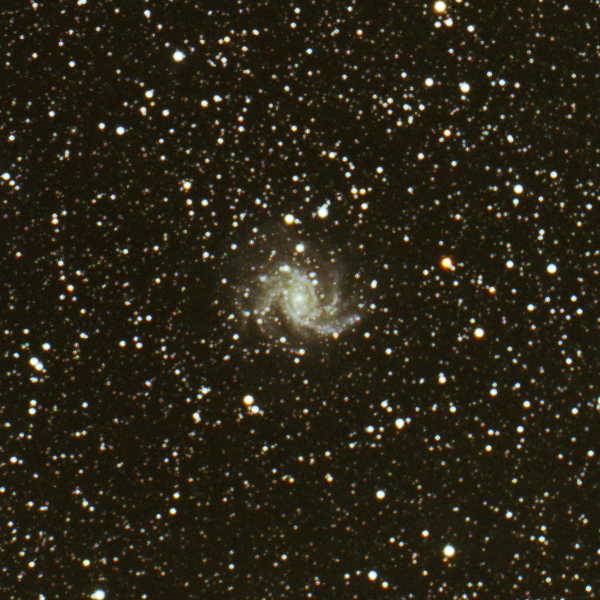
Today I have something besides another globular cluster picture for you: a picture of a galaxy. This galaxy is officially named NGC 6946, though it unofficially goes by the name of the Fireworks Galaxy. It is located on the border between Cepheus and Cygnus, which puts it very close to the plane of the Milky Way. This fact means that it is obscured rather heavily by the dust in our galaxy, making it appear much fainter than it otherwise would.

NGC 6946 is located about \(22.5\pm7.8\) million light-years away, which actually makes it one of the closest galaxies outside the Local Group. As you can see from the picture below, it's fairly large, with a diameter of about 11.5 by 9.8 arcminutes. This gives it a physical size of about 75,000 by 63,000 light-years, about two-thirds to three-quarters the size of the Milky Way galaxy. You can easily make out several spiral arms wrapping around the core, and what appears to be a faint ring around the nucleus.

NGC 6946 (the Fireworks Galaxy) on the border between Cygnus and Cepheus.
NGC 6946 currently holds the record for the largest number of supernovae observed in a galaxy (and earns it nickname in the process): nine so far, in 1917, 1939, 1948, 1968, 1969, 1980, 2002, 2004, and 2008. Typically in a galaxy this size you'd expect to see one every fifty years or so on average, which gives you an idea just how extraordinary this galaxy is.

Sunday, August 5, 2012

Globular Cluster Photo Series (Part 19): M9

The last globular cluster I showed a picture of, Messier 64, was quite far away from the galactic center. Today I'm going to go in the opposite direction with a picture of Messier 9. This cluster is moderately far from Earth at a distance of about 25,800 light-years, but that's because it happens to be one of the closest globular clusters to the galactic core. The distance between M9 and the core is only about 5,500 light-years, which is pretty small when you remember that the Galaxy is about 100,000 light-years across. (For comparison, our Solar System is about 23,000 light-years from the core.) M9 is a average-sized cluster about 90 light-years across, which at its distance translates to a size of about 12.0 arcminutes (about a third as large as the full Moon).

Messier 9 in Ophiuchus.

Partly as a result of being so close to the center of the Galaxy Messier 9 is retreating from us quite quickly, at a rate of 224 kilometers per second (just a hair over half a million miles per hour). It is also located close to the dark nebula Barnard 64, which you can see as the region to the upper-left of the cluster that appears to be devoid of stars. This dark molecular cloud (made up of interstellar gas and dust) is probably something like what the Orion Nebula and the Lagoon Nebula would look like from the other side.

Saturday, July 28, 2012

Closest Quasar

Today I have a picture of a very unique object to show you: the first quasar ever discovered. I had meant to take this picture before the transit of Venus, but the combination of poor weather and a heavy workload made it impossible. Luckily for me, Virgo was still high in the sky when I took this picture on the 11th of July.

A short note about quasars: quasars (short for quasi-stellar objects) are believed to be comparatively small accretion disks around supermassive black holes in distant galaxies. They are known as quasi-stellar objects because they appear star-like to all but the most powerful telescope due to their extremely great distances. They give off tremendous amounts of light all across the electromagnetic spectrum, from X-rays to infrared. Some also give off copious amounts of gamma rays and radio waves.

The quasar below is thought to be the closest quasar to us at 2.44 billion light-years away. Yes, that's billion with a "b". Our Milky Way galaxy is about 100,00 light-years across, so nearly 25,000 galaxies like the Milky Way could fit between this quasar and our galaxy. And that's the closest quasar to us. Most quasars are much further away, and due to their extreme luminosity are some of the farthest objects visible in the universe. This quasar, though, is likely the farthest object you could reasonably expect to see through an amateur-sized telescope.

Anyway, enough explanation. Here it is, entry 273 in the Third Cambridge Catalog of Radio Sources, 3C 273 itself!

3C 274, the closest quasar to us. Located 2.44 billion light years away in the constellation Virgo.

Kindly hold all applause until the end of the blog post. I know it's not much to look at, but it's remarkable because of what it represents. With a 4-inch telescope and a CCD camera you and I can see the light from the mind-bogglingly intense region of warped space-time around a black hole with more than 800 million times the Sun's mass from over 2,440,000,000 light-years away. It's staggering to me that such a thing is even possible. Hopefully you can see why this is such an amazing picture, even if it isn't as showy as some of the ones I put up here.

3C 273 is an interesting object because it was the first quasar to have its spectrum taken (due to the fact that it is the brightest quasar in the visible light range), which helped show that it wasn't a star and was in fact very much further away than previously thought. Although we know more about quasars now than ever before, they continue to remain mysterious objects and there are many questions about them yet to be answered.

Saturday, May 5, 2012

Black-Eyed Galaxy

I haven't traditionally done a lot of galaxy images in the past, but today I have a picture of a slightly mysterious galaxy with a rather evocative name. Messier 64 is also known as “The Black Eye Galaxy” or “The Sleeping Beauty Galaxy”, and it's a really neat celestial sight. It is a spiral galaxy located in the constellation Coma Berenices (Berenice's Hair, named after the legend of Queen Berenice II of Egypt, her missing sacrificial hair, and a quick-thinking court astronomer. But you can read that story for yourself at the link up there).

Messier 64, the Black Eye Galaxy, in Coma Berenices.

M64 gets its name the Black Eye Galaxy from its appearance in a small telescope. This is mainly due to the massive clouds of dust circulating through it, especially the prominent band silhouetted in front of the bright galactic nucleus, which I've seen myself through a moderate-size telescope. If it weren't for the dust clouds in the outer regions of the galaxy blocking most of the light, M64 would be a lot brighter.

Surprisingly, given its large apparent size, the distance to M64 is not very well known. The best figures I could find suggested a distance of 17-19 million light-years, but there are estimates ranging from 12 to 40 million. Given its redshift and applying the Hubble Law would give a rough distance of about 16 million; however, M64 sits on the outskirts of the humongous Virgo Galaxy Cluster, which gives it an unknown extra component to its radial velocity that makes the Hubble Law only very roughly approximate. Since even 40 million light-years is essentially just down the block in the cosmic neighborhood, it's rather surprising that the distance isn't known more accurately, as the Cepheid variable stars used as standard candles for determining distance in nearby galaxies ought to be visible. One possible reason the distance isn't known better is that to date no supernovae have been observed in M64. One of those would definitely help pin down the distance.

M64 is about 80,000-90,000 light-years across, similar in size to (about 10% smaller) than our own Milky Way Galaxy (about 100,000 light-years across). One extremely interesting feature of this galaxy, however, is that the innermost 6,000 light-year-across region seems to be rotating in the opposite direction to the rest of the galaxy. This is quite unusual, and may hint at a possible galactic merger sometime in the galaxy's past. At the border, the differently spinning clouds of gas may be colliding with each other, possible spurring a wave of star formation. This certainly isn't your run-of-the-mill spiral galaxy. (Though to be fair, pretty much every spiral galaxy is unique in some way.)

Thursday, April 12, 2012

Globular Cluster Photo Series (Part 17): M3

Today I have a picture of one of the biggest and brightest globular clusters in the Northern Hemisphere, narrowly beaten out by the likes of M13. This globular cluster, Messier 3, is found in the northerly constellation of Canes Venatici, the Hunting Dogs, just below the handle of the Big Dipper asterism.

M3 is, as its name indicates, the 3rd object in Messier's popular list of bright non-comets, and as such it may have the distinction of being the object that prompted him to begin a systematic search for these objects instead of simply cataloging ones that he came across by chance.

M3 is a bright cluster that currently stands as the record-holder for largest number of variable stars – 274 – found in a globular cluster to date. It has an angular size on the sky of 18.0 arcminutes, a bit less than two-thirds of the width of the full Moon and ever-so-slightly smaller than M13's 20.0. It is actually a bit larger than M13 physically at 180 light-years across (10 more than M13),  but is also a bit further away from us at 33,900 light-years compared to M13's 25,000. Even this far away from us, further away than the center of our own galaxy, it still shines just bright enough to possibly be seen with the naked eye under pristine conditions at apparent magnitude 6.2. With any sort of magnification, of course, it looks quite nice. (For comparison, the distance to the supermassive black hole Sagittarius A* at the center of our galaxy is 25,900 \(\pm\) 1,400 light-years.)

Messier 3 in Canes Venatici. Click for larger picture.
M3 also beats out M13 in the number-of-stars department, having perhaps 500,000 compared to M13's 300,000 which puts it at about half the number of Omega Centauri, and in the top few percent for Milky Way globulars overall. This unusually large population is probably one reason so many variable stars have been discovered in it.

Currently M3 is cruising at about 40,000 light-years away from the galactic core, which is quite respectable when you consider that the Milky Way is only about 100,000 light-years across, and which puts M13 even further from the core than we are from M13. (You know you're an astronomer when you find yourself saying things like “only one-hundred-thousand light-years” – that's only about six-hundred-thousand trillion miles, for you curious.) Despite this distance, it probably has a better view of the core than we do as it is about 33,000 light years above the plane of the disk, while we have to look through all the dust and gas in the plane of the galaxy between us and the core.

Wednesday, April 4, 2012

Southern Winter Milky Way Skies.

Today I want to do something a little different and share a picture taken by my housemate and good friend Jonathan. He's recently gotten into astrophotography using his DSLR camera, but has been too busy to do much (it being his last semester at UHHilo and all).

Two weeks ago he was able to make it up to the Vis and took the following picture, which he posted on his blog (which you can find at Life is a Zwitterion). I saw it and offered to label the constellations and a few other objects visible in it for him, and he suggested I post it on my blog, so here it it. Thanks Jon!


This is a 30-second exposure taken from the Visitor Information Station on Mauna Kea looking south at 8:25 on March 19th, 2012. Visible near the bottom is the flank of Mauna Loa, with part of the rim of Puʻu Kalepeamoa visible in the foreground (ka lepe a moa means "the comb of the rooster" in Hawaiian, which is  an apt description for the shape of the range of hills it is part of). In the background lies a stretch of the winter Milky Way, with several prominent constellations visible.

Also visible in this picture are the two brightest stars in the night sky, Sirius and Canopus. Sirius is one of the twenty closest stars us, a mere 8.6 light-years away. It is actually a binary system composed of a white main sequence star (Sirius A) of spectral type A1 about twice as massive as the Sun and about 25 times as luminous, and a white dwarf (Sirius B) first discovered in 1862. Sirius B has a diameter of about 12,000 kilometers (7,500 miles), nearly the same as Earth, but contains 98% of the mass of the Sun.

The other bright star, Canopus, is much further away: 310\(\pm\)10 light-years. Canopus is a supergiant star of spectral type F, and it is 13,600 times more luminous than the Sun. In fact, it's the most intrinsically luminous star within ~700 light-years. Unfortunately, it's far enough south as not to be visible from much of the continental United States, although south of 37\(^\circ\)18' it may be visible under very good conditions.  Its radius is fully one-third of the distance from the Earth to the Sun, about 50 million kilometers or 30 million miles.

Along with stars, there are quite a few constellations (or parts of them) visible in this image. Prominently placed is Canis Major, the Big Dog (Canis Minor is out of the top of the picture, however). The three constellations that made up the old constellation Argo Navis are also visible here; Puppis, the Poop Deck, Carina, the Keel, and Vela, the Sail. Also visible is Pyxis, the Ship's Compass, though it is a modern addition by Nicolas Louis de Lacaille in the 18th century. Below Canis Major is Columba, the Dove, and Pictor, short for Equuleus Pictoris the Painter's Easel (another modern addition courtesy of de Lacaille). Finally, just at the bottom of the picture is Dorado, the Swordfish. Dorado is interesting because it contains both the majority of the Large Magellanic Cloud (one of the Milky Way's satellite galaxies) and the south celestial pole. In fact, if it weren't for Mauna Loa getting in the way, the Large Magellanic Cloud would be visible at the bottom of the picture.

Finally, there are at least three Messier objects visible in this picture (there are probably even more that I missed): M46, M47, and M41. Messier 46 you may recall as the open cluster with superimposed planetary nebula I showed a picture of a few weeks ago.

Monday, November 14, 2011

Globular Cluster Photo Series (Part 14): M71

Today's picture is of the globular cluster Messier 71 in the tiny constellation Sagitta, the Arrow (not to be confused with the much larger and more familiar constellation Sagittarius, the Archer). M71 is an unusual globular cluster between 12-13,000 light-years away with a diameter of about 27 light years, fairly small for a globular cluster. It has a small apparent diameter of only 7.2 arcminutes (less than a third the width of the full Moon).

Messier 71 in Sagitta.
Sagitta is located in the plane of the Milky Way from our point of view, which explains the high stellar density in the background of this image. M71 was for a long time (up until the 1970's, in fact) thought to be a dense open cluster rather than what it actually is, a loose globular cluster. One reason was that the stars in M71 are younger than is typical for globular clusters, although that fact simply turned out to mean that M71 is a relatively young globular cluster. M71 also lacks a particular kind of variable star called RR Lyrae stars (after the prototype RR Lyrae) that are common in globular clusters, which turned out to be related to its age: its stars are too young to have become RR Lyrae-type variables yet. In fact, M71 contains only 8 known variable stars, though one of them is an interesting irregular variable.

This lack of RR Lyrae stars is one reason the distance to M71 is known to no better than a thousand light-years. RR Lyrae stars make good standard candles within our Galaxy, as the relation between their periods and their luminosities is well-known. They are also much more common than the other type of variable star commonly used as standard candles, Cepheid variables. RR Lyrae stars can be found at all angles in the sky (in contrast to Cepheids which is are strongly associated with the galactic plane), and consequently make up 90% of the variable stars found in globular clusters.

Anyway, that's it for tonight, I need to get some sleep. A hui hou!

Monday, October 31, 2011

The Great Galaxy in Andromeda

Saturday night while I was up at the Vis I decided to take a break from imaging globular clusters to try my hand at what probably pretty much every astrophotagrapher ever has broken their teeth on: Messier 31, the Great Galaxy in Andromeda.

The Andromeda Galaxy is located in the direction of the constellation Andromeda, about 2.5 million light years away. It's not the closest galaxy to our own Milky Way, but it's the closest spiral galaxy and the one closest in size to the Milky Way in our Local Group of about 30 galaxies. (Intriguingly, although Andromeda is larger in size than the Milky Way, recent studies indicate that the Milky Way may have more mass. It also has a higher star formation rate, and a higher rate of supernovae.)

The Great Galaxy in Andromeda, Messier 31. Technically, only the innermost part of it. M32 (at top) and M110 (at lower left) are also visible.

While Andromeda may or may not be the most massive galaxy in our Local Group, there is no doubt that it's the brightest galaxy in the northern hemisphere. It's also the largest on the sky. In fact, if we could see it all, it would appear as wide as six full moons on the sky! Its huge size, however, is paradoxically what makes it so hard to see. All that light is spread over a large area, making it exceedingly faint. What you're seeing in this picture is no more than the central third of the galaxy; it stretches out on both sides almost as far again as seen in this picture (mostly because I didn't have a lot of time to image it, so I took the longest exposures I did in the time available).

Being as it is the largest on the sky and brightest in the northern hemisphere, Andromeda was the first galaxy to have its spectra taken (by Vesto Slipher in 1912) and the first galaxy to be confirmed as such (i.e. a system of star not materially associated with the Milky Way), by Edwin Hubble in 1922-23. This discovery increased the size of the known universe by several times, and was instrumental in the development of our current picture of the universe.

The Andromeda Galaxy is a fascinating star system, and I could write pages more on its various interesting features, but it's getting late here and I ought to get some sleep. After seeing how this picture came out, I'm tempted to try again and get a longer exposure to show fainter details, so perhaps I'll write more about it if I do.

Edit (11/5/11): Due to a suggestion from a master imager, I went back and re-reduced the data for this picture, stretching the light curve in a different manner to get better results. DeepSkyStacker, the program I use to do the data reduction, lets you apply different light curves to your photo after it does all the work to reduce the noise in the image. Basically, different light curves are better for bringing out different features. The one I chose (called "cube root") helped show the faint nebulosity better without simultaneously blowing out the the bright, dense core. So, here's the same picture, version 2:

The Andromeda Galaxy, Messier 31. Now much prettier!
If you compare the two pictures, you can see that the second one shows a lot more detail. I'm glad I learned how to apply different light curves, as my typical globular cluster shots didn't usually change much when I played around with them before so I wasn't quite sure what it did. But as you can see, it works wonders with nebulous subjects! (And since there aren't as many globular clusters to image during the winter, I'll probably be taking a little break from them to image some of the other cool objects in the night sky...)

Friday, October 7, 2011

Messier Globular Cluster Collage

How's that for a noun cluster? This picture is a collage of all the pictures of globular clusters I've taken so far, all nicely labeled.

My housemate Jonathan told me the title immediately made him think of ‘assorted candies.’

These are all at the original size as they appeared in the images I took, they haven't been scaled relative to each other (well, they're original size when you click on the image to see the full version). When you look at them like this it's easy to see why Omega Centauri is one of the best ones to see visually. For comparison, Omega Centauri is about the size of the full moon on the sky. They're arranged in no particular order. They're also not at the same quality level, and I might end up re-doing some of them such as M107 if I get the chance. I've submitted this picture for the slideshow at the annual Volunteer Appreciation Banquet for Mauna Kea volunteers tomorrow, which I'm really looking forward to!

Saturday, September 17, 2011

Yet Another Supernova!

This summer has been really good to supernova aficionados in the northern hemisphere, with two supernovae visible in low-power telescopes going off fairly close to each other within two months. You can see my picture of SN2011dh in Messier 51 in an earlier post in June and further down in this one, because today I have a picture of the more recent SN2011fe which showed up in Messier 101 on August 24th (though the picture is from September 2nd).
SN2011fe in Messier 101, the Pinwheel Galaxy.
Compare the above picture with this one I took of M51 and SN2011dh back in June:
SN2011dh in Messier 51, the Whirlpool Galaxy.
These pictures are fairly similar in terms of exposure time, both using several stacked exposures of 5 minutes each for the three color filters, although the second one used 5 minutes for the luminance filter while the first used only 1:40. And yet even with those slight differences, you can still see that the Whirlpool Galaxy is much more concentrated and easier to see than the Pinwheel, which has actually been stretched a bit to differentiate it from the background.

It would appear from a comparison of the pictures that SN2011fe is a bit brighter than SN2011dh. This may have something to do with the fact that the Pinwheel Galaxy is a little closer to us (21 million light-years instead of 24), but the imprecision in our knowledge of the distance to the Whirlpool Galaxy (plus or minus 3 million light years) means they could actually be at very similar distances to us. It's likely that SN2011fe is intrinsically more luminous than SN2011dh, and that has to do with the fact that they are two distinctly different types of supernovae.

SN2011dh was a type IIa supernova, which means it's the last dying gasp from a star several times the sun's mass. In contrast, SN2011 was a type Ia supernova, which means it came from a white dwarf in a binary system, with a mass known almost exactly: about 1.4 times the mass of the sun. The reason for the vast difference in energy output is because in a type IIa typically only a small percentage of the star's mass is ejected as debris, perhaps a few solar masses' worth. The remaining material is left behind as a neutron star, or, in some cases, a black hole. In contrast, a white dwarf undergoing a type Ia supernova explodes, completely, utterly, and finally. There is no stellar remnant left behind after one of these goes off. The uniformity in their masses before explosion make supernovae Ia valuable as standard candles in the universe for estimating distances to far away objects, and the fact that we now have one to study right in our backyard, as it were, is a great opportunity for astronomers.

Saturday, August 6, 2011

Globular Cluster Photo Series (Part 9): M15

Today I have a picture of the globular cluster Messier 15 for you to enjoy. M15 is a large cluster at approximately 170 light years across. It appears about two-thirds the size of the full Moon on the sky (18.0 arcminutes), and would appear larger were it not for the fact that it is nearly 33,600 light years away (or about as far from us as we are from the galactic core).

Messier 15 in Pegasus.
M15 is one of the most densely packed globular clusters in the Milky Way, due to its core having undergone something called "core collapse". This is a simple process whereby kinetic energy is transferred from the stars in the core to the stars on the periphery, causing the outer layers to "puff up" while the stars in the center contract and pull in closer to each other. M15 has over a hundred thousand stars, though, so there are plenty to go around.

In fact, that enormous number of stars includes some interesting things, including 112 variable stars, 8 pulsars, and a planetary nebula. This was the first planetary nebula (which have nothing to do with planets besides appearance in small instruments) found in a globular cluster, and one of only four located in globular clusters found to this point. It is also thought that there may be a massive black hole in the center of this cluster. So all in all, a bit more interesting than some of the clusters I've focused on recently.

Monday, July 25, 2011

Globular Cluster Photo Series (Part 8): M72

Today I have a picture of Messier 72 for your perusal. This is one of the farther clusters from us, at a whopping 55,000 or so light years (keep in mind that the Milky Way galaxy is about 100,000 light years or so in diameter, or roughly six hundred quadrillion miles). It is located in the direction of the constellation Aquarius, which combined with its great distance places it on the far side of the galactic core from us. It's the smallest cluster in apparent angular size we've looked at so far at a miniscule 6.6 arcminutes in diameter, about a fifth as wide as the full Moon.

Messier 72 in Aquarius.
While it appears faint to us, the great distance of M72 means that it is actually one of the more intrinsically luminous globular clusters out there. At 106 light years in diameter it's fairly average sized, but has an unusually large number of variable stars, at least 44. It's also one of the least concentrated clusters, by which I mean that it has a very even distribution of light instead of a much brighter spike in the middle (look back at earlier pictures to see examples of more concentrated clusters). And other than that, there's not much for me to say about it except that I still think it's kind of pretty.

Thursday, June 30, 2011

Globular Cluster Photo Series (Part 5): M10

The object for today is the globular cluster Messier 10, found in Ophiucus. Similar in apparent diameter to M13 at 20 arcminutes, it is much smaller in actual size - 83 light years as opposed to 170. It's much closer, too, about the same distance as Omega Centauri at 14,300 light years away.

Messier 22 in Ophiuchus.
Other than that, there isn't too much to say about it. It's a bit too faint to see with the naked eye, and not overly impressive in a small scope like the scope the camera is mounted on (the fact that the exposure times were pretty short, only a minute forty seconds per exposure likely contributes).

Ok, one thing I did find interesting is the paucity of stars in this image compared to yesterday's image of M22. This is because M22 is in Sagittarius, and is thus located in the general direction of the galactic core and higher star density. Ophiuchus, although directly next to Sagittarius on the sky, is in a direction a little above (or below depending on how you want to look at it) the galactic core, and as such we're looking out of the plane of the galaxy and so see fewer stars when looking in that direction.

Wednesday, June 29, 2011

Globular Cluster Photo Series (Part 4): M22

Today's globular cluster is Messier 22, a nearby bright cluster in Sagittarius. Similar to M4, M22 is relatively close to us at a mere 10,600 light years, give or take a thousand. It is larger than M4 at about 100 light years across, but smaller than Omega Centauri or M13, though appearing about as bright due to its closer distance (in fact, it is the third brightest globular cluster in the sky after Omega Centauri and 47 Tucanae, just edging out M13 for the distinction). It has an apparent diameter of 32 arcminutes, making it almost the same size as the Moon, and about in the middle of the clusters shown so far. It has a somewhat smaller number of stars, only about 70,000.

Messier 22 in Sagittarius. Click for larger image.
It also has the distinction of being quite possibly the first globular cluster discovered, as far back as 1665 by an amateur astronomer by the name of Johann Ihle while he was observing Saturn in Sagittarius (M22 lies very near the ecliptic, the line the planets and Sun seem to traverse on the sky due to our perspective). Although Omega Centauri and 47 Tucanae were known well before this time (Omega Centauri as far back as the time of Ptolemy), they were thought to be simply faint stars, which is where their names come from.

M22 is also somewhat unique in that it is one of only four of the Milky Way's numerous globular clusters known to contain a planetary nebula, the wispy gaseous cocoon of a Sun-like star as it nears the end of its time on the main sequence and starts becoming a white dwarf. It's much too small and faint to be visible in my picture, though. I have some images I took of planetary nebulae within the Milky Way that I'll post when I run out of my backlog of globular cluster images. Also when I'm done with the current run of images I plan to make a little graphic showing the relative sizes of the various globular clusters we've seen.