Showing posts with label Cygnus. Show all posts

Tuesday, October 30, 2012

The Veil Nebula

Today, instead of pictures of spiders and caves, I have a picture of the lovely celestial object known as the Veil Nebula. Now, I'll have to be more precise than that: you see, the Veil Nebula as a whole refers to a humongous supernova remnant about 1,470 light-years away in the constellation Cygnus, the Swan. This nebula is quite large: it can be traced for almost 3 degrees in the sky, making it 6 times wider than the full Moon (and about the width of the Andromeda galaxy), while covering 36 times the area. Because it is such a diffuse ball of gas spread over such a large area (nearly a hundred light-years), it is easiest to see around the edges.

There are a few places where those edges are thicker and easier to see, and it is one of those edges that I have for you to see today. This part is known as the Western Veil nebula, and is one of the two brightest portions of the nebula. Because the nebula is so tremendously huge on the sky compared to most objects, different parts of it have actually been assigned their own numbers in the New General Catalogue (NGC). This part is known as NGC 6960.

The Western Veil Nebula, NGC 6960, in Cynus. The bright star is an unrelated foreground star, 52 Cygni.
So in this picture, you can see part of the outer arc of the supernova remnant where it's a bit thicker than average. The original explosion site was to the right and slightly below this picture, and if you look closely to the right of the bright part of the nebula you can see very faint and wispy filaments of gas. The nebula looks sort of purple-ish to me; the blue light comes from doubly-ionized oxygen, and I suspect that the red light is your basic hydrogen-alpha.

Monday, September 10, 2012

The Fireworks Galaxy

Today I have something besides another globular cluster picture for you: a picture of a galaxy. This galaxy is officially named NGC 6946, though it unofficially goes by the name of the Fireworks Galaxy. It is located on the border between Cepheus and Cygnus, which puts it very close to the plane of the Milky Way. This fact means that it is obscured rather heavily by the dust in our galaxy, making it appear much fainter than it otherwise would.

NGC 6946 is located about \(22.5\pm7.8\) million light-years away, which actually makes it one of the closest galaxies outside the Local Group. As you can see from the picture below, it's fairly large, with a diameter of about 11.5 by 9.8 arcminutes. This gives it a physical size of about 75,000 by 63,000 light-years, about two-thirds to three-quarters the size of the Milky Way galaxy. You can easily make out several spiral arms wrapping around the core, and what appears to be a faint ring around the nucleus.
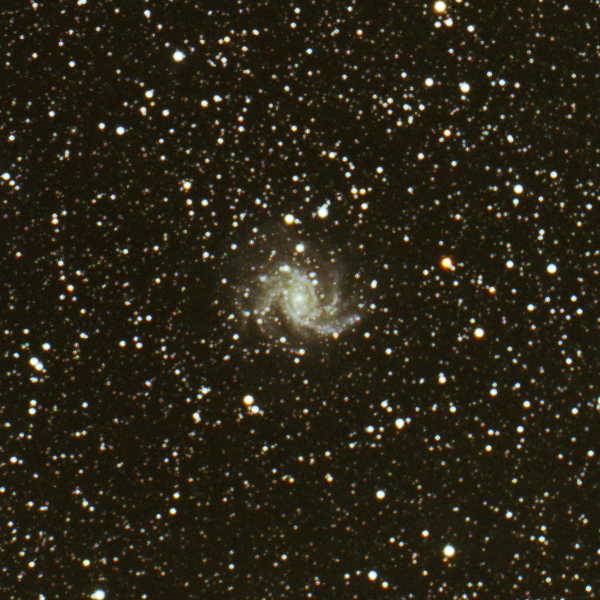
NGC 6946 (the Fireworks Galaxy) on the border between Cygnus and Cepheus.
NGC 6946 currently holds the record for the largest number of supernovae observed in a galaxy (and earns it nickname in the process): nine so far, in 1917, 1939, 1948, 1968, 1969, 1980, 2002, 2004, and 2008. Typically in a galaxy this size you'd expect to see one every fifty years or so on average, which gives you an idea just how extraordinary this galaxy is.