Showing posts with label SCUBA-2. Show all posts

Sunday, July 19, 2020

Painting the JCMT

While at home these past few months, I've been a bit constrained in my painting by a lack of painting materials (namely, I don't have a very wide array of colors with me—most of my paint is still at my desk in Swinburne, and will be there for at least the next month-and-a-half—and I also didn't have much canvas with me when the first lockdown started). However, I did have a canvas in progress which I started near the end of last year, of the James Clerk Maxwell Telescope where I used to work from 2013–2016. Thankfully, it didn't require a wide variety of colors, and I'd already blocked in about half of it back in November (based on the only in-progress picture of it I could find), though I took a few months' break from it after that. I've been working on it slowly off and on over the course of the lockdown(s), and I finally finished it last week.

“James Clerk Maxwell Telescope,” acrylic on canvas, 14×18”.

I based this off a photo taken by a college friend of mine who was a telescope operator at the JCMT for a few years, contemporaneously with me. If you're not familiar with the JCMT, it's a telescope which detects light in the sub-millimeter wavelength range, between infrared and radio waves. The dish itself sits behind the large Gore-Tex membrane in the world, which is the area in the middle of the painting with the contour lines. (The Gore-Tex is essentially invisible at sub-millimeter wavelengths, so it doesn't block the observations.)

(Incidentally, getting the contour lines to look not-wrong may have been the hardest part of the painting, as I painted them on only to realize they looked wrong at least twice. The membrane has a somewhat complicated shape, so I ended up drawing them on with pencil so I could more easily change them, and after several weeks of adjusting them they're at least approximately correct.)

Another neat fact about the JCMT is that the SCUBA-2 sub-millmeter camera (which I worked with primarily, though on the quality assurance side) is the coldest place in the known universe: the detector is kept at a working temperature of just 70 millikelvins above absolute zero. This is because the detector has to be colder than what it's observing to prevent swamping the observation with thermal noise, and sub-millimeter light comes from extremely cold gas and dust, on the order of a few to tens of kelvins.

Anyway, that's one of the things I've been working on lately. I'd like to do another painting of the other telescope I've worked at (the Yuan-Tseh Lee Array) on the last canvas I have with me, but as I only just started that this week it probably won't be done anytime soon (though it's also a much smaller canvas, so we'll see). Maybe I can start a series of “Observatories I Have Worked At.” And maybe in the future, it'll contain more than two paintings! Who knows? A hui hou!

Monday, March 14, 2016

Looking Back, Moving On

Well, in the two weeks since my last post I've been coming to terms with my coming unemployment, and doing a lot of thinking about where to take my life from here. I don't have anything definite to report yet, but I think I'm finally ready to start looking around.

I went to a seminar at Subaru last Monday that was very helpful in this regard. The seminar was on Data Visualization, by Mark SubbaRao from the Adler Planetarium in Chicago, and in the process of watching incredible visualizations of hundreds of thousands of galaxies and learning about how correct color map choice can dramatically increase the chances of a doctor noticing problems with your arteries, I came to a realization: I really enjoy data visualization.

During the talk I found myself thinking about how the times I'd had the most fun at my job working for the JAC and EAO were when I was designing systems and writing scripts to visualize data. Looking back even further, I've always loved seeing things like artists' impressions of exotic astronomical systems, and when I first discovered graphics programs like Inkscape, the GIMP, and Blender, one of the purposes I put them towards after figuring out how to use them was making my own such artist's impressions. (Some of my astronomy-related artwork on this blog can be seen here.) I'm a very visual person, and love figuring out new ways to make abstract concepts and abstruse ideas more comprehensible.

In fact, speaking of systems for visualizing data, I'm reminded that I never did introduce the project that occupied the majority of my time at work last year, the SCUBA-2 Calibration Database. This is a webpage linked from the EAO website that allows access to a database containing information on every calibration for SCUBA-2, the JCMT's powerful sub-millimeter continuum camera. You can search dates, date ranges, or pick a semester and project code to get a list of all calibrations taken on nights that project took data. You can filter by specific calibrators if you want, and when the results have been returned there are download links that will take you to the Canadian Advanced Data Centre where you can download all raw and reduced files associated with an observation.

Of course, the best part in my opinion is the option to graph the results you get. You have to enable the option, but doing so will let you graph anything from a single night's worth of observations to every single calibration ever taken with SCUBA-2. I had a lot of fun learning how to get a dynamically created image served up on command and writing the graphing script to get an interesting and useful image out. I've been adding some new features I always wanted to get around to in to my development version recently, so there will also be some new stuff released in the next two weeks.

(If you're wondering what these “Arcsec” and “Peak” FCFs you can plot are, FCF stands for Flux Calibration Factor, and they're essentially the ratio of a particular number to what that number would be if there were no pesky atmosphere getting in the way and attenuating the energy received from it. Put simply, Peak FCFs deal with the maximum brightness of an object and are very sensitive to proper focus of the telescope, while Arcsecond FCFs deal with the total energy received and thus should be more resistant to small changes in focus. Being out of focus moves the energy around in the image, but you have to be really out of focus for it to move outside the area being measured. The gray horizontal bar across the graph represents the range the FCFs should generally be in; as you can see, there are plenty of times this is not the case, and there a whole host of reasons why this is not the case ranging from dish deformation due to residual heat at the start of the night to long-term drifts in the Water Vapor Meter that estimates the transparency of the astmosphere.)

Anyway, that's how things have been going for me. I'm looking to start getting back into graphic design a bit after being introduced by a coworker to the work of a friend of his dealing with using Blender for scientific data visualization, so who knows, I might have some new projects to show here in the near future. We'll see! A hui hou!

Tuesday, June 11, 2013

Cuttting-Edge Astronomy on Mauna Kea: Visiting JCMT and UKIRT

Well, this post is a few weeks late, but I thought I'd put up some pictures from the trip I took on Memorial Day. Along with a few co-workers (current and previous), I got to take a tour of both the James Clerk Maxwell Telescope (which I work for) and the United Kingdom Infrared Telescope, both of which are currently part of the Joint Astronomy Center (although that will change in the months to come, though exactly how is not yet known).

Anyway, I'd never been inside UKIRT before this, and only once inside JCMT (as I posted about a month or two ago). That time wasn't for sightseeing, so I got to see a lot more of the telescope this time. You might remember from that post that I got a picture of the telescope from behind, like this:

The main JCMT dish, lit from beneath.
The weather that day turned out to be absolutely miserable (very cold, fine, blowing rain the entire day), dashing our hopes to hike to lake Waiau and the summit, so we instead took a nice leisurely tour of both telescopes. The last time I was there I didn't climb up high enough to see into the dish, but I was able to do so this time, and get a nice picture:

The JCMT primary dish.

Here's another picture at a slightly different angle, showing the secondary mirror support structure and the grand arch of the overhanging Gore-Tex covering:


If these pictures disorient you as they do me, it may help to remember that the telescope was parked at this time, and the dish is pointing straight up. The metal panels you see in the background are part of the wall. The Gore-Tex is arching over the dish, and provides it protection during operation. (Yes, it's left in place. It's nearly transparent at sub-millimeter wavelengths, so the telescope basically looks right through it.)

Speaking of the Gore-Tex membrane, part of our tour took us near where its upper edge rested (just off to the right in the photo above). It was nicely backlit, and I was inspired to have a friend take some pictures of me with it:

Can't talk now, I'm posing!
Deep in thought.

A different angle that shows more of the upper edge of the membrane.
After getting that dramatic posing out of my system, we took a walk outside around the upper catwalk, just below the roof. This turned out to be a much worse idea than it seemed, because the door we came out from was mostly sheltered from the wind; as we curved our way along the narrow metal catwalk, jutting out from the building a couple stories above the ground and completely exposed to the elements, we faced more into the wind at every turn which made it nearly impossible to actually see or appreciate anything due to the cold mist being blown in our eyes. It was still a neat experience, and I hope to be able to do it again sometime when I can properly appreciate it.

Anyway, after some more looking around we headed up from Sub-millimeter Valley to the ridge where UKIRT is located. The contrast between the two buildings is quite striking, and very interesting (I wish it had been clear enough to get pictures of them from the outside). You see, JCMT is built such that the entire upper portion is one with the telescope, and it all rotates together (yes, the operator room too). This gives it (the building, at any rate) a feeling of lightness, or even unsubstantiability, because except for the first floor everything is built to be light and able to move. UKIRT, however, is built more traditionally, with the building firmly anchored and only the telescope itself able to move, which gives it (again, the building) a feeling of rock-solid permanence and durability. Anyway, here's a picture of the telescope itself:


The secondary mirror is on the left, and the long black tube is where the light goes after it reflects off the secondary down through the hole in the center of the primary. The orange-colored part is the harness that controls it motion east and west across the sky. Here's a view from another angle, with the secondary visible on the right:


And from up above, looking down towards the main mirror, which is covered up by the dust covers:
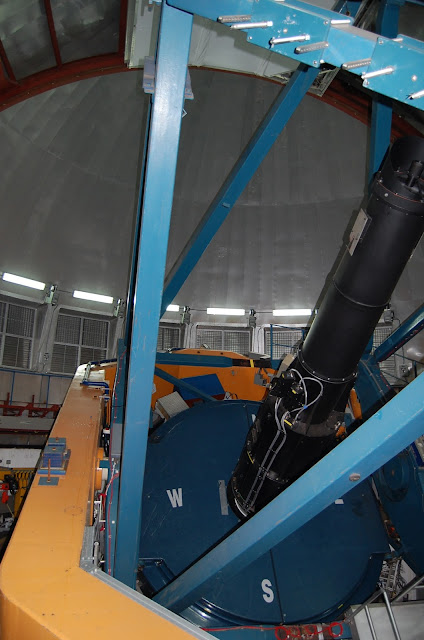
The “W” and “S” stand for west and south; this picture faces north.
Now, I titled this post “Cutting-Edge Astronomy” but I haven't really talked about it. Since it's getting late I'll keep this short, but basically, neither of these telescopes “see” in optical light, the sole domain of telescopes for over three hundred years (UKIRT is infrared, JCMT is sub-millimeter). Being able to take pictures of objects in infrared and the longer sub-millimeter wavelengths is something that probably couldn't have been even conceived of as recently as a hundred years ago, and only within the last fifty has it become possible at all. It is only within that time that we have been able to see the universe in more than the infinitesimal fraction of the electromagnetic spectrum that out eyes are sensitive too. If you consider all the information that visible light brings to us about the universe, there are countless times that amount of information out there in other wavelengths just waiting to be discovered by us.

And it's not just that JCMT and UKIRT are pioneering new regimes. There are, after all, two other sub-millimeter telescopes, one dedicated infrared, and at least two more telescopes capable of infrared observing on Mauna Kea. JCMT and UKIRT also have some of the most advanced, state-of-the-art detectors on them, such as SCUBA-2 that I work with, which is the world's best sub-millimeter “camera” currently. (I'm not as familiar with UKIRT, but I know it also has some amazing detectors. In fact, last year, UKIRT was the world's number one most productive telescope in terms of papers published.)

Anyway, it's getting late as I said so I'm going to wrap this post up here. A hui hou!

Saturday, April 27, 2013

Adventures at the James Clerk Maxwell Telescope

Two weeks ago I was privileged to be invited up to the summit of Mauna Kea to the James Clerk Maxwell Telescope as part of my job. Well, I say that, but really the only reason I was there was as a "warm body" – safety regulations require a minimum of two people together up at the summit at all times, in case of medical emergency, so my specific job had nothing to do with it.

Which I don't mind at all! It meant I got to go up with no real responsibilities besides crisis management in the event that something came up, which it didn't. I was therefore free to get a tour of the telescope that I officially work for, and wander around to get some pictures.

For instance, this black machine here is the water vapor meter, whose output I work with a lot. It measures the amount of water vapor in the air, which directly (and dramatically) affects the opacity of the atmosphere in the sub-millimeter wavelengths we observe in. It's been having some issues, so it was actually replaced with a different (silver) one just last week.


This big blue machine down here is SCUBA-2, the Sub-millimeter Common User Bolometer Array (2). This is another instrument whose output I work with on a regular basis. It's basically the best sub-millimeter camera in the world today.


It also happens to be the coldest place in the known universe. You think outer space is cold? Out far away from hot stars and galaxies, in the inter-galactic voids of space, the temperature can drop to about 2.7 kelvins, the temperature of the cosmic microwave background radiation, which is about 2.7 degrees Celsius above absolute zero (which is -273.15 °C or -459.67 °F).

That's cold alright, but it's still quite a bit hotter than the temperature of the SCUBA-2 imaging arrays, which are kept a mere one-tenth of a kelvin above absolute zero.

(The reason for such cold temperatures is that, in order to get a reasonably high signal-to-noise ratio from the electronic imaging arrays used in astronomy and digital cameras, the imaging array itself has to be cold enough that it's not emitting too much electromagnetic radiation in the portion of the spectrum it's trying to take a picture of. Consumer digital cameras work because they aren't glowing at visible wavelengths. Another way to think about it is that trying to take images in the sub-millimeter portion of the spectrum [which comes from objects that are themselves quite cold already] is like trying to take pictures with a digital camera that is on fire. The amount of light given off by the camera at that point is so much that you won't catch much light coming from what you want to photograph by comparison.)

Anyway, this is a panorama I took from behind the telescope looking up at the back of the dish. It's slightly misleading; it looks like it's looking at the sky, but that's actually the world's largest piece of Goretex (no joke). It also looks like it has a square opening, but that's a result of the image stretch due to the panorama. It's actually more like a rectangular slice in the side of a cylinder. (Unfortunately I forgot to take a picture of it from the outside.)


Finally, here's a high dynamic range image of the back of the dish. I had to take this one lying on the floor to get it all in, hence the slightly off-horizontal angle.


For those who don't know what the JCMT looks like from the outside, here's a picture of it from back in 2010 while I was up on a summit tour. It's the white cylinder on the middle-left. The opening is on the left side of the cylinder in this picture (the whole building rotates to point the telescope), but it wasn't actually open at the time.