Showing posts with label birds. Show all posts

Wednesday, August 12, 2026

Hummingbirds, sea lions, and honey bees, oh my!

I spent the final week of July in California visiting family where I had the opportunity to take a number of pictures of animals I don't see very often. Hummingbirds were active about the feeder, we visited Pier 39 in San Francisco and saw the sea lions there, and there were a lot of thirsty honey bees around in the July heat.


It's difficult to get a good shot of a hummingbird in flight with how fast they move, so my only chance was when they came up to the feeder to eat. I tried on two different days (seen here) and I'm impressed with how clear the wings came out in the first photo considering the blur they were in person. I was also impressed by how close they let me stand to get these photos. Occasionally one would fly over even closer, at about arm's reach, to hover at head-height and regard me quizzically for a few seconds, a delightful (and ever-so-slightly unnerving) experience.


We were fortunate while visiting Pier 39 that there were a number of sea lions there, since it varies. Mostly they were napping in the sun, though there were generally always one or two swimming about, jumping on or off the floating rafts, and occasionally getting into disputes.


And sometime after my last visit, my parents let a commercial beekeeper park some hives on their property. (It's a great location with all the eucalyptus and almond trees around.) I don't think I've ever really mentioned it on this blog, since it happened before I started writing it, but I used to have bees for a few years before moving out to Hawaii. I enjoyed it, though I'm a poor bee-haver; I picked a bad time to start between Varroa mites and Colony Collapse Disorder (and it hasn't exactly gotten better since then), and my hives didn't manage to survive. I figured it best left to the past when I moved, but I've always retained a sort spot for honey bees. When some fell into the pool I was filling up for them I rescued them with a leaf and let them chill on my hand while I did some macro photography. It's always funny to me how matter-of-factly they go about cleaning and drying themselves before taking to the air again.

And that's it for this post. There are plenty of cool critters here in Hawaii (including honey bees), but it's nice to see some that I haven't in a while. A hui hou!

Tuesday, September 30, 2025

Visiting Hakalau Natural Area Reserve

A few weeks ago on September 13 I had the opportunity to attend the annual Find Your Wild open day high on the slopes of Mauna Kea. This event happens only once a year and is limited to 500 people, but it allows members of the public to access the Hakalau Forest National Wildlife Refuge (part of the Natural Area Reserve System, or NARS) and see the rare plants and birds found there. Since we work in a fellow Natural Area Reserve and know many of the people working at Hakalau, most of us from work went as a group.

There were a variety of events going on over the course of the day, with the mains ones being a several-mile-round-trip hike through the woodland in the process of being restored, a tour of the greenhouse where plants are propagated (though we missed out on that), and lots of booths from various conservation organization around the island and state. Judging by the photography equipment a lot of people were there to see the rare native birds, such as the ʻiʻiwi, ʻapapane, ʻakepa, ʻakiapōlāʻau, and ʻelepaio (and others I'm forgetting). We see those birds occasionally in the Puʻu Makaʻala Natural Area Reserve where we work, but on the older slopes of Mauna Kea where the forest has had more time to turn lava rock into nutritious soil the sheer number of birds we saw was incredible. These birds no longer exist at lower elevations (where most of the island's population lives) due to mosquitoes and the deadly avian malaria they carry, so few people get to see or hear them without taking trips to high-elevation woodlands.

Part of the hike. Other than a few trees the entire area was clear-cut just a few decades a go.

Speaking of plants, we also got to see some rare varieties of those. Some of them appear at Puʻu Makaʻala, but again there were some Mauna Kea-specific species which I hadn't seen before. We got to hear from a conservationist there about one particular plant in the mint family, Phyllostegia brevidans, which was first described in 1862 and then disappeared from the record and was thought extinct for around a hundred and fifty years. Sometime earlier this century a single specimen was found by an exploring conservationist. He took some samples, which took six years to be identified from leaf samples in the Bishop Museum collection, after which he was able to return to the same individual plant to try to collect seeds. The plant was half-dead, with a single bunch of moldy fruit, but the seeds he got (remarkably) sprouted, and with some care and attention (and an ungulate-free enclosure to grow in) the plants were returned to the wild and many individuals are now thriving.

However! P. brevidans was previously pollinated by the nectivorous ʻiʻiwi, whose long, curved bills perfectly fit the plant's long, curved flowers. But its numbers had dropped so low for so long that ʻiʻiwi simply passed it by when it was replanted; they likely hadn't seen any in generations, and had completely lost the part of their cultural knowledge that told them it was edible. Thankfully, after some years they eventually figured it out again, and as of a few years ago are once again feeding from (and pollinating) their long-lost symbiotic flora. I can't tell it nearly as well as I heard it, but it was a truly inspiring success story of conservation.

I couldn't get a good photo of the several ʻiʻiwi I saw, so here's a gorgeous 3D-printed one! (Life-size.)

Overall it was a really interesting experience, and was a great way to see some rare and endangered birds and plants. It's a long drive to get there along Mana Road, but it offers some great views that I hadn't seen before. We'll see how often I get to go again (as it requires signing up before slots fill up), but I enjoyed the experience a lot. A hui hou!

Saturday, July 26, 2025

Zoo, part two

I mentioned back in May how I went to the Panaʻewa Rainforest Zoo just south of Hilo for the first time on my birthday, and how that happened to be a rainy day. While I did enjoy my visit and the lack of crowds caused by the rain, I wanted to go back at some point when it wasn't raining to get more photos of the animals. I finally went about a month later, in June, which is about a month ago from when I'm writing this post as it's been pretty busy for me in the intervening weeks.

I found myself drawn back to several of the same animals, as the change in weather had some clear effects on their behavior or look. The red iguana above already looked good in the rain, but positively glows in the sunlight with an iridescent sheen. (And also appears to be enjoying itself from this angle.)

Similarly, I once again ended photographing the bumblebee poison dart frogs, which were much more active this time. Whereas before they were pretty much motionless, this time I saw several climbing or jumping around the enclosure. I think they were being fed, as this little group kept bobbing their heads forward and darting their tongues towards the mesh.

I did end up with a few photos that weren't just repeats, such as this one of the alligator in its enclosure.

I also got a nice shot of this golden crowned crane, native to Africa and the national bird of Uganda. I had to get in position with my phone then make a little noise to get it to look at me, but it worked out!

Overall it was a fun time. It was interesting to see how the animals' behaviors changed (or didn't) with the weather, and the lighting let me appreciate various colors better. There were a lot more people there with the sunny weather, but not enough to feel too crowded.

This is a little unfortunately timed, in that the zoo will begin charging a small admission fee in August, so this weekend is one of the last times to visit for free. I can see the reasoning behind it, and there's a relatively cheap annual pass so it shouldn't be too hard for people to continue going, but it's still a bummer. We'll see how it goes, I suppose, perhaps the revenue will allow for expansion and renovation (there are a few places noticeably empty at the moment which could have animals in them). A hui hou!

Saturday, May 17, 2025

A rainy birthday zoo visit

Just south of Hilo lies the Panaʻewa Rainforest Zoo & Gardens. It's the only zoo in the United States located in a rainforest, it's free to enter, and in over a dozen years of living in Hilo I…have never visited. Recently there have been discussions about needing to start requiring an entrance fee, and now that I pass by it several times a week for my new job I decided to fix that oversight and visit for my birthday.

Despite the fact that it was pouring down rain today. Actually, even in spite of the rain I still had a fun time. I went with my friend Josh who had visited multiple times before but hadn't been in over a decade, and he was able to point out some of the changes and improvements. I managed to take some surprisingly good photos despite the rain, so have a few of them:

A bumblebee poison dart frog in its enclosure.

It's not a very large zoo – it took us perhaps a bit under two hours to see everything – but I found that rather nice; I've visited much larger zoos that took all day to see everything, and it does get a little exhausting after a while. This was a refreshingly ‘bite-sized’ zoo.

A red iguana chilling in the rain. Despite appearances, it was awake and watching me.

And it's not like it lacked for interesting animals, either. I'm only showing the better photos I managed to get, but it's got a neat selection of reptiles and amphibians, including several species of poison dart frogs and various chelonians. There are four native Hawaiian birds, the pueo (owl), ʻio (hawk), ʻalalā (crow) and nēnē (goose), multiple primates and a number of brightly-colored tropical birds, some peafowl who roam the park, tigers, emus, and even some binturongs and an alligator. 

A pueo, the native Hawaiian owl.

All in all it was a fun excursion, and with how close and easy to visit it is I'm a bit embarrassed I never visited sooner. I'm actually quite impressed with how well some of the photos I got with my Pixel 9 Pro came out despite the rain (and me juggling an umbrella in one hand), and I'm interested in coming back on a clearer day to spend some more time and see what else I can get.

A couple of emus in the rain. I knew better than to get my phone (and fingers) up close to them…

And altogether that made for a fun and memorable 36th birthday. My birthday hasn't been on a weekend since 2020, and since I'm usually saving vacation time for trips it was nice to have a relaxing day off to myself this year. (Especially after spending a rather chillier and less pleasant rainy day in the field earlier this week.) A hui hou!

Sunday, May 11, 2025

A new job with NEON

It's been four weeks since I started my new job with NEON, the National Ecological Observatory Network (managed by Battelle), long enough for me to start settling in and having a chance to catch my breath. There's been a lot to learn. The past few weeks have been a blur of trainings on various data-collection protocols, learning to identifying dozens of plant species, and a procession of trips to various pre-established plots in the rainforest for data collection. (Plus a little bit of lab work.)

Being up at altitude near dawn for mosquito collection is rough, but the dewy grass is incredible.

NEON's mission is to provide a decades-long collection of ecological data from a network of locations across the US, so the various protocols are designed to get that data in a standardized format from diverse locations. There are twenty ‘domains’ across the US (of which we are Domain 20), which may have multiple sites where data is collected (though there's only one site in Hawaii). This data is open-source and available for anyone to use, a fact which fits my personal leanings very nicely. (Having an ORCiD already set up from my time in astronomy proved useful as we use them for attaching credit to data collection, so I may be able see data I've collected used and attributed in future papers.)

Some Astelia menziesiana (an endemic lilly) on a log.

Collecting such data isn't necessarily easy, though! In addition to the simple fact of the collections sites being located around 5,000–6,000 ft (~1,500–1,800 m) up the side of Mauna Loa, the nature of many protocols involves strict time sampling restrictions, which might require spending the day working in rain. (We're supposed to evacuate in thunderstorms, but those are rare near Hilo.) Even without rain spending 6+ hours in the field is no joke; some plots may have a lot of hard lava rock underfoot, while others (especially with feral pigs present) may be slippery mudholes. I've been amazed by the number of fallen logs in some of the older sections of the forest, which combined with the undergrowth can make getting around something of a challenge. We work four 10-hour days, and while the three-day weekend is nice there's no denying that working that long can be grueling, especially on field days.

Me recording data in a light drizzle.

Still, it's not without its upsides. While it can be uncomfortably hot, cold, or wet at times, at others it can be fairly pleasant. The work itself is interesting; while I had some experience identifying plants before, I'm learning all kinds of new, native plant species, and finding them for the plant diversity protocol is rather like a treasure hunt. Depending on the plot, we might find trees some 500 years old, or be exploring relatively younger lava flows from Mauna Loa perhaps a mere 250 years old. There's little human presence in the Natural Area Reserve where we work (although it's technically open for hiking), and the still-intact native forests house native birds which are rare elsewhere.

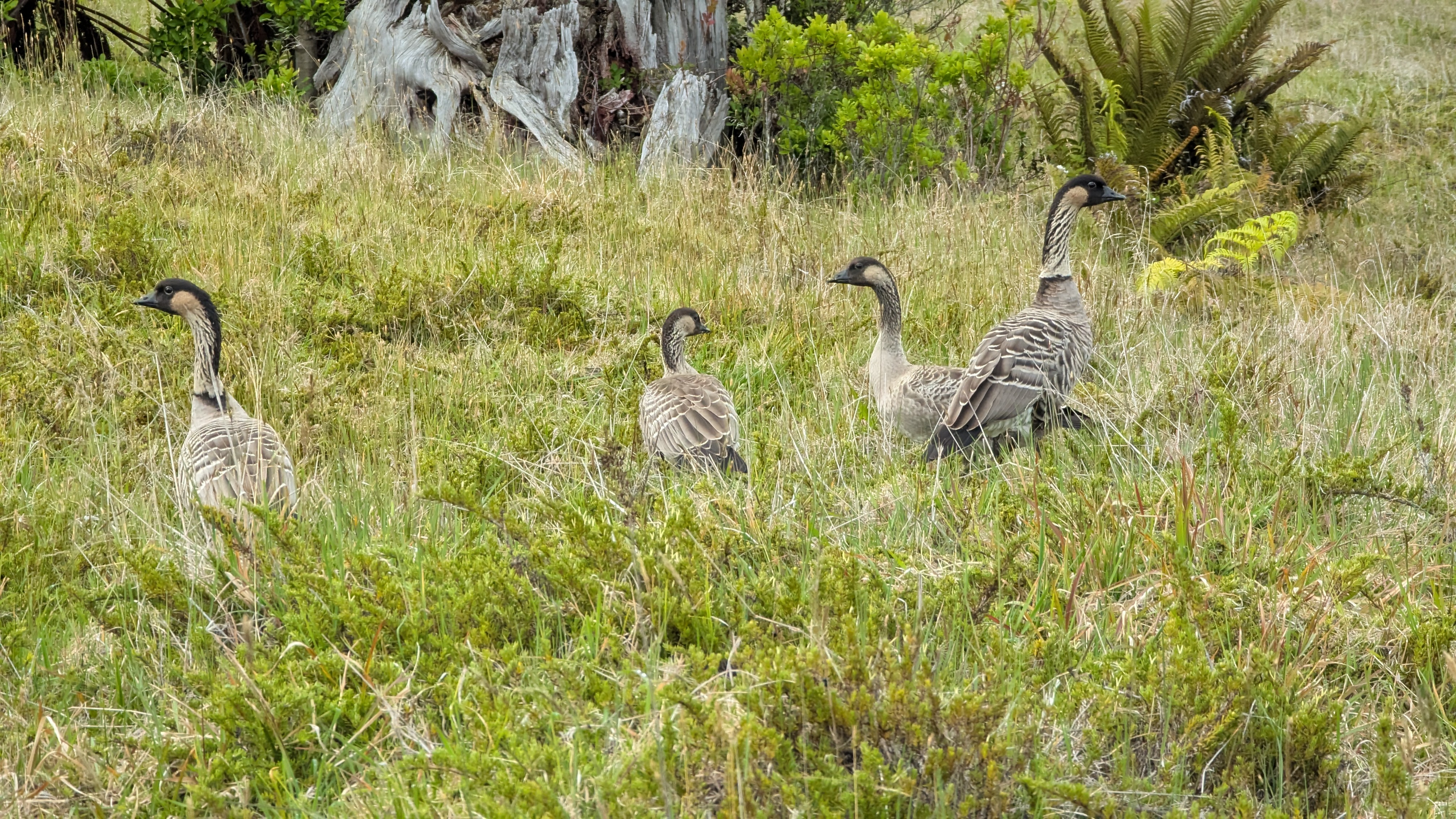
We often see nēnē at the site; I think I saw more my first day than in all my time here previously.

I've also found the labwork, though a far cry from anything I've done before, to be interesting. So far I've sorted leaf-litter from our leaf-litter traps, seeing how the distribution of species varies from plot to plot, and identified beetles from our beetle traps. The particular beetles we're interested in are called carabids, and while most species on the mainland are ground beetles, our native Hawaiian species are arboreal (though we still manage to catch them in our ground traps, somehow). There have actually been two entirely new species found in our traps in years past, which is certainly an exciting prospect.

Leaf litter sorting, into various piles for things like leaves, flower, seeds, twigs, etc.

After four weeks I'm not sure if this is something I want to continue doing indefinitely, but I've got a wonderful group of motivated, clever, and fun coworkers to work with and there are certainly fascinating aspects to the project and sights I wouldn't see otherwise. Perhaps I'll feel differently after a few more months. We'll see! A hui hou!

Friday, December 22, 2023

An Arizona trip highlights video

I'm in the middle of a two-week vacation, which has provided me some much-needed time to rest and recuperate. I can tell I really needed this time off; normally, after two days of rest I've recovered my creative spark, but this time it's taken nearly five days to start to feel like doing much of anything. I say this by way of explanation for why updates have been so sparse around here, and hopefully I'll be able to get around to a few of the many projects I've got tucked away in my brain in the remainder of the year.

For this post, have a little video with some drone footage from my trip to Arizona. I took a motley collection of clips from a variety of locations, and have interwoven them in what seemed like an interesting fashion.

One location that shows up a few times is Cochise Stronghold (named for a famous Apache chieftain who held out and was eventually buried in the area). It's a large rock formation in the Dragoon Mountains, with a hiking path going up to it.

Cochise Stronghold (taken from the air with my Mini 3 Pro).

Another thing which shows up in the video a few times is the migration stop (or overwintering site, I'm not sure which) for sandhill cranes. As seen, there were a lot of them there; they're quite common and not endangered (estimated population in North America in the hundreds of thousands), and didn't seem to be all that bothered by my drone beyond a little unease, so I felt comfortable flying fairly close. It was incredible seeing what must've been thousands together like that; we don't really see anything like that here in Hawaii (or maybe I'm just not looking in the right places!).

A tiny fraction of the sandhill cranes present. They're fairly large birds, think “flamingo-sized.”

Also appearing a few times is the town of Pearce where I stayed. It's intertwined with a golf course built around half a century ago, which ultimately didn't prove successful. (I can only imagine the water bill to keep it green during the summer!) The holes meandered about through the town, and traces of them can still be seen all over the place, including the water hazard now being used as a reservoir for the vineyard seen at about 1:20 in the video.

Anyway, that's all for this post. I still have a few locations where I took enough photos to get another post or two out, but I wanted to get this video out to show off some of the bits and bobs of footage I got. A hui hou!

Sunday, March 21, 2021

Birds of Melbourne: rainbow lorikeets

I've finally gotten around to editing some footage I shot in January of some rainbow lorikeets feeding. If you thought the crimson rosellas were gorgeous, take a look at these beauties! You might even be familiar with them already from advertising; I feel like they're the go-to birds to display whenever TV makers want to tout their latest screens. They do make a fantastic test of color ability with those rainbow hues, to be fair!

I see these around once or twice a week on average, so they're relatively common. As you can hear in the video, they're quite vocal little parrots, almost constantly chirruping and squawking quietly. But of course, what you're going to mainly notice is that jaw-dropping plumage, going from deep blue or purple, to lighter blue, to bright green, then through yellow, orange, and even a deep reddish-orange hue. (Fun fact: I made the gradient in the words “Rainbow lorikeets” in the video thumbnail by sampling from different parts of the bird in the image, with some slight tweaks.)

I think that's all the footage of birds feeding I've recorded so far; I really need to get around to trying out that motion-sensing setup idea I had now that GoPro's come out with the GoPro Labs firmware for the Hero 9, which allows you to, say, only record while a (user-settable) level of motion is detected. I've tried it out once or twice but still need to play with it to find a good level of motion detection for feeding birds (and of course, have some interesting birds come by while I'm filming!). We'll have to see how that goes in the future. A hui hou!

Sunday, February 7, 2021

Birds of Melbourne: Australian magpie


I'm back with another bird-feeding video, this time starring an inquisitive Australian magpie. Unlike their Eurasian counterparts, which are corvids (birds like crows and ravens), Australian magpies are passerine birds (perching birds, or songbirds). They also have a reputation as one of the most feared birds in Australia, due to a tiny fraction getting territorial around mating season and dive-bombing people traveling past their nests. (Especially bikers, for some reason; if you see an Australian biker with zip-ties or pipe-cleaners poking out of their helmet, that's an anti-magpie strategy.)

I've never had a magpie swoop me (just noisy miners), but they're undoubtedly quite confident birds that will often betray no concern as you walk by mere feet away. I've seen them come over to almost within arm's reach when I've offered food. They've also got some amazing vocalizations; my favorite (and their most famous) is a sort of warbling call with some fascinating harmonics, though apparently they can also imitate dozens of other bird species and even natural sounds or human speech!

For the video below, I found a magpie outside and put out a cluster of seeds for it, then set up my camera a few feet away on a short tripod to get a ground-level view. (Magpies spend quite a lot of time walking around on the ground looking for food.) I took a seat just behind the camera, so I was quite surprised when, after about a minutes of pecking at the seeds, the magpie came over and starting checking out the camera! It was pretty neat, and I got some great footage out of it.

Despite their fearsome reputation and visage, magpies can be surprisingly playful. I've seen one rolling over on its back in the grass (and heard of such behavior from other people), and apparently they've been seen doing things like having one magpie hang on to a hanging towel upside down, and get swung back and forth by other individuals. Pretty fun-loving birds, all things considered! A hui hou!

Edit (2/16/21): I've just come across the following video of Australian magpies playing (from the YouTube channel "The Magpie Whisperer"), and had to share—it's really funny to watch them doing summersaults and just clearly having a grand old time. You can also hear some of their wonderful warbling song.

And here's another clip of some juvenile magpies hanging upside from towels on the line. Such funny birds!


Saturday, January 16, 2021

Birds of Melbourne: Crimson Rosella

Now that I've got a GoPro I'm constantly on the lookout for new and different things to film, and recently had the idea of trying to catch some of the neat birds that are present this far out in the suburbs of Melbourne. I was surprised at just how many species of parrots are found in Australia when I first moved here—I can think of at least four widely different ones I see around here on timescales from every few days to every few weeks. Anyway, I started putting out some birdseed, and last week I got lucky when a crimson rosella showed up to eat just a few minutes after I set up my camera. Crimson rosellas are native to the southern and eastern parts of Australia, and have a striking red-and-blue-and-black coloration. You can see (and hear) a few of them in action in the video below:

I think in future videos I'll try to stick to a more consistent field of view and resolution; I was experimenting changing between different ones, which made the final video a bit disjointed. I'm definitely still learning as I go, but it's great to be able to capture such high-quality video so easily. I've been a bit doubtful of the usefulness of shooting in 4k resolution when I only have a 1080p monitor and it chews up so much memory space, but I tried shooting some of the central segments of the video in 4k and even when downscaled to 1080p resolution it retains so much more detail. I'll definitely be experimenting more with it in future, maybe even start releasing videos in 4k? We'll see! I can't exactly promise more videos like this because it depends on the birds and luck, but I'd really like to do more, showing off more of the cool bird species around here. A hui hou!

Edit (1/26/21): There's a bird which I identified as a “myna” which flies by in the video, and I have recently discovered to my chagrin that I have misidentified it: it's actually a noisy miner. There are common mynas in Australia (an introduced pest), and they look fairly similar at first glance, but I've seen enough noisy miners around where I live to tell them apart now.

Saturday, June 22, 2019

Painting Phosphorescent Penguins

Two weeks ago I finished a painting for a fellow student's birthday, and as it was the first time I've made use of phosphorescent paint and it came out pretty well I've been meaning to show it off. The intended recipient really likes penguins, so I decided to paint a frigid Antarctic scene with some penguins in the foreground and the Aurora Australis in the night sky.

Mouse over to see how it looks in the dark! (“Antarctic Night,” acrylic on canvas, 8”×10”)
I'm quite happy with how the penguins came out, even as small as they are. I was surprised, actually, at how easy it turned out to be to paint them, and I'm now thinking about doing a larger animal painting (and I may even have an idea of what…).

I'm also pretty happy with how the glow-in-the-dark effects came out, though I don't feel the aurorae look particularly great. To be fair, I've never seen an aurora myself, and it was my first attempt at painting them—I was afraid they'd be too faint, so I really laid on both the colored and phosphorescent paint.

Speaking of which, I realize that I've never mentioned my phosphorescent paint here on the blog before. It's called “Lit,” and is from a specialist paint maker in the U.K. that I discovered back in January. It's billed as “the most powerful light emitting pigment on the planet,” and I can certainly believe it. In fact, it's so bright that more than one person has asked me if it's radioactive! (It's not; it's just the product of a careful search for “the most powerful light-emitting pigments and rare earth activators.”)

Here's the glowing dark version again in case you're reading this on something that can't do a mouse-over.
The mix of pigments is such that it both glows brightly immediately, but also easily continues glowing at moderate brightness for an entire night. And unlike the typical glow-in-the-dark materials that's we've all seen, this particular paint is so bright that you can start to see the effect at just slightly dim lighting conditions rather than it needing to be completely dark. (And when it is completely dark, the brilliance is remarkable.)

Interestingly, you can't get this as premixed paint, only as a pigment that must be mixed with a little water and some acrylic base to make paint; even in a sealed container the pigment will react with the acrylic and harden. I've got some ideas for how to use this phosphorescent paint in the future, but it'll probably be a while till any of them materialize. (If you have any ideas for things I could paint, do let me know!). Yet again, I find the possibilities of modern paint to be pretty incredible. A hui hou!

Sunday, February 17, 2019

Healesville Sanctuary Trip the Second

Well, it's been nearly a month since my family departed back to California and things have mostly settled back into a familiar routine. I was a bit trepidatious about getting back to work on my research after a month away, but it turned out to be surprisingly easy to pick up where I'd left off; I think the re-writing of my code I've been doing after the SciCoder workshop in November has paid off with more easily-understandable and maintainable code. Our weekly art workshops at Swinburne have resumed and I've gotten back into painting regularly again; I've picked up a bunch of new paint and painting supplies and I've got several exciting projects in progress and ideas for several more, but I'm going to wait till they're finished before showing them off here so that'll be a post for another time!

For today, though, I have a few pictures from the trip we took to Healesville Sanctuary:


Here's one of an endangered Regent Parrot eating out of a dish I'm holding in one of the several aviaries at the sanctuary.


And here's a Red-Tailed Black Cockatoo!


This is an echidna, something I don't remember seeing in my trip to the sanctuary last year. This one was pretty funny, as for the entire time we watched it never stopped waddling around its enclosure (for what reason we were unable to determine).


And finally, me with some native Australian fauna I found in the gift store on the way out.

I've got a lot more pictures to go through so there are more coming, and hopefully I'll have the next ones up with less of a wait in between. A hui hou!

Sunday, June 3, 2018

A Trip to Healesville Sanctuary

Last month on the 5th of May I accepted an offer by a recently-graduated student at Swinburne for a lift out to the Healesville Sanctuary, a zoo/conservatory about an hour out of Melbourne in the Yarra Valley. Healesville Sanctuary focuses on native Australian fauna and has a strong captive breeding program, being the first place in the world to successfully breed platypuses in captivity in 1943.

I brought my camera with me, but about an hour after we arrived we attended a fantastic bird show where I decided to try out the new super-slow motion feature on the camera of my new phone. And after getting a few video clips of birds in slow motion, I thought why not get some more clips of various animals and make a video out of it? So I did.


I didn't remember or manage to get video clips of all the animals I wanted to, so there are a few still photos in there, but I'm pretty happy with how it came out. I'm especially pleased with that two-second side-on clip of a platypus swimming by; none of my attempts to photograph the platypuses worked out, but somehow the videos did. A hui hou!

A picture that didn't make it into the video but I thought was fun.

Monday, April 16, 2018

April Astrobite, a Supercomputer Tour, and Other News!

So this is a few days late, but I wrote another post for Astrobites this month back on the 12th. It covers a really cool paper about the largest flare yet observed from Proxima Centauri, the closest star to the Sun. Proxima Centauri is a red dwarf, the most common type of star in the universe, but also the faintest; it emits a mere 0.17% of the light the Sun does, and despite being the closest star at just over 4 light-years away normally sits at about magnitude 11.13, or over a hundred times fainter than can be seen with the naked eye. However, during the flare reported in the paper, the authors calculate that it would have briefly reached up to magnitude 6.8, making it just barely visible to the naked eye from a very dark site for a few minutes! Pretty nifty! I even got an email from the lead author on the paper saying he'd enjoyed my summary of it, so that was nice.


In other news, I was fortunate enough to tag along on a tour of Swinburne's new supercomputer. (We are the “College of Astrophysics and Supercomputing,” after all!) It's called OzStar and replaces an older supercomputer called G2, though that one will still be in operation for most of the rest of the year to give people time to switch over.

OzStar, CAS's new supercomputer. I don't actually have reason to use it myself, sadly.


Going through all my photos in my panorama series, I've been struck by just how many photos of random birds I take. So have another one of some really colorful parrots I found in a eucalyptus tree near where I live one day while walking!

Parrots! Really colorful ones, too. These pictures are all from my new S9+, by the way.


And finally, one thing I haven't been able to find here in Australia is my favorite salad dressing, Hidden Valley Ranch. You can get Ranch dressing here, but there's usually only a single kind on sale. One of my friends from church was in the US for a few weeks as part of a school trip and very kindly brought me back the ambrosia below:

Just can't beat the original.


I also gave my first public Astrotour at Swinburne last week! We have a 3D theater that is used primarily for public outreach with grad students and faculty who volunteer giving talks to both school groups and the general public. I signed up last year, and gave my first talk to a small public audience last Tuesday. I felt rather rusty and disjointed as it's been so long since I gave a public talk about astronomy, but all that practice at the VIS paid off and it seems to have gone well. I've got another scheduled for the 30th of April, though I think this one is a school group, so that'll probably be a very different experience.

And I think that's all so far for this surprisingly busy month. Oh yes, last week I finally managed to write some code that collated some information on atomic transition lines that we've been trying to get together for a few months now, and this week we sent them off to some collaborators to do some calculations for us. So that's a huge weight off my chest. A hui hou!

Sunday, November 19, 2017

An Australian Mountain Adventure

This Saturday I was invited on a sight-seeing trip to the Dandenongs (a mountain range just to the east of Melbourne) by a family from the church I've been attending, an opportunity I gladly jumped at.

Not the greatest picture as it was taken through the window of the car, but it gets the message across.
We stopped at a few places along the way up the delightfully winding road up the mountains, including a small town with a candy store (sorry, a “lollies shop”) where I picked up a small collection of sweets to try (purely in the spirit of sampling the local culture, of course!). Another place where we stopped for afternoon tea (read: snacks) had a large flock of cockatoos hanging around, plus a few other native birds.

These birds were quite used to being fed, and not shy about hanging around in hopes of food.

…to the point of happily jumping up on the picnic table in front of me!
It was really cool and a bit strange seeing flocks of birds flitting betwixt and sitting in the eucalyptus trees, as we didn't really have many birds that did that back in California, the only ones being the vultures that liked to nest in one particular large dead tree (and didn't do a lot of flitting among the branches, for obvious reasons).

This crimson rosella was perfectly fine walking underneath my seat, making it a little hard to photograph!
In fact, the cockatoos were comfortable enough with people to jump up your shoulder in search of food!


After our tea-time adventure, we hiked to Sherbrooke Falls in the Sherbrooke Forest National Park. On the whole, it reminded me of hiking amongst the redwoods back in California, except with eucalyptus trees instead. And what eucalyptus trees they were! I'd known that certain species of eucalyptus trees are among the tallest trees in the world (behind only redwoods), and having grown up among eucalyptus trees in California I thought I was familiar with their heights, but these trees were something else entirely. It's hard to guess of course, but I felt like many of the trees I saw had to have been at least twice as tall as the tallest eucalyptus trees I'd know previously, again underscoring the similarity to hiking in the redwood forests.

It's hard to tell and I could't get it all in one shot, but this is a tall tree.
The hike to the waterfall was quite pleasant, but the return journey was an adventure. It was a nice day when we set out, but as we started back the sky became cloudy and overcast. Soon we could hear thunder rumbling in the distance, then the tops of the trees were buffeted by an increasingly strong wind. By the time we'd gotten back to the carpark the first few large drops were falling, only for us to realize that we'd returned to the wrong carpark, having taken a wrong turn at one of the several branches in the trail on the way back.

As we regrouped to the map at the trail head and figured out where we were, the rain started coming down in earnest, followed soon after by hail! Luckily there were some other people leaving from the carpark due to the rain so our driver was able to get a ride back to the car and come back to pick us up where we were huddled beneath the increasingly-inadequate shelter of the tiny structure protecting the map as rain and hail pelted the ground around.

Thankfully we made it back through the hail and storm all right (though it was coming down fast enough to have significant water on the road in places), but it certainly made for quite the adventure! A hui hou!

Saturday, October 14, 2017

Life in Australia

It's been just over two weeks since I arrived in Australia, and great news: I got my computer through customs and delivered this week! Yesterday (Saturday) I was able to go pick up a few things necessary to get it running again (a monitor, since I didn't bring one, and a Wi-Fi PCI-E card since I can't connect directly to the router here), and after some two hours of carefully replacing all the parts I'd removed for transport, replacing the thermal paste between the CPU and water cooler, and tentatively starting it up…it didn't work. But then it turned out I merely hadn't seated the RAM all the way back in when replacing it, and the second time it booted right up! (I vaguely remember the same thing happening the first time I built it, as it's possible to get the RAM in and have it feel solid but not actually be in all the way.)

So hooray! My computer is working again, and I can use it to write this blog post, which is a lot easier than trying to write it on my phone like the last one!

So, uh, Australia…

Well…I recognize some of these brands.
It's interesting being here. It's been about a decade since I was last out of the U.S., but I'm used to visiting countries that aren't part of the Anglosphere so it's still a different experience. Some of the oddness comes from how similar things are; I'm used to radically different architectures, languages, and cultures, but here the relatively small differences are accentuated by the more familiar settings they come in. It's strange.

It's still really cold. Well, to me anyway. It doesn't matter if it's 5° or 50° below my comfort threshold, I'm going to be unhappy either way, and my impression so far is of being cold each and every day I've been here. We've had exactly one day since the start of the month where it finally warmed up enough in the afternoon that I could put on shorts. I have no less than five quilts on my bed at night, and am thankful for every one. It's like being back in California during the winter, but at least there we had things like double-paned windows for insulation. I swear, once I finish my Ph.D. I am moving back to the tropics and never leaving again.

Some people have asked whether I have a car, and so far the answer is ‘no’. While I would absolutely like to have one compared to needing to rely on public transport, driving on the left side of the road is rather disorienting still, and I wouldn't feel safe myself driving one until I've had a bit more time to get used to traffic patterns here. I've never particularly enjoyed city driving, either, and it seems like everyone drives really fast here compared to Hilo.

Objectively, I can tell that the public transport system in Melbourne is quite good. There's a train system radiating out from the center like dendrites on a neuron. Buses run in roughly concentric arcs around and between train stations. I live about a mile from the nearest train station (Mitcham), which I can either walk to or take a five-minute bus ride to. Then it's a twenty-minute train ride to Glenferrie train station, which is basically on the Swinburne campus. Trains and buses are pretty good about being on time, and there's an app that can plot a course for you by public transport between two addresses and look up when any particular service will be running. All payments are handled quickly and efficiently by a system involving a personal “myki” [sic] card, which you simply hold against a payment screen to wirelessly deduct money from (or add money to, when necessary).

The Victorian train network around Melbourne. Swinburne is on that blue branching line to the right (as am I).
For an introvert who abhors crowds and likes his personal space, it's not as bad as I feared, most of the time. The buses I take are pretty empty much of the time, and as long as you avoid the rush hour crowds the trains aren't usually too crowded either. You might not be able to find a seat, but there's usually room to stand un-crowded. Occasionally it's extremely packed, and that's double-plus-unfun, but I'm learning to time things better to avoid it.

Taken from Glenferrie train station, looking east. The building on the right with the little arches is where I work.
Victoria's not as flat as the interior of Australia, and Melbourne sprawls across a number of little hills and gullies, but it's no Hawaiʻi either; there's no looming mountainous presence off in the distance to admire, though the Dandenong mountain range (maximum elevation: 633 meters / 2077 feet) sits a little ways off to the east and can be seen from some vantage points. There are some nature preserve areas and parks within walking distance of where I live (where I got to hear a kookaburra for the first time) and out in the suburbs there's a lot of plant life so it's not too industrial or urban.

(I've also heard magpies for the first time, and boy do they have the coolest warbling sound. I'll have to try to record it sometime in the future; it sounds like malfunctioning sci-fi robot!)

Well, this post has gone on long enough, and I need to see about some other things (first order of business: getting a desk for my computer, I'm getting cramped sitting on the floor) so I'll end it here for now. A hui hou!

Edit (7/11/17): you can't see it in the picture of the vending machine, but I discovered one key difference between vending machines here and in the U.S.: the ones here take credit cards! Now I can't avoid them simply by virtue of not carrying convenient amounts of cash around with me…

Saturday, November 14, 2015

Shore Acres State Park Pictures

In the confusion surrounding attending the International Astronomical Union session just a few days after getting home from vacation this summer I only recently realized that I had some pictures lying around on my hard drive that I'd intended to post. I put up some panoramas I'd made soon after getting back from the IAU, but forgot about some other, single pictures I'd taken. So here they are!

These pictures are from Shore Acres State Park in Oregon—once the estate of pioneer lumberman and shipbuilder Louis J. Simpson, now the site of a five-acre formal garden overlooking the Pacific Ocean. Looking over my pictures I don't seem to have been feeling like taking any wide-angle photos, as most of my pictures are more focused on individual things. So nothing showing the large-scale structure of the gardens, sorry.

These aren't real birds, they're just statues—but very nice-looking ones.

 Slightly-wider view of the pond they reside  in.

Do not adjust your monitor! This picture is not upside down—it's a reflection showing the lovely conifers surrounding the park.

The park had a small greenhouse full of various flowers and plants. This particular one caught my eye for its spiral leaf patterns. (The text says “rex begonia 'Escargot'”.)

Another picture of a second plant of the same type, showing off those radical foliage helices.

And that's all for now. A hui hou!

Monday, May 25, 2015

Kīlauea Lava Lake

Two weeks ago my friend Graham and I took a trip out to Volcanoes National Park to see the Kīlauea lava lake. (This isn't the trip I posted about before, which didn't actually materialize.) We also stopped at a nearby bird sanctuary and took a neat drive up the side of Mauna Loa, though in pretty much reverse order to how I just listed things.

We spent forty-five minutes sitting in the line of cars waiting to get to the viewing overlook at the Jagger Museum so it was after sunset by the time we got there, the visibility not improved by a light drizzle. Due to that I'm afraid I wasn't able to get any pictures worth sharing, but thankfully Graham was a bit more prepared and managed to get some video with his DSLR. He'd also been two weeks earlier when the lava lake first rose into view and took footage then too, which I had the idea of compositing together to give a comparison of the activity levels at both times.

When we went the lake was a bit more active than it had been when he'd first gone, with one side constantly slowly boiling like a pot on the stove, periodically throwing a spray of incandescent rock into the air to fall as molten rain as giant bubbles of gas burst unceasingly from the depths of the earth. In the dark it's hard to get a sense of scale, but when you watch the video below keep in mind that that lava lake is eight acres in size. I've taken the footage from both trips and played them one after the other, sped up by 4x to keep the video shorter. (Apologies for the lack of sound; the original audio is just a babble of tourists and doesn't add anything so I muted it, and since this is pretty much my first video compositing experience I was more focused on getting it working than adding audio.)


Only a few days after this trip the lava lake level lowered to where it once again couldn't be seen from the overlook and so far as I know hasn't risen again, so it looks like I caught it just in time. Who knows, though, this is the apparently the first time it's been visible from the overlook in something like thirty years, so perhaps it indicates that the eruption activity center is moving back to the summit and away from the flank. Only time will tell.

Oh, I mentioned going on a scenic drive up the flank of Mauna Loa. The day was intermittently rainy and sunny, with rain clouds rolling in waves across the landscape, so while it was pretty it again wasn't very conducive to photography.

What was (surprisingly) conducive to photography were some of the birds we saw as we drove up. I was driving along on the one-lane road and noticed a solitary francolin standing on the left side of the road. It was standing on one leg in what looked like a fresh dirt-bath dirt patch, and continued to stand there as the car got closer…and closer…and closer, until I had pulled up directly beside it. It seemed completely unfazed as rolled down my window and sat staring at it in stupefaction, mere feet from where I sat.

(If I may digress; francolins are in the same family as chickens [though never domesticated], and I grew up around a lot of chickens. Other than chicks that were incubated and raised primarily around humans, I've never seen a chicken-like bird this unafraid of people, especially a wild one. I couldn't [and to a degree still can't] get over just how unruffled this bird was. I guess this must have been what it felt like landing on Mauritius and encountering the dodos for the first time.)

Anyway, after picking my jaw up off the floor, I was able to get some extreme close-ups of the francolin thanks to its complete coöperation, such as this one:

"What, never seen a francolin before?"

After what felt like a few minutes staring in wonder at this fearless bird as it stared dispassionately back, we left it where it was and continued up the road. Not much further we ran into a flock of five francolins in the process of slowly crossing the road, whom we interrupted just as they had a bird directly on each side of the road. Once again they weren't inclined to move even as we drove directly between them, mere feet away from a francolin on either side. Given the behavior of the francolins I've seen on Mauna Kea it was, frankly, a bit surreal. I don't know why these francolins so far up Mauna Loa are so fearless – perhaps the isolation and lack of experience with humans? – but it was a really amazing experience.

At the end of the road, about 6,000 feet up, one of the trails to the summit of Mauna Loa begins. It's a long hike, about three or four days, with cabins to stay at along the way. The end of the road also offered an amazing view down to Kīlauea caldera, which we were able to catch glimpses of in between the clouds rolling through. We also took a short hike to where some Mauna Loa silverswords had been planted as part of a reintroduction program. It was interesting to see the differences between them and their Mauna Kea brethren.


The Mauna Loa silverswords, as seen above, seem to have their leaves initially green only to turn silver later, while the Mauana Kea ones appear to be silver from the get-go. All the ones we saw were pretty small; that was one of the largest ones, and it's only about the size of a large cabbage. Of course, that may just be due to age differences between the two populations (both of them human-planted, coincidentally). The Mauna Loa silverswords, additionally, seemed to have only a single rosette, in contrast to the Mauna Kea ones that often have multiple rosettes in one plant. (I've heard this is the result of a genetic bottleneck; the single-rosette form is the standard, the multi-rosette is due to a mutation, but it just so happened that when they were collecting what few silverswords remained on Mauna Kea for breeding the few they got had this mutation so the ones that have been re-introduced do as well.)

Also between the drive and the volcano we stopped a bird sanctuary, which I don't have much to say about other than that it was a nice mile-long hike in the gathering dusk, trying to make out lots of little bird flitting about in the trees. And there were some neat kalij pheasants in the undergrowth that were pretty fearless around us too, though not quite to the extent the francolins were. All in all, a nice trip.