The hurricane seasons continues to churn in the Pacific, kicked into overdrive by the strongest El Niño on record. This past Saturday hurricane Nolo swung by south of the islands, bringing some rain but staying far enough away to not bring much wind. Thankfully there wasn't much damage; I think only a few people even lost power. UH Hilo preemptively shut down Thursday and Friday, which – as the AC remains broken in STB – was a welcome opportunity to work from home and catch up on grading homework in some lovely cool weather. In fact this week the word came down that we're to minimize our time in the building, with various classes being temporarily relocated, so I've been working mostly from home the past few days. The AC may be fixed next week, though, so we'll see how that goes. Never boring around here! A hui hou!
Wednesday, September 30, 2026

Saturday, August 30, 2025
Checking out the new USGS building in Hilo, with drones!
There's a new building under construction on the UH Hilo campus (near to several places I have worked/am working), which when completed will house the USGS Hawaiian Volcano Observatory (HVO) and the USGS Pacific Island Ecosystems Research Center (PIERC). It's replacing a previous HVO building which was located in Hawaiian Volcanoes National Park and was damaged in Kīlauea's 2018 eruption; this new one will be closer to staff who live in Hilo and students from the UH campus. Preparation of the lot started last year but construction really picked up this spring, and since I drive by it most days I've been able to watch its progress. And as a construction site not really near lots of people, I felt comfortable bringing out my Avata for some FPV exploration.
Along with my Mini 3 Pro; the video below contains footage from both. This was recorded on the 4th of July weekend, though I had to go back and reshoot the FPV footage on a different day because I was still figuring out which lens profiles worked with Gyroflow for post-production stabilization. (Note to self: It's the Wide profile that works, not Normal or [as you might think] Extra Wide). It's a slight shame since the weather was absolutely beautiful the first day, but the FPV footage I got the second time was better overall so it all works out.
I'm pretty happy with the resulting video. I couldn't really figure out a way to make a single long FPV shot look good, but I like the cutting between wide establishing shots and the more interesting individual fly-throughs. The music actually does stop like that halfway through (though I extended the pause slightly), and when I saw that collision in my footage I thought it was too funny not to sync them up. The recovery makes me smile, as I had basically nothing to do with it – the Avata can sometimes autonomously recover from collisions when you'd hardly expect it to.
It turns out I got that footage at pretty much the optimal point in the construction process as just the next week they started filling in the walls, making the main building less see-through and (probably) harder to fly through. I hope I get a chance to visit when it's complete, as they're going to have some amazing views of Mauna Kea, Mauna Loa, and the Saddle between them from that north lanai. We'll see how it goes! I don't know how much longer construction will take, but I'd imagine it'll finish sometime next year. A hui hou!
Sunday, August 3, 2025
Tsunami (2025 edition)
Well, it's been a while since I last used the tsunami label on a post! Looking back I used it six times between 2010 and 2014, then…not until now. The first three years I lived in Hawaii each had a tsunami alert (two important enough to use the sirens), which primed to me think of them as roughly annual events. But then I haven't experienced one since 2014 (I don't think there were any while I was away in Australia), so when we started hearing tsunami watches (and then warnings) on the radio on Tuesday the 29th while working up at the Natural Area Reserve it was something of a blast from the past.
Thankfully, much like the others I've experienced living here, this one proved relatively uneventful. I've seen a reported wave height in Hilo of 4.9 feet, which was enough to flood some parking lots (and probably the first floors of some buildings) along the coast, but not enough to cause major damage. The wave was initially estimated to arrive just after 7 PM; it was still just light enough (right after sunset) that I put my drone in the air for about twenty minutes to see if I could see anything in the bay. The actual arrival happened around 8:30 PM, though, when it was far too dark to be see anything. (I also saw another drone in the air while I was up there, so I wasn't the only one with that idea.)
This was the largest tsunami alert since 2011, large enough that the sirens were activated – and since Friday was the first of the month, they also got activated for the usual first-of-the-month test, so I got to hear them twice in four days. Since I'm (decently far) out of the evacuation zone where I live it ended up being a relatively normal evening for me, but it's a good reminder that life's never boring when you live on a volcano in the middle of the Pacific! A hui hou!
Sunday, April 13, 2025
Relaxing waves in Hilo bay
I'm starting my new job tomorrow, so I may be a bit preoccupied with that for a while as I settle into a new routine. I know some generalities about what I'll be doing, but the particulars remain to be discovered. (Though I'm expecting to be rather sore and tired for the next week or so.) I'll probably get some posts out of it in the future, at least!
Earlier this week, though, I took the opportunity of some high-surf days to get some drone footage of waves crashing over the breakwater in the bay and turned it into this video:
The observant may remember I did a similar video last year. While that one was taken in overcast, almost stormy conditions, the high surf days this week were on gorgeous, mostly-clear days, which made for a nice contrast. Where I went with some fast-paced music with that video, this one got some calmer music, slower editing, and some nice relaxing wave sounds. Anyway, hope you enjoy it! A hui hou!
Friday, September 27, 2024
Touring an oceanic research vessel
Back on the 11th I had the opportunity to take a tour of the NOAA ship Okeanos Explorer, the only federal ship dedicated to mapping and exploring the deep sea and sea floor while it was in port in Hilo. (This was through Gemini; some of the ship's crew got a return tour of the telescope a few days later.) The ship itself is a converted former Navy submarine hunter, making it perfect for running quietly while carrying out sonar mapping.
 |
| View from in front of the bow. |
The Okeanos Explorer can carry and deploy underwater vehicles equipped with lights, video feeds, arms for grabbing samples, and more, and livestream their underwater expeditions. I've come across clips from them on YouTube before, so it was really neat getting to see where those discoveries came from.
 |
| Starboard side of roughly the latter half of the ship. |
You might have heard about the Okeanos Explorer from when their discovery of a mysterious golden-colored egg on the ocean floor briefly went viral earlier this year. It was about the size of an emu egg and had a hole where something had hatched, but no one was able to identify what species it might have come from, which gave it an evocative, mysterious appeal that made it briefly famous. So far it still hasn't been identified; I asked our guide about it, and found out she'd been the one who bagged it up when it was collected for study, so “all the world was going crazy about this thing, and I had it in a Zip-loc bag full of ethanol,” as she put it.
 |
| The control room for the underwater vehicles, and livestreaming the expeditions. |
We got a lot of interesting information over the course of an hour and a half; the ship had been in the Pacific several years ago, but had then been in the Atlantic the past few years, and is now back in the Pacific for a few years on its first expedition of several (though it doesn't have underwater vehicles for this one, it's a mapping expedition instead). It left harbor sometime over the weekend on a ten-day voyage to where it will have begun its mapping by now in the Papahānaumokuākea Marine National Monument to the north-west. It was supposed to leave at 0830 Saturday morning, and I was hoping to catch it with my drone when it did from the lookout point on the west side of the bay, but something must've come up since it still hadn't left the dock after an hour and a half. I found out I could zoom in with my phone and make it out at dock (from several kilometers away!), which resulted in some shots like the one below artistically framed by a vine in the foreground.
 |
| The Okeanos Explorer at dock (the white ball near center is its radar dome). |
Overall it was a really interesting tour and I'm glad I got to go. One thing that struck me was how a number of aspects of running a science ship like that mirrored running an observatory; one major parallel was how the weather dictates the schedule for both, but there were a number of other little similarities as well. It was fascinating to hear about the work they do, especially with having previously seen video clips taken from the ship. I guess that's another parallel to astronomy: trying to engage the public and share the knowledge they're gaining. Which I thought was pretty inspiring. A hui hou!
Tuesday, August 27, 2024
Windy wet weather
This weekend was wet and windy as the center of tropical storm/hurricane Hone passed just to the south of the island. (It upgraded in status a short while before its closest approach.) According to the 48-hour rainfall map I saw Hilo got about 8-10 inches, so the rivers have been running high. After work yesterday I drove up to Waiʻale Falls, and found the lighting rather evocative above the raging river:
 |
| Waiʻale Falls, swollen with recent rain. |
Thankfully, damage was fairly minor within Hilo from what I've seen. Around 5,000 people lost power according to HECO, but that seems to have been mostly outside Hilo in more rural areas, and all but about 400 had it restored by this morning. I heard a transformer blow not too far away (it made a tremendous noise), but never lost power. We've got another storm (Gilma) projected to pass by north of this island later this week (perhaps hitting the rest of the chain more square-on), but it was just downgraded from a hurricane in the last day or so and is expected to get weaker and not cause any significant effects here. All just part of hurricane season in Hawaii!
In other news, I found out last week that I didn't get the Gemini telescope operator job; from the message I got they went with someone currently working as a telescope operator, which certainly makes a lot of sense. That's pretty much the last nail in the coffin for me sticking on with Gemini, so I've been adjusting to that. I'm still waiting to hear back from the other two interviews I had, despite sending some gently querying emails about a week ago. I know things can move slowly, and no news can be good news at this stage, but I'm a bit surprised not to have heard anything. Still, not much to do for it except wait (and maybe see about putting in some more applications…). A hui hou!
Sunday, June 30, 2024
A late tau day, and some cruise ship photos
First of all, happy belated Tau Day! I remembered to bring it up at work on Friday and forgot to note it here. I'm going to blame the bout of COVID-19 I had last week making me a bit scatter-brained.
Second, two weeks ago I went flying over the bay with the intent of catching a cruise ship leaving in a hyperlapse. I actually managed to pull off a pretty good one, where I got my drone to focus on the ship while executing a sideways move, creating a very dynamic video. However, the experience has also cemented my previous opinion that hyperlapses involving the ocean just fundamentally don't work, at least with the Mini 3 Pro where the fastest interval between frames is two seconds (for reference, that rate compresses fifty seconds' worth of time into each second of the hyperlapse, at 25 fps). Going over land, that frequency isn't a big deal, as the land itself generally isn't moving noticeably so any movement comes from the drone. Over the ocean, though, the surface waves which are so slow and relaxing in real-time become a series of flickering monstrosities when sped up fifty times. It's not something that can be handled by, say, slowing the drone's speed, because it's inherently part of the environment. Perhaps if I can slow it down a bit I'll share it, because it's otherwise a pretty neat clip, but I just don't like how the waves look when sped up that much.
I did take a few normal video clips of the ship as it got out of the harbor and onto the open sea, and while they don't really come together into a cohesive video I at least managed to get some interesting still frames from them that I wanted to share:
 |
| I quite like how the ship's silhouette carves into the Sun's reflection. |
 |
| A top-down view of the pool as I flew over. |
 |
| Looking back towards shore. |
 |
| And out towards the open ocean. Full steam ahead! |
I've mentioned on this blog that it's been a very rainy winter and spring here in Hilo so far this year, and even now as we get into summer we still have a lot of overcast and rainy days. (I'm not complaining, as it keeps things cooler with the AC out at work.) We have, however, started to have some more sunny and clear days like this one recorded here, and it's been nice to get out and fly again after not flying at all in May. I'm looking forward to doing more flying in the near future, so we'll see what that produces (there's a waterfall I've been wanting to revisit for months now). A hui hou!
Tuesday, May 14, 2024
A new view of the Wailuku
It's been so rainy for the past few months that I haven't had many chances to put a drone in the air. Last Friday we had an absolute downpour of up to 3 inches per hour for a short time, which caused a pretty widespread power outage including at the Gemini offices. I heard of one person in Piʻihonua whose rain gauge went from empty to 7 inches over the course of the day. A few weeks ago the rain let up long enough for me to get in a flight, and while the lighting isn't the best as it was still overcast I thought the photos I got were interesting enough to share.
I've been vaguely aware that there's a small hydroelectric power station in Hilo on the Wailuku River for some years now (it gets mentioned in the occasional local news article), but didn't actually know where it was located. There's an electrical station next to the river near downtown which I thought was associated with it, but I recently learned that it's actually upstream, outside the city proper above Waiale Falls (in Piʻihonua, actually).
I'm pretty sure that's it in the photo below, given the water coming out (though I don't know where the intake is). It's not very large, which makes sense since the Wailuku, though it reliably flows all year, spends most of its time in a very low flow state that can't be providing that much energy. I found myself more enchanted by the rest of the scene, with the emerald-green grass and the Wailuku rising up the mountain side, a distant waterfall barely glimpsed in the distance. It's quite idyllic…though the invasive Molucca albizia trees growing on the right shore spoil the mood a bit. (They grow faster than native trees and crowd and shade them out, but are pretty fragile and easily drop large branches, making them dangerous during storms.)

Anyway, that's all for now. I just wanted to share a nice photo of a new part of the Wailuku I hadn't really explored before. A hui hou!
Sunday, March 31, 2024
Local sculpture
Two weeks ago I was invited by my friend Ken (whom I've gone on excursions with before) to come along with a local photography club to visit the sculpture garden of a local sculptor, Mike Shewmaker. While I only found out during the visit, I've been passing by one of his sculptures in downtown Hilo for years; it's located near the corner of Kilauea Avenue and Keawe Street, by the Subway. I'd never actually paid much attention to it, but when I saw some of Mike's other work and someone reminded me of the one downtown it instantly clicked.
 |
| The sculpture downtown; a plaque mentions that the primary meaning of “hilo” is to braid or twist. |
Mike's sculptures tend towards the abstract primarily, with a number playing on this theme of curving, looping structures seemingly frozen in motion. He was there to meet us and talked about the creation process at some length; interestingly, he designs them in miniature, then has them constructed, and hasn't yet found a design his construction team couldn't handle (even when he was deliberately pushing the limits!).
 |
| I quite like this one with the single curly tendril. |
 |
| Another similar to the one downtown, with some others in the background. |

Saturday, February 17, 2024
High surf days in Hilo
In February of last year, I don't think I saw the Sun for the entire month. This year has had nicer weather in comparison, but where last winter saw us receiving torrential rain, this year's theme has been “high winds.” I'm not sure of the exact number, but we've lost probably in the range of a week or two of observing nights due to winds exceeding 50 mph on the summit over the course of January and February to date. While the winds don't get that high in Hilo (outside of hurricanes), they've definitely been noticeably stronger on numerous days this past month.
One effect of that has been a lot of high surf warnings, and that led me on the 2nd to fly my drone out to the Hilo bay breakwater to capture the waves rolling over it majestically one late afternoon. Serendipitously, a hole in the clouds opened to the west, letting the Sun shine in a bit and cast an unusual illumination over the scene. But enough talk, here's the video!
Normally the bay is much more placid (and ‘pacific’), so it's both a shock and a treat to see the waves crashing over the breakwater like that. There's just something about that motion, and the rippling of the sea's surface in general, that I find mesmerizing. Anyway, hope you enjoy the video! A hui hou!
Monday, October 30, 2023
So I bought a kayak…
 |
| My new kayak, fully assembled. |
 |
| View from a little cove in the bay. |
 |
| Everything drying out after a good rinsing off. |
Saturday, September 30, 2023
Life lived in one place
As of today it's been about two years since I moved back to Hawaii from Australia. Together with the nine years I spent in Hawaii before, I've now lived a little over eleven years here. That's now finally (and definitively) longer than the previous longest span of time I lived somewhere, in California (which was about nine and a half years). I was going to write about this last year when I surpassed that record, but I have once again managed to get off-by-one-year in my reckoning of anniversaries. (I suppose summer trips back home during college would've added several months to the California total, so waiting another year is playing it safe.) We'll see if I can manage to beat my record for continuously living in one place someday…though given past events I'll almost certainly remember it a year late if I do.
Anyway, that's about it for this post, just a little rumination on life. My family moved multiple times during my early childhood, so while I've lived in quite a number of places, I've only spent more than five years in just two, California and Hawaii. Hopefully, I'm finally at a point in life where I can minimize the number of future moves I have to make, as after experiencing multiple different climates in my life, I've discovered that “tropical island” suits me juuuust fine. We shall see what the future holds, I suppose. A hui hou!
Wednesday, September 27, 2023
A new drone!
So this post is actually several months late, for reasons I'll explain shortly. You see, back in May I got a new drone: the DJI Avata. I got it right before taking a trip to visit my family in California, and was excited to start sharing footage from it. One small problem: the video editor I use (KDEnlive) crashed every time I imported a clip into it. Not clips from my Mini 3 Pro, or GoPro 9, mind you, only the Avata.
I considered trying a different editor – maybe learning how to use Blender for video editing – but I'm busy, and lazy, and didn't get around to it. Fortunately, when I upgraded my computer from Debian 11 to 12 last month, something in amongst all the upgrades seems to have fixed the problem, allowing me to continue using what I know to make videos with Avata footage. Huzzah! And now that I can, have not just one, but two new videos!
Before that, though, a quick digression on types of drones, of which there are essentially two nowadays. They don't exactly have defined names (and all categories are blurry to some extent), but I've seen the name “flying cameras” to describe drones like my first one, the Mini 3 Pro. These are drones which are meant (generally speaking) for eye-in-the-sky photos or smooth cinematic video clips, up in air away from obstacles, since they're generally pretty delicate and a collision with almost anything will knock them out of the sky due to their unprotected propellers.
The other type is first-person view drones (or FPV). FPV drones project their camera feed directly on a headset instead of a controller, giving a pilot a more immersive experience which makes it somewhat easier to judge a drone's position and distance from obstacles. FPV drones generally focus on video rather than photos, and often from much closer to objects than the other type of drone. They're generally pretty hearty and damage resistant, and some (like the Avata) have propeller guards, allowing them to fly in close proximity to people and even potentially bounce off obstacles without getting knocked out of the air. (Though there are also ones without propeller guards.)
Since the Avata is so tough (as plenty of reviews on YouTube will attest), I wasn't too worried about letting my family fly it. There were some crashes, as expected (the Avata is good at getting you to take risks while flying it), and I thought splicing some of the resulting footage together could make for an amusing video. In this video, all the footage is from when my two brothers were flying (but while the crashing is amusing, lest you think they're terrible pilots I also included some non-crash footage to balance it out).
And to reassure that my drone is, indeed, still fine after those crashes, I have a second video. The footage for this was taken just a few weeks ago after discovering I could use it in my editor. This video was taken at Waiale Falls on the Wailuku river, not too far from where I live. The river's pretty low right now, so I thought I'd try flying up and down over the falls.
I wasn't originally planning to make a video out of this footage (hence why it's two clips put together rather than one long one), as my original motivation for taking it was trying out Gyroflow. Gyroflow is a program which can take GPS data embedded in a video file to stabilize it after it was taken, and a lot of people swear by it for video stabilization. It requires turning off any electronic image stabilization (such as I had on in the first video), and running the footage through Gyroflow after taking it, but I was impressed enough with the results that I decided to turn a few clips into the video above, and I can see why people speak so highly of it.
Anyway, I hope to be able to make and share some new types of videos with my Avata in future! One drawback it does have is that it's seriously loud. That's just par for the course for FPV drones since they need a lot of power, but it's not helped by the fact that it generally gets better footage when flown closer to the ground rather than up in the sky like my Mini 3 Pro. I dislike flying it around people, but it's a big island, so I'm sure I can find some nice secluded places to go flying.
And finally, while I know I've picked up two drones in less than a year since I started flying, I don't have plans to amass a large fleet or anything. I've got a representative of each of the two main categories of drone now, and while it's possible I might upgrade to newer models in future, they're both quite capable enough already that I don't see a big need to do so for a while. A hui hou!
Tuesday, February 21, 2023
It's not just rivers of *lava* in Hawaii
It's been rainy and overcast most of the past few weeks, but this past weekend especially we've been going through a significant storm here in the islands. Apparently Hilo got over 11 inches/ 26.5 cm of rain on Saturday, and while that was the most in a single day we also got plenty both before and after. It's episodic rather than steady rain, however, so on Monday I took advantage of a break in the rain to see what Waiale Falls looked like with this much water.
The answer turned out to be “phenomenal.” I saw it as I crossed the bridge to park, but the falls' true fury stuck me as I walked back onto the bridge for a better look. A torrent of water poured over the falls, roiling and churning a foamy brown as it passed beneath the bridge under my feet. A ponderous roar filled my ears, and I had to shade my eyes against a cloud of mists fitfully blowing over me from the direction of the falls. It felt like the ground itself was shaking beneath the cascade of water rushing towards the sea (and not just while I was standing on the bridge!).
 |
| Waiale Falls, Wailuku River. A flow rate of ~1000 cubic feet per second. |
Quickly moving out of the billowing spray, I got my drone in the air and surveyed the river from above. The sight of the churning waves of water was mesmerizing, but, not knowing how long I had before the rain returned, I took a few photos and got a video flying up the river. A good thing, too, as I can't have been in the air for more than ten minutes before I felt the first drops of returning rain and had to quickly land.
With the footage in hand, I looked back through my files and found a similar video I'd taken all the way back in June when I first got my drone, when the river was running near its lowest ebb. I've wanted to be able to compare the river between low and high flow states for months now, so I put together the following video showing the dramatic difference. The name Wailuku comes from “wai,” meaning “water,” and “luku,” meaning “destruction,” and while you might wonder about the name seeing the river when it's low, this video should amply demonstrate where it comes from.
Thursday, February 16, 2023
Miscellaneous family visit photos (part 3)
I mentioned in the last post in this series that I had a few photos from something I hadn't done before, and that turns out to have been “riding in a helicopter.” The final day my family was here visiting last year, we tried to take a helicopter tour of Kīlauea. Unfortunately, the weather did not comply; it was raining lightly when we took off, but the tour company thought we'd have a chance of making it out ahead of the clouds before we got to the volcano. However, a denser bit of weather rolled in faster than anticipated, and before we'd flown more than five minutes we were informed that it just wasn't meant to be that day and we had to turn back.
An upside is that they didn't charge us for the ten-minute helicopter flight we took, which was still a pretty neat experience. Riding in it felt exactly like how I'd imagined my drone must feel while flying, and while none of the photos I got during the trip were particularly great (due to the rain), I did snap a few of the area around the Hilo airport that I thought were interesting enough to share.
 |
| A shot looking over towards the UH Hilo campus (and Gemini facility), over the mall on the left. |
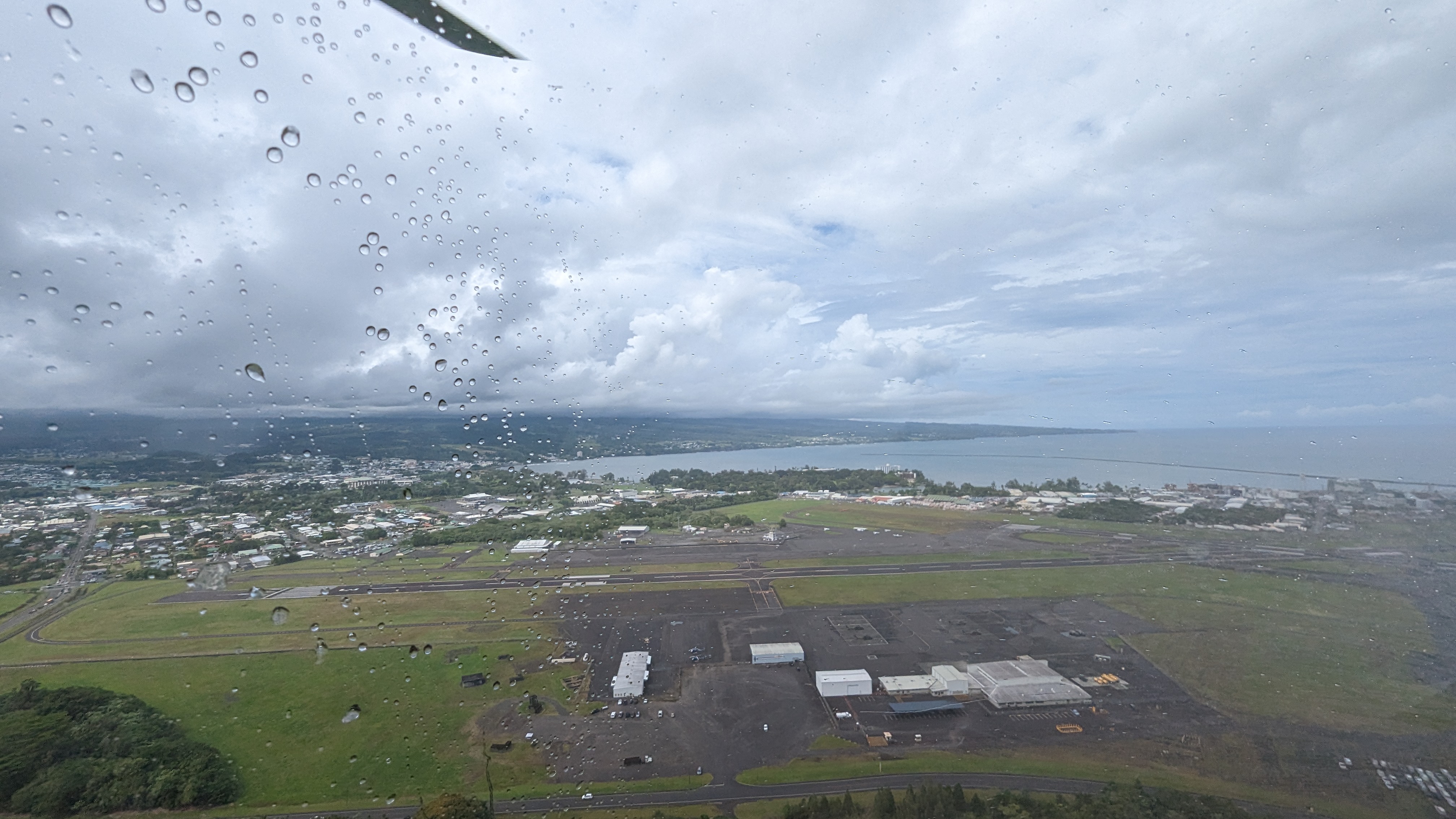 |
| View of the second runway at Hilo airport looking out over the bay. |
Like I said, they're not the best shots, but it was really cool getting to see the ground from a height above where I can fly a drone and I always enjoy such opportunities. And with that failed outing, perhaps we'll have to try again in the future sometime. While I hate flying for long durations (on crowded airplanes, with no leg room…), I actually quite enjoy flying in short bursts.
Anyway, with this post series winding down, I've got some more post topics coming up due to the fact (which I can finally announce) that I spent two weeks over the end of January and beginning of February in Jordan, digging at an archaeological excavation and going on a few tours as well. Preparing for that trip was eating up a lot of my focus and energy in January, so now that it's over and I'm recovering from jetlag I can hopefully get some more posts out before too long. So keep an eye out! A hui hou!
Monday, September 19, 2022
Volca-nomenclature in Hilo's roads
Hawaiʻi island is built (at least the portion of it above the ocean's surface) from five volcanoes: Kohala, Maunakea, Hualālai, Mauna Loa, and Kīlauea. Given the importance of these volcanoes to the people who live on the island, it's hardly surprising that some of Hilo's streets are named after them. There's no street named after Kohala that I can find, but the other four are all represented. What's interested me for some years, however, is the particular streets the names have been applied to.
Let's start with Maunakea and Mauna Loa; they're the two biggest volcanoes on the island and the only two directly visible from Hilo. The modern town lies mainly on lava flows from Mauna Loa, though a small part of it is located on Maunakea north of the Wailuku river (which flows along the boundary line between the two volcanoes). Given the prominence of these two volcanoes and the place of Maunakea in Hawaiian culture, you might expect their names to be attached to prominent streets in Hilo. So I find it somewhat amusing that the eponymous Mauna Kea and Mauna Loa Streets are both tiny alleys in a residential part of town, barely wider than one lane and quite short.

You can see all four streets in the image above, and just how short the first two are. Unless you live on those streets, you'll pretty much never have occasion to drive on them. (Though I have on occasion driven down the unlabeled street that passes through both of them.) Hualālai, though not visible over the Saddle between Maunakea and Mauna Loa, fares better with its eponymous two-lane road Hualalai Street. It's moderately longer, with a number of shops and services located along it, and I probably have occasion to drive at least part of it perhaps once or twice a month. (Not sure I've ever driven that little wiggly bit at the southwest end, though.) When I had to retake the driving test in May to get my driver license again after letting it lapse in Australia part of the route involved both Hualalai Street and Kilauea Avenue.
Speaking of which, the image above is actually incomplete, for the reason that Kilauea Avenue is actually several times longer than the other three volcanically-christened roads. Here's another picture which shows its full extent:

I'm not sure if Kilauea Avenue is the longest road in Hilo, but it's certainly up there. It's interesting to me that of the four volcanoes with streets named after them, Kīlauea gets by far the longest (and widest, going up to four lanes for perhaps a third of its length). While Hilo has no official "Main Street", I could make a decent case that Kilauea Avenue comes pretty close to filling the position. (Personally I probably drive on at least parts of it a few times a month, on average.) It's interesting because Kīlauea itself isn't visible from Hilo, and while it's one of the two most active volcanoes on the island, unlike Mauna Loa its eruptions pose no direct threat to Hilo.
Of course, it could also be chance and historical development. Hilo was much smaller in the past, after all, and it might be that when the streets were named they were closer in size and it wasn't obvious which might expand in the future. According to oral tradition, Hilo is the site of the first human settlement in the islands, with archaeology suggesting it's been continuously inhabited for around a thousand years at this point, so it's possible whoever named the roads expected Mauna Kea and Mauna Loa Streets to become bigger in the future.

I did a little looking around and found Old Maps Online, which…well, you can probably guess what it does from the name. Searching for Hilo led me to the map above, from 1917. It's jaw-dropping to me to see just how much smaller Hilo was a hundred years ago, but what I found interesting is that I'm pretty sure all four streets are on it. Hualalai Street is a bit shorter, but other than that it looks like all four were pretty much in their current locations already over a century ago. It's hard to gauge where Kilauea Avenue stops on this map, since there isn't a highway present for it to merge into and it seems to turn into a road between Hilo and settlements further uphill, but it tracks its modern course quite well from what I could see. Unfortunately there are no street names on this map, and I don't know when the names were officially assigned. But it looks like there's a good chance that whenever they were the streets probably weren't too different from their modern course.
Ultimately it's a minor factoid about Hilo, but it's one I've had in the back of my mind to share for literal years at this point. There may be more history-related posts in this vein to come; I've been getting more interested in local history recently and learning some interesting things (for instance, you may notice the presence of a railroad track on the map above which is not there in the present day). We'll see where it goes. A hui hou!
Tuesday, August 30, 2022
An aerial view of Richardson beach
I randomly learned today that August 30 is National Beach Day, so in honor of this day I'd never heard of before, have this lovely panorama I put together from a visit to Richardson beach a few weeks ago.

Richardson beach is a popular local place on the outskirts of Hilo to go for swimming, and I think snorkeling as well; those little outlying island help break up the incoming waves. It's actually appeared on this blog before, way back in the misty recesses of 2011, when I was still only an undergraduate student in my second semester at UH Hilo trying to get some decent sunrise photos. Since I don't, in general, tend to spend a lot of time near the ocean that previous trip remains one of the handful of times I've seen a sea turtle here. It's Anyway, happy National Beach Day! A hui hou!
Wednesday, June 29, 2022
Watch a cruise ship leave Hilo Bay
One of the places I've been flying my new Mini 3 Pro is a scenic lookout point along the coast just north of downtown Hilo, along the Hāmākua highway. From there you can get a good view out over Hilo Bay, as it's just across from the end of the breakwater protecting the harbor. It's pretty much the closest place I can go to fly over the ocean due to the proximity of the airport to the bay beaches, and as once I got over my worry that my drone was going to randomly plummet from the sky into the ocean, I discovered that flying over open water is pretty great because of the lack of obstacles or changes in ground height to have to pay attention to.
Coincidentally, the first time I went was on a Tuesday, which is the day each week when a cruise ship visits Hilo from 8:00 AM to 6:00 PM. I got there just after the cruise ship had left the bay and was heading out into the ocean, and decided that it would be an interesting challenge trying to film it in the process of exiting the bay. The next week I went, the weather was bad, with spitting rain not long before the ship passed by and threatening overcast skies; I was also caught off guard by just how fast it could move, so I barely managed to get my drone in the air fast enough to catch it, and only got a few photos (which weren't great due to the lighting conditions).
With the days starting to shorten again after the summer solstice, I tried again this week, and this time the weather cooperated and I was ready (just). I could tell that my confidence was much improved even from just the week before, as I quickly got my drone into the air and sent it whizzing off over the waves.
But rather than continue to tell you about it, I'll just show you! I got enough footage to put together a short video, and here it is:
That ship was really moving, mind you; all but the very last shot in that video is from a single nine-minute take, and that includes the time getting to and from the boat at the beginning and end. The time the ship took to get out of the harbor once it lined up was no more than about three minutes, which is part of why I wasn't prepared for it the week before. All that movement made it a really interesting target to try to match velocity with and get some cinematic shots of, though, especially since I didn't have to worry about hitting anything else while flying.
As I was editing the video I realized it's been a little over a year since my last one (from before I left Australia), and it felt great to get back into editing again. Hopefully this will be merely the first of many to come! A hui hou!
Friday, June 10, 2022
Dreams of flight, fulfilled!
I don't remember when I first heard about remote-control quadcopter drones, but it must've been some time ago, approaching a decade. I remember because my impression at the time was that they were toys: a little RC helicopter-like device you could send hovering around in the air for a few minutes. Neat, in a way, but not something I was really interested in.
Over the years I didn't pay much attention to the improvements taking place in drone development (especially the inclusion of cameras), until about two years ago. Sometime a few months into lockdown in Melbourne in 2020, I started watching videos incorporating drone footage that were popping up in my recommendations on YouTube. At a time when I could leave the house for no more than an hour a day (and then only to walk about enjoying a grey and dreary Melbourne winter), seeing people's soaring footage from around the world (often from before the pandemic, to be clear) made me realize that drones now had the potential to be more than mere toys: in the right hands, they could be conduits to completely new perspectives on familiar things, vicariously allowing people the power of flight in something other than a ponderous airplane. I was quickly hooked.
But of course, I was completing a PhD at the time; I had neither time, money, nor access to anywhere interesting to fly, and no prospects for any in the near future, so it remained a dream. But if there's one thing I can be when needed, it's patient, so I bided my time and started learning more about the various kinds of drones out there, dreaming of a day when I might possibly return to Hawaii and have a drone of my own, able to show off the natural wonders of my adopted home like other people were doing for places around the globe. Miraculously, the first part of that dream came true last year when I was able to move back to Hawaii with a great new job. And this week, the second part came true when the DJI Mini 3 Pro I ordered arrived!
 |
| An early-morning shot looking north-east towards Hilo bay, from about 60 m up. |
Yes, I've finally made the jump into drone flying, and I am having a blast. I had plenty of other more necessary things to spend money on when I first arrived back in Hawaii, so I've been waiting patiently for months. In January rumors of a new DJI drone in the Mini family surfaced, which piqued my interest, so I held off until it was officially revealed in May. The Mini line of DJI drones represents drones under 250 grams, which both means they don't need to be registered in the US if used for solely recreational flying, and makes them eminently portable on, say, a nice long hike. They're not the highest-end consumer drones out there, but they're highly capable little flying cameras, and the Mini 3 Pro continues that tradition. So when it came out to good reviews (the specs having been leaked a few weeks earlier), I took the plunge and ordered.
 |
| A few miles out of Hilo, about 1000 feet in elevation. (Find me near photo center…) |
I'd been vaguely hoping it would arrive before my trip back to California last week, but alas. It instead arrived on Tuesday, and I've been eagerly taking it out flying almost as often as possible; I was so excited on Wednesday after flying it the first time Tuesday evening that I woke up early and went flying before work—then again after work. The Mini 3 Pro routinely gets upwards of 20 minutes of flight time on a single battery, so even with just one I can get out for a good length of time and take photos and videos and practice my flying.
 |
| Another shot towards the bay; greater distance from the airport let me go up to the full 120 m limit. |
I find the experience of flying itself magical, though it's a bit nervewracking, to be sure, especially sending my (not exactly cheap!) drone far away from myself either horizontally or vertically. Still, being able to get a perspective from up in the sky is worth the nerves, and the feeling of directing it around through the air is a lot of fun. I haven't been more than a few miles out of Hilo yet, but I love being able to look out over the city and recognize places from the air. I'm still practicing my cinematography skills, but I can hardly wait to start exploring some of the amazing sights this island has to offer in photos and video. (To aid with the latter I've got some additional batteries on order to allow longer flight times, but they won't ship until July.) National parks are off-limits (a fact I'm both happy and sad about), so don't expect any cool aerial shots of Kīlauea or anything like that, but there's still a lot of island available to fly over, and I'm looking forward to having more photos to show in the future. Now, it's off to bed so I can get up early and fly again tomorrow morning while the Sun is low. A hui hou!
Wednesday, May 18, 2022
Lāhainā noon, May 2022
Now that I'm back in the tropics again, I got to experience a uniquely tropical phenomenon today: at noon, the sun stood directly at the zenith overhead. In Hawaii, such days are known as “lāhainā noon” days, after a contest held by Bishop Museum in 1990 in which that was the winning entry. Briefly, as the Earth travels around the sun, the latitude at which it appears directly overhead (the subsolar point) varies from +23.5° on the June solstice to −23.5° on the December solstice. Points at those latitudes will see the sun reach directly overhead on just that one day, but points between the Tropics of Cancer and Capricorn will see the sun pass directly overhead twice a year. On the equator this happens on the equinoxes, then steadily closer to the solstices the further away you get.
Here in Hilo, at a latitude of +19.7°, the two lāhainā noon days are May 18 and July 24 (at least for 2022, it's possible the exact day could shift by one depending on e.g., whether it's a leap year). So this is the first one I've experienced since moving back at the end of September last year. For the next two months, roughly, the sun will appear north of zenith in the sky. Directly at lāhainā noon, however, shadows are cast straight down, so tall straight objects like flagpoles effectively have no shadow. I tried to get some photos, but there was a haze of clouds over the sun that made shadows very faint—I could make them out by eye, but they didn't really come out well on camera. I'll just have to wait for July to try again.
Oh, and if you're wondering about the name, it comes from the Lāhainā region on the island of Maui, which, being on the leeward side of the island, is prone to droughts. It can be translated fairly literally as “cruel sun.” Another, older, Hawaiian name for this phenomenon is “kau ka lā i ka lolo,” which has the humorous translation of “the sun rests upon the brain.” Anyway, that's all for now. Hopefully I'll be able to get some photos next time the sun comes around overhead. A hui hou!