Thursday, February 16, 2023

Miscellaneous family visit photos (part 3)

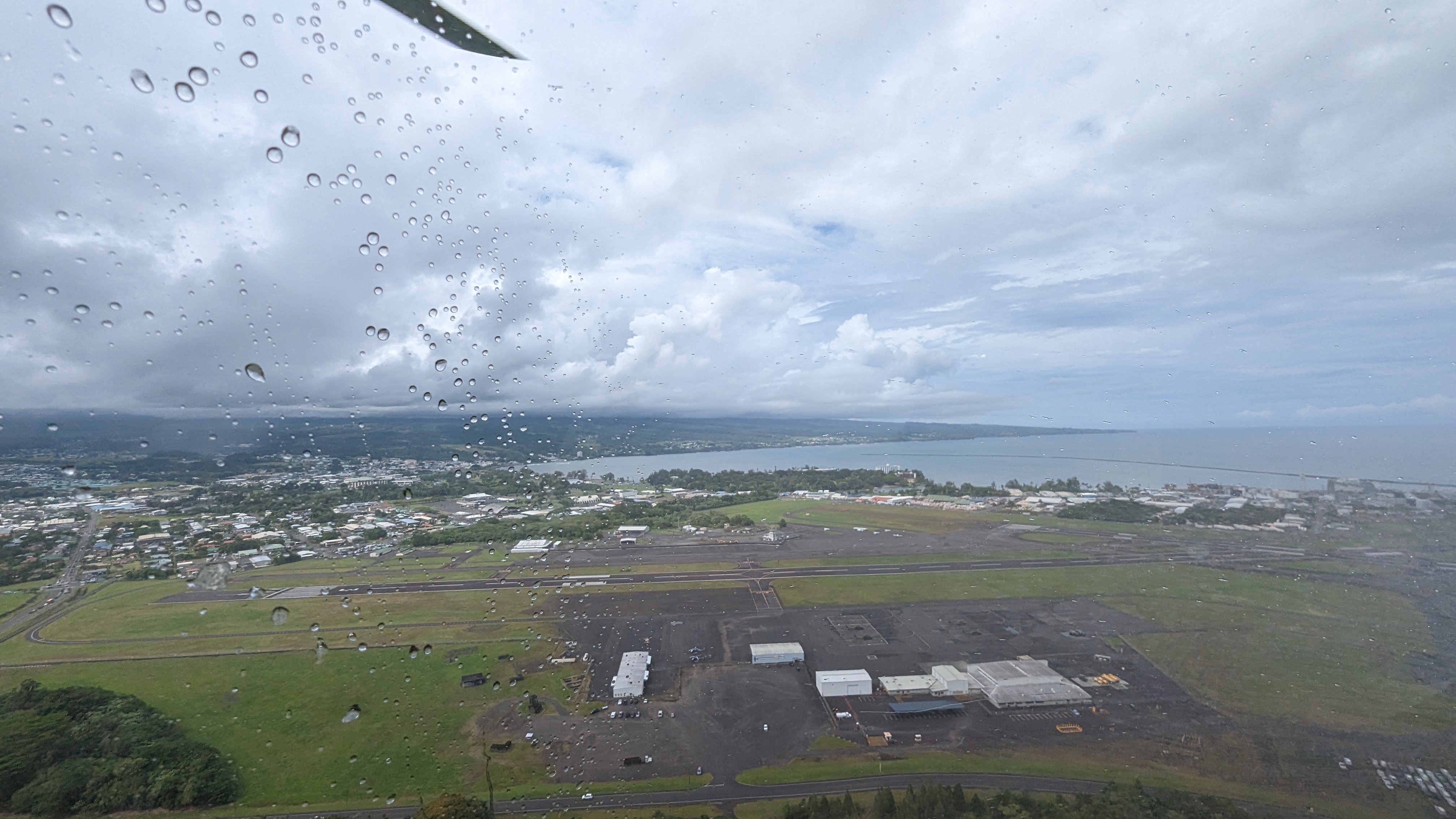
I mentioned in the last post in this series that I had a few photos from something I hadn't done before, and that turns out to have been “riding in a helicopter.” The final day my family was here visiting last year, we tried to take a helicopter tour of Kīlauea. Unfortunately, the weather did not comply; it was raining lightly when we took off, but the tour company thought we'd have a chance of making it out ahead of the clouds before we got to the volcano. However, a denser bit of weather rolled in faster than anticipated, and before we'd flown more than five minutes we were informed that it just wasn't meant to be that day and we had to turn back.

An upside is that they didn't charge us for the ten-minute helicopter flight we took, which was still a pretty neat experience. Riding in it felt exactly like how I'd imagined my drone must feel while flying, and while none of the photos I got during the trip were particularly great (due to the rain), I did snap a few of the area around the Hilo airport that I thought were interesting enough to share.

A shot looking over towards the UH Hilo campus (and Gemini facility), over the mall on the left.

View of the second runway at Hilo airport looking out over the bay.

Like I said, they're not the best shots, but it was really cool getting to see the ground from a height above where I can fly a drone and I always enjoy such opportunities. And with that failed outing, perhaps we'll have to try again in the future sometime. While I hate flying for long durations (on crowded airplanes, with no leg room…), I actually quite enjoy flying in short bursts.

Anyway, with this post series winding down, I've got some more post topics coming up due to the fact (which I can finally announce) that I spent two weeks over the end of January and beginning of February in Jordan, digging at an archaeological excavation and going on a few tours as well. Preparing for that trip was eating up a lot of my focus and energy in January, so now that it's over and I'm recovering from jetlag I can hopefully get some more posts out before too long. So keep an eye out! A hui hou!

Sunday, January 29, 2023

Miscellaneous family visit photos (part 2)

Part 2 of the miscellaneous photos series, these will cover more of the geological things we saw and places we visited.

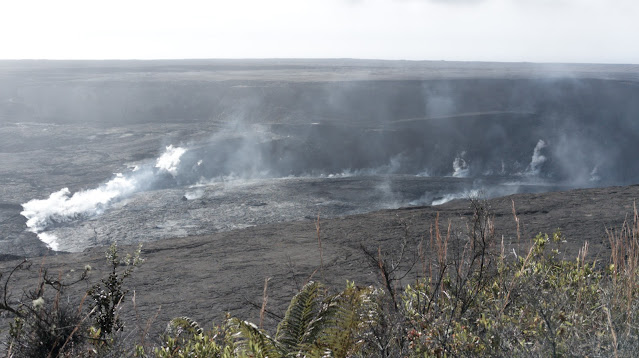
Two days before Mauna Loa awoke from its 38-year slumber, we visited Kīlauea in Volcanoes National Park. While I was there earlier last year, I hadn't actually gone to see the overlook of the (post-2018-eruption) caldera.  It was a pretty spectacular sight, as you could see giant cracks in the ground (visible near center-image below) where huge blocks of material had faulted and collapsed.

Kīlauea caldera. Sorry for the lens flare, the Pixel 7 Pro camera seems a bit prone to it.
The outgassing from around the crater floor that day was also pretty impressive:

Outgassing in Kīlauea caldera.

We also hiked the Kīlauea Iki trail, and I was able to get a nice photo back across the crater floor with hardly any people in it:

Kīlauea Iki crater floor.

I don't have too much to say about these photos since they're generally places I've seen and posted about before. We also visited Akaka Falls (for the first time since I got back), which was as impressive as always:

Akaka Falls.
It's still amazing to think about those fish (the ʻoʻopu) that are born above the falls, plunge down on their way to the ocean, then return and climb up the waterfall (along the rocks with suction cups) to breed. ʻOʻopu are hardcore. (For reference, Akaka Falls is 135 m high, and there are ʻoʻopu found at the top of 300 m high waterfalls elsewhere on the Hāmākua coast.)

Finally, stretching the definition of the post title slightly, here's a drone photo from November 29th, the day my family flew out and I went up to try to see Mauna Loa's eruption. This was taken when I flew out towards the lava, as in my video from last month. I couldn't see the lava very well on my controller screen so I didn't bother taking many photos, but in hindsight this is still a fairly cool photo and I should probably learn it's better to take a bunch of low-quality photos than to miss out on a potentially amazing one.

Lava rivers running down Mauna Loa's flank, November 29, 2022.

There may be one more post in this series with a few more photos, which will at least involve something new that I'd never done before. A hui hou!

Sunday, January 15, 2023

Miscellaneous family visit photos (part 1)

While my family was visiting in November we checked out a number of places on the island, from which I have a bunch of photos. I'd just gotten a new phone (the Pixel 7 Pro, for the curious) and was learning the camera, and partly because of that I often only ended up with one or two good shots from a location. Instead of writing a lot of little posts about each individual spot, I thought I'd bundle up photos from multiple places into a few larger posts. (They also won't necessarily be in chronological order.)

For this post, I think I'll focus more on the biological splendors (or things of interest) that we saw. Two interesting places we toured were a coffee farm on the Kona sida and a chocolate farm just north of Hilo (just a few miles from my house). I'd never seen either fruit on the tree before, so it was interesting to see how they grow and hear about the process by which they become the end products we're familiar with.

Coffee berries at Greenwell Farms.

Chocolate pods at the Lavaloha chocolate farm.

The chocolate pods in particular were rather interesting with the way they just grew seemingly at random upon the tree, including up and down the trunk. I'm holding a mature one in that photo, to give you a sense of scale (the coffee berries were more like olive-size). Within the pods are a bunch of seeds surrounded by a fleshy layer, which has an odd but not unpleasant taste. (We got to eat some straight from the tree on the guided tour!)

We also visited Richardson beach and walked along the coast to Leleiwi beach were we came across a pair of sea turtles sunning themselves on the rocks. I think that's only like the third time I've seen turtles in my time here (not spending a great deal of my time at the beach), so it was pretty neat. Especially since the zoom on the Pixel 7 Pro is a lot better than on my old phone, allowing me to get shots like these while staying safely distant from the nonchalant chelonians:

Two tired turtles at Leleiwi beach.


Close-up of one of them checking us out. (We we safely beyond the legal distance, don't worry.)

Anyway, that's all for this (fairly short) post. I'll try to get another up fairly soon summarizing some of the cool geological sights at the places we visited. A hui hou!

Wednesday, January 11, 2023

A (belated) Christmas (Eve) crater

Last year on Christmas Eve I took a trip up Maunakea to check out something new. Well, “new” in the grand scheme of things; I wanted to see a young pit crater which appeared high on the flanks of Maunakea…back in 2015. I first heard about it the week before, however, and decided to check it out for myself since it's actually fairly substantial, perhaps about 40 m/150 ft across. It's also pretty high up, at around the 10,000 ft/3,000 m level, a bit higher than the Visitor Information Station. It's also in a region not open to hiking, so I had to get a little creative by flying my drone up the mountain side from a place where I could hike.

Anyway, here it is, the newest geological feature on Maunakea that I know of. In case you're wondering, this is not an eruptive crater; it's actually a collapse crater. From what I've heard, this could come about from an old, empty space (left over when magma drained away from past eruptions) slowly migrating upwards via successive ceiling collapse until it reached the surface, almost like a bubble moving upwards through liquid.

I was able to fly directly over and look down, and it's possible to make out the bottom, faintly. From looking at it while flying around I estimate it's maybe a bit deeper than it is wide (though it seems to widen out slightly below ground, possibly). In this photo you can better see that there's a fence around it, so clearly it's been known for a while and I'm late to the event, but I still think it's pretty cool to get to see something like this that's still so relatively new.

As an aside, reaching this by drone was an interesting experience. Drone regulations only allow flying up to 120 m/400 ft above ground level, but since this was up the side of the mountain I actually flew up to 500 m above my position vertically (the maximum permitted elevation of the DJI Mini 3 Pro) while flying up the slope. Luckily, that turned out be just high enough to reach the crater and get these photos, which were taken pretty close to that limit. It would've been cool to get a bit closer, but because I was flying from down on the ground I had to stay pretty high in the air or an intervening puʻu would block my signal (not just theoretically, I started losing signal strength several times during the flight by going too low).

I'll leave you with one more photo I took when I turned my drone around to fly back: the clouds were coming in at just that elevation, which is probably not a sight a lot of drone pilots get to see. Overall it was a fun experience, and a great demonstration of one of the reasons I wanted to get a drone: to better show off the amazing environment of this island by getting photos I otherwise couldn't. And should I hear of any other new (accessible) geologic features forming, I'll try to check them out as well*! A hui hou!

*The recent lava flow from Mauna Loa is still a bit too far away from open roads, unfortunately, I tried for that the day after Christmas. I did see in a news article that they're hoping to re-open the Mauna Loa Access Road in a few months once the lava covering it cools and they can re-build the road to the observatories.

Saturday, December 31, 2022

Happy New Year 2023!

In a piece of good news for the final hours of 2022, I discovered an early Christmas gift in that the two papers from my PhD, the completion of which has eaten up so much of my free time this year, were officially published in the Monthly Notices of the Royal Astronomical Society on Christmas Eve. It's been a multi-year journey writing these papers (I think I started back in 2019 or possibly even late 2018), and I originally submitted them to MNRAS at the beginning of April so it's been almost 8 months getting them published as well. (Much longer than the average, according to my advisors.) These papers have been hanging over my head for most of the year and taken a lot of my outside-of-work hours to bring to completion, so I am extraordinarily relieved to see them finally published; I am, in a sense, finally “done” with my PhD. And now that I am, and have more energy and free time to do so, I hope to have a post (or perhaps a short series) out sometime next month actually explaining what my thesis is about. Tangentially, even counting this post, this year will mark the lowest number of posts-per-year for this blog, and it's hard to escape the conclusion that a large part of that was me not being able to summon the motivation to write more when I was already spending so much of my evenings and weekends finishing up papers/responding to referee reports/checking proofs for errors that inexplicably appear in the process of typesetting. With that out of the way, I hope to have a bit more time for doing interesting things, which will hopefully translate into more posts sharing said interesting things.

My life hasn't been completely devoid of interest this year, of course; getting a drone has been and continues to be a source of excitement and fresh perspectives on things, even if my dreams of up-close lava examination were dashed by no-fly zones during Mauna Loa's streak-breaking eruption. That aside, there are still plenty of awesome landscapes to explore on this island, and I expect to continue to do so next year.

And it's also true that some things in life are better when they're not exciting, like one's employment status and having a steady place to live. Thankfully both of those have been staidly boring this year, just the way I like it. That's not to say that my job is boring; while it might not be exciting, it remains consistently interesting, for which I am grateful. I've learned a lot about how DRAGONS works over the past year and have been able to make some significant contributions of my own (along with a lot of small improvements in between larger projects). Ultimately 2023 looks to be largely more of the same, and I am very much ready for it.

With that, as the firecrackers continue to thunder intermittently in the distance and 2022 draws to a close, I look forward to another hopefully “unexciting” year to come. (Though there may be some things of interest on the horizon to share.) A hui hou!

Sunday, December 25, 2022

A Christmas volcano visit for 2022

Merry Christmas everyone! I finally got around to editing together a video from drone footage I got back on November 29 when I went up to see Mauna Loa's eruption on its second full day. I flew from Puʻu Huluhulu out towards where the lava was flowing, but it was still so far away at that point that even at the limit of my signal range it didn't look all that impressive on my controller screen. Which is a shame, because it meant I didn't bother taking that much video at the closest point, whereas it actually looks fairly neat when blown up to a larger size; a good lesson to learn for the future, I suppose.

One other very cool event occurred along the way, however, which I really wanted to include in a video and is a good part of why I eventually made this one. I left the camera recording while flying out toward the lava flow, and perhaps halfway there a flock of birds appeared out of nowhere, flying and diving around and in front of my drone. I almost had a heart attack as my first thought was that they they might attack the drone, but they simply flew along with it for around half a minute before diving out of sight. I'm not sure why they decided to fly along, as I was deliberately flying nearly at my height ceiling to avoid disturbing any wildlife that might be on the ground; maybe they were just passing by and decided to follow along for fun? You can watch the video and judge for yourself:

Just to be clear, while a no-fly zone was put in place over the eruption area the next day, to the best of my knowledge this was still an acceptable flight when I did it. It's a bit disappointing to me that there wasn't any flying allowed for the rest of the eruption, but I guess the lesson to be learned is to jump on the next one quickly. Anyway, that's my Christmas present to all of you this year. I may have some more mauna*-related drone photos/videos in the not-too-distant future, but we'll see how things play out. Mele Kalikimaka, a hui hou!

*Loa and kea.

Tuesday, December 13, 2022

Latest eruption wrapping up, it looks like

Well, it was fun while it lasted: over the past few days the indications are that Mauna Loa's latest eruption is coming to an end. It's always possible it could restart, of course, but observations of past eruptions suggest that's pretty unlikely. Interestingly, Kīlauea's latest eruption (which started the day I returned to Hilo last year, September 29th) also seems to have stopped, with the lava lake in its caldera abruptly cooling and solidifying. It's an open question how much influence the two volcanoes have on each other – for instance, historically Mauna Loa has often been active while Kīlauea was quiet, and vice versa, but that's certainly not always true. They're definitely two separate volcanoes with separate magma reservoirs, and go off independently, but their general proximity makes it seem likely that there could be some degree of influence between them. It's possible that magma erupting from Mauna Loa in this eruption relieved pressure on Kīlauea's magma chamber and in some part caused its eruption to end, for instance. But it remains an area of active research for now.

On the mundane side of things, this means Saddle Road is no longer in danger of being overflowed, which, depending on where it happened, could've been very bad news for the observatories on Maunakea (not to mention a very large number of other people who rely on Saddle Road to get across the island). The observatories on Mauna Loa remain cut off, as the flow crossed the Mauna Loa access road very early on in the eruption. It was definitely strange to see photos of it, considering how familiar I am with that road. Assuming that the eruption has indeed stopped at this point, I'm curious to see how long it'll take for the road to be reopened (or rebuilt?) and when I can get up to its end again. Once that happens and the volcano is deemed safe and the summit trails reopened I definitely would like to tackle hiking Mauna Loa's summit again, to see where the fresh lava coated the caldera's floor.

And that brings up the really interesting question: when will the next eruption happen? The thirty-eight year period between the previous eruption and this one was the longest in recorded history for Mauna Loa. Prior to this, it erupted fairly frequently; I've seen five and nine years for its average eruption frequency, so it might depend on how you count, but the point is that it happened pretty often. Of course, there was significant variability among historical eruptions, with multiple eruptions sometime occurring in a single year and a recent twenty-five year quiet period from 1950 to 1975. So who knows? We might be back to seeing eruptions every few years, or it might be decades again before the next one. We'll just have to wait and see! As I've said at least once before on this blog, life's never dull when you live on an active volcano in the middle of the ocean. A hui hou!

Monday, December 5, 2022

Lava viewing on Mauna Loa

It's been an exciting week as Mauna Loa continues to erupt here on Hawaiʻi island for the first time in 38 years. On Monday night last week (the first full day of the eruption) it was clear enough that from Hilo we could see a red glow in the sky off to the west. It wasn't the easiest to capture on camera, but here's a passable photo of it:

Glow of lava off to the west, as seen from Hilo.

My family left for home the next morning, and since I had the rest of the day off I took the opportunity to head up Saddle Road to see if I could see the lava. To make a long story short, the answer was yes, after an hour waiting around for clouds to lift. Which they did, thankfully, a little before sunset, allowing a good view of the rivers of molten rock coursing down Mauna Loa's sides from Puʻu Huluhulu.

Lava seen through trees on Puʻu Huluhulu (and clouds).

Here you can see a lava fountain in silhouette high up on the rift zone and the lava as it snaked its way down the volcano. This is as good a time as any to mention that I got a new phone last month, the Pixel 7 Pro, and I'm finding myself rather impressed with its camera. While its maximum 30× zoom isn't anything I'd want to share, I find it can still get good results like this into the teens× zoom range, and certainly much better than my previous (almost 5-year-old) phone (which got pretty bad beyond maybe ~2–3×). Anyway, here's one last wide photo to get a better sense of the scale:

View south from Puʻu Huluhulu toward lava coming down Mauna Loa.

The lava was still pretty far away at that point (I think about 18 km), so even though I tried sending my drone out towards it I couldn't get close enough for the view to appreciably change. The news since then has been all about how the front of the flow is approaching Saddle Road, though it's been getting slower over time as the lava reaches flatter areas, and even if it continues at it's current pace unabated (which is unlikely) it'll be over a week before it reaches the road. It'd be pretty major if it did, as Saddle Road is the shortest route between the east and west sides of the island and thus a major thoroughfare, and no matter which side of the Maunakea access road it hypothetically covers it'd create a major headache for some of the observatories up there. It's currently coming pretty much straight down the line dividing east from west, so at some point it'll have to split to one side or the other, and then we'll probably have a better idea of where (and if) it'll cross the road. (If it heads west, the road rises higher on Maunakea's slopes and will probably be fine; east is a bit more iffy, considering the road currently sits on lava flows from mid-last-century.)

I haven't been up since Tuesday since the weather has, unfortunately, been rather poor, often with thick clouds over the Saddle region meaning I wouldn't see much of anything even if I did go up. (It got lost among all the volcano coverage, but we actually got snow on Maunakea's summit the same night the eruption started.) I'm definitely keeping an eye on things, though, and if the weather clears up enough to make viewing reasonable I'll probably be heading up the mountain again, camera(s?) in tow. Anyway, to summarize, no one's in danger at this point (historical evidence suggests that the eruption will remain confined to the northeast rift zone and not threaten people on the west and south), and any potential danger to infrastructure is also likely not imminent (and even then, it's ultimately just a road, rather than a residential neighborhood or something). It has been (and will continue to be) very interesting to watch this develop, though! A hui hou!

Monday, November 28, 2022

Mauna Loa, awakened again at last!

Exciting news to wake up to this morning: after 38 years, its longest recorded quiet period in history, Mauna Loa is erupting again! There's not much information available yet, but apparently it started erupting about 11:30 PM last night, November 27. 

This is a frame from the USGS webcam situated on the rim of the summit caldera of Mauna Loa, which saves an image every hour into a 24-hour GIF; this one is the first showing the eruption breaking out along a fault line and spreading lava across the caldera floor. So far it seems like the eruption may be confined to the summit caldera, though it might also have spread a few kilometers outside it. We'll know more once they can do an overflight, hopefully today.

Oh, and there's the first snow of the winter season on Maunakea this morning too, apparently. It's a big day! I'm looking forward to having more updates soon on this historic event. A hui hou!

Wednesday, November 23, 2022

Waiale Falls and surrounds

One fun side effect of getting a drone and wanting simply to get out and fly with it in the beginning has been exploring and finding places relatively nearby that I hadn't been to or didn't know about before. One such place is Waiale Falls on the Wailuku River, just on the outskirts of Hilo. There's a bridge which crosses the river just below the falls, offering a nice vantage point, and it's actually more than just a single waterfall, as the topography makes for some interesting and complicated confluences and meanderings of waterways. Since it's only about 10 minutes from my house (while offering some relative solitude for practicing drone pilots), I've gone there a number of times both to take photos and practice my flying.

There are actually two main waterfalls in quick succession along the Wailuku river, two streams which join with it in the space of a few dozen meters, and an area where water splits off above the top waterfall only to meander around and join with the river again. In the image from Google Maps below, the road (Waiānuenue Avenue) crosses the Wailuku near the center-bottom of the image. To its left you can see the lower falls, then there's an island in the river and the upper falls, plus the Kapehu and Nakakauila Streams which join the river.

However, while the overhead view is useful if you know what you're looking at, a nice drone shot can be a lot more immediately understandable:

Here's a shot of the same area (looking roughly south-west), though with the lower falls hidden behind trees. It's hard to see, but the area where the cars are parked in the center is actually an island itself, as a stream splits off from just above the upper falls and meander down around below the bridge in the foreground, only to join the river again below the bridge below the lower falls. It's tricky to see because of trees, but here's a shot showing the area around the upper falls:

Despite what it might look like, the two pools of water here are not connected: there's a spur of rock that separates them (behind the foreground tree), letting the waters of the main river continue on the left while splitting those on the right off to meander around before rejoining the river. It's a really interesting formation and one that I suspect isn't particularly common!

Here's a shot showing the two falls and the area between them with a sort of gravel-bar island a bit better (the bridge is just out of shot to the bottom):

The lower fall clearly has some man-made construction going on, though I don't know the details. Incidentally, the name Waiale comes from the words wai and ʻale, meaning “rippling water,” so I suspect the pond's been there since before anything was done to the lower fall. There are some (rough, unnofficial) trails in the area which let you walk up to that area, and I've seen people swimming around the island. When the river's low like in the photos it's probably not too bad, but the Wailuku is the single most dangerous river in the state, responsible for something like 30% of river drowning deaths annually, so I wouldn't exactly advise it unless you really know what you're doing. When it rains the water flow of the river can increase by something like a hundred times over what it looks like in these photos in a very short span of time, so you definitely don't want to get caught in a flash flood. (In fact, the name of the river, Wailuku, translates roughly to “waters of destruction.”)

Here's one final photo of the lower falls, taken from below the level of the bridge just above the water to give a perspective on its power even in its relatively low-flow state:

(These photos were taken on different days, which is why the lighting conditions differ so much between them.) All in all, I enjoy this area (which I hadn't visited prior to June), and it makes a conveniently-nearby place to go relax and fly after work if I want something more interesting than houses in Hilo to look at. It's started raining more again lately as we come into the wet season here, so I'm hoping to catch it soon in a higher-flow state to compare with these photos. I might even put together a video if I can get enough good clips.

On a related note, my family will be visiting for a week over Thanksgiving and I'm looking forward to getting photos of the various places we visit, so I'll probably have a raft of new exciting photos to share before long. It'll probably take a bit of time to sort through everything and post them, but I should have some great new stuff to share in the not-too-distant future. In the meantime, happy Thanksgiving! A hui hou!