Sunday, April 24, 2022

Terraforming Mars (again)

This past week a game called Terraformers, about (what else?) terraforming Mars released on Steam. I've been waiting for its release for a while now, having played both its initial demo for Steam Next Fest nearly a year ago and then the free prologue that came out back in October. It's a neat game, and it's been interesting to see how it developed over time, but instead of telling you about it here, I will link to an article about it which I submitted over at Gaming on Linux, and which came out today. I didn't really plan to write an article beforehand, I just enjoyed Terraformers enough while playing it that I figured the worst that could happen was that it didn't get accepted. If you're interested, check out the article! A hui hou!

(And if anyone's wondering about the closing sentence over there, the other three games I have about terraforming Mars are Surviving Mars, Terraforming Mars, and Ad Astra.)

Monday, April 18, 2022

Expanding the Farmstand: Part II

This weekend I performed my first complete reset on my Farmstand—that's where I harvest all the plants, take it all apart and clean it, put it back together, and reseed (generally with new seedlings, though you could transfer mature plants over if they were still producing). Lettuce Grow recommends doing this about every three months, which at first I thought was a bit frequent, but I can see the rationale behind it better now. Plants—at least the ones offered for use with the Farmstand—grow fast enough hydroponically that they've generally finished their useful lifespans in less than three months after arriving as seedlings. For instance, my dill, which I planted at the beginning of December, flowered and died off in less than four months, and most lettuces start bolting (growing tall but with small leaves) after 5–9 weeks. So there's not really much point to letting things continue growing indefinitely. I've learned that lesson after this first cycle, and will be a little more prompt in harvesting things in future. (And proactively pruning, because pruning the bushes that my oregano and thyme had become by this point was un-fun, to say the least.)

The actual process was straightforward, if somewhat physically exhausting. I ordered some replacement seedlings, and spent the last two weeks before they arrived systematically harvesting various plants. I've been composting the organic remains with Lomi, but it has a limited capacity per run so I tried to spread things out over as much time as I could. Lettuce Grow was also running another promotion for a free Farmstand level with purchase of at least eighteen seedlings around the time I ordered, so I took the opportunity to expand up to five levels with a capacity of thirty plants in total. 

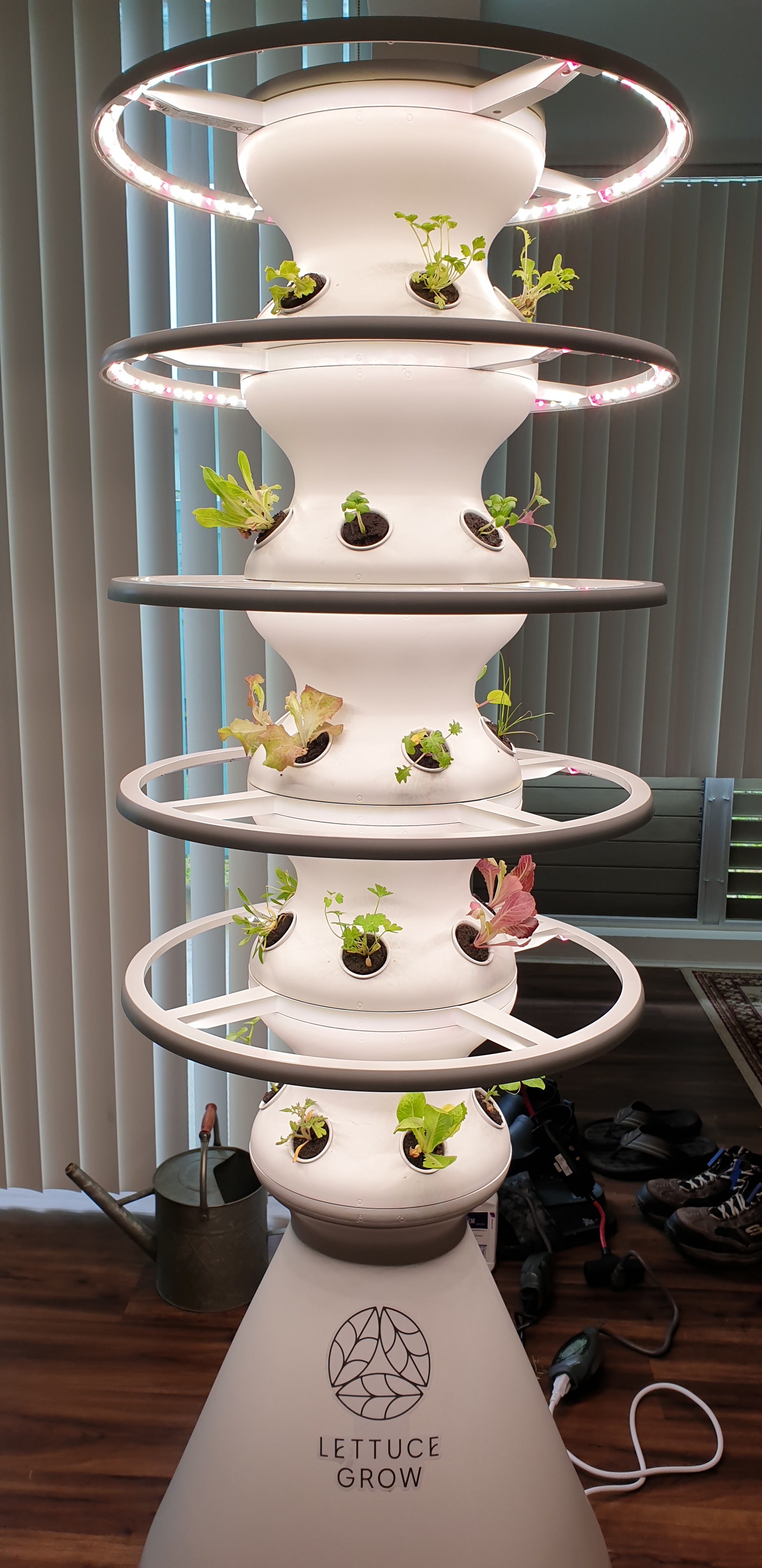
And here it is! It's nearly as tall as I am now—I can still see over the top flat-footed, but only just. I used to wonder why Lettuce Grow only ever talked about going up to six levels—after all, the pump used to bring water up to the top is quite strong and could easily lift water higher—but putting the fifth level on for the first time I understand why. Even at that height I was needing to connect the electrical connections of the light-providing Glow-Rings (which go up the inside of the Farmstand) sight-unseen in the highest levels. I imagine I might need to stand on something for a sixth level, at which point the Farmstand would officially be taller than me. When everything's producing, thirty plants is going to putting out a lot of produce, so I'm again in no major hurry to add a sixth level, but who knows? It's nice to be able to share the excess with people, so if there's another promotion later this year…well, we'll find out, won't we? A hui hou!

Tuesday, April 5, 2022

Berry good!

Now that I'm no longer spending my nights and weekends getting my papers ready, I've once again got time and motivation to dash off silly projects like this Venn diagram comparing things we call berries, and things which are berries according to botanists:

A Venn diagram showing things called berries and things which are berries.
I got the idea for this upon learning this weekend that pumpkins are actually giant berries, botanically speaking. I already knew raspberries and blackberries weren't berries, so I got curious about just how large the overlap is. This is by no means a comprehensive image; I listed everything I could think of with “berry” in the name, then looked at the Wikipedia page on berries for more such things and examples of things that were berries botanically. There are definitely more things that fall into the bottom circle, I'm sure; I left a few controversial ones out, like avocados, because there's apparently some disagreement about whether they're actually berries or not.

On the whole, I was actually slightly surprised at how many things fell into the intersection of the diagram. I was expecting more entries in the top circle, but it looks like possibly a majority of things with “berry” in the name are actually berries, botanically speaking. Though there could very well be more things called berries than I could think of, so if you think of any please leave a comment!

A few things in the bottom circle also surprised me; like, I can see how tomatoes and grapes could be berries, they're similar enough in form to things like blueberries or cranberries that it makes sense. But pumpkins? Eggplants? Bananas?? Bananas definitely surprised me. Guess I've got a fun bit of party trivia for the future.

And speaking of strawberries (which are actually “accessory fruits”), I had my first one from my Farmstand! They're a bit on the slower side to grow (compared to, say, lettuce), since I started the plant at the start of January, but the strawberry I had was deliciously sweet. There's another red one and a few still green that are coming along, so I'm looking forward to having some more perhaps later this week or the next. I'll probably have some more news on the indoor farming front around that time as well. A hui hou! 

Friday, April 1, 2022

Papers are submitted!

It's been six months (plus a few days) since I arrived back in Hilo, and yesterday was a pretty significant milestone for me: I finally submitted the two papers that form the basis of my thesis to the Monthly Notices of the Royal Astronomical Society! While the papers were mostly written before I moved (indeed, they've been being written for literally years now), they went through a long period of editing and refinement and rewriting since, and even had some new sections added along the way. (Including just this past week!) It mostly took so long because I was having to do it on weekends and holidays and weeknights after work, but it's finally done.

My two papers were submitted along with another two (including one to Science) by people in the solar twins method research group as part of a coordinated wave, revealing the method I spent my PhD establishing and its results: a constraint on variation in the fine-structure constant nearly 100 times more precise than the current best constraints from astronomy. (At some point in the future I'd like to write a post series explaining my PhD work in simplified terms, so I won't go into detail here just yet.)

This is just the first step; from here the papers will go to peer review (assuming they're accepted, but I don't expect that to be an issue), and probably within a few weeks or months I'll get them back and have to make changes for the final published versions. The upshot, however, is that—for now—I actually have free time, for basically the first time since moving. I'm luxuriating this evening in the lack of a feeling in the back of my mind that I really ought to be working on my papers, for the first time in over half a year (I've got other things I need to get done that I've been putting off to work on my papers, but now I can finally start checking them off.)

It's a significant milestone for a few reasons: for the solar twins method, as these papers will establish its validity and open it up to the wider research community, allowing people to build on it in the future. And for me, I'm finally getting to share all the work I've been doing for the past 4½ years beyond the handful of people involved. Many, perhaps the majority, of PhD students in astronomy already have several papers published by the time they get their degrees, so it's validating to finally have my work published as well. (Due to the nature of my establishing the solar twins method almost from scratch, it didn't really make sense to publish results along the way; instead we needed to have everything done to prove everything worked before we could really publish any of it.) With my papers submitted (and eventually published), I'm also finally going to start having more free time to begin recovering from the past few years of nigh-unrelenting stress and toil, and start getting to enjoy living in Hawaii again. I'm bursting with ideas of things to do and create and try, and hopefully that'll translate to more posts this year sharing the results of those ideas. Maybe not immediately, but there's a light at the end of the tunnel, and it's more than just the point it's been for years. A hui hou!

Sunday, March 27, 2022

Trying out “Lomi” by Pela

Watching Back to the Future 2 growing up, I remember being struck by the scene near the beginning of the movie where Doc Brown appears from the future and immediately starts dumping household trash (including various food waste) into the DeLorean's fusion reactor for energy. I've always found food waste disgusting, so the idea of being able to take this gross garbage and get something useful out stuck with me (even if I knew it was fiction even back then). While portable fusion reactors running on trash are sadly still not available, I was immediately reminded of that scene when I came across a company called Pela last year and their new device they were taking pre-orders for, called simply “Lomi.”

Lomi is a…well, I suppose it could be described as an “active composter.” It's a device about the size of a bread machine into which you can put food waste, paper, approved bioplastics, etc., and over the course of 4–20 hours (depending on which of three modes is chosen) it breaks it down into dirt. (Pela advise that only dirt from the longest cycle should be directly given to plants, but even the shorter two cycles get the contents a significant amount of the way, and can then be composted naturally the rest of the way.) Last month Pela started shipping out units to North America (with a global availability scheduled for September), and this past week mine arrived!

A white Lomi sitting on a countertop.
And here it is in action! Not much to look at, admittedly…
I was able to get it setup over the weekend and try it out, and it really does work! Eggshells, asparagus ends, some old wilted leaves from the brassicas in my Farmstand, the bioplastic packaging Lomi comes in, some random paper, all these things left in the ~2 liter bucket ended up as a small pile of dry dirt at the bottom. It performs a cycle of grinding up and warming what you give it to encourage speedy microbial decomposition (they include small optional pellets containing a blend of microbes you can add for optimum results), followed by a hotter drying cycle to leave you with nice clean dry dirt rather than half-decomposed sludge.

Living in a rental apartment like I do with no place outside to compost, I was really happy to hear about Lomi and I'm excited it lives up to its advertising. (I know there are various indoor composting solutions, but I just don't really feel like leaving a bunch of decomposing food waste around in my house.) Being able to compost food waste means it's not sitting around in the trash (potentially attracting critters), and a lower volume of trash in general. Plus, I've been thinking of expanding my indoor gardening to encompass growing some root vegetables like potatoes and carrots in soil (since those don't really work well in hydroponics), and the compost from Lomi would be an ideal way to recycle food waste into plant nutrients. I've been waiting on my Lomi delivery to see how that'd work before setting anything up, but now that Lomi's up and running I might have to see about expanding my farming operations in the near future…

Anyway, just thought I'd share my experience with Lomi. The promised ability to quickly and non-messily turn food waste into nice clean dirt and ready plant nutrients seemed almost too good to be true, so here's my testimonial to other prospective buyers. And hopefully before too long I'll be turning food waste into tasty tubers or other vegetables! A hui hou!

Wednesday, March 16, 2022

Paging Dr. Berke!

It's been very quiet on the blog front for a few weeks now, but I have some good news: as of February 17, my revised thesis was accepted, making me officially a doctor! And yes, that was three days before my last post. I've been kept very busy since then because, though officially "done" with my PhD, I'm not yet truly done. Mainly because of the two papers which made up my thesis have yet to be published, and need to be submitted before March 25th to support a companion proposal (by my advisor and the group I worked with, to continue on with the larger project). There are a few bureaucratic formalities to finish up as well to receive my diploma, but I am officially allowed to the use the title "Dr." from when I got the announcement.

I should be able to have the papers submitted by the deadline, as they're almost done except for changing one plot and a minor bit of rewriting, but it's kept me occupied in evenings and weekends—which, after a day (or week) of work, is not exactly my most productive time. I'm certainly looking forward to having these papers done and some free time to get back to more interesting creative pursuits, which should spill over into more posts here. In the meantime, I should get back to work on them. A hui hou!

Sunday, February 20, 2022

Some thoughts on herbs: oregano and thyme

It's coming up on three months since I first planted seedlings in my Farmstead, and of those original twelve I still have six plants, including oregano and time. When I was first looking into hydroponic gardening, among the many consumer-scale systems out there I saw several fairly small devices, set up for growing just six or seven plants sometimes. Typically, I'd see them advertised primarily for herbs, since they were small enough there wasn't much space for larger plants like lettuces to grow. I didn't think just growing herbs would be very useful, since you can't make a salad out of them, so I ended up going with the Farmstand for more growing space. However, now that I've lived with the ability to pick fresh herbs for a few months, my stance on them has definitely softened a bit.

Oregano at the top, thyme near the bottom.
While I probably still wouldn't get a system for growing exclusively herbs (the ability to pick my own salads daily is just so good!), I've come to appreciate fresh herbs a lot more. Generally herbs, by their nature, work well with the “cut and come again” method of progressive harvesting over time, which I prefer over harvesting a whole plant at once. And they can really do a lot to spice up a dish! I used oregano and thyme to approximate a crude za‘atar for some lamb I cooked last week, and it came out quite well, and reminiscent of the real thing (which usually includes some additional herbs, such as the eponymous za‘atar plant). When making a breakfast omelet I sometimes sprinkle in some thyme or crumbled oregano or sage leaves, or chopped garlic chives. I've used the herbs I grow (including dill and bunched green onions in addition to the ones already listed) in a number of recipes: tuna or egg salad, soups, pasta sauce, even sandwiches. Having fresh herbs at hand is a much more valuable tool in the chef's arsenal than I appreciated before.

Having said that, I wanted to talk about the two herbs in the title, oregano and thyme. You can see them in the photo above (a photo of the Farmstand from the opposite side than in photos in previous posts); oregano is the plant in the center near the top with the hanging stems, though it's somewhat difficult to make out due to being encroached on by sylvetta arugula from the left and celery from the right. Two tiers below it, occupying much of the bottom of the photo, is thyme. Now, these plants superficially seem pretty similar. They're both somewhat bushy, with similar patterns of pairs of leaves branching out along their stems. They have a fairly similar flavor, as well, both somewhat pungent, almost spicy. However, while similar in form, they differ in scale, and that turns out to make a huge difference to how easy they are to harvest.

Oregano, as you can see at the top, has fewer (and slightly thicker) stems and larger leaves. (They're perhaps around the size of a postage stamp when fullly grown.) It has maybe 10–20 stems growing out, which makes it pretty easy to snip one off and pull the leaves off it for use. Thyme, on the other hand…thyme is a monster. A hydra, with dozens, probably well over a hundred stems all clawing their way outwards., and any one you clip off just grows two more stems from the stump. The leaves are perhaps a tenth the size of oregano, and the stems are much thinner, which makes it harder to strip the leaves off—the thin stems often tend to break, and the leaves hold on proportionately better than oregano leaves do. In general, I find stripping thyme leaves much more aggravating than oregano. (I've got an “herb stripper,” a small metal device with differently-sized holes which you can pull stems through, to strip the leaves off, but it's unfortunately not much better than using my hands for thyme.) I do like the taste of thyme—it's especially good paired with meat—but I sigh a bit inwardly whenever I'm clipping more than one or two stems for use. The one good aspect to thyme's increased vigor is that there's so much of it that I can afford to be a lot less efficient in harvesting it—if I lose 30% of the leaves on a stem because I couldn't be bothered picking each tiny leaf off individually after going over it once, no problem, I can just snip another few stems to make up for it.

I'll probably continue growing both oregano and thyme (and other herbs) in the future, as I've quickly grown accustomed to the taste, and I've got enough lettuce varieties already that I can spare some slots for herbs. (They're both prolific enough that I might see about harvesting a bunch of leaves from both plants and drying them for saving, which would be neat and potentially make a nice gift). I've just been musing recently about how two plants, so alike in form otherwise, can be so different simply due to their different size scales. And if you're thinking of trying hydroponic gardening, but can't afford (or fit in) a large system like the Farmstand, maybe give one of those smaller systems a try, even if just for growing herbs. A hui hou!

Wednesday, February 2, 2022

Expanding the Farmstand

This post is almost a month behind the times, but back at the start of January I expanded my Farmstand  with another two levels (out of a possible total of six). I always meant to expand it over time as I figured out how much food it produced and how much I could eat, but there was a promotion in December that resulted in me getting a free level, so I sped up the timeline a little.

Freshly (re)planted.

I also took the opportunity to harvest six of the original plants, leaving just the celery, dill, oregano, thyme, garlic chives, and scarlet cherry tomato from the first planting, which is why it looks so bare again in the above photo. (Thyme, by the way, is like a hydra; it's got dozens of stocks, and every time I cut one off two more sprout from the stump.) Adding two levels to the Farmstand actually had an interesting psychological effect. Before, it came up barely to my waist, and any tending to it required bending over. Now, the top of the highest tier comes up to about the level of my shoulders, making it much more of a peer in height and allowing me to tend to plants in the top levels while standing straight. (The extra grow light levels also light up the living room noticeably more, allowing it to stand double-duty as a floor lamp!) It's quite the change, and I'm curious to see how it'll go with the full six layers, although I'm not in a huge hurry to install them; the amount of food from four layers is pretty impressive compared to just two.

After three weeks' growth.

I took this photo last week, about three weeks since planting. While it's still slow enough to barely notice between days, I remain impressed at the speed plants grow in a hydroponic system. Double the number of plants has increased the weekly water consumption too; whereas before I only needed one trip with the 1.75 gallon watering can, this past week took two and a little bit extra!

With the extra space, I replenished a few plants that are fast becoming favorites (classic butter lettuce, lolla rossa lettuce) while taking the opportunity to try some new things. Lettuce Grow has a huge variety of seedlings available (something like 200 total, although it varies seasonally), so among other things I added a strawberry, some cauliflower and broccoli, and sage. I've discovered I quite like komatsuna for salads, which grow fast and have absolutely gigantic leaves—you can see it in the photo above in the third level, the plant directly facing the camera. (Some of those leaves are bigger than my hand!) I've also discovered I'm not a fan of arugula—unfortunate, since I planted two varieties of it (astro arugula and sylvette arugula), but that's what experimentation is for. Over time I'll figure out the plants I like and want to grow.

I probably won't expand to the final two levels for at least a few months, but come March it'll be three months since I started farming. Lettuce Grow recommends taking the Farmstand apart for a good cleaning about that often to prevent algae build-up, so it might also be a good time to harvest some plants and introduce some new seedlings. They apparently do two seasonal seedlings each month, so we'll just have to wait and see what comes out. A hui hou!

Wednesday, January 19, 2022

Moving-in: complete!

Today marks four months since I packed up my things in Melbourne to begin moving to Hilo…and it's also the day I finally got said things delivered! Almost above my expectations, nothing broke in my computer on its long journey, and I'm in fact typing this post on it right now. (Unlike when I mailed it to Melbourne, where I removed most of the components and reassembled it there, this time I just shipped it intact and it appears to have remained in that condition.) It's somewhat amusing, as after waiting months for the boat with my stuff to cross the Pacific and get through the queue off the coast of Los Angeles, when it finally arrived in Hilo it made its way to me in less than three days: it arrived in port Monday, I got a call from the shipping company Tuesday, and they delivered it today.

I'll keep this post short since my computer is currently set up in a highly un-ergonomic configuration on a couple of cardboard boxes with a small TV someone gave me being used as the monitor, but I've got a desk and a better monitor on their way to being delivered next week. It'll probably take me a few weeks to re-equilibrate and absorb this influx of new things into my house and routine, but hopefully before too long I'll be able to get back to some of my creative hobbies that I've had to forgo the past four months. I can't promise anything soon, but, oh, the possibilities now! A hui hou!

Friday, January 14, 2022

Air fryers and pressure cookers: adventures in new kitchen gadgets.

Welcome to 2022, everyone, and a post about food.

Well, a post about kitchen gadgets that facilitate the preparation of food, anyway. Moving into my new place back in November I found myself in the novel situation of having almost a blank slate when it came to kitchen tools, and kitchen equipment, and kitchen...just about anything, really. I did ship some things from Australia—measuring spoons, the electric kettle I was gifted, some serving spoons and the like—but those still haven't arrived yet (though I've heard the boat is slated to arrive in Hilo on Monday!). I thus found myself in a unique position to start almost from scratch and tailor my kitchen to how I wanted it with the latest advances in cooking technology. While in Australia I held off any any purchases of new gadgets beyond the bare essentials for several reasons (difficulty in moving back before I expected to have moving expenses paid, electric plug differences, ect.), but I'd picked up a few ideas from the internet over the years that I wanted to try out.

Perhaps most pressingly, I didn't have a microwave, and while I was down in Walmart browsing the selection an intriguing combination microwave + toaster oven + air fryer caught my eye. I'd heard about air fryers and wanted to give one a try, and multi-use gadgets have always appealed to me (and made a lot of sense in my kitchen, which is not huge), so I picked it up.

So far, it's been quite handy and I'm really happy with it. Much like how I mentioned in the post about my new car, I have the feeling of technology having taken a leap forward without my noticing it. (Also like my car, I'm sure some of the innovations have been around a few years, but they're still new to me.) In the past, microwave ovens have been things you put food inside of, guess at how much time it'll take to heat it up satisfactorily, input that time, and stood back while it cooked. Now, I can cook with either microwaves or convection in the same appliance (both at once, even!), and it's got humidity sensors that let you automatically heat or reheat food to the right temperature. In fact, I've only turned on my oven once since moving in (to make lasagne with the new pan my aunt gave me for Christmas) because anything that would otherwise need the oven which can fit in the microwave is easier done in there. If I want to make cookies I can just stick them in the microwave and set it to the preset "Bake cookies" option. If I need to cook a frozen fish filet, it knows how long to do it based on the weight. Mozzarella sticks or French fries? The air fryer functionality stands ready to cook them conveniently and quickly. It's quite a useful device, and I'm happy I got it (it's this model by Galanz if anyone's interested).

Another gadget I haven't had before, and have been low-key interested in for a while, is a pressure cooker, so when I moved it I bought an Instant Pot Duo. It wouldn't be hyperbole to say that it's revolutionized my cooking even more than the microwave air fryer. It does such an incredible job of simplifying the cooking process that I can't get over it. If I wanted to make pasta before, I'd have to put a pot of water on the stove, wait for it to boil, put in the pasta, stir it for 10 minutes or so making sure it doesn't boil over, and finally have it ready. During that time I couldn't stray too far from the stove for too long, which made preparing other food at the same time tricky. With the pressure cooker, I just dump the noodles and some water in the inner pot, set it to pressure cook for a few minutes after building up pressure, and come back in 10 minutes or so to ready-to-use noodles. Similarly, I like rice, but making it manually is a dull and time-consuming affair. Now, I just rinse it, put it in, and hit the Rice button to come back to beautifully cooked rice. I've also been experimenting with steaming a variety of vegetables, and I'm finding steaming retains the flavor better than other cooking methods I've tried in the past (in addition to being easier).

And it's not just pressure cooking, either! The Instant Pot Duo can also function as a slow-cooker (another multi-use gadget!), so I've used it to make my particular slow-cook chilli a few times already. It can also be used to sauté, so just today I used it to sauté some frozen burger patties (which came out incredibly delicious, garnished with some greens from my hydroponic garden). Unlike doing it in a frying pan, the spattered grease was easier to contain (with the help of a lid), making it a lot cleaner than doing it on the stove. There's other features I've yet to try (like "yoghurt making," and cooking soups or roasts), but I feel I've already gotten my money's worth on this gadget and then some. It's just so nice and efficient to be able to put food in to cook and then having that time to work on other things rather than needing to stir a pot or whatever.

Anyway, that's not the end of my experimentation with new kitchen gadgets and tools, but I'll save that for another post. I just wanted to my voice to the chorus of people on the Internet who've discovered these things and had them change their cooking experience. In my case, while I've been cooking for myself for over a decade now, it's not usually something I initiate because I want to, but rather because I, well, need food. Between the pressure cooker and microwave air fryer and a few other new gadgets, I'm finding myself actually excited to cook, and after several years of grad school and lockdowns I'm actually finding myself increasingly eager to try cooking new things. It's a good feeling! A hui hou!