Showing posts with label Saturn. Show all posts
Showing posts with label Saturn. Show all posts
Tuesday, December 24, 2019
Merry Christmas! Have a Titan Fact.
Merry Christmas everyone! This year I volunteered on the Astrobites hiring committee, which was an interesting experience, though we're still in the process of sending out invites so I won't say too much more about it just yet. In the process, though, I learned a rather cool fact about Titan, the largest moon of Saturn, which I thought I'd pass on: mountains and mountain ranges on Titan are all named after mountains and mountain ranges from the works of J. R. R. Tolkien. (Specifically, ones found in Middle Earth.) So yes, Doom Mons exists, and is quite possibly a cryovolcano, too! While writing this I also discovered that hills on Titan are named after characters from Middle Earth. As a big lover of Tolkien, I just thought that was a fun fact to share. Mele Kalikimaka everyone!

Tuesday, September 19, 2017
End of an Era, in More Ways Than One
Last Friday, September 15, was the last day for two things: my employment with ASIAA, and the Cassini–Huygens mission to Saturn.
Cassini was launched in 1997, when I was eight years old and firmly in the grip of my first passionate love of astronomy, focused on the planets in the solar system. It took seven years to reach Saturn so I had plenty of time to find out about it and years to look forward to its arrival at my favorite planet in the far-off future of 2004. When Cassini finally reached Saturn I remember reading all about it, about the Huygens' probe's successful landing on Titan, the first such landing on a solid body in the outer solar system, and the incredible pictures being beamed back from Saturnian orbit. And over the past thirteen years I've watched as any number of amazing discoveries were made and awesome photos taken.
Cassini was originally slated for a four-year mission, from 2004 to 2008, but its outstanding success allowed it a mission extension first to 2010, then an additional seven years beyond that. I was fifteen when it got to Saturn, and it came to feel like a a constant: multiple rovers landed on Mars, Messenger flew by Mercury a few times, New Horizons sped past Pluto, several other missions blazed brightly briefly in the public consciousness like shooting stars but the whole time Cassini was there, quietly taking pictures and measurements and redefining our knowledge of Saturn and its gorgeous system of rings and moons, constant like the cosmic microwave background.
Cassini was launched in 1997, when I was eight years old and firmly in the grip of my first passionate love of astronomy, focused on the planets in the solar system. It took seven years to reach Saturn so I had plenty of time to find out about it and years to look forward to its arrival at my favorite planet in the far-off future of 2004. When Cassini finally reached Saturn I remember reading all about it, about the Huygens' probe's successful landing on Titan, the first such landing on a solid body in the outer solar system, and the incredible pictures being beamed back from Saturnian orbit. And over the past thirteen years I've watched as any number of amazing discoveries were made and awesome photos taken.
 |
| Saturn from Cassini in 2016; photo by NASA (public domain). |
Cassini was originally slated for a four-year mission, from 2004 to 2008, but its outstanding success allowed it a mission extension first to 2010, then an additional seven years beyond that. I was fifteen when it got to Saturn, and it came to feel like a a constant: multiple rovers landed on Mars, Messenger flew by Mercury a few times, New Horizons sped past Pluto, several other missions blazed brightly briefly in the public consciousness like shooting stars but the whole time Cassini was there, quietly taking pictures and measurements and redefining our knowledge of Saturn and its gorgeous system of rings and moons, constant like the cosmic microwave background.
This video gives a brief overview of the mission.
To me, having grown up with Cassini it's strange to think that it's finally gone; no more news stories with the latest eye-catching pictures, or amazing discoveries it made (although I don't think we've exhausted the scientific value of the data it sent back yet, not by a long shot). I didn't keep particularly close tabs on it as the years went by (partly due to that perception of permanance)—and only found out about the end of the mission a few days ago in fact—but I generally kept up with the major discoveries, and all in all I'm going to miss that intrepid probe.
But fuel, and NASA's budget allowance, eventually come to an end, and so too did Cassini's incredible mission. And coincidentally it happened on my last day of work with ASIAA, where I've been a telescope operator for AMiBA for the past six months (exactly!). It feels like the end of an era, in more ways than one, as I'm now busy preparing to move to Australia to start graduate school in just over a week.
People keep asking me if I'm excited, or telling me how excited I must be. Being free of work has left me free to face the reality of moving and all the many things still remaining to be done in the next far-too-few days. My internal emotional state seems to be a quantum superposition of many confusing and conflicting feelings, and observing it usually yields a value best approximated by “abject terror,” so I try not to do that too often.
For some reason people seem to ascribe to me a confidence and adventurousness I can only dream of possessing in reality. The truth is I am a man who finds blessed comfort in routines and the thought of breaking all of them—simultaneously—terrifying in the extreme. I find travel (especially alone) highly stressful, necessitating as it does the disruption of so many comforting patterns, though at least for the past eight years it's only been between my current and my childhood homes; now I face the looming specter of leaving everything I know behind to travel somewhere I know no one. Perhaps some people would find that exciting? All I know is that it doesn't feel like excitement to me.
Sorry, that got a bit philosophical towards the end didn't it? It's not all so doom-and-gloom as this probably makes it sound. I should get back to preparations—I've got a lot to do before next Wednesday! A hui hou!
 |
| My final picture of the YTLA, taken a day before on the 14th. |
For some reason people seem to ascribe to me a confidence and adventurousness I can only dream of possessing in reality. The truth is I am a man who finds blessed comfort in routines and the thought of breaking all of them—simultaneously—terrifying in the extreme. I find travel (especially alone) highly stressful, necessitating as it does the disruption of so many comforting patterns, though at least for the past eight years it's only been between my current and my childhood homes; now I face the looming specter of leaving everything I know behind to travel somewhere I know no one. Perhaps some people would find that exciting? All I know is that it doesn't feel like excitement to me.
Sorry, that got a bit philosophical towards the end didn't it? It's not all so doom-and-gloom as this probably makes it sound. I should get back to preparations—I've got a lot to do before next Wednesday! A hui hou!
Sunday, October 11, 2015
Astro-Art: Saturn in SVG
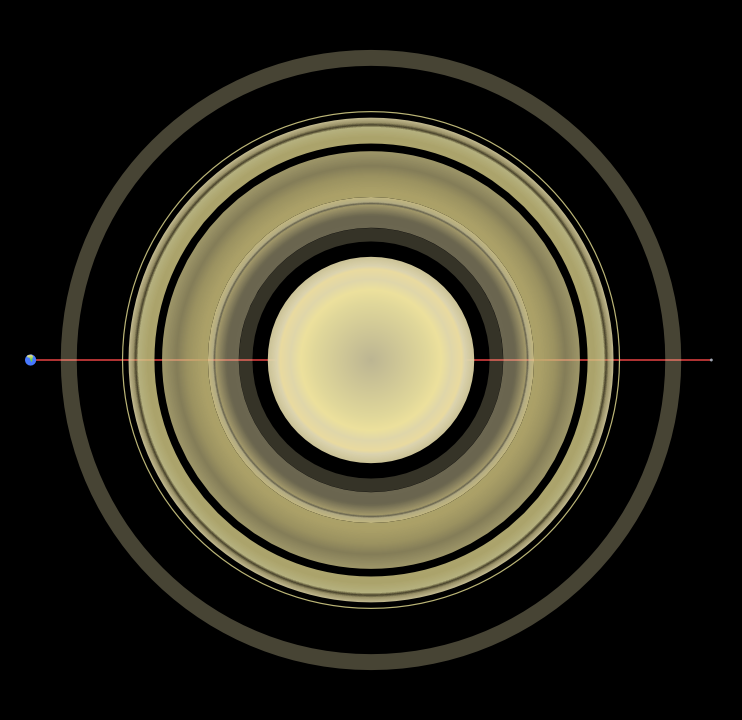
When I put together those pictures of Saturn I used to illustrate the scale of Saturn's ring system last month I went to a lot of trouble to make all the rings consist of two mirrored halves, with the intention of using them to make the illustration in perspective (by hiding one set behind Saturn, then squashing both sets symmetrically inwards vertically, if you're curious). Along the way I decided I liked the straight-on overhead view better and ended up not doing it, but the capability remained, so today I decided to blow the virtual dust off the file and see what I could make of it. I had to make a new radial gradient for Saturn, but I think it came out looking pretty nice:

(Despite the title, this is just a plain old PNG image, as Blogger unfortunately doesn't take SVG images directly. But the original is SVG, anyway. See how many of the rings mentioned in my previous post you can spot here!)
Monday, September 14, 2015
Saturn's Rings and the Earth-Moon Distance
A few weeks ago I happened to hear offhand that Saturn and its rings would fit nicely in the space between the Earth and Moon. Being the visual-oriented person I am, I decided to go ahead and make a picture to put them in perspective, and figured I'd share.
First of all, a quick primer on the nomenclature of Saturn's rings. The rings are labeled alphabetically in order of discovery, although the A, B, and C rings were all discovered basically at the same time and the decision to name them working outward in towards the planet was pretty much arbitrary.

Technically the F ring is too thin to be shown here; it's only about 30–500 km thick which means it's about 40–400 times thinner than shown here. The relative brightnesses of the rings is also only approximate; the G ring (and even D ring) are also fainter than shown here, and aren't visible to the naked eye. They were only discovered with photography from various interplanetary probes after 1979 (as was the F ring). The F ring is the outermost of the “discrete” rings; beyond it, the rings are diffuse and may have moons orbiting embedded within them.
The astute among you might have noticed that there is a distinct lack of an E ring in the above image. Don't worry, we'll come back to that. Anyway, let's see how these rings stack up against the average Earth-Moon distance:

With an average separation distance between them of about 358,000 km, we can see that the Earth and the Moon nicely frame Saturn and its main rings there. It also gives a good idea of the size of Saturn relative to Earth.
But what about that E ring I glossed over a paragraph ago? Turns out the E ring is outside the G ring and extremely large, but like the G ring it's also extremely faint and diffuse.
Anyway, here's the E ring in all its glory (I've left the Earth, Moon, and the line between them in place):

Yeah, the E ring's pretty wide (and again, it's so diffuse that it's not visible to the naked eye). Its outer edge is just within the orbit of Saturn's largest moon, Titan. As you can see (or maybe not), the E ring's diameter is around twice as large as the average Earth-Moon distance.
But believe it or not, that's not all of Saturn's rings! There are a few more ringlets between the G and E ring that are too thin to show here, but there's another ring outside the E ring that's even larger and even more diffuse. This ring was only discovered in October 2009, and is known as the Phoebe ring after Saturn's unusual moon Phoebe which orbits just outside of it in a retrograde orbit. Here it is, with the rest of the ring system for comparison:

Yep, that little disc in the center is the E ring we just saw in the last picture—with the inner ring system and Saturn within that. This ring is really large. In fact, unlike the other rings which have a maximum thickness on the order of tens to maybe hundreds of meters, the Phoebe ring has a thickness around forty times greater than the radius of Saturn itself. In other words, this ring is thicker than the entire diameter of the E ring.
So there you have it! Saturn and its fascinating ring system, and how it compares to the distance between the Earth and the Moon. Hope you found it as interesting as I did putting these images together. A hui hou!
First of all, a quick primer on the nomenclature of Saturn's rings. The rings are labeled alphabetically in order of discovery, although the A, B, and C rings were all discovered basically at the same time and the decision to name them working outward in towards the planet was pretty much arbitrary.
Technically the F ring is too thin to be shown here; it's only about 30–500 km thick which means it's about 40–400 times thinner than shown here. The relative brightnesses of the rings is also only approximate; the G ring (and even D ring) are also fainter than shown here, and aren't visible to the naked eye. They were only discovered with photography from various interplanetary probes after 1979 (as was the F ring). The F ring is the outermost of the “discrete” rings; beyond it, the rings are diffuse and may have moons orbiting embedded within them.
The astute among you might have noticed that there is a distinct lack of an E ring in the above image. Don't worry, we'll come back to that. Anyway, let's see how these rings stack up against the average Earth-Moon distance:
With an average separation distance between them of about 358,000 km, we can see that the Earth and the Moon nicely frame Saturn and its main rings there. It also gives a good idea of the size of Saturn relative to Earth.
But what about that E ring I glossed over a paragraph ago? Turns out the E ring is outside the G ring and extremely large, but like the G ring it's also extremely faint and diffuse.
Anyway, here's the E ring in all its glory (I've left the Earth, Moon, and the line between them in place):
Yeah, the E ring's pretty wide (and again, it's so diffuse that it's not visible to the naked eye). Its outer edge is just within the orbit of Saturn's largest moon, Titan. As you can see (or maybe not), the E ring's diameter is around twice as large as the average Earth-Moon distance.
But believe it or not, that's not all of Saturn's rings! There are a few more ringlets between the G and E ring that are too thin to show here, but there's another ring outside the E ring that's even larger and even more diffuse. This ring was only discovered in October 2009, and is known as the Phoebe ring after Saturn's unusual moon Phoebe which orbits just outside of it in a retrograde orbit. Here it is, with the rest of the ring system for comparison:

Yep, that little disc in the center is the E ring we just saw in the last picture—with the inner ring system and Saturn within that. This ring is really large. In fact, unlike the other rings which have a maximum thickness on the order of tens to maybe hundreds of meters, the Phoebe ring has a thickness around forty times greater than the radius of Saturn itself. In other words, this ring is thicker than the entire diameter of the E ring.
So there you have it! Saturn and its fascinating ring system, and how it compares to the distance between the Earth and the Moon. Hope you found it as interesting as I did putting these images together. A hui hou!
Sunday, August 25, 2013
Science Clock Series: Part XI
Today's number comes from astronomy and is given by:
 \[\approx\ \text{diameter of ♃(in \(\beta\); \(\oplus=1\beta\)}\] This is a slightly roundabout way of saying "approximately the diameter of Jupiter in Earth-diameters." Let's look at it a little more closely:
First of all, what in the world is ♃ supposed to be? Or \(\oplus\)? To answer those questions we need to go back in time. About 2,000 years in fact, give or take. You see, one thing that I've learned from idly inspecting ancient writing, whether written, inscribed, or etched, is that ancient people liked to abbreviate.
Although it surprised me at first, this is entirely reasonable when you think about it; we do it all the time in everyday life, especially with the proliferation of instant messaging. Ancient peoples had to write everything by hand, which in my opinion is very dull and tiresome. You start looking for ways to reduce the amount you have to write, and before you know it you've got abbreviations all over the place.
Anyway, writing goes back a long time, but for much of history it was limited to a thin slice of the most educated in society. The study of astronomy also goes back a long time, and was one of the most common subjects for that educated elite to study, given its importance to pre-Industrial societies in helping to determine things like the proper time to plant and harvest crops in order to ensure everyone didn't starve over the winter.
Put those fact together, and people have been writing about astronomy for a very long time. Some of the oldest writings we find have been discovered to be about astronomy. Since it was so important, and given that most people like to save time and effort when writing, ancient astronomers in the Hellenistic period around the time of Christ came up with a set of symbols to refer to the "planets."
Note that the word "planets" in this context refers to the seven "planets" of the Ptolemaic (and originally Aristotelian) heliocentric system: the Sun, the Moon, Mercury, Venus, Mars, Jupiter, and Saturn.These are the objects which, if you're familiar with the night sky, appear to move across it against the background of the fixed stars. Anyway, ancient astronomers came up with symbols for them that were used up through the Renaissance period. In fact, their use was so common that when astronomers such as William Herschel started discovering new planets astronomers rapidly came up with new symbols for them too. Anyway, here's a table with the symbols for the Sun, and the eight planets discovered before 1900:
\begin{align*}
\text{Sun}&\dots☉\\
\text{Mercury}&\dots☿\\
\text{Venus}&\dots♀\\
\text{Earth}&\dots\oplus\\
\text{Mars}&\dots♂\\
\text{Jupiter}&\dots♃\\
\text{Saturn}&\dots♄\\
\text{Uranus}&\dots♅\\
\text{Neptune}&\dots♆
\end{align*}You may be familiar with the symbols for Mars and Venus, as they have come to stand for “male” and “female” respectively in modern usage. Other than that, the only symbols commonly used in astronomy any more are the ones for the Sun and Earth. It's standard practice in astronomical journals for the symbols \(\text{R}_☉\), \(\text{M}_☉\), and \(\text{L}_☉\) to stand for the mass, radius, and luminosity of the Sun, respectively (and similarly for the Earth using the symbol for Earth).
It might give you some indication just how little known these symbols are today if I told you that right up until I looked them up to write this post I thought the symbol for Jupiter on my clock stood for Neptune!
Now that I know it stands for Jupiter, we can look at what the clock actually says: approximately the diameter of Jupiter in terms of “beta”, where “Earth” = 1 “beta.” I actually looked up beta to make sure there wasn't some special use for it that I wasn't aware of and couldn't find anything, so I'm not entirely sure what the point of introducing it only to immediately define it as one Earth was. Anyway, if we then check with the diameters of both Earth and Jupiter, we find that Jupiter does indeed have a diameter about 10.9377 times greater than Earth's.
So there you have it. And I realize this post isn't actually as short as I promised last time, though hopefully it was still interesting. There's a lot related to the astronomical symbols that I didn't cover, such as the fact that several were created for the first nineteen asteroids discovered before people realized that creating unique symbols for every asteroid would be effectively impossible and gave up (given that we now know of over a hundred thousand asteroids and suspect there may be ten times that number in the solar system, we can see that this was a good decision!).
Anyway, check back for the final post in this series, with a number from meteorology! Click here to jump directly to it.
First of all, what in the world is ♃ supposed to be? Or \(\oplus\)? To answer those questions we need to go back in time. About 2,000 years in fact, give or take. You see, one thing that I've learned from idly inspecting ancient writing, whether written, inscribed, or etched, is that ancient people liked to abbreviate.
Although it surprised me at first, this is entirely reasonable when you think about it; we do it all the time in everyday life, especially with the proliferation of instant messaging. Ancient peoples had to write everything by hand, which in my opinion is very dull and tiresome. You start looking for ways to reduce the amount you have to write, and before you know it you've got abbreviations all over the place.
Anyway, writing goes back a long time, but for much of history it was limited to a thin slice of the most educated in society. The study of astronomy also goes back a long time, and was one of the most common subjects for that educated elite to study, given its importance to pre-Industrial societies in helping to determine things like the proper time to plant and harvest crops in order to ensure everyone didn't starve over the winter.
Put those fact together, and people have been writing about astronomy for a very long time. Some of the oldest writings we find have been discovered to be about astronomy. Since it was so important, and given that most people like to save time and effort when writing, ancient astronomers in the Hellenistic period around the time of Christ came up with a set of symbols to refer to the "planets."
Note that the word "planets" in this context refers to the seven "planets" of the Ptolemaic (and originally Aristotelian) heliocentric system: the Sun, the Moon, Mercury, Venus, Mars, Jupiter, and Saturn.These are the objects which, if you're familiar with the night sky, appear to move across it against the background of the fixed stars. Anyway, ancient astronomers came up with symbols for them that were used up through the Renaissance period. In fact, their use was so common that when astronomers such as William Herschel started discovering new planets astronomers rapidly came up with new symbols for them too. Anyway, here's a table with the symbols for the Sun, and the eight planets discovered before 1900:
\begin{align*}
\text{Sun}&\dots☉\\
\text{Mercury}&\dots☿\\
\text{Venus}&\dots♀\\
\text{Earth}&\dots\oplus\\
\text{Mars}&\dots♂\\
\text{Jupiter}&\dots♃\\
\text{Saturn}&\dots♄\\
\text{Uranus}&\dots♅\\
\text{Neptune}&\dots♆
\end{align*}You may be familiar with the symbols for Mars and Venus, as they have come to stand for “male” and “female” respectively in modern usage. Other than that, the only symbols commonly used in astronomy any more are the ones for the Sun and Earth. It's standard practice in astronomical journals for the symbols \(\text{R}_☉\), \(\text{M}_☉\), and \(\text{L}_☉\) to stand for the mass, radius, and luminosity of the Sun, respectively (and similarly for the Earth using the symbol for Earth).
It might give you some indication just how little known these symbols are today if I told you that right up until I looked them up to write this post I thought the symbol for Jupiter on my clock stood for Neptune!
Now that I know it stands for Jupiter, we can look at what the clock actually says: approximately the diameter of Jupiter in terms of “beta”, where “Earth” = 1 “beta.” I actually looked up beta to make sure there wasn't some special use for it that I wasn't aware of and couldn't find anything, so I'm not entirely sure what the point of introducing it only to immediately define it as one Earth was. Anyway, if we then check with the diameters of both Earth and Jupiter, we find that Jupiter does indeed have a diameter about 10.9377 times greater than Earth's.
So there you have it. And I realize this post isn't actually as short as I promised last time, though hopefully it was still interesting. There's a lot related to the astronomical symbols that I didn't cover, such as the fact that several were created for the first nineteen asteroids discovered before people realized that creating unique symbols for every asteroid would be effectively impossible and gave up (given that we now know of over a hundred thousand asteroids and suspect there may be ten times that number in the solar system, we can see that this was a good decision!).
Anyway, check back for the final post in this series, with a number from meteorology! Click here to jump directly to it.
Sunday, May 5, 2013
Moons and Months
It's probably not a big surprise to most of you to learn that the words for "moon" and "month" are related in English (and some other languages as well). Our Moon's orbital period of 27 days, 7 hours, and 41.1 minutes comes very close to the number of days you get when you divide the Earth's orbital period by twelve, and makes a nice natural division of time.
But have you ever thought about the moons of other planets? For example Mars' two moons, Phobos and Deimos, orbit their parent planet in just 7 hours 40 minutes and 30.3 hours respectively. Many of Jupiter and Saturn's close-in moons likewise orbit in less than an Earth day. In fact, there are dozens of moons with a shorter orbital period than our Moon.
On the flip side of the scale, there are also dozens of moons with longer orbital periods than our Moon. Jupiter and Saturn both also have lots of small, irregular moons that orbit far from their parent body, which can take months or even years to complete one orbit. Saturn's moon Phoebe, for instance, takes 550.3 days to make a complete circuit, nearly two Earth years. Prior to last week, I knew of a few Jovian moons with orbital periods measured in days in the 600's and 700's. Given Jupiter's humongous mass, you'd expect that it would be able to hold onto satellites further out than other planets, which would have correspondingly long orbital periods.
So you can imagine my surprise when I, on a whim, looked up the satellite with the longest orbital period and discovered it belonged to...Neptune?? And not just by a few days or even a few months – we're talking years here.
In fact, it turns out the four longest orbital-period moons all belong to Neptune. The two inner ones, Sao and Laomedia, have orbital periods of 7.97 and 8.68 years respectively. The two outer ones, Psamathe and Neso, take 24.84 and 26.67 years to orbit Neptune once, respectively.
I found this revelation absolutely mind-boggling. Neither of these moons has completed an orbit since I've been born. They have longer orbital periods than the first five inner planets. They orbit Neptune at a mean distance of around 48-49 billion kilometers (about 30 million miles), which is nearly a third of the distance from the Earth to Sun. At its furthest point, Neso can be further from Neptune than Mercury ever gets from the Sun!
If you wondered, like me, how Neptune and not Jupiter can have the furthest-out and longest-orbiting satellites, it has to do with something called the Hill sphere (named after 19th-century American astronomer and mathematician George William Hill). The Hill sphere is basically the region of space in which an object's gravitational pull dominates the attraction from other objects in the region. For a moon to remain in orbit about a planet, it must remain entirely inside the planet's Hill sphere, or it will eventually be pulled loose by the gravitational perturbations of other planets. This limits how long of an orbital period a moon (or other satellite) can have before it is no longer stably bound to its parent planet. For instance, the mathematics suggests that it is impossible for the Earth to have a satellite with an orbital period of longer than about seven months.
To get to the point, a planet's Hill sphere depends both on its mass, and its distance from the Sun (and other massive sources of gravitational perturbation). Jupiter, of course, is many times more massive than Neptune (and all the other planets combined), but Neptune is several times further from the Sun. Add in the inverse-square nature of gravity, and Neptune manages to eke out a victory in the "largest planetary Hill sphere" competition. (Interestingly, of the four outer planets, Jupiter has the smallest Hill sphere; it increases slightly but steadily in size from Jupiter through Saturn and Uranus on to Neptune. Turns out increased distance from the Sun is more important than decreasing mass.) Neso and Psamathe are orbiting nearly at the outer limit of Neptune's Hill sphere, so they are likely to remain the moons with the longest orbital periods for the foreseeable future.
Of course, they were only discovered in 2002 and 2003, respectively, so who knows what else could be out there! It's an exciting time for us lovers of planetary science and Solar System dynamics.
Anyway, I hope you found that as interesting as I did. If you're interested in other comparisons between the moons of the Solar System, this page on Wikipedia has a nice table that you can sort by various categories.
But have you ever thought about the moons of other planets? For example Mars' two moons, Phobos and Deimos, orbit their parent planet in just 7 hours 40 minutes and 30.3 hours respectively. Many of Jupiter and Saturn's close-in moons likewise orbit in less than an Earth day. In fact, there are dozens of moons with a shorter orbital period than our Moon.
On the flip side of the scale, there are also dozens of moons with longer orbital periods than our Moon. Jupiter and Saturn both also have lots of small, irregular moons that orbit far from their parent body, which can take months or even years to complete one orbit. Saturn's moon Phoebe, for instance, takes 550.3 days to make a complete circuit, nearly two Earth years. Prior to last week, I knew of a few Jovian moons with orbital periods measured in days in the 600's and 700's. Given Jupiter's humongous mass, you'd expect that it would be able to hold onto satellites further out than other planets, which would have correspondingly long orbital periods.
So you can imagine my surprise when I, on a whim, looked up the satellite with the longest orbital period and discovered it belonged to...Neptune?? And not just by a few days or even a few months – we're talking years here.
In fact, it turns out the four longest orbital-period moons all belong to Neptune. The two inner ones, Sao and Laomedia, have orbital periods of 7.97 and 8.68 years respectively. The two outer ones, Psamathe and Neso, take 24.84 and 26.67 years to orbit Neptune once, respectively.
I found this revelation absolutely mind-boggling. Neither of these moons has completed an orbit since I've been born. They have longer orbital periods than the first five inner planets. They orbit Neptune at a mean distance of around 48-49 billion kilometers (about 30 million miles), which is nearly a third of the distance from the Earth to Sun. At its furthest point, Neso can be further from Neptune than Mercury ever gets from the Sun!
If you wondered, like me, how Neptune and not Jupiter can have the furthest-out and longest-orbiting satellites, it has to do with something called the Hill sphere (named after 19th-century American astronomer and mathematician George William Hill). The Hill sphere is basically the region of space in which an object's gravitational pull dominates the attraction from other objects in the region. For a moon to remain in orbit about a planet, it must remain entirely inside the planet's Hill sphere, or it will eventually be pulled loose by the gravitational perturbations of other planets. This limits how long of an orbital period a moon (or other satellite) can have before it is no longer stably bound to its parent planet. For instance, the mathematics suggests that it is impossible for the Earth to have a satellite with an orbital period of longer than about seven months.
To get to the point, a planet's Hill sphere depends both on its mass, and its distance from the Sun (and other massive sources of gravitational perturbation). Jupiter, of course, is many times more massive than Neptune (and all the other planets combined), but Neptune is several times further from the Sun. Add in the inverse-square nature of gravity, and Neptune manages to eke out a victory in the "largest planetary Hill sphere" competition. (Interestingly, of the four outer planets, Jupiter has the smallest Hill sphere; it increases slightly but steadily in size from Jupiter through Saturn and Uranus on to Neptune. Turns out increased distance from the Sun is more important than decreasing mass.) Neso and Psamathe are orbiting nearly at the outer limit of Neptune's Hill sphere, so they are likely to remain the moons with the longest orbital periods for the foreseeable future.
Of course, they were only discovered in 2002 and 2003, respectively, so who knows what else could be out there! It's an exciting time for us lovers of planetary science and Solar System dynamics.
Anyway, I hope you found that as interesting as I did. If you're interested in other comparisons between the moons of the Solar System, this page on Wikipedia has a nice table that you can sort by various categories.
Wednesday, January 23, 2013
Through the clouds of Titan
Eight years ago now, on January 14th, 2005, the robotic probe Huygens separated from its carrier (the robotic probe Cassini) and plummeted towards Saturn's largest moon Titan. After several hours of falling through space it entered Titan's atmosphere and eventually made a controlled landing by parachute, and in the process gave us our very first glimpse of the surface of this remote and distant world. Titan is perpetually shrouded in thick orange clouds, making its surface impossible to see in visible light. Now, for the first time that I know of, some talented people at NASA, ESA, JPL, and the University of Arizona have stitched together the images Huygens got as it descended into a movie, starting from when it first separated from Cassini. It's really quite fascinating to watch, and very beautiful as well.
Tuesday, November 15, 2011
Our Star
Have you stopped to ponder just how mind-blowingly huge the Sun is lately?
Last week while volunteering up at the Vis I took a picture of the Sun through the solar telescope on a whim. I noticed a large sunspot group on it, but didn't think anything else of it until this week when I learned that said sunspot group (called Active Region 1339) is one of the larger ones on record. I'd also heard somewhere along the line that it was larger than Earth, so I decided to do some visual comparing of my own. After seeing how Earth and Jupiter looked against the Sun, I decided to go all the way and add the rest of the planets. This image is the result. It shows the 8 planets of our Solar System against the Sun with AR 1339, all of them correctly sized relative to each other. (The distances between the planets are not to scale, due to the way I set up the picture.)
Look at this image, and let it sink in for bit. The Sun accounts for a whopping 99.86% of all matter in the Solar System. It's big. For fun, see how many other sunspots you can spot in this picture that are larger than Earth.
Edit (11/25/11): One other thing I like about this picture that I forgot to mention the first time is the sense of security it gives, when you really think about it. Stable orbits, despite their ubiquity in nature, are still nothing to take for granted, and it's sort of comforting seeing just how huge the Sun is compared to the Earth, and just how firmly we're caught in its gravitational embrace.
“Tremble before Him, all the Earth; indeed, the world is firmly established, it will not be moved. Let the heavens be glad, and let the Earth rejoice” -- 1 Chronicles 16:30-31a
Last week while volunteering up at the Vis I took a picture of the Sun through the solar telescope on a whim. I noticed a large sunspot group on it, but didn't think anything else of it until this week when I learned that said sunspot group (called Active Region 1339) is one of the larger ones on record. I'd also heard somewhere along the line that it was larger than Earth, so I decided to do some visual comparing of my own. After seeing how Earth and Jupiter looked against the Sun, I decided to go all the way and add the rest of the planets. This image is the result. It shows the 8 planets of our Solar System against the Sun with AR 1339, all of them correctly sized relative to each other. (The distances between the planets are not to scale, due to the way I set up the picture.)
 |
| Our Solar System. |
Edit (11/25/11): One other thing I like about this picture that I forgot to mention the first time is the sense of security it gives, when you really think about it. Stable orbits, despite their ubiquity in nature, are still nothing to take for granted, and it's sort of comforting seeing just how huge the Sun is compared to the Earth, and just how firmly we're caught in its gravitational embrace.
“Tremble before Him, all the Earth; indeed, the world is firmly established, it will not be moved. Let the heavens be glad, and let the Earth rejoice” -- 1 Chronicles 16:30-31a
Friday, September 24, 2010
Celestial Choreography.
Since I'm going up to Mauna Kea tonight, I thought I'd put up some pictures I took the last time I was there. The first one is very cool, because it shows one of the phases of Venus. I don't recall ever having seen these before, so it was an awesome experience for me. Seeing such phases is one way to tell that Venus orbits closer to the Sun than we do.
North is roughly off to the right in the picture. Note the chromatic aberration present in the image, visible as a slight separation between the most red and most blue parts of the image.
The second picture is of Jupiter, the behemoth of the solar system.
 North is up in this picture. You can clearly the North Equatorial Belt near the top of the planet. The corresponding South Equatorial Belt has been missing for several months now. It will no doubt return as it always has sometime in the next few years, but for now you get to see the planet in a little more lop-sided version.
While checking up on Jupiter, I learned a rather funny fact about the Trojan asteroids. The Trojan asteroids are two groups of asteroids that are caught by gravity at Jupiter's L4 and L5 Lagrange points. This means they orbit the Sun roughly 60 degrees ahead of and behind Jupiter in its orbit. I had never known why they were called the Trojan asteroids before, but it turns out it's because the first one discovered was called Achilles, and by convention every one discovered since (all 4,076 of them) have been named after figures in the Trojan War from the Iliad. In fact, it's even more structured than that; the asteroids orbiting ahead of Jupiter are named after people in the Greek camp, while those following Jupiter are named after people in the Trojan camp (although this rule was suggested after they'd found a few, so there are two exceptions: Patroclus is found in the Trojan camp, and Hektor, the largest of them, in the Greek camp).
As an interesting aside, the word trojan has now entered the astronomical lexicon to refer to any body trapped 60 degrees ahead or or behind another in its orbit. Thus, there are other trojan asteroids (note the lowercase spelling); several associated with Mars, and a few with Neptune. There are even 4 known trojan moons, all in orbit around Saturn, which is where three moons share the same orbit, one large one in the middle with two smaller flanking ones behind and before.
A hui hou!
 |
| Crescent Venus. |
The second picture is of Jupiter, the behemoth of the solar system.

While checking up on Jupiter, I learned a rather funny fact about the Trojan asteroids. The Trojan asteroids are two groups of asteroids that are caught by gravity at Jupiter's L4 and L5 Lagrange points. This means they orbit the Sun roughly 60 degrees ahead of and behind Jupiter in its orbit. I had never known why they were called the Trojan asteroids before, but it turns out it's because the first one discovered was called Achilles, and by convention every one discovered since (all 4,076 of them) have been named after figures in the Trojan War from the Iliad. In fact, it's even more structured than that; the asteroids orbiting ahead of Jupiter are named after people in the Greek camp, while those following Jupiter are named after people in the Trojan camp (although this rule was suggested after they'd found a few, so there are two exceptions: Patroclus is found in the Trojan camp, and Hektor, the largest of them, in the Greek camp).
As an interesting aside, the word trojan has now entered the astronomical lexicon to refer to any body trapped 60 degrees ahead or or behind another in its orbit. Thus, there are other trojan asteroids (note the lowercase spelling); several associated with Mars, and a few with Neptune. There are even 4 known trojan moons, all in orbit around Saturn, which is where three moons share the same orbit, one large one in the middle with two smaller flanking ones behind and before.
A hui hou!
Wednesday, July 14, 2010
When worlds align...
Well, the frogs are chirping merrily away in the background, and for once there are no clouds in the sky, allowing me to see the close conjunction of Venus and the Moon, with Mars and Saturn nearby for good measure. It's a beautiful night in Hilo.
It almost makes me sad, knowing that Thursday I'll be on the airplane back home to California for a few weeks. By the time you're reading this, I may already be in the air. To be honest, I'm going to miss the lovely weather here. And the rain. I'll probably miss the rain.
In the almost 11 months I've been living here, Hawai`i has steadily grown on me, ever since I first got off the airplane. I love it here, and will be sad if or when I eventually have to move away.
But all good things tend to come to an end, and indeed, trying to hold onto a good thing too hard often ends up being counter-productive. It'll be good to see family and friends again, catch up, "talk story". And at the end of my vacation, I have the coming back to look forward to. So I guess it's not so bad after all.
Mentioning that conjunction reminded me I should try to go photograph it. As you can see below, it's quite the picturesque alignment:
Visible in the full-size picture but hard to see here, Saturn lies near the top of the picture with Mars to its lower right, while just to the right of the three-day-young Moon lies Venus. And the nifty part is, the alignments just get more interesting as we head into August! Saturn, Mars, and Venus will each take turns getting close to each other over the next few weeks, and are optimally placed for evening viewing. Check them out some time, if you get a chance. There's really no way you can miss Venus, as it's the brightest thing in the sky after the Moon, and Saturn and Mars will show up as fairly bright stars to its upper left, similar to the picture...for a few days, at any rate.
See you in California!
It almost makes me sad, knowing that Thursday I'll be on the airplane back home to California for a few weeks. By the time you're reading this, I may already be in the air. To be honest, I'm going to miss the lovely weather here. And the rain. I'll probably miss the rain.
In the almost 11 months I've been living here, Hawai`i has steadily grown on me, ever since I first got off the airplane. I love it here, and will be sad if or when I eventually have to move away.
But all good things tend to come to an end, and indeed, trying to hold onto a good thing too hard often ends up being counter-productive. It'll be good to see family and friends again, catch up, "talk story". And at the end of my vacation, I have the coming back to look forward to. So I guess it's not so bad after all.
Mentioning that conjunction reminded me I should try to go photograph it. As you can see below, it's quite the picturesque alignment:
 |
| Saturn, Mars, the Moon, and Venus. Click on the image for a larger view. |
Visible in the full-size picture but hard to see here, Saturn lies near the top of the picture with Mars to its lower right, while just to the right of the three-day-young Moon lies Venus. And the nifty part is, the alignments just get more interesting as we head into August! Saturn, Mars, and Venus will each take turns getting close to each other over the next few weeks, and are optimally placed for evening viewing. Check them out some time, if you get a chance. There's really no way you can miss Venus, as it's the brightest thing in the sky after the Moon, and Saturn and Mars will show up as fairly bright stars to its upper left, similar to the picture...for a few days, at any rate.
See you in California!
Thursday, June 24, 2010
Thoughts on astrophotography.
Things haven't been too busy around here, but they have been happening. I've just been too lazy recently to write about them. Rather than write one big block post, I'll space it out over a few days. It's taken me this long to get around to writing about it, but Saturday I went on a summit tour to Mauna Kea, during which I decided to stick around for stargazing as well. That's 10 and a half hours above 9,000 feet, which can take a bit of a toll on your energy levels.
The summit tour was nice, although once again -- as it has been 4 out of 5 of the times I've gone -- there were some scattered clouds around the summit (strangely, the one time it wasn't cloudy is when I forgot my camera, although they assure me that such cloudy days are rare up there. Apparently I am a cloud magnet). We stopped at the Very Large Baseline Array telescope on the way up to the summit, which allowed me to get this great picture of the first-quarter moon over the telescope:
For comparison, this telescope is 82 feet (25 m) in diameter, nearly 10 stories tall when pointed straight up, and weighs over 200 tons (I had to cut off the base so you could see the moon easily).
Stargazing in the evening went well too, although the first-quarter moon washed out most of the Milky Way, so I couldn't get a picture of it. There were a lot of people there; two different school groups, a group of Women in Engineering, plus the usual assorted tourists. Probably close to a hundred for a good part of the night.
I spent some hands-on time with one of the larger Dobsonian-mounted Newtonian telescopes, observing Saturn, Mars, the Moon (blindingly bright!), the beautiful double star Albireo (two similar brightness stars, one yellow, one blue), and the tiny but iconic Ring Nebula in Lyra. As an astronomer, I feel it's important to do some visual observing once in a while. Most of the things I observe in the telescope I have already seen in photographs, often very good ones, perhaps even by the Hubble Space Telescope. Compared to those pictures, what I see in the telescope is somewhat akin to watching a High-Definition made-for-widescreen movie on a 5-inch black-and-white screen. And yet the visual experiences are what leave me overawed and grasping for words to describe, every time. I have a special fondness for Saturn, and have seen a good many amazing pictures from the Cassini space probe currently orbiting it, but the most immediate reactions I have to it are when I'm seeing it as a tiny dot that I can just make out the rings on, with Titan and perhaps another moon or two hanging off to the side in its gravitational embrace. A picture is worth a thousand words, so they say; but a good visual observation is worth a thousand pictures any day (or night) in my book.
(of course, sometimes pictures are all you can have, which is why I will continue to keep taking them for those who don't have the privilege of seeing these things for themselves)
Next time I'll post some pictures of silverswords in bloom, along with a surprising fact I learned about them on Saturday...
The summit tour was nice, although once again -- as it has been 4 out of 5 of the times I've gone -- there were some scattered clouds around the summit (strangely, the one time it wasn't cloudy is when I forgot my camera, although they assure me that such cloudy days are rare up there. Apparently I am a cloud magnet). We stopped at the Very Large Baseline Array telescope on the way up to the summit, which allowed me to get this great picture of the first-quarter moon over the telescope:
 |
| Moon over VLBA. |
Stargazing in the evening went well too, although the first-quarter moon washed out most of the Milky Way, so I couldn't get a picture of it. There were a lot of people there; two different school groups, a group of Women in Engineering, plus the usual assorted tourists. Probably close to a hundred for a good part of the night.
I spent some hands-on time with one of the larger Dobsonian-mounted Newtonian telescopes, observing Saturn, Mars, the Moon (blindingly bright!), the beautiful double star Albireo (two similar brightness stars, one yellow, one blue), and the tiny but iconic Ring Nebula in Lyra. As an astronomer, I feel it's important to do some visual observing once in a while. Most of the things I observe in the telescope I have already seen in photographs, often very good ones, perhaps even by the Hubble Space Telescope. Compared to those pictures, what I see in the telescope is somewhat akin to watching a High-Definition made-for-widescreen movie on a 5-inch black-and-white screen. And yet the visual experiences are what leave me overawed and grasping for words to describe, every time. I have a special fondness for Saturn, and have seen a good many amazing pictures from the Cassini space probe currently orbiting it, but the most immediate reactions I have to it are when I'm seeing it as a tiny dot that I can just make out the rings on, with Titan and perhaps another moon or two hanging off to the side in its gravitational embrace. A picture is worth a thousand words, so they say; but a good visual observation is worth a thousand pictures any day (or night) in my book.
(of course, sometimes pictures are all you can have, which is why I will continue to keep taking them for those who don't have the privilege of seeing these things for themselves)
Next time I'll post some pictures of silverswords in bloom, along with a surprising fact I learned about them on Saturday...
Subscribe to:
Posts (Atom)