Showing posts with label trees. Show all posts

Sunday, July 20, 2025

Hilo Bonsai Exhibition, 2025 edition

This past weekend I spent a night observing on Keck, and the weekend prior my parents were in Hilo, so it's been something of a busy month for me with less downtime than usual. I've got a few post ideas backing up as a result which I hope to get out before too long, and for today's post I want to get back to something that happened last month (on Tau Day, even!), a visit to the annual bonsai exhibition at the Wailoa Art Center.

There was a lot of impressive topiary on display, and while walking around to see and photograph it one thing I saw there stuck with me: a little placard that said something like, “Bonsai is not about making a big tree small, but about making a small tree look big.” It inspired me to look in a different way while taking pictures; instead of simply snapping a shot from my vantage point (usually looking down on a piece), I tried taking a few shots as if from the ground looking up at a normal-sized tree.

This one benefited from the light pouring in on it from above, which lit it up in a striking manner. I went about an hour before it closed in the late afternoon, since I was finally feeling better that day after being sick with COVID-19 the entire week (for the third confirmed [and probably sixth overall] time). The way the leaves are illuminated from above reminds me of working in the forest, especially since this month we started a data-collection protocol involving measuring the crowns and canopies of trees (with a lot of associated looking upwards, usually right into the Sun overhead).

And while this one isn't that little – it's probably a good two feet high – a low angle helps it look even larger. Cut out the background and you could fit this tree in a landscape with little difficulty (other than the fact that I cropped the edges out; whoops).

Anyway, I've got some more post ideas and projects in the works that I just haven't had the time or mental energy to get out yet, but with this weekend hopefully going back to normal I might be able to make some progress on that front. We'll see! A hui hou!

Saturday, February 15, 2025

Visiting a tea plantation

I spent the last week of January in Indonesia (specifically the isle of Java) visiting my parents, who are there for (at least) two years for work. I unfortunately came down with some nasty food poisoning near the end of the trip which laid me out for a few days, then was busy with Journey through the Universe after getting back (for the first time since all the way back in 2014 and 2015, though this year was just being part of a career panel rather than a classroom presentation since I didn't know when I signed up last year if I'd still be on-island in February). Thankfully things have finally settled down enough for me to write a few posts.

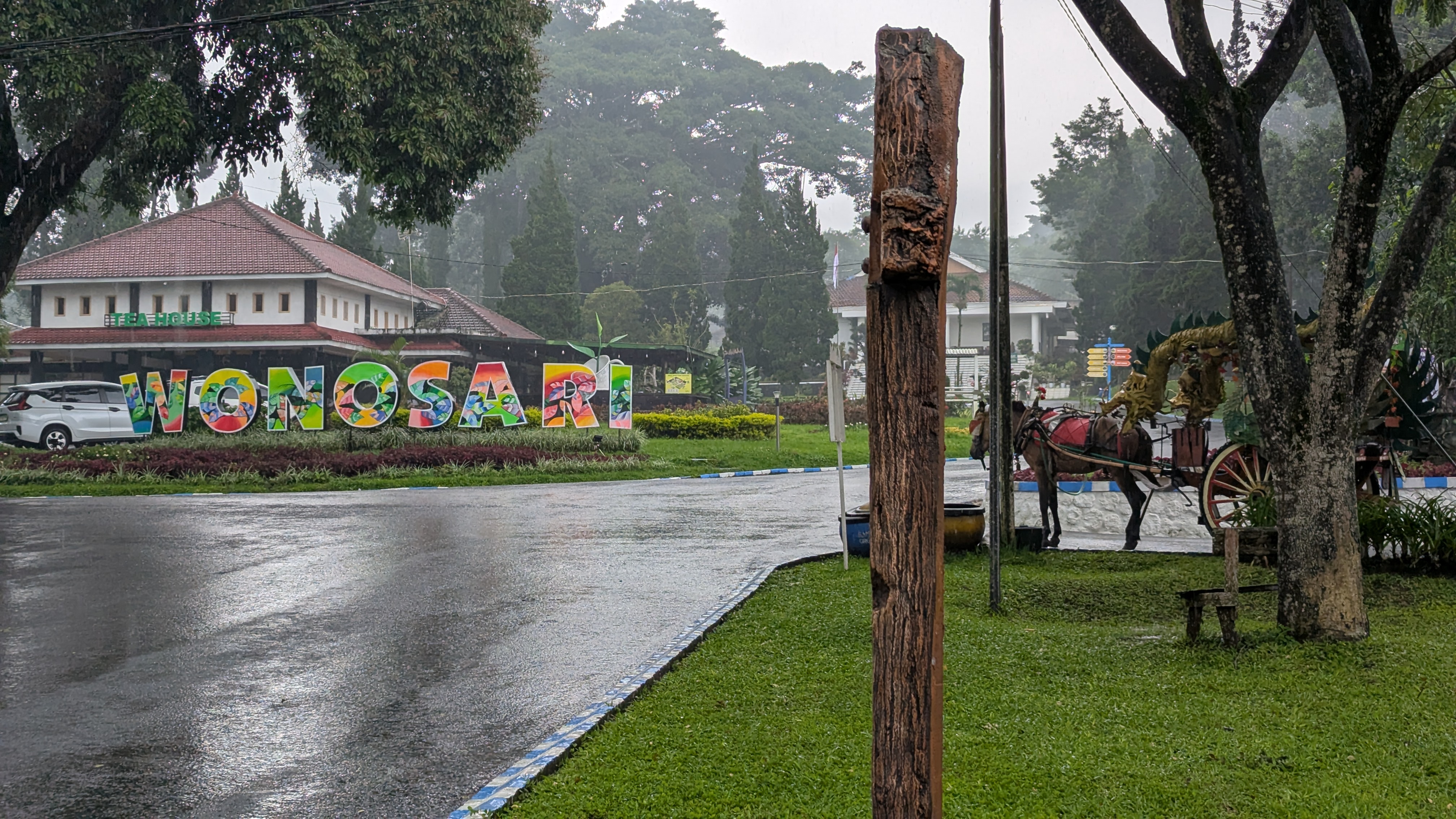
The first day I was in Indonesia, we visited Wonosari Tea Plantation on the slopes of the Arjuna volcano. It's nearly a thousand meters above sea level, which keeps the climate cool enough for the tea plants to survive; lower down the tropical climate would be too hot for them.

Photo taken during a downpour that rolled in while we were there.

Seeing the fields of tea plants was rather interesting. One thing that struck me about them was that they had other trees planted at regular intervals in them, as seen in the photo below. I don't recall all the reasons our guide mentioned as to why, but I remember they at least use wood from the trees as fuel, and they might have other uses too (like shade for the tea harvesters, or attracting pollinators or biological pest control, perhaps).

You can see the tea plants in the photo above, growing as roughly waist-height bushes. Something I learned from our guide is that tea plants, if left alone, are really tea trees, growing to some 20 feet high or more. (They left a few to grow naturally as a demonstration.) So in a sense, all the plants here are tea bonsai, which I found rather amusing.

Perhaps the reason they're so small is because they're constantly having the buds and new leaves nipped off for tea. The fountain statue above shows the all-important part of the plant which is harvested: the bud and no more than two leaves down. Those sprigs of tea go into a sorting and drying process which happens on site and which we got a tour of, but weren't allowed to take pictures of. It was an interesting process; the plantation is quite large, and while I don't remember the exact amounts I think they were shipping out hundreds of pounds (possibly tons) of tea every single day (since the tea can grow year-round, and they can just work their way around the fields giving each section time to regrow).

Anyway, it was a neat tour, and afterwards I was going to send my drone up and get some photos only for a tropical downpour to roll in (as seen in the top photo, which I actually took as we were leaving). I'm a little bummed about missing out on that since I think I would have gotten some amazing views, but I did get to use my drone later on so that's something to look forward to. I'm not sure how many posts I'll get out of this trip, but there should be another one or two coming at least. A hui hou!

Thursday, November 28, 2024

Sizing koa saplings

Yesterday I went back up to the State Tree Nursery in Waimea to volunteer again (after my first time there three weeks earlier). I had thought we'd be doing the same thing, but discovered we were doing something a little different this time. Instead of transplanting seedlings from their germination beds into individual growing containers, we had trays of already-transplanted saplings several months old, and were dividing them by size (and spacing them out a little more) to help the smaller ones grow better without getting shading out by the taller ones.

(When does a seedling become a sapling, anyway? I guess that's a bit like asking when a baby becomes a child…)

(Oh, and happy Thanksgiving!)

This photo shows the process: on the right, a tray of saplings of various sizes, which I sorted into the four trays on the table. (I started with three size categories, but found four worked slightly better after some experience, which is why they go second-smallest/largest/second-largest/smallest from left to right.) We also gave them a bit of fertilizer, and removed any weeds that had sprouted. It was a rather meditative (and surprisingly satisfying) experience, as I quickly became proficient at sizing saplings and there was a hydroponic setup with some gently recirculating water that made it a very low-stress, soothing time. Perhaps as a result I didn't bother counting closely, but we probably handled some two thousand or so saplings over the course of the morning, finishing about 1:30 in the afternoon.

One other interesting thing I got to see was koa seeds (above). Koa is in the Fabaceae or pea family, and forms little leguminous seed pods which contain the seeds, which are about the size of a soybean, though a lot flatter.

Anyway, that's all the volunteering for the Mauna Kea Forest Restoration Project I have for now; the volunteering opportunities they have aren't spread evenly throughout the year, but tend to bunch up somewhat. I asked about the saplings I helped sort yesterday, and was told they'll probably be planted next spring in a few months, so who knows, I might get a chance to help put them in the ground come that time. We'll see! A hui hou!

Wednesday, November 13, 2024

Transplanting koa seedlings

Last week I had the opportunity to volunteer at the State Tree Nursery over in Waimea. We were helping transplant koa seedling from their germination beds into individual containers, to grow up a bit more before being used for reforestation efforts on Maunakea next year. If you remember when I volunteered to go planting back in the spring, this is where those saplings we were planting came from. It was interesting to see that, a bit like reading a prequel story. 

Here's a photo of what we were working with – hundreds of seedlings, germinated together in a bed on a table.

Each went into its own individual container, to grow until they're about waist height and ready for outplanting.

And here's how many we had left at the end of the day! I know I personally filled six racks of fifty containers each (plus helped fill a few more), so between volunteers and staff that were there that day we probably transplanted over two thousand seedlings, easily. Not all of them will survive when planted in the wild, but that's still quite a few trees that will go out next year! And this was just one day of four – I'll be heading back on the 27th for another day of transplanting.

In fact, as I took Old Saddle Road to Waimea in the morning, I drove by where I'd helped plant saplings earlier this year and caught glimpses of some of them in passing. I don't know how long koa take to grow – I imagine it's on the order of decades – so it'll probably be a while until they're majestic trees, but it was inspiring to see them growing there. Hopefully I'll have more opportunities to help with planting in the future. A hui hou!

Thursday, October 17, 2024

Catching Comet Tsuchinshan–ATLAS

Tuesday evening I drove up Maunakea to the Visitor Information Station to see if I could spot Comet C/2023 A3, a.k.a. Comet Tsuchinshan–ATLAS. I hadn't felt particularly motivated to get up before dawn to see it earlier, but now that it's in the evening sky I figured I'd see if I could spot it.

For an astronomer, I'm a little embarrassed at how few comets I've actually seen. While solar eclipses (which I actually have never seen) either land in very out-of-the-way places or come at inconvenient times when I'm scrambling not to spend money on travel, I haven't lacked for chances over the past few decades to see comets (though a few, like Comet NEOWISE in 2020, did come at times when I wasn't really able to get somewhere dark enough to see them). Still, I don't have much excuse for missing Comet McNaught in 2007 or Comet Lovejoy in 2011. I did see Comet Holmes' remarkable brightening in 2007, though that was an unusual comet since we were seeing it almost head-on, so it didn't really display much of a tail. There are probably a few more I missed in that time span as well which I've forgotten; on the whole, I have a pretty poor track record of seeing naked-eye comets even when presented with the opportunity.

Which is why I found myself yesterday trudging up the path to the top of Puʻu Kalepeamoa in some extremely strong (and frigid) winds, setting up my GoPro for a timelapse, and waiting for the sunset. The timelapse didn't quite work out as planned since it failed to adjust the exposure time properly after it got dark, but I managed to get some photos, at least. 

The setting Sun through a māmane tree. They're in bloom this time of year.
The nearly-full Moon, unfortunately, wasn't doing the comet any favors as it lit up the night sky. I was first able to make it out maybe a half hour after sunset, then as twilight faded it became easily visible for perhaps another hour or so; by the time I left, nearly two hours after sunset, it was getting low enough on the horizon to be difficult to make out again.
Comet Tsuchinshan-ATLAS over Hualālai, with Venus at left.

With that, I can finally say that I've seen a proper, honest-to-goodness hairy star, and I have the pictures to prove it. Speaking of, I got those shots with my Pixel 7 Pro; not as good as a professional camera, but it's still remarkable to me just how good the software and hardware in phones has gotten, that it can capture shots like this in low light. (I did set it up on a tripod for stability, but still.)

Overall it was an interesting experience, and I'm glad I made the effort to see it. (Though after sitting out in those winds, maybe I should've gotten up to see it before dawn from Hilo, where it'd be warm[er] and humid instead of frigid and parched…) It should still be visible for a little while, perhaps the next few weeks; the Moon will start rising later and it'll be getting higher above the horizon, which will both make it easier to see, but it's also receding from the Sun which will make it get fainter, so there's a tension between the various effects. The next few days should still be good, though, and I'd recommend making the effort if you haven't seen it. I probably won't head up Maunakea again, but I'll try to keep an eye out for it from Hilo as it rises high enough now to be seen above the western horizon. A hui hou!

Tuesday, May 14, 2024

A new view of the Wailuku

It's been so rainy for the past few months that I haven't had many chances to put a drone in the air. Last Friday we had an absolute downpour of up to 3 inches per hour for a short time, which caused a pretty widespread power outage including at the Gemini offices. I heard of one person in Piʻihonua whose rain gauge went from empty to 7 inches over the course of the day. A few weeks ago the rain let up long enough for me to get in a flight, and while the lighting isn't the best as it was still overcast I thought the photos I got were interesting enough to share.

I've been vaguely aware that there's a small hydroelectric power station in Hilo on the Wailuku River for some years now (it gets mentioned in the occasional local news article), but didn't actually know where it was located. There's an electrical station next to the river near downtown which I thought was associated with it, but I recently learned that it's actually upstream, outside the city proper above Waiale Falls (in Piʻihonua, actually).

I'm pretty sure that's it in the photo below, given the water coming out (though I don't know where the intake is). It's not very large, which makes sense since the Wailuku, though it reliably flows all year, spends most of its time in a very low flow state that can't be providing that much energy. I found myself more enchanted by the rest of the scene, with the emerald-green grass and the Wailuku rising up the mountain side, a distant waterfall barely glimpsed in the distance. It's quite idyllic…though the invasive Molucca albizia trees growing on the right shore spoil the mood a bit. (They grow faster than native trees and crowd and shade them out, but are pretty fragile and easily drop large branches, making them dangerous during storms.)

Anyway, that's all for now. I just wanted to share a nice photo of a new part of the Wailuku I hadn't really explored before. A hui hou!

Tuesday, April 2, 2024

Reforesting Mauna Kea

Last week I took the opportunity for a new experience: helping plant trees with the Mauna Kea Forest Restoration Project. For background, much of the high-elevation slopes of Mauna Kea was originally upland forest. A lot of that forest was later cleared for grazing cattle or as a result of grazing by invasive ungulate species; I don't know the exact details, but the point is that a lot of former upland forests is now upland grasslands. Montane prairie? (It does tend to remind me of the prairies of Nebraska when I'm up there, and a co-worker mentioned it reminded him of Scotland.) I'm sure there's a term for it.

Anyway, the location this time was the Kaʻohe Restoration Area on the west side of Mauna Kea about 6,000 feet (~1,800 meters) up. The area is part of the habitat range of the endangered palila, of which only a few hundred individuals remain (mostly in the wild, though there's also a captive breeding program). The hope is that, by restoring the forests that originally blanketed the mountain slopes, palila and other various endangered native birds will have more habitat available and able to expand their ranges. The area we were planting in was directly along the highway running between Saddle Road and Waimea, so it'll be easy to spot the trees growing in future while driving by.

Drone view from above Puʻu Ahumoa, a cinder cone up mauka (uphill) of where we were planting.

This time we were planting koa seedlings, a tree in the Acacia genus endemic to Hawaii famed as a hardwood for making canoes, surfboards, and other things (and unusual for being a thornless Acacia). The seedlings were either one or two years old (I think the latter), and already a few feet tall. We started with 800 seedlings, and despite having only about half the number of people who'd signed up we managed to plant 765 of them over the course of about five hours. (And only stopped because we ran out of gas for the portable hole drillers and didn't have a means to manually dig holes!)

My first tree planted!
Interestingly, I learned that koa have “baby” and “mature” leaves, though the mature type are not true leaves, but actually phyllodes – enlarged and flattened petioles (the leaf “stalk”) which take on the function of leaves. The photo below shows one of a few koa that had been planted in the same location last year to test how well they would grow, and shows both types of leaves on the same plant.

A ~3 year-old sapling showing different leaf types.

The weather was also interesting, being clear and sunny throughout the morning before a cloud rolled in over lunch turning everything misty and foggy (which was pretty typical, I learned from people who'd been there for a lot of plantings). Last year's archaeology experience gave me a good idea of how to prepare, though being well above rather than below sea level meant the sun was completely unforgiving. (I missed a patch of sunscreen just below one eye, with the resulting sunburn Wednesday morning looking humorously like I had a black eye.)

Me with seedlings after lunch, to get an idea of the scale.
All in all it was a fun experience, though my knees are still sore a week later from all the up-down-up-down involved. I'd definitely like to go again (after some time to recuperate), though probably not very often as the days it happens are unfortunately mostly during the week (though this occasion was on Prince Kuhio Day, a holiday, so I'll keep an eye out for opportunities). It feels nice to be part of regrowing forests, and knowing that the trees I planted could potentially be seen by people driving by for decades or even centuries to come. We'll see what comes of it in future! A hui hou!

Thursday, May 6, 2021

Mars: Birthday #17

In the first of this month's birthdays, today I have my 17th birthday on Mars. That'll be the lowest number we see this month, since Mars orbits the Sun the slowest.

To give me something to talk about in these posts, I've decided to do something I don't normally do and post some photos of a painting in progress. I started this one in March, and it's not finished as of today, so this will be some good motivation to keep working on it. It was actually directly inspired by my previous painting, though I expect the link will not be obvious; I'll reveal it when the painting's done, and leave it to your imagination in the meantime.

Anyway, for this painting, I needed a background looking like bark, so I decided to try something new and do some plein air painting. En plein air is a French term meaning “outdoors,” and plein air painting is the act of painting outdoors, as opposed to inside a studio. While I could simply look up bark textures online, I decided I wanted to paint one from life, so I packed up some supplies and headed out to the nearest tree.

Setting up the easel and canvas next to my model.

Turns out plein air painting, especially with acrylics, is a very different beast to painting indoors. I picked a moderately sunny day, and my acrylic paint—already known for drying quickly—was drying even faster both on the palette and the canvas. I made liberal use of the spray bottle I brought with me, furiously misting everything in an attempt to keep everything damp enough to work with, but still ended up rushing to capture the texture as quickly as I could (I sketched it out roughly on the canvas first). While this generated a unique sort of pressure to the painting, I don't think it was negative, exactly; I ended up using some very fast, loose brush strokes, which gave it a somewhat freer quality than normal for me, I think. Anyway, here's a shot I got of myself with the finished product:

The Sun came out from behind the clouds after a while.

…and here's a closeup of the canvas:

Sort of looks like bark, if you squint?

As you can see, I only used the tree as a reference for the texture, not the color. As to why I chose the particular colors I did, well, that's part of the composition…which I'll reveal on my next birthday! For now, I'll leave you with the fruit of my first experiment in plein air painting, while I get back to work. A hui hou!

Sunday, June 30, 2019

Paintings and Pie

Friday was Tau Day (where \(\tau=2\pi\)), so for Journal Club that morning I and another guy at Swinburne brought in two (homemade) pies. I can't, to my knowledge, remember baking a pie before, but it turned out to be really easy: I settled on a blueberry pie (which I haven't had in ages), and with a pre-made frozen pie crust the rest of the pie-making was surprisingly simple. It came out tasting amazing, so I'll probably experiment with more pie-making in the future. I've noticed that fruit pies seem to be somewhat rare in Australia compared to the U.S.; they're not unknown, as I came across pre-made frozen apple pie while looking for pie crusts, but they're definitely not a common thing.

Delicious blueberry pie.

On the topic of painting, I recently finished a small landscape painting I started back in February and didn't get back around to working on for a few months. It's going to be…either a highly belated or an extremely early (depending on how you look at it) Christmas gift for my housemate's parents who had me over for Christmas last year.

“Dandenong Nighttime Vista,” canvas, 10”×8”.
I had some silver paint leftover from another project, and as I'd been planning to do a sort of moonlight-on-the-forest-leaves effect I tried using silver for it. (I also used it for the stars, where I think it works quite well.) I'm not 100% convinced it works—I probably shouldn't have spread it horizontally so much in the background as that makes it look more like moonlight on water—but it does make for an interesting and perhaps unconventional approach. I am pretty happy about the trees in the foreground, as I spent quite a while painting all the vertical lines making them up.

Finally, you may remember my Easter painting from back in April. Although my original intent was to try a looser, more impressionistic style for it—as seen in the sky, the first part I did—it morphed into my more usual meticulous, detailed style along the way. I was never quite happy about the sky, therefore, so although I had intended it to be finished by Easter, I ended up going back and reworking it. It fact, I reworked the sky twice before being satisfied with it, and ended up detailing some of the mid- and foreground more as well. It's still recognizably the same painting, but I'm a lot happier with it in its current state now:

“Easter Morning,” 40×30 cm.
I've also been working on some space-related paintings for an exhibit I'll be participating in in honor of the 50th anniversary of Apollo 11 next month, but things are all in the final stages of coming together for that, so I'll get some pictures of the works I and others have contributed for that soon. I'm looking forward to seeing it all hung and ready for exhibition! A hui hou!

Saturday, September 15, 2018

Walking About in “The Bush”

It's been a bit quiet on the ol’ blog front recently, hasn't it? I've had a few ideas for posts in mind but never seem to find time to realize them—I've been pretty busy with a number of things lately, including a new project I'm not quite ready to show off yet but has something to do with this:

Clearly, I've started up a paint factory.
Last week I went on a nature walk with a bunch of other young adults from church, which was a really enjoyable experience. It was one of the first days showing indications of spring so far this year, and the weather was pretty much perfect. We went for a (short) walk along the Yarra River (which flows through the heart of Melbourne) through “the bush,” a thick forest of eucalypts, wattles, and other Australian flora. (The only fauna we saw were some cockatoos, including some beautiful black ones, but we did hear a kookaburra.)

The Yarra River in panorama from the trail.
I still find it amusing that—due to growing up in a small eucalyptus grove in California—the smell of warm eucalyptus (…or wet eucalyptus, or really any eucalyptus) instantly makes me feel at home. Anyway, hopefully I'll have time to post some more soon, including my secret painting project which I'm enjoying far more than I expected. A hui hou!

Monday, April 16, 2018

April Astrobite, a Supercomputer Tour, and Other News!

So this is a few days late, but I wrote another post for Astrobites this month back on the 12th. It covers a really cool paper about the largest flare yet observed from Proxima Centauri, the closest star to the Sun. Proxima Centauri is a red dwarf, the most common type of star in the universe, but also the faintest; it emits a mere 0.17% of the light the Sun does, and despite being the closest star at just over 4 light-years away normally sits at about magnitude 11.13, or over a hundred times fainter than can be seen with the naked eye. However, during the flare reported in the paper, the authors calculate that it would have briefly reached up to magnitude 6.8, making it just barely visible to the naked eye from a very dark site for a few minutes! Pretty nifty! I even got an email from the lead author on the paper saying he'd enjoyed my summary of it, so that was nice.


In other news, I was fortunate enough to tag along on a tour of Swinburne's new supercomputer. (We are the “College of Astrophysics and Supercomputing,” after all!) It's called OzStar and replaces an older supercomputer called G2, though that one will still be in operation for most of the rest of the year to give people time to switch over.

OzStar, CAS's new supercomputer. I don't actually have reason to use it myself, sadly.


Going through all my photos in my panorama series, I've been struck by just how many photos of random birds I take. So have another one of some really colorful parrots I found in a eucalyptus tree near where I live one day while walking!

Parrots! Really colorful ones, too. These pictures are all from my new S9+, by the way.


And finally, one thing I haven't been able to find here in Australia is my favorite salad dressing, Hidden Valley Ranch. You can get Ranch dressing here, but there's usually only a single kind on sale. One of my friends from church was in the US for a few weeks as part of a school trip and very kindly brought me back the ambrosia below:

Just can't beat the original.


I also gave my first public Astrotour at Swinburne last week! We have a 3D theater that is used primarily for public outreach with grad students and faculty who volunteer giving talks to both school groups and the general public. I signed up last year, and gave my first talk to a small public audience last Tuesday. I felt rather rusty and disjointed as it's been so long since I gave a public talk about astronomy, but all that practice at the VIS paid off and it seems to have gone well. I've got another scheduled for the 30th of April, though I think this one is a school group, so that'll probably be a very different experience.

And I think that's all so far for this surprisingly busy month. Oh yes, last week I finally managed to write some code that collated some information on atomic transition lines that we've been trying to get together for a few months now, and this week we sent them off to some collaborators to do some calculations for us. So that's a huge weight off my chest. A hui hou!

Saturday, April 7, 2018

Personal Panoramic History, Part 4: 2011

In the previous post in this series we looked at a whole bunch of panoramas of Mauna Loa. In 2011, in contrast…okay, I can't lie, we'll see a few more panoramas of Mauna Loa. If ever there were mountains made for panoramic viewing, it's Mauna Kea and Mauna Loa. But! We'll also see some new and unique vistas which for various reasons I haven't had the chance to recreate.

2011 was the year I finished college and graduated from UH Hilo, and thanks to all the volunteering I'd done at the Visitor Information Station I had a job lined up to start there in 2012. But for now, let's get on to the pictures…

January


In January 2011 my housemate Jonathan and I decided it'd be cool to try to get some photos of the Sun rising out of the ocean from Hilo. It took us several trips to various locations around Hilo at the crack of dawn over the course of a few weeks to realize that the joke was on us: there are always clouds away off on the eastern horizon around Hawaiʻi. So we never did get the pictures of the Sun rising majestically out of the ocean like we wanted, but at least I got this first light panorama of Hilo Bay out of it (unintentionally, I only found and put these photos together while writing this post):

Mauna Kea over Hilo Bay. Coconut Island on the right.
This panorama from the morning of January 17th shows Mauna Kea, resplendent in the pre-dawn chill, with Hilo stretched out along the left side of the image and Coconut Island on the right. You can probably only see it if you already know what you're looking for, but you can see the breakwater that protects the bay stretching along the horizon behind Coconut Island on the right side of the picture. It looks like it may have been raining north of Hilo and further up the slopes of Mauna Kea that day.

February


On February 22nd I hiked the summit trail of Mauna Kea (down) for the first (and so far only) time as part of a volunteer effort to pick up trash and keep the trail clean. (As before, you can follow that link and mouseover the panoramas in the post to see the original hand-made versions.) This allowed me to get a panorama of a rather different body of water:

Lake Waiau.
This is Lake Waiau, at an elevation of 13,020 feet (3970 m) making it one of the higher lakes in the world (though it depends strongly upon which list of lofty lakes you consult, as there's no official definition of what a lake is). I did originally have a picture of the right hand side of the lake (its north end, from this perspective), but somehow lost it in the process of transferring the photos from my camera to my computer all the way back when I made my first, manual version of this panorama. I have another panorama of this lake, but that's for a future post!

Mauna Loa, from part-way down the south slope of Mauna Kea.
And here's our first Mauna Loa panorama for the year, from somewhere down the trail. The summit area of Mauna Kea is so broad and flat that it can be hard to remember you're on top of a mountain sometimes, but as you descend you reach some (moderately) steeper bits that allow you look down and see the Saddle region spreading before you, with Mauna Loa in the distance. If you look closely you can even just make out Hualālai peeking over the hills on the right. This is definitely another one of my favorite panoramas I've taken.

June


On the 12th of June I had the opportunity to hike to the actual summit of Mauna Kea, something I've only done three or four times over the years despite being in the general area more frequently. (It's not a long walk, it's perhaps ten minutes or so from the closest road, I just never usually had time when I was up there due to other duties.) Whenever I had the chance to do so, however, I'd always discover that I had either forgotten my camera, its batteries were dead, or the weather was so bad that I couldn't get pictures (it wouldn't be until January of 2012 that I got my first smart phone, and I had no way of getting photos off the phone I had before that).

Except this time. For once I'd remembered my camera, it still had battery power, and the weather, though not great, was good enough to get this panorama:

Mauna Loa and Mauna Kea summit.
This may be the only picture on this blog from Mauna Kea's summit, at the rarefied height of 13,796 feet (4,205 meters). This view stretches from looking east on the left down towards Mauna Loa to the south. As you can see the weather was not particularly great that day, with lots of cloud cover both around the slopes of the volcanoes and also much higher up. The cinder cone bowl seen in the foreground on the right of the image is Puʻu Wēkiu, wēkiu meaning “summit” in Hawaiian. The summit proper is simply the highest point in its rim.

I really wish I'd done a 360° panorama for this one. Oh well, future life goals I guess. Someday when the weather's better would make a better picture anyway.

July


Come July I was once again back home in California visiting family, and my mom's family had a reunion up in Washington so we drove up through Oregon to attend. Along the way we stopped at some pretty nifty places, and I was able to get a few panoramas out of it (only one of which has shown up on this blog before).

One of the places we stopped was Crater Lake inside Mount Mazama, which is a fabulously cool place to visit. Despite visiting in July there was still plenty of snow piled high in places.

Crater Lake, with Phantom Ship visible.
This simple four-photo panorama comes from somewhere on the south-eastern side on the rim of the massive caldera that makes up the lake. Visible near the bottom-center is Phantom Ship, the smaller of the two islands in the lake. This and the next panorama were only created while writing this post, so they're new to me as well!

Crater Lake, this time with the much larger Wizard Island visible.
This panorama comes from the walkway heading towards the Visitor Center which provides an overlook of and lots of information about Crater Lake itself. In this shot the much larger Wizard Island near the western side of the lake is visible. The lake is 1,949 feet (594 meters) deep at its deepest point, yet Wizard Island still towers an additional 755 feet (230 meters) above its surface! It's a cinder cone formed in the caldera after the monumental eruption that dropped Mount Mazama's height by nearly a kilometer and created the original caldera.

Crater Lake with Wizard Island again, from the Visitor Center.
Finally, this panorama is one I've shown before, though this version was created with Hugin rather than by hand (you can compare the two by mousing over the image in the linked post). I really didn't write that much about Crater Lake when I visited it, which is a shame because it's a fascinating place. Especially after living in Hawaii for a few years and becoming acquainted with volcanoes.

For instance, Crater Lake is the deepest lake in the US, the ninth deepest in the world, and has some of the clearest water of any natural bodies of water anywhere. And the scale is simply mind-blowing: Mount Mazama was estimated to be about 12,000 feet (3,200 meters) high before its fateful eruption; the highest point on the rim is now 8,159 feet (2,487 meters). A beautiful and poignant reminder of the raw energy of the natural world.

Another place we stopped after visiting the lake was the John Day Fossil Beds National Monument, Painted Hills Unit. (Hooray for taking pictures of signs so I know where it was!) These two panoramas were both two-photo accidental panoramas that I only discovered while writing this post.

Painted Hills, Oregon.
The landscape was truly spectacular. I wish I'd created more panoramas while I was there, as there was no shortage of subjects.

Oregonian bluff.
I'm not sure what this bluff is called (if anything), or where it is exactly—all I can tell is that we took a few group photos in front of it after I got this panorama and it appears to be near where we ate a picnic lunch. It's a great representative of the landscape in the area, though!

September


September found me back in Hawaii, taking pictures of the same familiar subjects once again: more Mauna Loa panoramas! Seriously, I'll have to count how many different ones this single volcano's featured in when I finish this series…

Mauna Loa.
This panorama and the next are reminiscent of a similar one from 2009 seen in part 2 (though here the grass is brown and dry). Possibly an attempt to recreate it, as the 2009 version is one of my favorite panoramas I've taken. Don't look too closely at those fence wires, they kinda pop in and out of existence near the bottom of the image. I imagine close-in fine details like that are difficult for Hugin to deal with when there isn't enough photo coverage and the perspective changes rapidly.

Mauna Loa, again.
This panorama (from a zoomed-in perspective) is the Hugin version of a panorama I originally created manually whose existence led me to discover this forgotten post where I'd already shown off the manual version but forgotten to apply any tags. Don't look too closely at the barbed wire in this one either.

Mauna Loa, from just outside the Keck building.
This two-photo mini-panorama comes from outside the Keck building, though it doesn't show much other than Mauna Loa in the background and some of the so-called Sub-millimeter Valley where the telescopes sensitive to light with sub-millimeter wavelengths reside. You can see CSO in the middle, and some of JCMT on the right. Pretty sure this wasn't planned to be a panorama originally or I'd have taken photos with a wider coverage.

November


On November 4th the University Astrophysics Club was able to get a tour of Gemini North, the InfraRed Telescope Facility, and UH Hilo's own Hōkū Keʻa telescope. This trip is the snowiest it's been up at the summit while I've been up there, which makes for some great images! The first two here I only created in the process of writing this post.

Snowy Mauna Kea summit, overlooking Submillimeter valley.
Another shot from outside Keck. (I'm not actually sure why, as I don't think a Keck tour was part of our itinerary—I don't have photos from inside it, anyway.) The snowfall must've been recent, but fairly light. (And judging by the distribution, must have come from the west, maybe? This is facing south towards Mauna Loa.)

Mauna Kea's snowy North Plateau.
This one's kinda interesting. It looks like it came from near IRTF, and is facing north over the North Plateau (where TMT, if it ever gets built, is slated to go). I don't usually take too many photos facing north like that, especially if the weather isn't clear and Maui isn't visible.


From a few weeks later (November 27th, to be precise) comes this panorama of Mauna Kea and Mauna Loa. Though it may not look it, this one is actually from a (slightly) different location to the others that have shown up so far. On the left of the image, between the peaks of Mauna Loa and Mauna Kea, you can see the peak of Puʻu Kelepeamoa, where several of these panoramas have been from. That peak, however, is merely the highest point in the rim of a giant cinder cone just below the Visitor Information Station (so large, in fact, that the Access Road runs through it). This panorama was taken from the second-highest point in the rim, on its eastern side. (Puʻu Kalepeamoa is on the west.)

In the original hand-made version of this panorama (visible at the link above) I put Mauna Loa on the right of Mauna Kea (possible as it's one of my rare full 360° panoramas), but I think this composition works a lot better.

December


In December of 2011 I graduated from UH Hilo (or technically, I participated in the ceremony, a slight miscalculation with paperwork meant that I didn't officially graduate until next semester). Also my family came out to visit for the first time! We did some sightseeing while everyone was there, and I have a lot of photos, but I could only find a single accidental panorama, from a botanical garden we visited a ways up the coast north of Hilo:

Hawaii Tropical Botanical Garden, looking out onto Onomea Bay. Don't look too closely at the middle palm tree.

And that's it for 2011! A pretty good year for panoramas, all told. The next post's going to be pretty short as I really didn't take too many panoramas in 2012, not even accidental ones to be discovered after the fact. There're a few good ones, though, and starting in 2012 there'll be ones taken with a phone camera—they're pretty awful at first, so it'll be interesting to watch them improve over the years. A hui hou!

Friday, March 30, 2018

Personal Panoramic History, Part 3: 2010

In the previous post in this series we looked at 2009 and a couple of my first attempts at taking panoramas of certain volcanoes. In 2010 I refined my technique a bit by taking panoramas of the same volcanoes—several times—but also experimented with some new things as well.

May


My first panorama of the year comes from May, when the University Astrophysics Club at UH Hilo was given a tour of the Subaru telescope. I had the chance to do a little hiking around Hale Pōhaku while we were waiting to acclimatize which I used to take the following panorama from the top of Puʻu Kelepeamoa (a popular sunset-viewing spot nearby):

Mauna Loa and Mauna Kea.
This was my first full 360° panorama. Actually, it went slightly more than a full turn around and when I first stitched a panorama together from the photos I refused to drop any of them, leading to a rather weird image with Mauna Kea in the center and the summit of Mauna Loa showing up twice, on either side. Hugin luckily can work out a full rotation and stop there, and also allows you to rotate your endpoints around, so I've made it a bit nicer looking by scooting Mauna Kea over to the side and no longer splitting Mauna Loa in twain. If you follow the link above you can see the original version by mousing over the panorama (which is now this new one) in the original post it came from.

June


Mauna Kea summit area.
In June I had another opportunity to visit Mauna Kea's summit (probably helping with a summit tour) and used it to snap this panorama. This one is taken from a totally different perspective than the one in part 2 which was taken from in front of the Keck building, which is the two identical domes near the center of the image. From left to right, you can see UKIRT, CSO (just barely), JCMT, SMA, Subarua, Keck I and II, IRTF, CFHT, and Gemini North.

July


In July I created this, my first and so far only astronomical panorama. This one's another hand-made image, as Hugin couldn't manage it. This is because the image is made up of twelve different images, each of which was a thirty second exposure in order to collect enough light. While thirty seconds is short enough that the star trails induced by the earth's rotation aren't too noticeable in each individual image, the entire sky would have moved pretty appreciably between the start and end of the series of exposures. I'm not entirely sure how I managed to wrangle this into a panorama myself—with a lot of effort, I suspect—and looking at it now I sometimes think I see some duplicate bits, but I'm still pretty happy with this view of the northern hemisphere summer Milky Way from the area near the Visitor Information Station on Mauna Kea. (You can see the glow from Hilo in the center of the image.)

August


In August 2010 while I was back home for vacation during the summer my family went on a two-day road trip around some parts of northern California, including the coast and through the redwood forests. This let me experiment with a vertical panorama:

The Chandelier Tree in Leggett, California.

This is a hand-made panorama, as I just couldn't get Hugin to make a good looking result. It probably has to do with the unusual way the perspective changes from standing on the ground and rotating the camera up to get pictures. It's an interesting challenge though; maybe I should try more vertical panoramas in the future.

November


In November 2010 I had my first chance to observe on Mauna Kea at Subaru while working as a student research assistant. Since we spent a day and a night at Hale Pōhaku acclimatizing before going up I had some time to hike a round and take a few panoramas:

Mauna Loa, Hualālai, and Mauna Kea.
You'd be forgiven for thinking I'd accidentally posted the same panorama from May again here. While writing this post I had to carefully double-check to make sure that I hadn't, as they both look pretty similar in the tiny preview thumbnails (this one has more cloud cover on the left, at least). While they do look very similar (and were taken from locations very close to each other on the top of Puʻu Kalepeamoa), the layout seen in both of them was created in this one and retroactively used for the May version when I was remaking both with Hugin. I like this layout a lot better, and I like to think it shows that I was getting a bit better at framing panoramas by this point.

Mauna Loa.
The previous panorama was taken from the summit of Puʻu Kalepeamoa, which is the hill in the foreground on the left of this image, which was taken from a cinder cone (or puʻu) slightly higher up Mauna Kea's flank. (Well, technically, “ka lepe a moa” means “the comb of the chicken”, and Puʻu Kelepeamoa is so named because it's a range of three or four rusty-red cinder cones that could be seen as a cock's comb, and I was technically still on [another part of] it while taking these pictures. The name is typically mostly used to refer to the hill lowest on the mountain and closest to the VIS, though.)

Mauna Loa and Hualālai.
This panorama was taken from a bit further up the flank of Mauna Kea again. In the foreground on the left you can see the summit of Puʻu Kalepeamoa again as well which helps give a sense of the movement between pictures. On the right side of this image you can see some more of the gigantic cinder cones (or puʻu) near the Visitor Information Station. These final two panoramas I'd never even created until writing this post so they're both completely new, which is a shame because I really like the last one—going through and creating these huge panoramas of gorgeous landscapes I just keep thinking “This would make a great picture to get printed and hang on my wall where I could actually enjoy it all at once, at full size.” Maybe in another decade or two when I can start to think about settling down and not moving every few years.


And that's it for 2010! I spent some time refining my panorama technique with the same choice of targets that year (you're probably sick of Mauan Loa panoramas from the north by now), but for the next part covering 2011 I'll have a few unique panoramas which, for various reasons, I've never repeated. A hui hou!