Showing posts with label the Moon. Show all posts

Sunday, May 30, 2021

Lunar eclipse of May 26, 2021

Thursday night we had a total lunar eclipse which turned out, quite surprisingly after a cloudy day, to be visible for most of its duration in the early evening. I'd been expecting to be clouded out so I had to scramble a bit, but I managed to set up my GoPro and take a video of nearly the entirety of the central, umbral portion. Taking an exposure every ten seconds for three hours got me thirty-six seconds of footage, which I've put into the video below (with a little zoom in afterwards on the Moon during totality).

I continue to be impressed at how good the quality of night footage a GoPro HERO 9 can get, especially with its comparatively minuscule aperture. While the full Moon is wildly overexposed at the beginning and end of the eclipse (which is to be expected with how bright it is), it actually works out pretty well during totality when it's darkest. I was amazed that you could even glimpse the dust lanes of the Milky Way at that point—I went out to look at it around then, and I definitely couldn't see a trace of them by eye. I'm glad I got the chance to try filming it, and thankfully the clouds only came in after totality and didn't block the main event. As the center of the Milky Way rises higher overhead in the weeks to come, I might try filming it around a new Moon if I get another clear night like tonight to see how well it comes out. Depends on the weather, of course, so we'll see! A hui hou!

Sunday, February 21, 2021

Sculpting Moon Craters: Tsiolkovskiy Crater

With all the end-of-year busyness last year, I never got around to posting about an artwork I finished back around December. (Then I decided it wasn't quite finished and did a little more work on it a few weeks ago, so go figure.) After my first foray into more three-dimensional sculpture back in 2019, I wanted to try something in a similar vein.

Back around December 2019 I was inspired by the crater Tsiolkovskiy (located on the far side of the Moon) to sculpt a crater out of clay and paint it. While much of the Moon's near side is covered with darker lava (as you can see by looking when the Moon is mostly full), most of the Moon's far side is lacking this, instead being the same color as the lighter areas of the near side (the “lunar highlands”). Tsiolkovskiy crater, named for Konstantin Tsiolkovskiy, one of the founding fathers of rocketry (with an important equation named after him too) is one of the rare exceptions, a crater with a floor flooded with dark lava. It's quite a large crater, too, with a diameter of some 300 km/185 miles; like many large craters it has a central “rebound” peak which towers an imposing 3200 m/10,500 ft above the smooth lava plains around it, around the height of Haleakalā above sea level.

Anyway, inspired by this fairly unique crater, I picked up a circular piece of artist's board about a year ago, painted it with an undercoat, and then left it on my desk for nine months during the lockdowns last year. When I was finally able to get back in to Swinburne and retrieve it, I picked up some modeling clay and started sculpting the crater's form, which proved to be quite fun!

The underlying topography of Tsiolkovskiy crater.

After letting the clay dry I painted it all a nice light gray, then got to the step which had originally inspired me: pouring a dark gray ‘lava’ into the crater to fill in the central plains. The paint turned out to be a little more viscous than I'd been imagining (even though it's called “self-leveling gel” for this sort of work!), but it worked out in the end.

With the dark lava plains filled in. North is roughly up in all of these photos, by the way.

I ended up painting it a little more gray after a few weeks—I'd been trying to give it a little tinge of color originally, but I felt it just wasn't working so I went back to a more neutral shade in the end.

“Tsiolkonskiy Crater,” 30 cm in diameter, modeling clay and acrylic.

Overall it's been a really interesting and fun project, and I might do more pieces in this vein in the future. It'd be cool to do a sculpture of Olympus Mons, for instance, or other famous craters, mountains, or valleys in the solar system. Given my love of experimenting with 3D effects on canvas, I suppose sculpture is simply a natural extension of that. With finishing my PhD on the horizon and the associated job-hunting and possibly-moving I don't know when I'll be able to make another one of these, but hopefully it won't be too long. A hui hou!

Tuesday, April 14, 2020

Forget Princess, I Want to Be an Astrophysicist

Back in January I showed off the picture below of a Christmas present from my mother. I've finally finished painting it, and it came out quite well if I do say so myself. Here's the original canvas:


And here's the finished version:


I really, really like how this came out. There's a few minor blemishes—mostly invisible in the photo—where I over-painted the boundaries and need touch them up when I get access to the Midnight Blue I used for the background again, but on the whole this gives me joy every time I see it. You might notice that the stars are all colored as if their sizes correspond to their relative masses, with the smallest being reddish, then orange, yellow, etc. I had to get creative with some of the colors since I finished it at home in quarantine without my full range of pigments, but I think it looks good. I decided that what looked like a ringed planet with a star coming out of it was actually a black hole with accretion disk devouring a star, and since I happened to have my Black 2.0 at home I was able to make it work. I'm glad to finally be able to show this off, it's been an interesting exercise in constraints painting it. While I've gone for very simple, solid shading much of the time I've also gone for more subtle and realistic shading in places, but I've stayed within the lines everywhere without adding anything. (I thought about stretching the accretion disk into photon rings around the black hole, but decided to stick to the lines.) Anyway, I now have this hanging behind me at my computer desk at home to continually remind me of my vocational aspirations. A hui hou!

Saturday, August 31, 2019

A Second Exhibition: Earth, Moon, and Mars Paintings

I've been incredibly busy this past month getting ready for my Mid-Candidature Review, which I passed on Thursday. (This wasn't helped by me coming down with a moderate case of the flu last week.) All of which meant that I didn't really mention here the exhibition I had some paintings in as part of the 50th anniversary of the Apollo 11 Moon landings, which was partly because I never even got to visit the gallery and see everything in person. (And yes, this means I'm now a twice-exhibited artist! Maybe I should add that to my résumé…)

Thankfully, my friend James at Swinburne visited and took some pictures for me, so you all get to see them after all. (All these pictures are courtesy of him; you can check out his website here.)

“Main Sequence”
The first one is one you've seen before, my series of stars on the main sequence. Here, though, they're arranged similarly to how they would be located on a Hertzprung-Russel diagram, from which the main sequence was first identified. This is how I'd always envisioned hanging them if I got the chance, so it was pretty cool to see.

“Tenuous Transport.” Individual panels 40×40 cm, or 40x80 cm. Acrylic, embroidery on canvas.
Now, this is an interesting one. It's a four-panel work (or tetraptych), of which I've posted the Moon painting before. The rest are new, however, and they're not all mine! This piece is a collaboration with another Swinburne student, Grace, who embroidered the outline of the Eagle (the Apollo 11 lander) on the second panel from the right. I had originally envisioned this piece as a single new panel, but while discussing it with everyone at one of our art workshops the topic of making it a multi-part collaborative effort came up, and since I already had the Moon painting it was a simple matter to paint a matching Earth painting to go with it. (Plus a few stars on a blank panel.) Grace meanwhile stitched the outline of the Eagle onto another canvas. The stitching and outline gave it a very fragile feeling, which led us to give the piece the name “Tenuous Transport” in recognition of the sheer fragility of the craft which carried the first humans to the Moon, and just how dangerous the journey was. (You definitely can't see it at this scale, but Grace also subtly highlighted some of the edges in the Moon in thread, making it an interesting mixed-media collaborative piece.)

Since it's probably not obvious at this size, the Earth painting is mostly looking at the Pacific Ocean; you can see Australia at the lower left, and the western coasts of North and South America on the right, but it's mostly water and clouds. Also now that I have it back I may go and touch up the shape of the terminator on the Earth a bit, as it doesn't quite match the Moon and it's been bugging me for a while.

“Vallis Marineris Afternoon Overlook.” 8×10 inches, acrylic on canvas.
And finally, here's a little piece I did unrelated to the Moon; instead, it's a view out over the colossal canyon Vallis Marineris on Mars. At least, that's what I intended, it never quite came together with the right perspective in my eyes, but at least the pink sky is really attractive. Much of the red color in this painting comes from iron oxide pigment, which is interesting because A) it's one of the first pigments people ever used for painting, as seen in cave paintings, and B) it's the reason for Mars' red color in the first place: iron oxide is rust. While I wouldn't call this one of my better works, it was still pretty fun to play around with some new colors I haven't really used before.

Anyway, those are some of the paintings I spent most of May, June, and the first half of July working on. Now that I've passed my Mid-Candidature Review I'm taking the next week off, which will hopefully allow me to get a lot of work done on the ones I've been working on since. A hui hou!

Sunday, June 30, 2019

Paintings and Pie

Friday was Tau Day (where \(\tau=2\pi\)), so for Journal Club that morning I and another guy at Swinburne brought in two (homemade) pies. I can't, to my knowledge, remember baking a pie before, but it turned out to be really easy: I settled on a blueberry pie (which I haven't had in ages), and with a pre-made frozen pie crust the rest of the pie-making was surprisingly simple. It came out tasting amazing, so I'll probably experiment with more pie-making in the future. I've noticed that fruit pies seem to be somewhat rare in Australia compared to the U.S.; they're not unknown, as I came across pre-made frozen apple pie while looking for pie crusts, but they're definitely not a common thing.

Delicious blueberry pie.

On the topic of painting, I recently finished a small landscape painting I started back in February and didn't get back around to working on for a few months. It's going to be…either a highly belated or an extremely early (depending on how you look at it) Christmas gift for my housemate's parents who had me over for Christmas last year.

“Dandenong Nighttime Vista,” canvas, 10”×8”.
I had some silver paint leftover from another project, and as I'd been planning to do a sort of moonlight-on-the-forest-leaves effect I tried using silver for it. (I also used it for the stars, where I think it works quite well.) I'm not 100% convinced it works—I probably shouldn't have spread it horizontally so much in the background as that makes it look more like moonlight on water—but it does make for an interesting and perhaps unconventional approach. I am pretty happy about the trees in the foreground, as I spent quite a while painting all the vertical lines making them up.

Finally, you may remember my Easter painting from back in April. Although my original intent was to try a looser, more impressionistic style for it—as seen in the sky, the first part I did—it morphed into my more usual meticulous, detailed style along the way. I was never quite happy about the sky, therefore, so although I had intended it to be finished by Easter, I ended up going back and reworking it. It fact, I reworked the sky twice before being satisfied with it, and ended up detailing some of the mid- and foreground more as well. It's still recognizably the same painting, but I'm a lot happier with it in its current state now:

“Easter Morning,” 40×30 cm.
I've also been working on some space-related paintings for an exhibit I'll be participating in in honor of the 50th anniversary of Apollo 11 next month, but things are all in the final stages of coming together for that, so I'll get some pictures of the works I and others have contributed for that soon. I'm looking forward to seeing it all hung and ready for exhibition! A hui hou!

Sunday, November 25, 2018

Moon-painting

I've finished my second painting project, a picture of the waxing crescent Moon illuminated by Earthshine. This one only took about a month, compared to my first one which took three, for a few reasons:
  1. This one is only 40x40 cm rather than 80x80 cm, or a quarter of the size of the first one.
  2. It uses a much more restricted palette (number of colors), mostly because:
  3. It's based on an actual astrophoto someone else took that I used as reference.
In fact it would have been finished even sooner, but for the SciCoder workshop last week leaving me no time to paint until Saturday. Still, it's finished now, and I'm pretty happy with it.

I only have one in-progress photo for this one; partly I forgot to take more, partly I chose not to because there often weren't significant differences between painting sessions.

You may be able to pick out, in the still un-painted areas, the pencil marks I sketched as a guide.
Here it is in progress, after two sessions; the first one I painted the sunlit side and maria (dark lava plains) there, and the second I started filling in the dark side highlands. It was interesting doing this one because I used a very restricted palette; white, black, gray, and one or two different types of blue.


And here's the finished product. I think this one looks a bit better from a distance, hence the wider shot of it hanging up in my kitchen. (The house I'm living in, very conveniently, has a ton of ready-made hooks for hanging things all over the walls.)

North is up in the painting so this is roughly how it'd look in the northern hemisphere, partly because I'm used to seeing it that way and partly because that's how the photo I painted it from looked. But you could easily flip it upside down to have a southern hemisphere view.

Anyway, it was a fun project, and interesting to paint with a restricted range of colors. I've already got several ideas in my head for future paintings, so we'll see which ones come to fruition first. Two weeks ago I discovered that the local art shop (where I'm now on a first-name basis with several of the employees) sells little 8×10 inch canvases by the 10-pack, so I've picked up one of those and have some Christmas presents to start painting… A hui hou!

Tuesday, January 9, 2018

2017 Retrospective: Making the World's First Let's Play of Dodge That Anvil!

Last year I created the world's first (and so far only) video Let's Play of Dodge That Anvil!.

The thought that I'd ever get to create the very first Let's Play of a game had never entered my mind prior to last year, but for those who have no idea what I just said, let me back up and explain. (I suggest listening to the game's soundtrack which can be found here in the background while reading, as it's great music and will help set the mood.)
  1. A “Let's Play” (or LP) is a fairly recent art form (stretching back perhaps two decades or so) that at its core involves playing though a game in order to share the experience with others. Typically this is done either in a series of videos of gameplay with accompanying commentary (with varying amounts of editing optional) or in the form of a mixture of textual commentary and screenshots, the type of game often dictating the best or most convenient format. Usually the person making the Let's Play does so because they love the game they're playing and want to share the joy playing it inspires with other people, and the love and dedication put into a truly great Let's Play can be a wonderful thing to behold (though actual levels of skill at the game and dedication to showing off everything in it vary).
  2. Dodge That Anvil! is an indie game made entirely by a single man named Jake Grandchamp that came out in 2006. I only discovered it sometime later—it must have been about 2007 or 2008, because I remember finding it and buying it around the time or soon after I started college. It has the humorous premise of a warren of technologically-savvy rabbits who grow their own crops but whose world is turned upside down one day when anvils begin raining from the sky, threatening all and sundry. The player is a brave “volunteer” who in order to feed the warren must run around harvesting crops while every few seconds an anvil falls out of the sky aimed at his head. (At least initially, later levels add more hazards of various kinds to avoid from exploding beach balls to anvils that come alive and chase you around like bulls to alien flying saucers from the Moon, who turn out to be the source of the anvils.) It's supported by a beautiful stylized art style, some amazing music, and a charming sense of humor in the writing that keeps it fun, but the real meat of the game is its gameplay, which is fast, fun, a little frantic, and utilizes the powerful Havok physics engine to create all kinds of hilarious emergent gameplay as anvils interact with the world, explosions, and each other.
After getting Dodge That Anvil! I played it off and on for about two years till moving away to college in 2009, often watched by my younger brothers. We all greatly enjoyed the experience, and the funny situations the game could come up with—I've got great memories of the three of us laughing uproariously at the latest foible of the physics engine. I then kind of forgot about it in the excitement of moving to Hawaii, and there things stood for almost a decade.

A shot from the first level, showing off an anvil trying to squish me as I gather crops from the tilled areas.
Last year I happened to remember Dodge That Anvil! out of the blue, and felt a nostalgic desire to see it in action again, so I typed its name into YouTube, and got…nothing. Well, not quite nothing, I found the original trailer for the game and a six-minute recording of someone playing the first level from the early days of YouTube soon after the game came out, but the point is that there were no Let's Plays. This is YouTube we're talking about here; if a game exists, someone, somewhere, has made a Let's Play about it. Usually more than one. But in this case, no one had.

After recovering from my surprise, I realized that this presented me with an incredible opportunity/responsibility: to make one myself. This immediately presented a slight problem, though: the game came out in 2006, the latest versions of Windows and Mac it officially worked on were almost a decade old by this point, and it didn't have a Linux version. The game's website was still up when I checked though, and even had the game download still working (the game allowed playing the first few levels as a demo before buying and unlocking the full game). I found my game key in an old Gmail chat nearly eight years old, installed Wine to run Windows applications, downloaded and installed the game, and to my pleasant surprise it ran on my computer (running Debian stable at the time). To my infinitely greater amazement, when I entered my game key at the appropriate screen, it thought for about two seconds and accepted it.


Here's a raging anvil trying to get me in a later level. Also note that it's now summer/fall instead of spring.
This is an indie game that had come out over a decade ago, and the key validation servers were still functioning. That blew my mind so hard that I distinctly remember sitting and staring at my computer screen open-mouthed for a few seconds in disbelief. Jake couldn't be making new sales of the game, not this long after the last supported versions of Windows and Mac were so many years behind, so the only reason those servers were still going had to be for people like me, who were coming back and installing the game again after so many years. That moment, right there, cemented my desire to make this the definitive Let's Play of Dodge That Anvil!—someone willing to spend money on keeping a key server alive over a decade after his game came out just so buyers could continue to play it deserved the very best I could give.

And so I did. Starting in March I steadily worked my way through the game I'd loved so much as a teenager. Unlike many of the games we look back on with rose-colored glasses, it lived up to my memories. The gameplay was just as good and frantic, the writing as humorous and charming, and I took just as many anvils to the noggin while distracted as I remembered. I did my best with every episode, explaining the many things I'd learned about the game, showing off all the secrets I could find, getting 100% completion on every level, all in pursuit of my quest to make a Let's Play that Jake could be proud of should he ever perchance come across it. I'd never been able to find out what happened to him after Dodge That Anvil! was published—he'd never released any other games that I could find and seemed to have dropped off the face of the earth, so I'd always wondered and this led me to push myself to share his wonderful game with the world lest it be forgotten.

Here's a later winter level, showing a multi-anvil strike called an anvil squadron. A split second later my hardhat makes the ultimate sacrifice to save me.
Dodge That Anvil! is actually a decently long game so I slowly worked my way through it at the rate of about one video a week, until August when the most amazing part of this story takes place. I'd finished the main story mode of the game (and was working on recording the post-game optional content) when a few days after posting the final story mode video I got one of the biggest surprises in my life: out of the blue, I got a message from Jake Grandchamp himself, saying that he'd randomly stumbled upon my Let's Play while searching YouTube to see if his original trailer was still up, and loved it! He explained that he'd long been a fan of Let's Plays and always secretly hoped that someone would make one of Dodge That Anvil!. He'd never expected to stumble upon such a good one over a decade after the game came out, he said, and it was worth the wait.

Needless to say I was thrilled beyond words that I'd succeeded in my mission of making a definitive Let's Play of a game which the creator himself could be proud of. We got to talking by email and as a token of his appreciation he sent me a package with a physical copy of the game (something I'd never had due to buying it online), the game's soundtrack, and an actual physical hard hat as a humorous reference to a running joke from my Let's Play of how many times I'd lose my hardhat to anvils and need to buy a new one. (I even did my first unboxing video ever with the package to capture my reactions upon opening it.)

Me wearing that hardhat at my job at the YTLA.
After that, I continued on with the game with renewed zeal. The climax of the game's story mode involves travelling to the Moon, but there's an optional Moon Mode that's unlocked after finishing the story that details the process of getting back from the Moon and involves playing on mirror-flipped versions of all the normal levels with low gravity and a space helmet taking the place of the hard hat to allow you to breathe. It starts to drag a bit near the end, but I've always enjoyed the feel of jumping around in low gravity and the usage of names of actual lunar landmarks for the levels.

Anyway, I finally finished Moon Mode (and by extension the story) near the end of November, a little over eight months since I started. It's been a long and sometimes arduous journey; the time I tried and failed one particular bonus challenge a hundred and thirty-eight times in a row comes to mind (Episode 12), or the time I forgot to record audio and had to add as much of the game's audio as I could back in by hand in editing (Episode 26), or the international move that happened two-thirds of the way through, or when I was two levels from the end of Moon Mode and upgrading from Debian stable to Debian testing wiped my save files, or…you get the picture. But on the whole it's been an incredibly rewarding experience and I'm very pleased with myself for having done it; it's something I can look back on and be proud of. It's definitely not a perfect Let's Play (though I like to think it gets better as it goes along), but I think I learned a lot about recording and video editing from the experience, and it pushed me to finally get a real microphone for vocal recordings and stop using my old phone as a makeshift mic.

Me fighting the final boss's ultimate weapon Anvil Prime on the Moon. It's a remarkably tense fight.
I'm not quite done with Dodge That Anvil! yet; near the beginning of January I put together a video of the game's soundtrack (linked at the start of this post) and I have some plans for a future video showing off some of the game's multiple game-changing codes (some of which I don't know that I've ever tried before, and the descriptions are quite intriguing!). For anyone who's interested and has survived this huge post, my full Let's Play playlist can be found here. I hope you enjoy it, and a hui hou!

Thursday, July 6, 2017

Nā Nananana o Mauna Loa (Or: The Spiders of Mauna Loa)

Two weeks ago I went to the optometrist and got some new contacts of a different brand to try, which also happened to be at my newly-updated prescription strength. Since then, every time I look further than a few hundred feet away I get a mini-jolt as I realize that I can see everything! In focus! No matter how far away! I can make out craters and maria on the moon again! (Apparently my eyes had drifted more than I realized from my old prescription…)

Due to a confluence of factors, I haven't actually been going up Mauna Loa for my job since before my eye appointment (instead working down in Hilo), until this week when I went up both Wednesday and Thursday (I write this having recently returned from the second night). The first night I was up there, I noticed a surprising number of spiders out in the middle of the night, where by “surprising” I mean “I'm surprised there were any spiders up there at all.” (Though come to think of it that's also the same evening a passing moth flew into my ear and freaked me out, so perhaps I shouldn't have been too surprised.) I noticed two spiders at different times over the course of the night by seeing the light from my head-lamp reflected in their eyes, both just out and about in the 5 °C/ 41 °F weather with apparently nary a care in the world.

I didn't think much of it beyond “Huh, there are spiders up here where I didn't expect them” until tonight, when I was driving down just after sunset after a short observing session in the late afternoon/early evening (which involved me getting a video of the telescope opening in daylight, so look for that in the future!). As I was driving down I noticed a spider's eye reflecting the headlights back at me, and pointed this out to my coworker Kristen who was in the car with me. She thought it was absolutely hilarious that I could pick out a spider at 30 miles per hour on a dark road, especially when she couldn't see the dozens of additional ones that I started noticing every few minutes down the road. (Other than a single one of the ones with a lustrous dark green/blue eye color.) Funnily enough we'd just been discussing contacts and glasses and other eye-related things and my updated prescription on the way up and how she'd been thinking of going to the optometrist and getting an updated prescription herself, and she's definitely going to do it soon after tonight!

So yeah: apparently “noticing lots more spiders” is one of the perks of correct prescription strength contacts. I think I'll keep the memory of those tiny spider eyes reflecting back at me from the dark handy for the next time I read The Hobbit. A hui hou!

(For the Hawaiian scholars out there, I debated on whether the spiders should be kino-ʻo or kino-ʻa for Mauna Loa [roughly, the difference between things owned inherently and things owned incidentally] and I'm not sure I chose correctly. Anyone who knows for sure feel free to confirm or correct me!)

Monday, September 14, 2015

Saturn's Rings and the Earth-Moon Distance

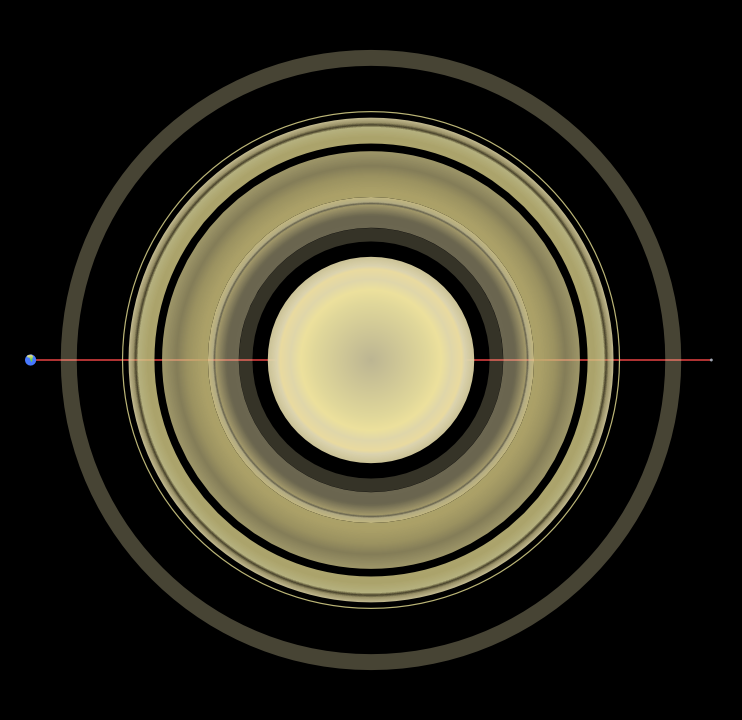
A few weeks ago I happened to hear offhand that Saturn and its rings would fit nicely in the space between the Earth and Moon. Being the visual-oriented person I am, I decided to go ahead and make a picture to put them in perspective, and figured I'd share.

First of all, a quick primer on the nomenclature of Saturn's rings. The rings are labeled alphabetically in order of discovery, although the A, B, and C rings were all discovered basically at the same time and the decision to name them working outward in towards the planet was pretty much arbitrary.


Technically the F ring is too thin to be shown here; it's only about 30–500 km thick which means it's about 40–400 times thinner than shown here. The relative brightnesses of the rings is also only approximate; the G ring (and even D ring) are also fainter than shown here, and aren't visible to the naked eye. They were only discovered with photography from various interplanetary probes after 1979 (as was the F ring). The F ring is the outermost of the “discrete” rings; beyond it, the rings are diffuse and may have moons orbiting embedded within them.

The astute among you might have noticed that there is a distinct lack of an E ring in the above image. Don't worry, we'll come back to that. Anyway, let's see how these rings stack up against the average Earth-Moon distance:


With an average separation distance between them of about 358,000 km, we can see that the Earth and the Moon nicely frame Saturn and its main rings there. It also gives a good idea of the size of Saturn relative to Earth.

But what about that E ring I glossed over a paragraph ago? Turns out the E ring is outside the G ring and extremely large, but like the G ring it's also extremely faint and diffuse.

Anyway, here's the E ring in all its glory (I've left the Earth, Moon, and the line between them in place):


Yeah, the E ring's pretty wide (and again, it's so diffuse that it's not visible to the naked eye). Its outer edge is just within the orbit of Saturn's largest moon, Titan. As you can see (or maybe not), the E ring's diameter is around twice as large as the average Earth-Moon distance.

But believe it or not, that's not all of Saturn's rings! There are a few more ringlets between the G and E ring that are too thin to show here, but there's another ring outside the E ring that's even larger and even more diffuse. This ring was only discovered in October 2009, and is known as the Phoebe ring after Saturn's unusual moon Phoebe which orbits just outside of it in a retrograde orbit. Here it is, with the rest of the ring system for comparison:


Yep, that little disc in the center is the E ring we just saw in the last picture—with the inner ring system and Saturn within that. This ring is really large. In fact, unlike the other rings which have a maximum thickness on the order of tens to maybe hundreds of meters, the Phoebe ring has a thickness around forty times greater than the radius of Saturn itself. In other words, this ring is thicker than the entire diameter of the E ring.

So there you have it! Saturn and its fascinating ring system, and how it compares to the distance between the Earth and the Moon. Hope you found it as interesting as I did putting these images together. A hui hou!

Friday, April 18, 2014

Lunar Eclipse Cycle

Monday night the moon underwent a beautiful total lunar eclipse. Sitting at my computer in front of my east-facing window I was able to watch the moon as it rose over the course of two hours while the earth's shadow slowly crept over it (when it was visible between the scattered clouds, that is!).

Lunar eclipses aren't as flashy as solar eclipses are, but while the majority of people will never see (or have the opportunity to see) a solar eclipse without traveling out of their way, lunar eclipses are visible to the entire night side of the world. I'm sorry that I didn't realize this one was coming up soon enough to advertise it ahead of the fact – I'll try to remember to do so for the next one, as it's a really cool experience to see one. This one was especially cool because the moon passed very close to Mars as it was at full coverage, making for quite the spectacle.

This eclipse was also interesting because it was the first in a cycle of four such total eclipses. The interactions between the earth and the moon are complex, and usually you get a mixture of partial and total lunar eclipses, but every so often we get these neat cycles of four total lunar eclipses in a row. The remaining three eclipses are set to take place on October 8 2014, April 4 2015, and September 28 2015. A hui hou!

Sunday, August 25, 2013

Science Clock Series: Part XI

Today's number comes from astronomy and is given by:

\[\approx\ \text{diameter of ♃(in \(\beta\); \(\oplus=1\beta\)}\] This is a slightly roundabout way of saying "approximately the diameter of Jupiter in Earth-diameters." Let's look at it a little more closely:

First of all, what in the world is ♃ supposed to be? Or \(\oplus\)? To answer those questions we need to go back in time. About 2,000 years in fact, give or take. You see, one thing that I've learned from idly inspecting ancient writing, whether written, inscribed, or etched, is that ancient people liked to abbreviate.

Although it surprised me at first, this is entirely reasonable when you think about it; we do it all the time in everyday life, especially with the proliferation of instant messaging. Ancient peoples had to write everything by hand, which in my opinion is very dull and tiresome. You start looking for ways to reduce the amount you have to write, and before you know it you've got abbreviations all over the place.

Anyway, writing goes back a long time, but for much of history it was limited to a thin slice of the most educated in society. The study of astronomy also goes back a long time, and was one of the most common subjects for that educated elite to study, given its importance to pre-Industrial societies in helping to determine things like the proper time to plant and harvest crops in order to ensure everyone didn't starve over the winter.

Put those fact together, and people have been writing about astronomy for a very long time. Some of the oldest writings we find have been discovered to be about astronomy. Since it was so important, and given that most people like to save time and effort when writing, ancient astronomers in the Hellenistic period around the time of Christ came up with a set of symbols to refer to the "planets."

Note that the word "planets" in this context refers to the seven "planets" of the Ptolemaic (and originally Aristotelian) heliocentric system: the Sun, the Moon, Mercury, Venus, Mars, Jupiter, and Saturn.These are the objects which, if you're familiar with the night sky, appear to move across it against the background of the fixed stars. Anyway, ancient astronomers came up with symbols for them that were used up through the Renaissance period. In fact, their use was so common that when astronomers such as William Herschel started discovering new planets astronomers rapidly came up with new symbols for them too. Anyway, here's a table with the symbols for the Sun, and the eight planets discovered before 1900:
\begin{align*}
\text{Sun}&\dots☉\\
\text{Mercury}&\dots☿\\
\text{Venus}&\dots♀\\
\text{Earth}&\dots\oplus\\
\text{Mars}&\dots♂\\
\text{Jupiter}&\dots♃\\
\text{Saturn}&\dots♄\\
\text{Uranus}&\dots♅\\
\text{Neptune}&\dots♆
\end{align*}You may be familiar with the symbols for Mars and Venus, as they have come to stand for “male” and “female” respectively in modern usage. Other than that, the only symbols commonly used in astronomy any more are the ones for the Sun and Earth. It's standard practice in astronomical journals for the symbols \(\text{R}_☉\), \(\text{M}_☉\), and \(\text{L}_☉\) to stand for the mass, radius, and luminosity of the Sun, respectively (and similarly for the Earth using the symbol for Earth).

It might give you some indication just how little known these symbols are today if I told you that right up until I looked them up to write this post I thought the symbol for Jupiter on my clock stood for Neptune!

Now that I know it stands for Jupiter, we can look at what the clock actually says: approximately the diameter of Jupiter in terms of “beta”, where “Earth” = 1 “beta.” I actually looked up beta to make sure there wasn't some special use for it that I wasn't aware of and couldn't find anything, so I'm not entirely sure what the point of introducing it only to immediately define it as one Earth was. Anyway, if we then check with the diameters of both Earth and Jupiter, we find that Jupiter does indeed have a diameter about 10.9377 times greater than Earth's.

So there you have it. And I realize this post isn't actually as short as I promised last time, though hopefully it was still interesting. There's a lot related to the astronomical symbols that I didn't cover, such as the fact that several were created for the first nineteen asteroids discovered before people realized that creating unique symbols for every asteroid would be effectively impossible and gave up (given that we now know of over a hundred thousand asteroids and suspect there may be ten times that number in the solar system, we can see that this was a good decision!).

Anyway, check back for the final post in this series, with a number from meteorology! Click here to jump directly to it.

Thursday, May 9, 2013

Partial Eclipse, Wholly Cloudy

Some of you may have been aware that there was a partial solar eclipse today (the 9th) that was visible only in a fairly narrow swath almost entirely over the Pacific Ocean. Since the Moon was close to apogee when it happened, and thus at its farthest point from Earth, it would not have been a total eclipse from anywhere on the Earth's surface (the Moon would have been too small); however, Hawai‘i was in the path close enough to the mid-line to have gotten about a 30% coverage of the Sun.

Unfortunately, despite the day beginning in bright sunshine, by noon it had clouded over, and by three o’ clock when the eclipse would have been most deep it had actually begun to rain (down in Hilo, though the web cam up at the Visitor Center showed a fair bit of cloud cover as well). So I wasn't able to see it this time, in case you were wondering (for the record, that makes the second partial solar eclipse I've been clouded out for since coming here).

Sunday, May 5, 2013

Moons and Months

It's probably not a big surprise to most of you to learn that the words for "moon" and "month" are related in English (and some other languages as well). Our Moon's orbital period of 27 days, 7 hours, and 41.1 minutes comes very close to the number of days you get when you divide the Earth's orbital period by twelve, and makes a nice natural division of time.

But have you ever thought about the moons of other planets? For example Mars' two moons, Phobos and Deimos, orbit their parent planet in just 7 hours 40 minutes and 30.3 hours respectively. Many of Jupiter and Saturn's close-in moons likewise orbit in less than an Earth day. In fact, there are dozens of moons with a shorter orbital period than our Moon.

On the flip side of the scale, there are also dozens of moons with longer orbital periods than our Moon. Jupiter and Saturn both also have lots of small, irregular moons that orbit far from their parent body, which can take months or even years to complete one orbit. Saturn's moon Phoebe, for instance, takes 550.3 days to make a complete circuit, nearly two Earth years. Prior to last week, I knew of a few Jovian moons with orbital periods measured in days in the 600's and 700's. Given Jupiter's humongous mass, you'd expect that it would be able to hold onto satellites further out than other planets, which would have correspondingly long orbital periods.

So you can imagine my surprise when I, on a whim, looked up the satellite with the longest orbital period and discovered it belonged to...Neptune?? And not just by a few days or even a few months – we're talking years here.

In fact, it turns out the four longest orbital-period moons all belong to Neptune. The two inner ones, Sao and Laomedia, have orbital periods of 7.97 and 8.68 years respectively. The two outer ones, Psamathe and Neso, take 24.84 and 26.67 years to orbit Neptune once, respectively.

I found this revelation absolutely mind-boggling. Neither of these moons has completed an orbit since I've been born. They have longer orbital periods than the first five inner planets. They orbit Neptune at a mean distance of around 48-49 billion kilometers (about 30 million miles), which is nearly a third of the distance from the Earth to Sun. At its furthest point, Neso can be further from Neptune than Mercury ever gets from the Sun!

If you wondered, like me, how Neptune and not Jupiter can have the furthest-out and longest-orbiting satellites, it has to do with something called the Hill sphere (named after 19th-century American astronomer and mathematician George William Hill). The Hill sphere is basically the region of space in which an object's gravitational pull dominates the attraction from other objects in the region. For a moon to remain in orbit about a planet, it must remain entirely inside the planet's Hill sphere, or it will eventually be pulled loose by the gravitational perturbations of other planets. This limits how long of an orbital period a moon (or other satellite) can have before it is no longer stably bound to its parent planet. For instance, the mathematics suggests that it is impossible for the Earth to have a satellite with an orbital period of longer than about seven months.

To get to the point, a planet's Hill sphere depends both on its mass, and its distance from the Sun (and other massive sources of gravitational perturbation). Jupiter, of course, is many times more massive than Neptune (and all the other planets combined), but Neptune is several times further from the Sun. Add in the inverse-square nature of gravity, and Neptune manages to eke out a victory in the "largest planetary Hill sphere" competition. (Interestingly, of the four outer planets, Jupiter has the smallest Hill sphere; it increases slightly but steadily in size from Jupiter through Saturn and Uranus on to Neptune. Turns out increased distance from the Sun is more important than decreasing mass.) Neso and Psamathe are orbiting nearly at the outer limit of Neptune's Hill sphere, so they are likely to remain the moons with the longest orbital periods for the foreseeable future.

Of course, they were only discovered in 2002 and 2003, respectively, so who knows what else could be out there! It's an exciting time for us lovers of planetary science and Solar System dynamics.

Anyway, I hope you found that as interesting as I did. If you're interested in other comparisons between the moons of the Solar System, this page on Wikipedia has a nice table that you can sort by various categories.

Sunday, August 26, 2012

R.I.P. Neil Armstrong

In case you haven't yet heard, Neil Armstrong, the first man to walk on the surface of another world, passed away Saturday at the age of 82.

According to people that knew him well, Armstrong was a humble man who never let fame go to his head. After becoming the first man to walk on the Moon he continued to work in the aerospace industry in various capacities, even taking a position at the University of Cincinnati's engineering department. His contributions to spaceflight stretch far beyond what he was most famous for. Armstrong was a big proponent of returning to the Moon, and expressed himself rather eloquently on the subject in 2010:
“Some question why America should return to the moon. ‘After all,’ they say, ‘we have already been there.’ I find that mystifying. It would be as if 16th-century monarchs proclaimed that ‘we need not go to the New World, we have already been there.’”
Here's hoping that the wishes of this great American hero will be realized before too many more years have passed.

Sunday, April 29, 2012

Luna Nova

Today I have a picture of a very young Moon for you to enjoy. The Moon was new on April 20 at 9:18 PM Hawaii Standard Time, and this picture is from April 22 at 7:55 PM, just 46 hours and 37 minutes later. While it's by no means the earliest you can see the new crescent Moon (people have done it less than 24 hours after new, an incredibly difficult feat), it's still a nice thin crescent in this view.

The Moon 46 hours and 37 minutes after new, seen from Mauna Kea.

This shot is actually a collage made of 5 separate images I took using a 14-inch telescope at the Vis, which is why you can see such good detail on the lunar rim. I don't really have much more to say about it tonight, other than that I need to go email it to the visiting tourist who was so intrigued when he saw me taking the images that he requested I send him the finished product, sight unseen.

Saturday, February 11, 2012

Lunar Vistas

Monday night was extremely quiet up at the Vis and I'd run out of stuff to do, so I took the opportunity to do a little astrophotography. Monday night was also the day before the Full Moon, however, and it was a bit too late to feasibly bring out the imaging telescope, so I decided to try something I'd never done before: connecting my camera directly to a telescope and taking pictures with it.

Now, I've taken pictures through a telescope with my camera before, but not the same way. Before, I put the camera to the lens of the eyepiece and took a picture, but Monday night I used a special connecting piece to attach my camera directly in place of the eyepiece, which has several advantages. For one thing, it's one fewer set of lenses for the light to pass through and attenuate before reaching the CCD chip, and for another, it allows me to take much longer images because I no longer have to worry about holding the camera steady because it's attached to the telescope.

Anyway, since the Moon was out and nearly full, I decided to turn my new camera-with-extremely-powerful-zoom-lens assembly on it and take some pictures. Once I figured out the correct exposure, the resulting images blew me away with their clarity and detail. I couldn't see the entire Moon due to the narrow field of view of the camera + telescope setup, so I had the idea to do one of the things I do well and put together a panorama of the Moon's surface. I took pictures all over the Moon's disk, then stitched them together by hand to get the picture that you see below.

Our glorious Moon. Click on the picture to see a larger version.

North in this picture is roughly to the upper-right, so this picture represents what you would typically see from the northern hemisphere. The slight bulge at the bottom-right is an unavoidable side-effect of the fact that I only got a few pictures of that region, and they contained subtly different perspectives. I was able to fix such perspective problems on the rest of the disk by using multiple photos, but that section by chance only had one or two photos covering it. Altogether this picture is composed of 10 separate exposures.

You can't see many shadows in this picture due to it being lunar high noon on the side facing us but if you look at the upper-left side you can see just a hint of shading, evidence that the Moon was still a day from being full.

Finally, I'd just like to note that this is the first time I've actually connected my camera (a Nikon DSLR) to a telescope and used it for astrophotography in the six years since I got it. That was one of the original reasons I got a DSLR in the first place, instead of just a point-and-shoot, so I was gratified that I was finally able to fulfill one of the purposes I had in mind for it when I got it.

Sunday, February 5, 2012

Slice of the Earth

Working up at 9,200 feet (2,800 meters) on Mauna Kea the other day I gained a new perspective on just what a thin shell humanity inhabits on this great giant globe of ours. At that elevation anything more strenuous that a walk becomes noticeably more exerting, due to the fact that you're working in about 70% of normal atmospheric pressure. This led me to ponder just how thin a volume people really live in, compared to the size of the Earth. As an astronomer I'm always interested in a new perspective, and being the visual sort of chap I am I decided to make something visual to explain.

I ended up creating the picture below, which attempts to show a slice though the Earth down to the core and compare it to a few other things, namely the heights of Mt. Everest and Mauna Kea and the depth of the Marianas trench. I decided to create it with a scale of one kilometer per pixel. Since the mean radius of the Earth is 6,371 kilometers, this is a BIG picture. It's so big I decided to just write my commentary in, rather than write a bunch more and have you scroll through a large boring picture. The reason I chose that scale is so that details at the surface could actually be made out, since the Earth turns out to be smoother than a pool ball if you compare them.

I also learned, upon trying to upload my finished masterpiece, that Blogger apparently has a maximum filesize limit (whether data-size or pixel-size I don't know, but frustrating either way). It cheerfully uploaded my picture without telling me anything was wrong, only for it to show up at about a quarter size, completely unreadable. I therefore remedied the problem by chopping my work into quarters (which hurt, artistically) which you see below. It's not quite as pretty as it is in its entirety (saving at lower quality to decrease the file size didn't help either), but I think it manages to get the idea across. Enjoy!

Edit (2/8/12): Today I went back, changed some of the text around, and split the picture into six pieces, each of which I saved as a PNG file, so the overall quality is much better. Check out the new and improved version below.


Final thoughts: this picture was a beast to put together. It took me the first five of Beethoven's symphonies plus I-don't-even-remember-how-many Vivaldi concerti. There are 4,122,000 pixels in the (original) picture, spread over 48 different layers (mostly because almost every bit of text automatically makes its own layer). It was tough, but I think the results are worth it.

Edit: Sometime after making this picture I learned that I'd drawn the Marianas Trench completely wrong. In actuality, it would look more like an inverted version of Mauna Kea—rather than a steep-sided canyon, it's more of a very gently-sloping depression in the ocean floor. The depth is still correct, but just imagine it being a very gentle depression sloping out at a very low angle.

Tuesday, January 31, 2012

Lunar Viewing

Saturday night while I was working up at the Vis we used one of our specialized video cameras mounted on a telescope to project the image of the Moon onto a flat screen TV we keep for such purposes. The moon was not quite to first quarter, and I thought it made a nice picture, which I was able to get with my handy-dandy phone.

Considering this is a picture of an image of the Moon on a TV screen, I think it came out pretty good. I tweaked the contrast levels a bit to make it stand out better, but the amount of detail visible was pretty impressive to begin with. Several of the lunar maria (dark plains of dried lava) are visible, including the isolated Mare Crisium near the lower-right limb of the Moon. ("Mare" [pronounced MAH-ray] is Latin for "sea", and "maria" is the plural. The names came about because early telescope observers didn't know what the dark spots they were seeing through their telescopes were, and assumed that they were seas of water. We now know that they are indeed seas...of dry, hardened, lava, not dissimilar to many of the black lava plains found here on Hawaiʻi.)

Wednesday, December 28, 2011

How Long is a Sunset? How Long for the Moon?

Monday night I got to see the lovely sight of Venus and the thin crescent Moon shining close to each other in the dusk after sunset. I was somewhat surprised when I saw them again half an hour later, only a little closer to the western horizon. And then yet again, some fifteen minutes after that. Living in the tropics as I do, I'm used to things setting (and rising) very quickly. If you see something close to the horizon, you'd better look quick, because it'll be gone before too much longer. Here in California, further from the equator, things hang around longer before dropping belong the horizon.

The reason has to do with the fact that the Earth is a sphere (to a good first approximation). If you're in the tropics (between \(\pm\)23.5\(^\circ\)), the Sun appears to set very nearly perpendicularly to the horizon.  Not only that, but your tangential speed \(-\) the speed you travel around the circle you proscribe on the surface of the Earth each day \(-\) is higher than it is further north or south, since you're further from the rotational axis of the Earth. As you travel away from the equator, celestial objects appear to set at more of an angle, and your tangential speed is lower as well, leading to objects taking longer to set (or rise).

Some simple mathematical calculations show that the Sun, about half a degree on the sky, would take about two minutes to set if you were located on the equator and it was either the spring or fall equinox. As you travel further from the equator that time increases until you reach the Arctic or Antarctic circles, whereupon the time to set ends up being longer than 24 hours, and the Sun simply travels around the sky. Above the Arctic circle (or below the Antarctic one) you are, in theory, guaranteed at least one, 24-hour period in which the Sun is above the horizon the whole time, and one 24-period in which the Sun is below the horizon the entire time. In theory, these would occur on the summer and winter solstices for the norther hemisphere, vice-versa in the southern. (In practice this depends on other factors such as clarity of the atmosphere, height of the observer above sea level, and the fact that the Sun is a disk on the sky and not a point.)

If you're wondering about similar considerations for the Moon, the picture is fairly similar, albeit modified by two important considerations: one, the Moon's orbit is inclined from the plane of the Earth's equator; and two, the Moon orbits the Earth, and so has a motion of its own that slows down its rising and setting (since it appears to move eastward across the sky, opposite the apparent direction given it by the rotation of the Earth). The Moon is nearly the same size as the Sun on the sky so a naïve calculation would give it about two minutes to set as a minimum time, but in practice the combination of all the factors mentioned above means it will always take longer than that. (Of course, since the full Moon sets at dawn, I doubt too many people are interested in how long it takes to set.)

A hui hou kākou!

Sunday, November 13, 2011

Moon rocks!

Saturday I went up for a summit tour and stayed to volunteer because it was the University Astrophysics Club night, and the sky was actually clear after a week of clouds and rain. And I'm glad I did, because not only was I able to image four different objects (while instructing a fellow student in the operation of the imager), but some people from NASA who were there running some tests showed up with a real moon rock in a box, and a real astronaut too!

To say that the crowd was excited was be a gross understatement. (And of course they brought the moon rock on the day I decided not to bring my camera.) A lot of the students from the UAC got to talk to the astronaut too, which from what I heard was the highlight of their evening. I'd write more about it, but I'm rather tired tonight, and was actually outside taking care of things for a good portion of the time they were there.

One reason I'm tired is that I just finished an 18-page, multi-megabyte document going over the data reduction process to create pictures from the images captured by the imaging telescope (yes, collecting the data is only about half the work). I've learned a bit about data reduction over the months, so I'd like to be able to pass on my knowledge to anyone else interested in learning to use the imager who comes after me.

Anyway, I should really get to bed now.