Showing posts with label indoor gardening. Show all posts

Monday, April 18, 2022

Expanding the Farmstand: Part II

This weekend I performed my first complete reset on my Farmstand—that's where I harvest all the plants, take it all apart and clean it, put it back together, and reseed (generally with new seedlings, though you could transfer mature plants over if they were still producing). Lettuce Grow recommends doing this about every three months, which at first I thought was a bit frequent, but I can see the rationale behind it better now. Plants—at least the ones offered for use with the Farmstand—grow fast enough hydroponically that they've generally finished their useful lifespans in less than three months after arriving as seedlings. For instance, my dill, which I planted at the beginning of December, flowered and died off in less than four months, and most lettuces start bolting (growing tall but with small leaves) after 5–9 weeks. So there's not really much point to letting things continue growing indefinitely. I've learned that lesson after this first cycle, and will be a little more prompt in harvesting things in future. (And proactively pruning, because pruning the bushes that my oregano and thyme had become by this point was un-fun, to say the least.)

The actual process was straightforward, if somewhat physically exhausting. I ordered some replacement seedlings, and spent the last two weeks before they arrived systematically harvesting various plants. I've been composting the organic remains with Lomi, but it has a limited capacity per run so I tried to spread things out over as much time as I could. Lettuce Grow was also running another promotion for a free Farmstand level with purchase of at least eighteen seedlings around the time I ordered, so I took the opportunity to expand up to five levels with a capacity of thirty plants in total. 

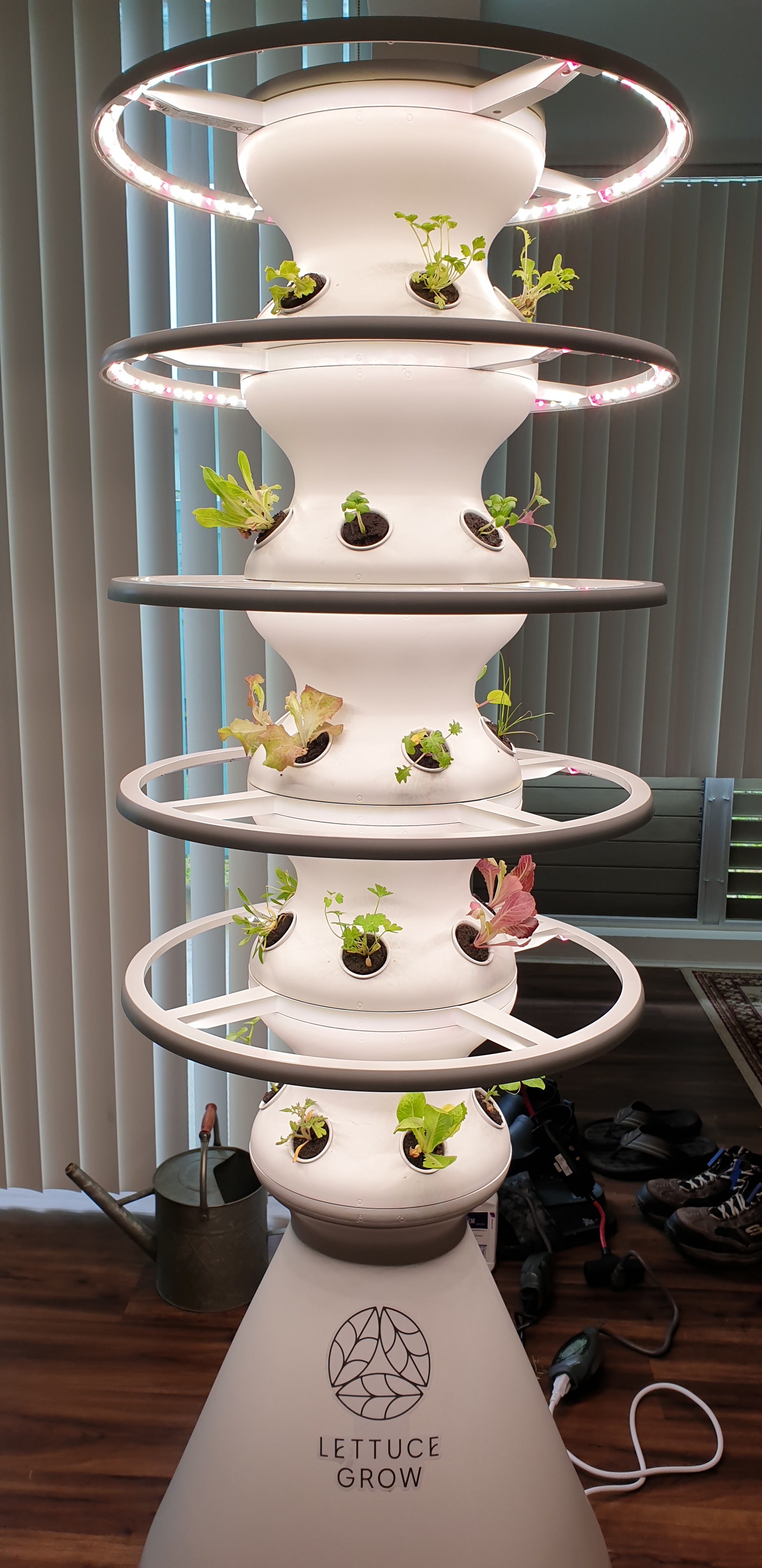
And here it is! It's nearly as tall as I am now—I can still see over the top flat-footed, but only just. I used to wonder why Lettuce Grow only ever talked about going up to six levels—after all, the pump used to bring water up to the top is quite strong and could easily lift water higher—but putting the fifth level on for the first time I understand why. Even at that height I was needing to connect the electrical connections of the light-providing Glow-Rings (which go up the inside of the Farmstand) sight-unseen in the highest levels. I imagine I might need to stand on something for a sixth level, at which point the Farmstand would officially be taller than me. When everything's producing, thirty plants is going to putting out a lot of produce, so I'm again in no major hurry to add a sixth level, but who knows? It's nice to be able to share the excess with people, so if there's another promotion later this year…well, we'll find out, won't we? A hui hou!

Tuesday, April 5, 2022

Berry good!

Now that I'm no longer spending my nights and weekends getting my papers ready, I've once again got time and motivation to dash off silly projects like this Venn diagram comparing things we call berries, and things which are berries according to botanists:

A Venn diagram showing things called berries and things which are berries.
I got the idea for this upon learning this weekend that pumpkins are actually giant berries, botanically speaking. I already knew raspberries and blackberries weren't berries, so I got curious about just how large the overlap is. This is by no means a comprehensive image; I listed everything I could think of with “berry” in the name, then looked at the Wikipedia page on berries for more such things and examples of things that were berries botanically. There are definitely more things that fall into the bottom circle, I'm sure; I left a few controversial ones out, like avocados, because there's apparently some disagreement about whether they're actually berries or not.

On the whole, I was actually slightly surprised at how many things fell into the intersection of the diagram. I was expecting more entries in the top circle, but it looks like possibly a majority of things with “berry” in the name are actually berries, botanically speaking. Though there could very well be more things called berries than I could think of, so if you think of any please leave a comment!

A few things in the bottom circle also surprised me; like, I can see how tomatoes and grapes could be berries, they're similar enough in form to things like blueberries or cranberries that it makes sense. But pumpkins? Eggplants? Bananas?? Bananas definitely surprised me. Guess I've got a fun bit of party trivia for the future.

And speaking of strawberries (which are actually “accessory fruits”), I had my first one from my Farmstand! They're a bit on the slower side to grow (compared to, say, lettuce), since I started the plant at the start of January, but the strawberry I had was deliciously sweet. There's another red one and a few still green that are coming along, so I'm looking forward to having some more perhaps later this week or the next. I'll probably have some more news on the indoor farming front around that time as well. A hui hou! 

Sunday, March 27, 2022

Trying out “Lomi” by Pela

Watching Back to the Future 2 growing up, I remember being struck by the scene near the beginning of the movie where Doc Brown appears from the future and immediately starts dumping household trash (including various food waste) into the DeLorean's fusion reactor for energy. I've always found food waste disgusting, so the idea of being able to take this gross garbage and get something useful out stuck with me (even if I knew it was fiction even back then). While portable fusion reactors running on trash are sadly still not available, I was immediately reminded of that scene when I came across a company called Pela last year and their new device they were taking pre-orders for, called simply “Lomi.”

Lomi is a…well, I suppose it could be described as an “active composter.” It's a device about the size of a bread machine into which you can put food waste, paper, approved bioplastics, etc., and over the course of 4–20 hours (depending on which of three modes is chosen) it breaks it down into dirt. (Pela advise that only dirt from the longest cycle should be directly given to plants, but even the shorter two cycles get the contents a significant amount of the way, and can then be composted naturally the rest of the way.) Last month Pela started shipping out units to North America (with a global availability scheduled for September), and this past week mine arrived!

A white Lomi sitting on a countertop.
And here it is in action! Not much to look at, admittedly…
I was able to get it setup over the weekend and try it out, and it really does work! Eggshells, asparagus ends, some old wilted leaves from the brassicas in my Farmstand, the bioplastic packaging Lomi comes in, some random paper, all these things left in the ~2 liter bucket ended up as a small pile of dry dirt at the bottom. It performs a cycle of grinding up and warming what you give it to encourage speedy microbial decomposition (they include small optional pellets containing a blend of microbes you can add for optimum results), followed by a hotter drying cycle to leave you with nice clean dry dirt rather than half-decomposed sludge.

Living in a rental apartment like I do with no place outside to compost, I was really happy to hear about Lomi and I'm excited it lives up to its advertising. (I know there are various indoor composting solutions, but I just don't really feel like leaving a bunch of decomposing food waste around in my house.) Being able to compost food waste means it's not sitting around in the trash (potentially attracting critters), and a lower volume of trash in general. Plus, I've been thinking of expanding my indoor gardening to encompass growing some root vegetables like potatoes and carrots in soil (since those don't really work well in hydroponics), and the compost from Lomi would be an ideal way to recycle food waste into plant nutrients. I've been waiting on my Lomi delivery to see how that'd work before setting anything up, but now that Lomi's up and running I might have to see about expanding my farming operations in the near future…

Anyway, just thought I'd share my experience with Lomi. The promised ability to quickly and non-messily turn food waste into nice clean dirt and ready plant nutrients seemed almost too good to be true, so here's my testimonial to other prospective buyers. And hopefully before too long I'll be turning food waste into tasty tubers or other vegetables! A hui hou!

Sunday, February 20, 2022

Some thoughts on herbs: oregano and thyme

It's coming up on three months since I first planted seedlings in my Farmstead, and of those original twelve I still have six plants, including oregano and time. When I was first looking into hydroponic gardening, among the many consumer-scale systems out there I saw several fairly small devices, set up for growing just six or seven plants sometimes. Typically, I'd see them advertised primarily for herbs, since they were small enough there wasn't much space for larger plants like lettuces to grow. I didn't think just growing herbs would be very useful, since you can't make a salad out of them, so I ended up going with the Farmstand for more growing space. However, now that I've lived with the ability to pick fresh herbs for a few months, my stance on them has definitely softened a bit.

Oregano at the top, thyme near the bottom.
While I probably still wouldn't get a system for growing exclusively herbs (the ability to pick my own salads daily is just so good!), I've come to appreciate fresh herbs a lot more. Generally herbs, by their nature, work well with the “cut and come again” method of progressive harvesting over time, which I prefer over harvesting a whole plant at once. And they can really do a lot to spice up a dish! I used oregano and thyme to approximate a crude za‘atar for some lamb I cooked last week, and it came out quite well, and reminiscent of the real thing (which usually includes some additional herbs, such as the eponymous za‘atar plant). When making a breakfast omelet I sometimes sprinkle in some thyme or crumbled oregano or sage leaves, or chopped garlic chives. I've used the herbs I grow (including dill and bunched green onions in addition to the ones already listed) in a number of recipes: tuna or egg salad, soups, pasta sauce, even sandwiches. Having fresh herbs at hand is a much more valuable tool in the chef's arsenal than I appreciated before.

Having said that, I wanted to talk about the two herbs in the title, oregano and thyme. You can see them in the photo above (a photo of the Farmstand from the opposite side than in photos in previous posts); oregano is the plant in the center near the top with the hanging stems, though it's somewhat difficult to make out due to being encroached on by sylvetta arugula from the left and celery from the right. Two tiers below it, occupying much of the bottom of the photo, is thyme. Now, these plants superficially seem pretty similar. They're both somewhat bushy, with similar patterns of pairs of leaves branching out along their stems. They have a fairly similar flavor, as well, both somewhat pungent, almost spicy. However, while similar in form, they differ in scale, and that turns out to make a huge difference to how easy they are to harvest.

Oregano, as you can see at the top, has fewer (and slightly thicker) stems and larger leaves. (They're perhaps around the size of a postage stamp when fullly grown.) It has maybe 10–20 stems growing out, which makes it pretty easy to snip one off and pull the leaves off it for use. Thyme, on the other hand…thyme is a monster. A hydra, with dozens, probably well over a hundred stems all clawing their way outwards., and any one you clip off just grows two more stems from the stump. The leaves are perhaps a tenth the size of oregano, and the stems are much thinner, which makes it harder to strip the leaves off—the thin stems often tend to break, and the leaves hold on proportionately better than oregano leaves do. In general, I find stripping thyme leaves much more aggravating than oregano. (I've got an “herb stripper,” a small metal device with differently-sized holes which you can pull stems through, to strip the leaves off, but it's unfortunately not much better than using my hands for thyme.) I do like the taste of thyme—it's especially good paired with meat—but I sigh a bit inwardly whenever I'm clipping more than one or two stems for use. The one good aspect to thyme's increased vigor is that there's so much of it that I can afford to be a lot less efficient in harvesting it—if I lose 30% of the leaves on a stem because I couldn't be bothered picking each tiny leaf off individually after going over it once, no problem, I can just snip another few stems to make up for it.

I'll probably continue growing both oregano and thyme (and other herbs) in the future, as I've quickly grown accustomed to the taste, and I've got enough lettuce varieties already that I can spare some slots for herbs. (They're both prolific enough that I might see about harvesting a bunch of leaves from both plants and drying them for saving, which would be neat and potentially make a nice gift). I've just been musing recently about how two plants, so alike in form otherwise, can be so different simply due to their different size scales. And if you're thinking of trying hydroponic gardening, but can't afford (or fit in) a large system like the Farmstand, maybe give one of those smaller systems a try, even if just for growing herbs. A hui hou!

Wednesday, February 2, 2022

Expanding the Farmstand

This post is almost a month behind the times, but back at the start of January I expanded my Farmstand  with another two levels (out of a possible total of six). I always meant to expand it over time as I figured out how much food it produced and how much I could eat, but there was a promotion in December that resulted in me getting a free level, so I sped up the timeline a little.

Freshly (re)planted.

I also took the opportunity to harvest six of the original plants, leaving just the celery, dill, oregano, thyme, garlic chives, and scarlet cherry tomato from the first planting, which is why it looks so bare again in the above photo. (Thyme, by the way, is like a hydra; it's got dozens of stocks, and every time I cut one off two more sprout from the stump.) Adding two levels to the Farmstand actually had an interesting psychological effect. Before, it came up barely to my waist, and any tending to it required bending over. Now, the top of the highest tier comes up to about the level of my shoulders, making it much more of a peer in height and allowing me to tend to plants in the top levels while standing straight. (The extra grow light levels also light up the living room noticeably more, allowing it to stand double-duty as a floor lamp!) It's quite the change, and I'm curious to see how it'll go with the full six layers, although I'm not in a huge hurry to install them; the amount of food from four layers is pretty impressive compared to just two.

After three weeks' growth.

I took this photo last week, about three weeks since planting. While it's still slow enough to barely notice between days, I remain impressed at the speed plants grow in a hydroponic system. Double the number of plants has increased the weekly water consumption too; whereas before I only needed one trip with the 1.75 gallon watering can, this past week took two and a little bit extra!

With the extra space, I replenished a few plants that are fast becoming favorites (classic butter lettuce, lolla rossa lettuce) while taking the opportunity to try some new things. Lettuce Grow has a huge variety of seedlings available (something like 200 total, although it varies seasonally), so among other things I added a strawberry, some cauliflower and broccoli, and sage. I've discovered I quite like komatsuna for salads, which grow fast and have absolutely gigantic leaves—you can see it in the photo above in the third level, the plant directly facing the camera. (Some of those leaves are bigger than my hand!) I've also discovered I'm not a fan of arugula—unfortunate, since I planted two varieties of it (astro arugula and sylvette arugula), but that's what experimentation is for. Over time I'll figure out the plants I like and want to grow.

I probably won't expand to the final two levels for at least a few months, but come March it'll be three months since I started farming. Lettuce Grow recommends taking the Farmstand apart for a good cleaning about that often to prevent algae build-up, so it might also be a good time to harvest some plants and introduce some new seedlings. They apparently do two seasonal seedlings each month, so we'll just have to wait and see what comes out. A hui hou!

Wednesday, December 22, 2021

...Farmer!

Yesterday I discussed passing my thesis defense, and becoming in some sense a “real” (astro)physicist, thus fulfilling the first part of this blog's domain name. Today, let's talk about that “farmer” part.

For those who might not know me as well, the Berkes have been farmers in Nebraska for multiple generations, stretching back over 150 years to the mid-1850s. My dad got a PhD in crop breeding rather than more traditional farming, but was always growing things as I was growing up (especially after we moved to five acres in California when I was eleven, where we had several vegetable gardens and orchards of as many types of fruit trees as he could get to grow in the climate). I, on the other hand, have never had a green thumb (I once managed to kill a resurrection plant), and found myself drawn rather to the starry heavens than the organic. I picked up a lot of knowledge related to growing plants a long the way, but other than a few abortive attempts over the span of my life was never really interested in doing so.

At least, not until fairly recently. I'm not sure when it started happening, nor can I point to a specific day, but over the course of the past two years (and centuries months of lockdown) I found myself wanting to grow my own food. Maybe it was always latent, maybe it was triggered by a desire to see things green and growing again after so long cooped up inside (especially through two Australian winters), maybe it was playing Stardew Valley starting in 2018 with its idyllic view of farming and sharing your bounty with others, but whatever it was, by the time I moved back to Hawaii I found myself with a burning desire to see what food I could grow for myself.

Then, a bit of a reality check: for one thing, I'm in an apartment with no area to grow a garden outside, and for another, Hawaii has endemic parasites that cause angiostrongyliasis, commonly known as rat lung-worm disease. Put simply, parasitic worms founds in land mollusks like slugs and snails in the islands can cause some serious damage to the human central nervous system, so if you're ever eating fresh produce in Hawaii make sure you wash it really well. Unable (and somewhat unwilling) to start an outdoors garden, I had to think outside the box, or rather, inside the house; and that's how I became a hydroponic gardener.

Hydroponics is the art/science of growing plants without soil, with nutrients delivered to the roots by dissolving them in water. Some years ago (before I started my PhD) we took a family trip to DisneyWorld in Florida, where we went on a behind-the-scenes tour of some of the gardens that grew the food served at the park, including a large hydroponics section. That's the first large-scale exposure to the concept I can remember, and it obviously stuck with me for me to remember it now. Anyway, as soon as I knew I'd be moving into my current place I started doing some research and soon after moving in I put in an order for a Farmstand from Lettuce Grow, one of several companies making consumer-ready hydroponics systems.

Just under three weeks ago, on December 2nd, the seedlings I'd ordered arrived (the parts to assemble the stand having arrived a few days earlier), and with expectant anticipation I arrayed them in the little recesses provided for them and set up the water pump and LED grow lights (which work on a schedule). Here's a photo I took of the first seedlings all ensconced in their places (with labels so I could remember what was what):

Farmstand, assembled!

For this first trial I picked a selection of different types of lettuce, some herbs, celery, and a cherry tomato plant. My motivation was that I'd like to be able to grow my own salads and avoid having to buy them as often. Once cool part about the Farmstand is that it's expandable; I've got the minimum of two layers, but it can go up to six, and I can already see myself growing a larger selection of vegetables in the future.

Anyway, I was a bit worried for the tender seedlings the first few days as they all looked a bit under the weather from their short trip here by FedEx, but they all not only survived, but thrived. Within a few days I could tell that the fastest-growing among them were visibly bigger, and by the end of the week even the slowest were showing growth. At the two-week mark I was able to pick my first few leaves of lettuce to put in my sandwiches for lunch or add to the store-bought salad I was having. Over the weekend I had my first salad entirely from my own lettuce mixture. And today, one day short of three weeks...well, see for yourself:

The grow lights make it hard to get natural-looking photos after dark.

Every morning now I come down from my bedroom upstairs eager to see how my plants are doing and have been growing over night. The lettuces are prolific, and are starting to look like leafy explosions in slow motion. The herbs are a bit slower, but still busy putting out leaves. Just this past week I discovered that the crafty tomato plant (on the far side in these photos), though not showing much too much outward growth, had sent one long thin root all the way down into the central reservoir, so hopefully it'll start picking up the pace. It's an amazing feeling to be able to just walk over and pick a few leaves from various plants for salads or sandwiches, and I think it's safe to say that I've found a new long-term hobby.

And that's the “farmer” part fulfilled now that I've eaten my own produce, at least on a small scale. (Though I have...plans. Indeed I do.) It's amusing to me that it ended up happening so close to the “physicist” part, but this blog's domain name is now finally topical! And it only took almost a dozen years! I'm sure I'll have much more to say on the topic of indoor gardening in the future, but this post is probably long enough for now. There'll be plenty of time to talk more about my new hobby. A hui hou!

Edit (12/29/21): One thing I forgot to mention, for anyone who might be tempted to get their own Farmstand, is that you can use my personal referral code FRIEND-YKPW to get $50 off the price of a Farmstand. (It also gives me $50 in credit.) That said, Lettuce Grow is hardly the only company making consumer-ready hydroponic growing systems, so look around to see what's available if you're thinking of making the leap to indoor gardening.