Showing posts with label lava tubes. Show all posts

Friday, June 23, 2017

Some Solstice News, 2017 Edition; Also Lava Tube Pictures

First of all, yes, I missed the solstice by two days (like I always do), but that was the original inspiration for this post. Then, having pointed out that, hey, it was the summer solstice for the northern hemisphere two days ago, I realize that there isn't much else to say to about it, so have a few pictures from my Kamehameha Day trip in addition.

I took a couple friends up to the Mauna Loa Observatory where I work on June 11, Kamehameha Day (a state holiday here in Hawaii) for a tour of the YTLA and some exploration of various lava tubes and geological features. For a state holiday, it was the busiest I've ever seen it up there, with both a tour group from South Korea on a tour and people around from both the eponymous atmospheric observatory and the Mauna Loa Solar Observatory, which I'd never actually noticed being open before (though I discovered they were likely the car we'd meet driving up at 4:00 AM as we were driving down after a night of observing!).

The telescope at the MLSO, observing the sun.
The weather unfortunately didn't coöperate for us in our attempt at spelunking on the way down, being wet and misty below 10,000 feet or so. It wasn't too bad at the first lava tube we stopped at on the way down, just below the 9,000 foot mark, so we explored it for a bit.

My friend Mark provides scale for the opening to this particular tube.
This lava tube has its opening right beside the road…and I do mean right beside the road. There's maybe a foot (if that) between the edge of the tarmac and the lip of the skylight into this tube. I have to admire the sheer indifference of the original road builders to stick to their plans and ignore this gaping hole right beside their work.

Once inside, I was pleasantly surprised to find that there were several large skylights at irregular intervals for some way, lighting it up to the point where a flashlight was hardly necessary at all.

A little hard to make out, but this is looking down the tube.
In a pattern that really shouldn't surprise me at this point, this lava tube was both similar and yet quite different from the others I've been in. This one is tall, often rising 20 feet or more to the roof, even with the copious collapse covering the floor. And yet, it wasn't difficult to navigate, having little slope and being wide open with plenty of room to maneuver; Kaumana Caves is much harder in many places due to its low ceilings. All the lava tubes I've been in have had white material (which I believe is crystallized gypsum) on their walls, but this tube was positively overflowing with the stuff.

Gypsum-coated walls reflect enough light that this picture actually worked.
In this picture, you can see Graham taking a picture of the incredibly white walls. Normally lava tube wall are pretty dark—sure, there's some reds and other colors, but a lot of the walls are plain black. Taking a picture with my phone's flash alone wouldn't have worked in most of the other tubes I've been in, but this one just has so much white gypsum reflecting light that it actually kinda works. (The light from a skylight just ahead, seen just in front of Graham in the middle, probably helped too.) I don't know why this particular tube should have so much more than others I've seen; I guess maybe the flow that made it was just especially gypsum-rich?

A skylight with a natural bridge crossing the tube.
This last picture is neat, though I don't know how easy it is to make out. At the top you have light from a skylight falling in, while in the middle is a sort of 'bridge' in the lava tube, a short arch in the middle of the tube that suggests this lava tube had a very interesting history, perhaps with multiple levels at some point. Even the bottom of that arch would be well above my head (6” 1’, 1.85 m), to give you an idea of the scale here

Despite what these pictures might make you think, we actually didn't get to fully explore the tube to my satisfaction; after a while the skylights stopped while the tube continued on, but as it was still crummy weather and starting to get a bit late we didn't continue on (I've heard the cave continues on a bit further before ending). I definitely plan to return, however! It's a really cool cave, and I plan to go back with my camera and a proper flashlight to plumb it to its end (we originally just planned to pop in and take a quick look due to the weather, which turned out to be closer to half an hour). A hui hou!

Sunday, May 14, 2017

More Pictures from the Mountain

It's not a particularly creative post title, but at least it's accurate. Have some more pictures from Mauna Loa!


After several tries, I've come to the regretful conclusion that it's simply impossible to replicate the colors seen in the sunsets up here in a photo. They're just so incredibly breathtaking in the range of hues.

That being said, this picture comes pretty decently close. (This is the view from just outside our break room.)


May 1st we had a snowfall on the summits of Mauna Kea and Mauna Loa. This is pretty late in the season for snow, though it's possible to get snow any time of the year here; I still remember the time it snowed all the way down to the Visitor Center while I was working there—in June! (This snow doesn't extend that far down.) At a little over 11,000 feet (~3,350 meters) our site was too low to get any snow, though.

I like how the snow here is mostly only in one sector, not equally spread around the summit.


A few days later, on May 5th, the snow had all melted, but the focus is this old eruptive vent near the road—we stopped on the way down after some daytime observations. This is maybe fifty feet from the road, and perhaps twenty feet deep. I couldn't get a good picture of the inside because it's so large, perhaps thirty feet across.

I don't know how old it is—based on the weathering I'd guess somewhere within the past few hundred years—but it's incredible to imagine when this fissure was belching molten rock and gasses from the interior of the earth.


There are also several lava tubes visible beside the road up to the site. This is the largest and most visible, though it doesn't go anywhere on either side beyond where it collapsed here. You can see where the road goes maybe twenty feet beyond the far end. This is not the gaping hole closest to the road—just above the 9,000 foot marker is the opening to a small lava tube literally within two feet of the side of the road, though I forgot to take a picture of it. I'm hoping to take a weekend soon to explore some of these lava tubes, so hopefully I'll have more pictures soon. A hui hou!

Sunday, April 21, 2013

Spelunking Emesine Cave, Part 3

This will be the third and final part of the Emesine Cave photos, finally. At the end of the last post we'd made it as far as we could in Emesine Cave. Coming back out I got a few more photos of things I either hadn't photographed or hadn't noticed on the way in.

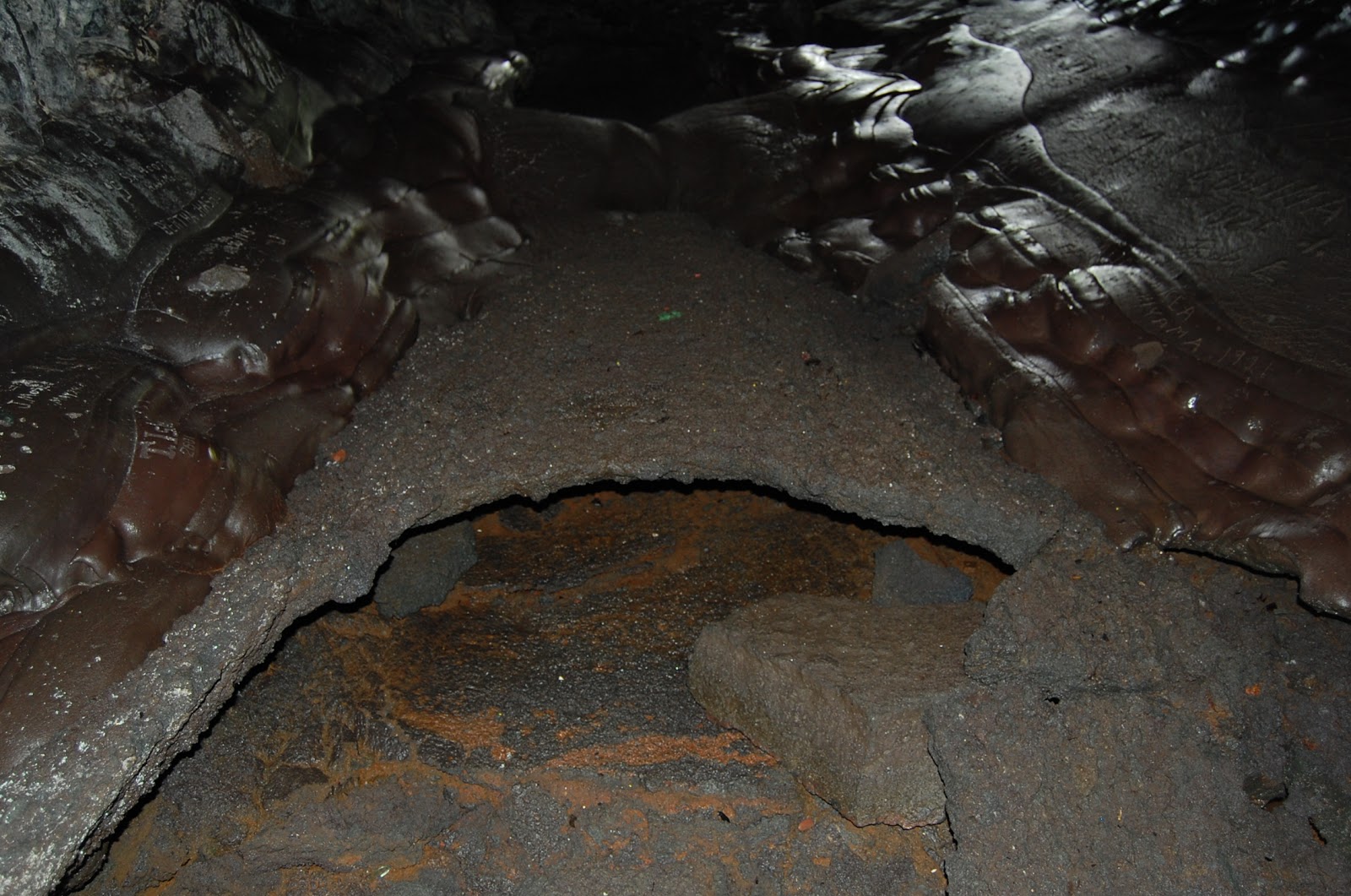
Just before the end of the cave, I found another example of a tube-in-tube formation.


I found some sort of fossil imprint, probably from a tree of some kind, in a bit of roof-collapse (some very orange roof-collapse):


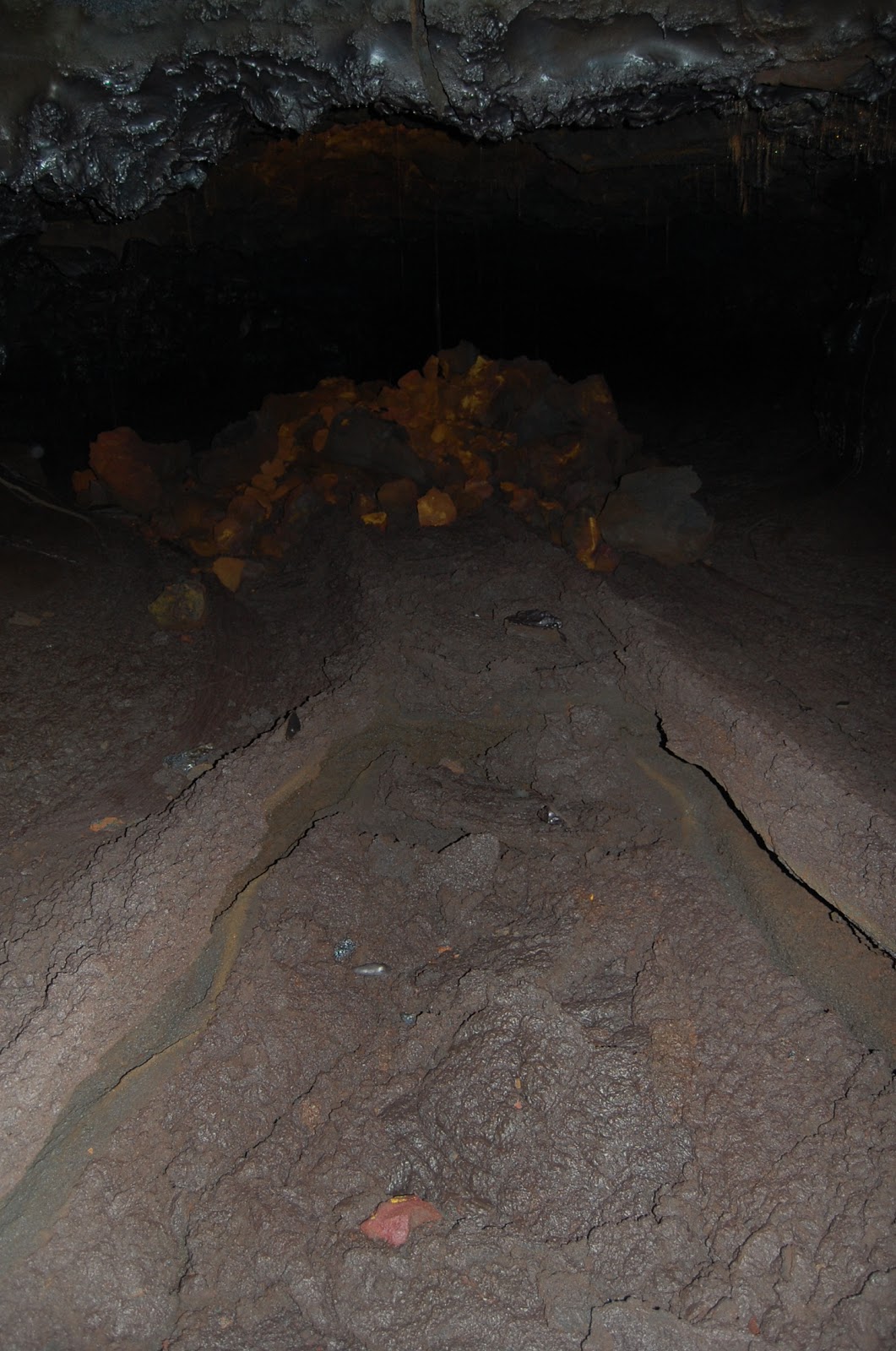
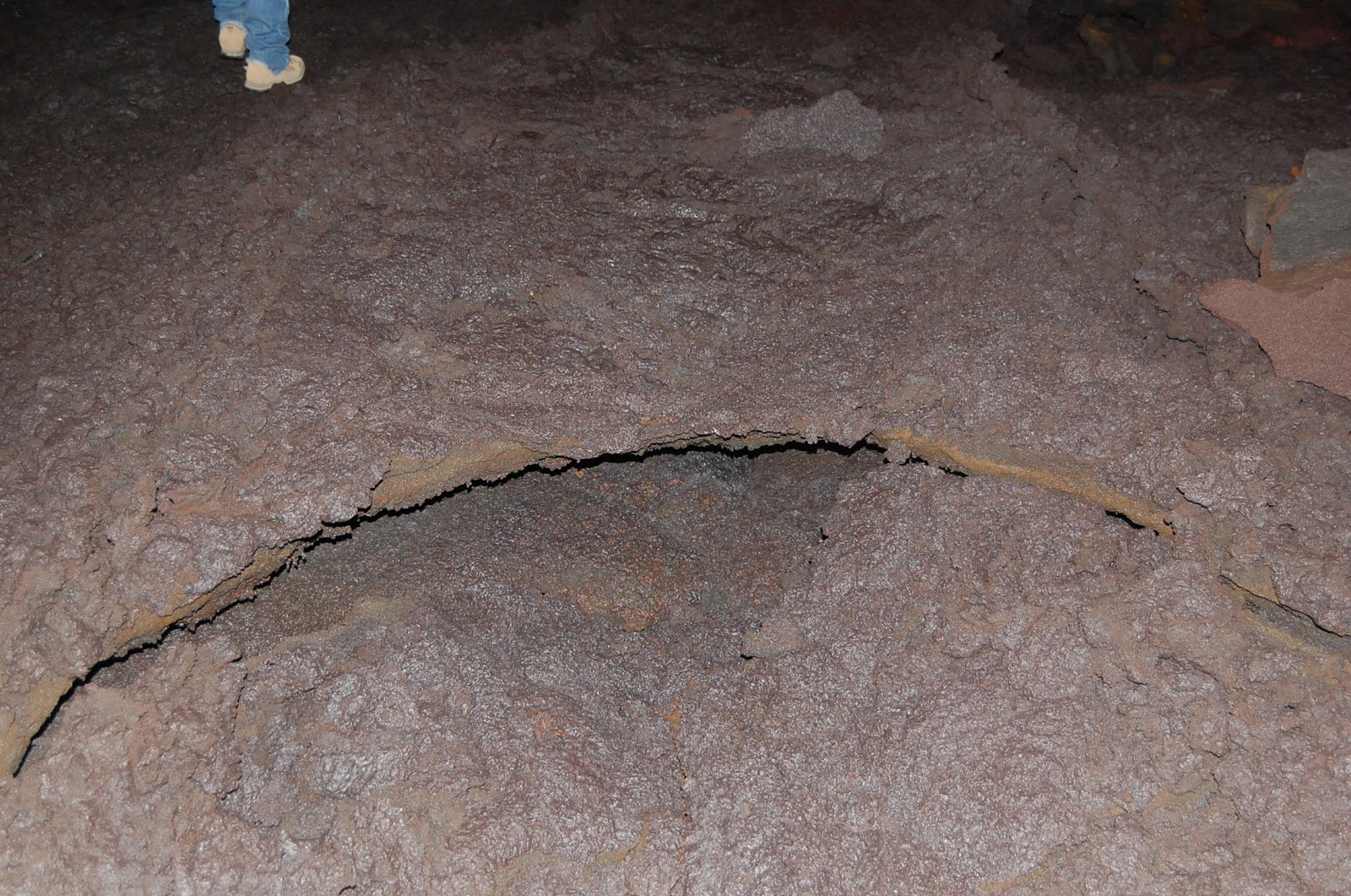
This large dip in the floor, where lava apparently poured over a lip of some kind, was pretty much the only place in the cave where the floor wasn't fairly smooth and nearly level. (Barring the places where you had to climb over ceiling collapse, which were few and far between.)


I also found these lavacicles with interesting accumulations of minerals on their lower ends. I'm not sure how that would happen. Maybe the lava level rose after they formed, but cooled somewhat and some stuff crystallized out onto the pre-existing structure? I don't know.


My coworker pointed out this amazingly thin formation. That paper-thin-looking part? It really is paper-thin. It just looks too fragile to form, let alone exist in this environment.


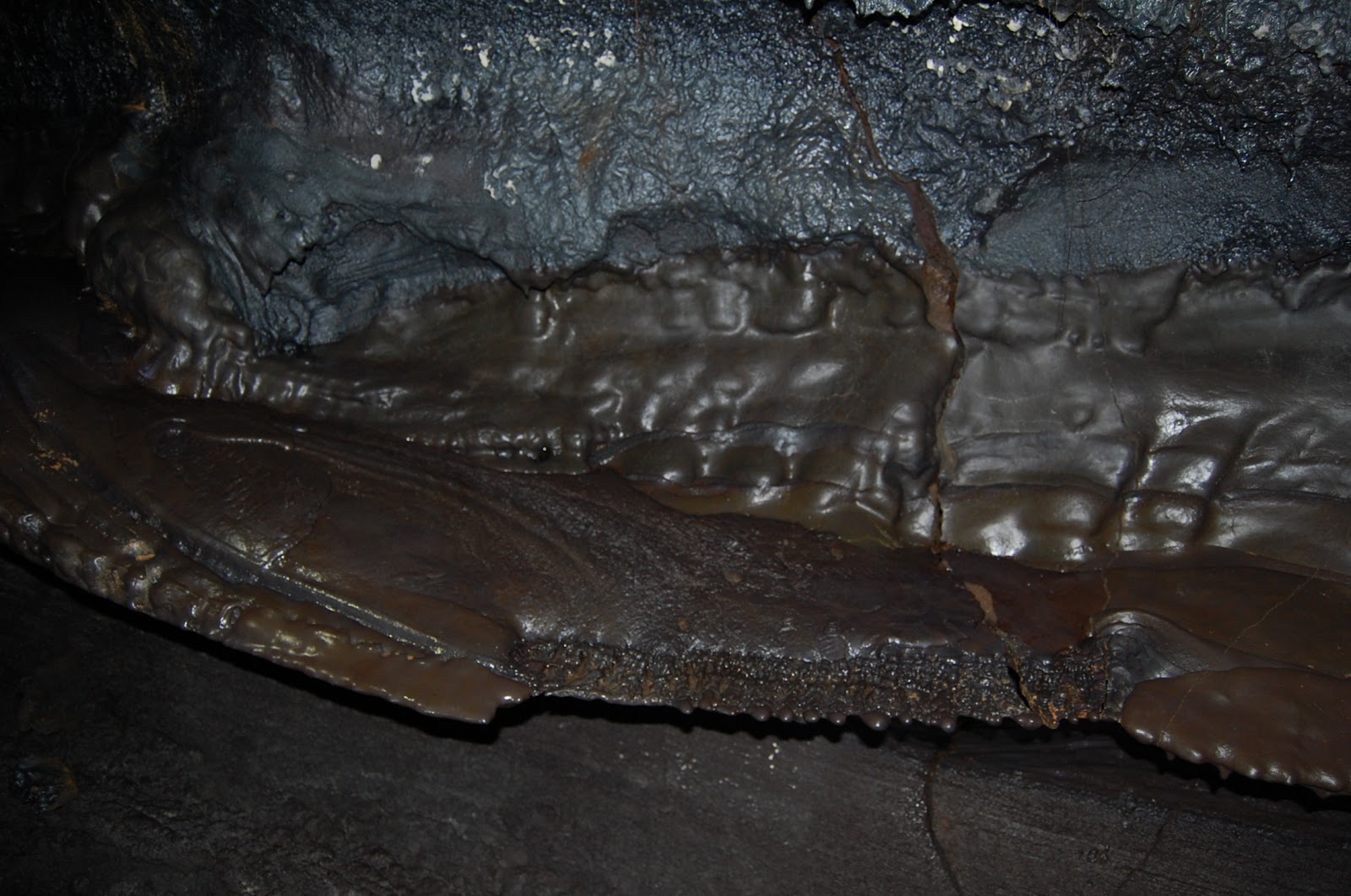
This next picture reminds me of cetaceans, or pinnipeds, for some reason. It just looks like blubber. It looks like lava flowed over onto the area at least five different times with varying flow rates each time.


Finally, just inside the cave mouth, I found these neat crystals growing on a lavacicle. I don't know what kind of mineral they are, I'm afraid. Very delicate looking and pretty though.


Well, I finally got through all my pictures of Emesine Cave. And I still have nearly as many again that I didn't show, for one reason or another. The walk back was uneventful, barring a continuous light rain from the east that, due to the straightness of the path and the constancy of the rain, left my right side soaked but my left side dry in places by the time I got back to the trail head. I've got more pictures for my next post, but of a slightly different subject. Until then, a hui hou!

Sunday, April 14, 2013

Spelunking Emesine Cave, Part 2

So, when I left off in the last post, we had just made it to the single skylight in this section of Emesine Cave. Unlike the entrance, the collapsed rock in this one didn't afford an easy way of entrance or exit. We passed on back into the murky gloom of the cave, our night vision acquired over the previous 30 minutes gone once again.

Once we'd readjusted our eyes to the darkness, we started to see some amazing speleothems (a word referring to just about any kind of secondary mineral formation in a cave). Probably due in part to the lower flux of tourists in Emesine Cave, there are a lot of very fragile lavacicles still clinging to the roof of the cave along its length. Take a look at these beauties:


Lavacicles (I had to add that word to my browser's dictionary just now) form when the roof of the tube cools enough to form a sort of skin over still semi-molten material. As the temperature of this material drops, dissolved gases inside begin to precipitate out of solution, displacing molten material and forcing it out through the skin like toothpaste out of a tube. After they solidify they make excellent channels for water precipitating on the ceilings to run down, as you can see by the drops of water hanging from their tips.

If this sort of thing happens lower down on the walls rather than the ceiling, you get structures like those seen below:


Here's a close-up picture of a bit of lavacicle that I found broken-off on the ground for scale: they all tend to be about this thick. This one is solid on the inside (though you can't see it), but you'll see some later on that are hollow.


We found some really long lavacicles in places. This one was probably nearly a foot and a half long (it was on the ceiling some ten feet up, so I couldn't get a close look).


Some of the lavacicles were quite interesting. As I mentioned, lavacicles form from gasses bubbling out of molten material. The gasses apparently can flow out through the forming lavacicles, leaving them hollow. This leads to a sort of formation that appears very similar to a soda straw (a type of formation in karst caves that are formed differently, but look strikingly similar). You can tell that the lavacicles in the picture below were hollow because of the way they collapsed. I find these structure quite remarkable (as you can tell by how much I'm remarking on them).


This picture doesn't have anything specific I want to point out, I just loved the contrast between the various textures in the picture.


In places there were dozens of lavacicles hanging down from the ceiling. There were also roots, as there typically are in these lava tubes.


I found this little lump of anomalously-colored material at one point along the way. Dunno what's causing the orange color, though my guess is that it's iron.


Some more of those amazing flattened soda-straws, most of them flattened in two or more different directions:


There wasn't much in the way of tube-in-tube formations, but I did find some:


This picture is pretty neat. It's the cast of a tree that fell over into lava and subsequently burned up or rotted away after the lava had cooled. You can clearly see where the branches forked in this picture (looking towards where the fork splits from the direction the roots would have been). Interestingly, this cast is on the ceiling, so I don't know what specific sequence of events led to its creation.


Anyway, I think that's all for the pictures I took on our way into the cave. I still have some more to go through that I took on our way back out, but I think I'll save those for a third post as this one's already getting a bit long.

Tuesday, April 9, 2013

Spelunking Emesine Cave, Part 1

About two weeks ago on Good Friday I organized an excursion with some friends to explore Emesine Cave, a lava tube high on the flank of Mauna Loa created in the 1880-1881 eruption that came perilously close to destroying Hilo. It exists as several disconnected sections totaling over ten miles in length, making it the fourth-longest lava tube in the world as of right now.  However, the section we explored at about 2,300 meters (5,700 feet) elevation was only about a mile in length.

I took quite a few pictures this trip, so much so in fact that after looking through them I've decided to split this post into multiple parts.

Unlike the Kaumana Caves county park where the entrance is just a few dozen feet from the parking lot, the entrance to Emesine Cave is found only after a 2.6 mile hike at nearly 6,000 feet. For being so high, the lower air pressure didn't really bother anyone as I was afraid it might. WolframAlpha suggests the pressure would be about 812 millibars, which is close to 80% of sea-level pressure, so I guess it wasn't really that bad. Hindsight, and all that.

The hike was pleasant, following the remains of a straight road that remained mostly flat or only slightly inclined along its length. We passed through several stands of older forest among the more barren and recent lava plains. Hawaiian has a word for these islands of older forest surrounded by newer flows of lava: kīpuka. These particular kīpuka are great habitats for some of the endemic Hawaiian birds, and it was really lovely to get out of the constant background noise of Hilo and hear some actual birdsong again. We didn't see many birds, but the sound of their song was a constant background for us along our trek.

Here's a panorama I took with my phone. I think it does a good job of capturing the feeling of the vast lava plains we were traversing.


Unfortunately you can't really see much in it, other than the dark surface of the lava in the shadow of all those fluffy clouds. If you click on it to blow it up, you can see the base of Mauna Kea off to the left.


Along the way I had some of these pointed out to me. They're called ʻŌhelo berries, or Vaccinium reticulatum. They're actually edible (and related to cranberries), so I ate a few. They grow wild at altitudes between 640–3,700 m (2,100–12,100 ft) in the rich volcanic soil, and are a popular ingredient in home-made jams and jellies in Hawai‘i, in the same way wild raspberries or blackberries might be on the mainland. The ones I consumed mostly didn't have much taste, but some of them were moderately sweet. The color doesn't necessarily indicate ripeness, I later learned.

When we finally got to the entrance, we found a large skylight perhaps thirty to forty feet across and about twenty feet deep that provided entrance to the tube. Unlike Kaumana Caves, there were no easy-access steps-with-accompanying-handrail going down into this one, so we had to clamber down the jumble of collapsed rock inside that fortunately came up close enough to the edge on one side to permit entry.

Entrance to Emesine Cave.

Since the guidebook I'd read said that the uphill side of this section was fairly uninteresting, we headed downhill.

There are a lot of interesting features in Emesine Cave. It's also an easier walk nearly its entire length than much of Kaumana Caves, which was nice. Most of the floor is easily-traversable cauliflower ʻaʻā, with little of the collapsed rock from the roof that makes Kaumana Caves so difficult to explore in places. Emesine Cave also tends to have a flatter grade than Kaumana; up this high on the flank of Mauna Loa the lava was flowing nearly horizontally and traveled for great distances in fairly uniform conditions without losing much heat. Contrast that with Kaumana Caves, near the end of the flow, where the terrain was rougher and the flow more intermittent, producing a huge diversity of features that change rapidly on short distance scales.

Anyway, enough talk, you want pictures!


One thing that never gets old in lava tubes is the amazing variety of colors. This photo was taken near the entrance, so I think the green is some kind of photosynthesizing-life, but it might also be olivine. And the white may be gypsum that crystallized out as the lava cooled.


This is a ledge extending out from the wall, showing where a tube-in-tube formation might have formed if the lava level had held steady.


Close-up of the previous picture. The saw-tooth structure is amazing, I've never seen anything like it before in a lava tube. Reminds me of a fish fin.


I love the whorls and contrast in this picture. It just doesn't look like solid rock, does it?


There are some massive formations of these kinds of lava-cicles in Emesine Cave. Near the top of the picture just left of center you can see some that appear to come in ridges, which may have something to do with how air was flowing through the tube when they formed.


As you approach the first (and only) skylight in Emesine cave, the tube splits just before the opening, giving you two exits. This is the right one, which is traversable (I tried it coming back), but not comfortably (I had to hunker down and waddle through for about twenty feet).


The left side is easily walked at full height, even for me. (Ignore the roots in the foreground, they're hard to see in the dim light of your flashlight and it isn't until you get home and look at your pictures that you realize just how much light they reflect and how badly they interfere with your photos.)

Anyway, I think I'll end it here for now. Look out for the next part to come soon!

Friday, November 9, 2012

Cave Photography, Part 2

As promised in my last post, here are the pictures from the second part of my latest spelunking trip. I'd have had it up earlier but for working quite a bit over the last week and not feeling up to the task of writing this post, which will probably take me at least an hour.

Anyway, after exiting from the mauka side (uphill, left in this case) of the cave, we proceeded into the makai side (downhill, right in this instance). This side of the tube has a much larger entrance that allows light to shine much further into it.

View from just inside the entrance, with the steps from last post in the background.
I was so enthralled with the view back out the entrance, that it took me a few minutes to turn around and actually look inside the cave. When I did, imagine my surprise and delight to find an amazing example of a tube-in-tube formation not more than fifty feet into the cave!

A tube-in-tube is a structure that forms inside lava tubes for reasons that have to do with why lava tubes form in the first place. As the lava level in the tube drops, it begins to cool and can eventually form a hard crust on its surface within the original tube. Sometimes this crust can break in places when the volume of lava coming through the tube picks up again, and you get this neat effect where the rim of the break is coated in a layer of smooth, liquid-looking rock where the lava surged out of the hole, then flowed back in.

Anyway, one of these formations lies just within the makai opening.

Tube-in-tube formation just inside the cave, looking back.
In the picture you can see the extremely smooth rock around the edges where the lava surged up and down, and also the rougher rock forming the crust over the channel in the middle.

View of the cave entrance from just beyond the tube-in-tube formation.
Counter-intuitively, the tube-in-tube formation doesn't exactly cover the entire floor of the lava tube. Instead, it has these sort of ridges (officially called “­levees”) that stand up vertically out from the walls of the tube roughly parallel to them and act as the sides of the channel. Already at this point they're much more pronounced than they ever are in the mauka side of the tube, but further on they're even more impressive. You can kind of see the gap between the levee and the wall in the bottom-left corner of the picture.

Same view without flash to better capture the feel of the cave.
This picture does a better job of capturing the view, although the walls and ceiling are still a bit brighter than they appear to the eye.

Another view of the entrance from further in. Note the hanging roots and sulfur on the walls.
One thing that struck me about the makai side is that light from the entrance is visible much further in than it is on the mauka side. This picture is probably between a hundred and two hundred feet in, and the opening is still visible. Compare to the mauka side, where the nature of the entrance is such that by fifty feet in it's pretty much pitch black.

I believe this is a mild case of what are called “shark-tooth stalactites”.
Another thing I'm learning from all this cave photography is the importance of shadow for establishing depth, and the need to keep in mind that in a cave, you make your own shadows. It's an interesting learning experience.

Example of a levee.
Remember those levees I mentioned earlier in the post? Here's a shot showing a nice example of one.You can see how it sits about a foot from the wall, and closely parallels it, even around curves. Here the crust on top of the tube-in-tube formation wasn't strong enough to avoid collapse when the lava flowing through it dried up, leaving only the stronger sides as levees.

More of the levee on the floor, and a ledge above it about waist high.
Further on down the cave, the ledges on either side of the tube come together, and you have to climb up about waist height onto a thick ledge to continue. The lava flows in the area make some really strange looking shapes.

Hardly looks like solid rock, does it?
This part of the cave is very interesting, as the tube is split roughly in half by a ledge of reddish congealed lava of varying thickness. Holes appear in it periodically where lava surged up through the cooling crust and flowed back down. In the area beneath are some really nice examples of pāhoehoe lava:

Pāhoehoe lava in the lower half of the lava tube.

Here you can see one of the holes where ledge was especially thick.

Finally, at the point we reached before having to turn back due to prior engagements the ledge again split into two ledges on the sides of the tube before disappearing entirely as the whole tube abruptly shrank in size, in a manner very reminiscent of a river coming together before entering a narrow canyon to form rapids.

Here the ledge splits apart again before the tube narrows. This rock may have been placed by lava.
All in all, it was a fascinating journey, and I would love to go back and go all the way through. Since the next part of the cave appears to be some sort of “lava rapids”, I expect it should be pretty cool. Next time though I need to remember to bring gloves for crawling around, as the makai side seems to have a lot more low-hanging areas best suited to crawling than the mauka side. A hui hou!