Showing posts with label Earth. Show all posts

Sunday, May 16, 2021

Earth: Birthday #32

Yes that's right, it's time for the big binarily-significant \(2^5\) birthday! Here on Earth anyway. Now there's just my Mercury birthday to wait for later this month. I don't have much more to say about it—you've heard the song and dance by now—so let's get back to talking about…

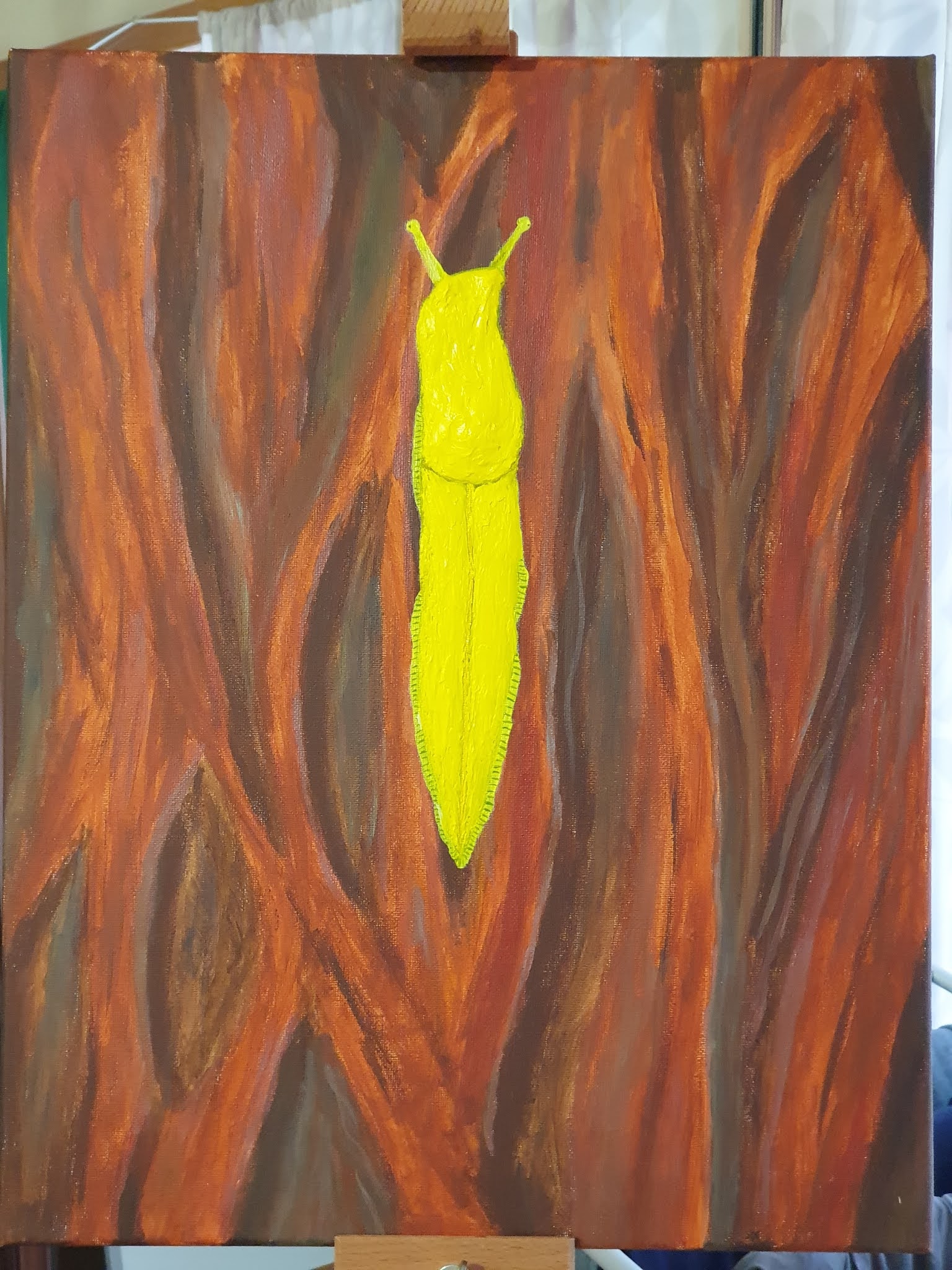
…this painting. If you remember from the previous post, I'd tried painting the shading of the slug from a picture, and decided I really didn't like the outcome. I then had the thought that perhaps this was a job for my favorite trick of putting some dimensionality into a painting by extruding it into the third dimension. It's unfortunately a little hard to tell due to the face-on angle of the above photo, but I've painted over the slug's body with some flexible modeling paste mixed with a little yellow paint. I immediately liked where this was going much better, so this'll be the new direction for this painting. I did another painting session adding more modeling paste to the posterior two-thirds of the slug's body, and tried to get a photo from a different angle that would show the topology a bit better:

It's still not the best lighting, but hopefully you can see how I've built up a kind of crest ridge along the back (as the real slugs indeed have). I need to go back over it and even it out with the front a bit, but I'm really enjoying this sort of…reverse-sculpting? The modeling paste is apparently marble dust in acrylic, so it's almost like the reverse of sculpting something out of a block of marble. One tricky aspect of the paste is that it's very plastic and easily retains brush strokes, so it's a very delicate process and when I've got it built out to where I want it I'll have to give it all a layer of paint to smooth it out a bit. Still, I suppose the little imperfections keep it from looking too perfect and give it some character. This photo's from the latest painting session a few days ago, so I'll have to get back to it to have something to show…for my next birthday! A hui hou!

Saturday, August 31, 2019

A Second Exhibition: Earth, Moon, and Mars Paintings

I've been incredibly busy this past month getting ready for my Mid-Candidature Review, which I passed on Thursday. (This wasn't helped by me coming down with a moderate case of the flu last week.) All of which meant that I didn't really mention here the exhibition I had some paintings in as part of the 50th anniversary of the Apollo 11 Moon landings, which was partly because I never even got to visit the gallery and see everything in person. (And yes, this means I'm now a twice-exhibited artist! Maybe I should add that to my résumé…)

Thankfully, my friend James at Swinburne visited and took some pictures for me, so you all get to see them after all. (All these pictures are courtesy of him; you can check out his website here.)

“Main Sequence”
The first one is one you've seen before, my series of stars on the main sequence. Here, though, they're arranged similarly to how they would be located on a Hertzprung-Russel diagram, from which the main sequence was first identified. This is how I'd always envisioned hanging them if I got the chance, so it was pretty cool to see.

“Tenuous Transport.” Individual panels 40×40 cm, or 40x80 cm. Acrylic, embroidery on canvas.
Now, this is an interesting one. It's a four-panel work (or tetraptych), of which I've posted the Moon painting before. The rest are new, however, and they're not all mine! This piece is a collaboration with another Swinburne student, Grace, who embroidered the outline of the Eagle (the Apollo 11 lander) on the second panel from the right. I had originally envisioned this piece as a single new panel, but while discussing it with everyone at one of our art workshops the topic of making it a multi-part collaborative effort came up, and since I already had the Moon painting it was a simple matter to paint a matching Earth painting to go with it. (Plus a few stars on a blank panel.) Grace meanwhile stitched the outline of the Eagle onto another canvas. The stitching and outline gave it a very fragile feeling, which led us to give the piece the name “Tenuous Transport” in recognition of the sheer fragility of the craft which carried the first humans to the Moon, and just how dangerous the journey was. (You definitely can't see it at this scale, but Grace also subtly highlighted some of the edges in the Moon in thread, making it an interesting mixed-media collaborative piece.)

Since it's probably not obvious at this size, the Earth painting is mostly looking at the Pacific Ocean; you can see Australia at the lower left, and the western coasts of North and South America on the right, but it's mostly water and clouds. Also now that I have it back I may go and touch up the shape of the terminator on the Earth a bit, as it doesn't quite match the Moon and it's been bugging me for a while.

“Vallis Marineris Afternoon Overlook.” 8×10 inches, acrylic on canvas.
And finally, here's a little piece I did unrelated to the Moon; instead, it's a view out over the colossal canyon Vallis Marineris on Mars. At least, that's what I intended, it never quite came together with the right perspective in my eyes, but at least the pink sky is really attractive. Much of the red color in this painting comes from iron oxide pigment, which is interesting because A) it's one of the first pigments people ever used for painting, as seen in cave paintings, and B) it's the reason for Mars' red color in the first place: iron oxide is rust. While I wouldn't call this one of my better works, it was still pretty fun to play around with some new colors I haven't really used before.

Anyway, those are some of the paintings I spent most of May, June, and the first half of July working on. Now that I've passed my Mid-Candidature Review I'm taking the next week off, which will hopefully allow me to get a lot of work done on the ones I've been working on since. A hui hou!

Wednesday, May 4, 2016

Rendering the Earth

I recently came across a neat tutorial for Blender on how to create a realistic Earth image using real land and cloud images from NASA. Well, all right, we hit “realistic” about half way through the tutorial and went on to “slightly stylized,” but I like how it came out so I thought I'd share it here.


…and looking at it now, I realize you can't actually see any of the land textures because they're all on the dark side of the planet (except Hawaii, which should be visible, but I can't find it even in the full-size image). Huh. Not the greatest composition ever, is it? I do love the night lights effect though, that's pretty neat.

While I could have added a realistic starry backdrop, I was focused on finishing the rest of the tutorial and instead went for a simple random noise texture stretched to get stars. While playing around with different noise textures for the background I found the Voronoi noise texture and thought it was cool enough to save a picture of:


(Incidentally, in this picture you can actually see the land textures…)

Anyway, I now have a fairly simple (minus the stylized parts) way of rendering a pretty realistic Earth, and I bet NASA has similar textures for other Solar System bodies, so I may have to do something with that in the future…

Monday, September 14, 2015

Saturn's Rings and the Earth-Moon Distance

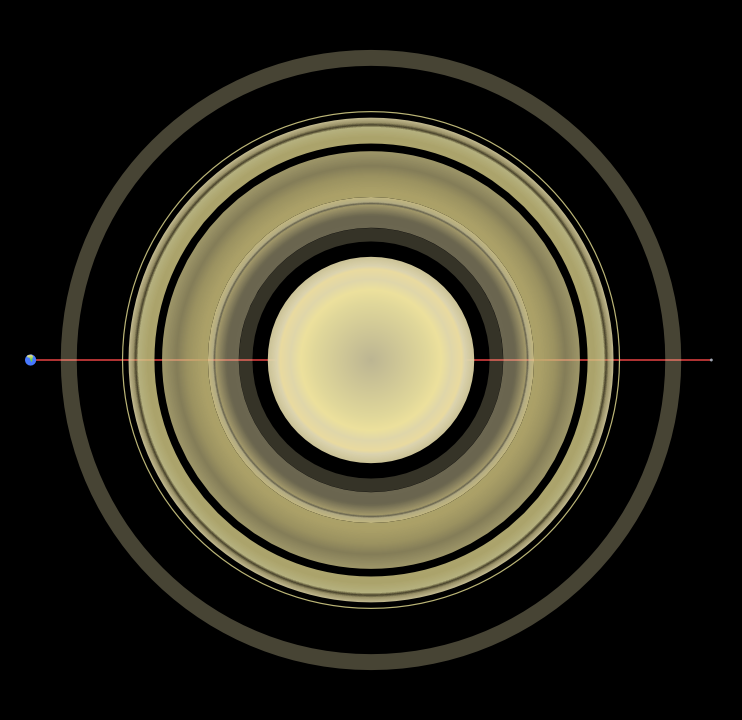
A few weeks ago I happened to hear offhand that Saturn and its rings would fit nicely in the space between the Earth and Moon. Being the visual-oriented person I am, I decided to go ahead and make a picture to put them in perspective, and figured I'd share.

First of all, a quick primer on the nomenclature of Saturn's rings. The rings are labeled alphabetically in order of discovery, although the A, B, and C rings were all discovered basically at the same time and the decision to name them working outward in towards the planet was pretty much arbitrary.


Technically the F ring is too thin to be shown here; it's only about 30–500 km thick which means it's about 40–400 times thinner than shown here. The relative brightnesses of the rings is also only approximate; the G ring (and even D ring) are also fainter than shown here, and aren't visible to the naked eye. They were only discovered with photography from various interplanetary probes after 1979 (as was the F ring). The F ring is the outermost of the “discrete” rings; beyond it, the rings are diffuse and may have moons orbiting embedded within them.

The astute among you might have noticed that there is a distinct lack of an E ring in the above image. Don't worry, we'll come back to that. Anyway, let's see how these rings stack up against the average Earth-Moon distance:


With an average separation distance between them of about 358,000 km, we can see that the Earth and the Moon nicely frame Saturn and its main rings there. It also gives a good idea of the size of Saturn relative to Earth.

But what about that E ring I glossed over a paragraph ago? Turns out the E ring is outside the G ring and extremely large, but like the G ring it's also extremely faint and diffuse.

Anyway, here's the E ring in all its glory (I've left the Earth, Moon, and the line between them in place):


Yeah, the E ring's pretty wide (and again, it's so diffuse that it's not visible to the naked eye). Its outer edge is just within the orbit of Saturn's largest moon, Titan. As you can see (or maybe not), the E ring's diameter is around twice as large as the average Earth-Moon distance.

But believe it or not, that's not all of Saturn's rings! There are a few more ringlets between the G and E ring that are too thin to show here, but there's another ring outside the E ring that's even larger and even more diffuse. This ring was only discovered in October 2009, and is known as the Phoebe ring after Saturn's unusual moon Phoebe which orbits just outside of it in a retrograde orbit. Here it is, with the rest of the ring system for comparison:


Yep, that little disc in the center is the E ring we just saw in the last picture—with the inner ring system and Saturn within that. This ring is really large. In fact, unlike the other rings which have a maximum thickness on the order of tens to maybe hundreds of meters, the Phoebe ring has a thickness around forty times greater than the radius of Saturn itself. In other words, this ring is thicker than the entire diameter of the E ring.

So there you have it! Saturn and its fascinating ring system, and how it compares to the distance between the Earth and the Moon. Hope you found it as interesting as I did putting these images together. A hui hou!

Friday, September 20, 2013

Terra Nova Cognita

Planet Earth never ceases to surprise us. Within the past month we've discovered a canyon and a volcano, both of which are longer and larger than the previous record-holders in those categories.

The first record-breaker, known as the Greenland Grand Canyon, remained unknown until last month because it lies beneath Greenland's ice cap. It was discovered using ice-penetrating radar and is over 750 kilometers (466 miles) long, a bit less than twice the length of the Grand Canyon in Arizona (at 446 kilometers [277 miles] long. It's also up to 800 meters (2,600 feet) deep, and up to 10 kilometers (6 miles) wide. (Though Arizona's Grand Canyon is both deeper and wider in places.)

(The longest canyon in the world is actually the Yarlung Tsangpo Grand Canyon in Tibet, which is a bit longer than the Grand Canyon in Arizona, although I couldn't find solid numbers on how much longer. It is also the worlds deepest canyon, with a deepest point of 6,009 meters [19,714 feet].)

The second record-breaker is a volcano located on the Pacific sea floor about one-third of the way from Japan to Hawai'i. This humongous edifice goes by the name of Tamu Massif, and while it has been known since at least 1993, it was previously thought to be multiple volcanoes due to its incredible size. On it September 5th it was announced by scientists studying it that it was actually a single volcano, which made it the largest volcano on earth.

This announcement was of interest to me, since I live on the flank of what was previously thought to be the largest volcano in the world – Mauna Loa. When we say “largest,” we should be sure to define what we mean. Tamu Massif is larger in surface area than Mauna Loa, but shorter in height. Mauna Loa has a surface area of 5,000 square kilometers (about 1,900 square miles), and rises an incredible 9,170 meters from the sea floor (30,085 feet). Tamu Massif, by contrast, rises a mere 4,460 meters (14,620 feet) from the sea floor, but has a surface area of 260,000 square kilometers (100,000 square miles), approximately the size of New Mexico.

Despite its height, the summit of Tamu Massif is still 1,980 meters (6,500 feet) below the surface of the Pacific Ocean. This is because it has an incredibly gentle slope (it's also long extinct, so it's not getting any higher). Mauna Loa has slopes that don't exceed an average inclination of 12 degrees, but Tamus Massif's sides have an average inclination of no more than a single degree.

Tamu Massif has some interesting similarities with a volcano on Mars called Alba Mons. Since “Everything's Bigger on Mars” when it comes to geological features, it's no surprise that Alba Mons is larger than Tamu Massif. In terms of surface area it stretches for a good 1,000 by 1,500 kilometers (620 by 930 miles). Like Tamu Massif, it too has incredibly gentle slopes of 0.5 degrees on average.

It's not surprising that these incredible features of our world could remain hidden for so long, given their locations under ice cap and ocean. It's definitely exciting that we're starting to discover them. Who knows what else there is out there waiting to be discovered? A hui hou!

Sunday, August 25, 2013

Science Clock Series: Part XI

Today's number comes from astronomy and is given by:

\[\approx\ \text{diameter of ♃(in \(\beta\); \(\oplus=1\beta\)}\] This is a slightly roundabout way of saying "approximately the diameter of Jupiter in Earth-diameters." Let's look at it a little more closely:

First of all, what in the world is ♃ supposed to be? Or \(\oplus\)? To answer those questions we need to go back in time. About 2,000 years in fact, give or take. You see, one thing that I've learned from idly inspecting ancient writing, whether written, inscribed, or etched, is that ancient people liked to abbreviate.

Although it surprised me at first, this is entirely reasonable when you think about it; we do it all the time in everyday life, especially with the proliferation of instant messaging. Ancient peoples had to write everything by hand, which in my opinion is very dull and tiresome. You start looking for ways to reduce the amount you have to write, and before you know it you've got abbreviations all over the place.

Anyway, writing goes back a long time, but for much of history it was limited to a thin slice of the most educated in society. The study of astronomy also goes back a long time, and was one of the most common subjects for that educated elite to study, given its importance to pre-Industrial societies in helping to determine things like the proper time to plant and harvest crops in order to ensure everyone didn't starve over the winter.

Put those fact together, and people have been writing about astronomy for a very long time. Some of the oldest writings we find have been discovered to be about astronomy. Since it was so important, and given that most people like to save time and effort when writing, ancient astronomers in the Hellenistic period around the time of Christ came up with a set of symbols to refer to the "planets."

Note that the word "planets" in this context refers to the seven "planets" of the Ptolemaic (and originally Aristotelian) heliocentric system: the Sun, the Moon, Mercury, Venus, Mars, Jupiter, and Saturn.These are the objects which, if you're familiar with the night sky, appear to move across it against the background of the fixed stars. Anyway, ancient astronomers came up with symbols for them that were used up through the Renaissance period. In fact, their use was so common that when astronomers such as William Herschel started discovering new planets astronomers rapidly came up with new symbols for them too. Anyway, here's a table with the symbols for the Sun, and the eight planets discovered before 1900:
\begin{align*}
\text{Sun}&\dots☉\\
\text{Mercury}&\dots☿\\
\text{Venus}&\dots♀\\
\text{Earth}&\dots\oplus\\
\text{Mars}&\dots♂\\
\text{Jupiter}&\dots♃\\
\text{Saturn}&\dots♄\\
\text{Uranus}&\dots♅\\
\text{Neptune}&\dots♆
\end{align*}You may be familiar with the symbols for Mars and Venus, as they have come to stand for “male” and “female” respectively in modern usage. Other than that, the only symbols commonly used in astronomy any more are the ones for the Sun and Earth. It's standard practice in astronomical journals for the symbols \(\text{R}_☉\), \(\text{M}_☉\), and \(\text{L}_☉\) to stand for the mass, radius, and luminosity of the Sun, respectively (and similarly for the Earth using the symbol for Earth).

It might give you some indication just how little known these symbols are today if I told you that right up until I looked them up to write this post I thought the symbol for Jupiter on my clock stood for Neptune!

Now that I know it stands for Jupiter, we can look at what the clock actually says: approximately the diameter of Jupiter in terms of “beta”, where “Earth” = 1 “beta.” I actually looked up beta to make sure there wasn't some special use for it that I wasn't aware of and couldn't find anything, so I'm not entirely sure what the point of introducing it only to immediately define it as one Earth was. Anyway, if we then check with the diameters of both Earth and Jupiter, we find that Jupiter does indeed have a diameter about 10.9377 times greater than Earth's.

So there you have it. And I realize this post isn't actually as short as I promised last time, though hopefully it was still interesting. There's a lot related to the astronomical symbols that I didn't cover, such as the fact that several were created for the first nineteen asteroids discovered before people realized that creating unique symbols for every asteroid would be effectively impossible and gave up (given that we now know of over a hundred thousand asteroids and suspect there may be ten times that number in the solar system, we can see that this was a good decision!).

Anyway, check back for the final post in this series, with a number from meteorology! Click here to jump directly to it.

Tuesday, June 18, 2013

Science Clock Series: Part I

For Christmas my parents got me a novelty clock with scientific references for the numbers which I put up in my office. It's a nice clock, although this was the best picture I could get of it:


Now, since there are a lot of different scientific references on this clock I decided to write a mini-series on them, each post focusing on one of the numbers. Although I'm familiar with nearly all of them there are a few that I myself need to look up, so it'll be a learning experience for me as well. I'll be explaining as many of the scientific concepts that come up as I can for those who aren't familiar with them.

Today I'm going to start with number one:

\[\rho\ \text{of}\ \text{H}_2\text{O}\ (\text{g/cm}^3\ \text{at}\ 4^\circ\text{C})\] The Greek lower-case letter \(\rho\) (rho) is traditionally used to represent density in chemistry; H\(_2\)O is water, made up of two hydrogen atoms and one oxygen atom. The g/cm\(^3\) notation means grams per cubic centimeter, so the whole expression means “the density of water in grams per cubic centimeter at four degrees Celsius,” which refers to one.

Why it equals one is rather interesting. Fundamentally it equals one by definition; water is such an important and ubiquitous substance (it makes up 65-70% of the human body, covers 70% of the Earth's surface, etc.) that it was chosen such that the mass of one cubic centimeter of water was equal to one gram (or equivalently one gram of water occupies one cubic centimeter), so that the density of water is exactly one by definition. Thus, you can immediately tell if a substance is more or less dense than water at a glance by seeing whether its density is greater or less than one. If a substance's density is less than water it will float in water; if greater, it will sink. Sodium, for example, has a density of 0.968 g/cm\(^3\), or 96.8% that of water, meaning that sodium will just float on water. (Or at least, it would if it wasn't reacting so incredibly fast with water to produce hydrogen and igniting it in powerful explosions.) Magnesium, with an atomic number merely one higher than sodium, has a density of 1.738 g/cm\(^3\), 70.38% more dense than water, so magnesium would sink in water.

However, there's a wrinkle with this whole scenario that the critically-minded among you may have been wondering about: it turns out that the density of a substance varies with temperature. For most substances, the density decreases as the substance gets hotter, and increases as it gets colder. The reason for this is that greater temperature means greater average energy on the molecular level, which translates into higher average molecular speed, which tends to lead to increased molecular spacing and thus the same amount of mass taking a slightly larger area. Typically the changes in density are fairly small for liquids and solids, larger for gases.

As I mentioned, most substances increase in density as the temperature decreases, and this is mostly true for water; however, it has a slight hiccup as it approaches its freezing point. Rather than decreasing monotonically as the temperature decreases to 0\(^\circ\)C, the density of water reaches a minimum at 4\(^\circ\)C, then begins to increase slightly as it approaches its freezing point.

This behavior is unusual, thought not entirely unique; there are a few other substances that display similar quirks. However, in water's case, this little quirk is quite important for life on Earth. Because of this quirk, ice floats on liquid water, which is highly unusual (most solid substances sink in their liquid forms). Ice is a pretty good insulator, so ice forming on the surface of lakes helps keep the water beneath it from freezing more, leaving liquid regions underneath throughout the winter where fish and other creatures can survive. And when spring comes, the ice floats on the surface of the water where it can be melted by the Sun, rather than sitting out of reach on the bottom of lakes and rivers.

This quirk of density is but one of the many ways water is a very unique substance (one reason it was chosen to define density), but that isn't the focus of this post which is already getting a bit long. Next time we'll take a look at something from nuclear physics! Click here to jump directly to it.

Thursday, May 9, 2013

Partial Eclipse, Wholly Cloudy

Some of you may have been aware that there was a partial solar eclipse today (the 9th) that was visible only in a fairly narrow swath almost entirely over the Pacific Ocean. Since the Moon was close to apogee when it happened, and thus at its farthest point from Earth, it would not have been a total eclipse from anywhere on the Earth's surface (the Moon would have been too small); however, Hawai‘i was in the path close enough to the mid-line to have gotten about a 30% coverage of the Sun.

Unfortunately, despite the day beginning in bright sunshine, by noon it had clouded over, and by three o’ clock when the eclipse would have been most deep it had actually begun to rain (down in Hilo, though the web cam up at the Visitor Center showed a fair bit of cloud cover as well). So I wasn't able to see it this time, in case you were wondering (for the record, that makes the second partial solar eclipse I've been clouded out for since coming here).

Sunday, May 5, 2013

Moons and Months

It's probably not a big surprise to most of you to learn that the words for "moon" and "month" are related in English (and some other languages as well). Our Moon's orbital period of 27 days, 7 hours, and 41.1 minutes comes very close to the number of days you get when you divide the Earth's orbital period by twelve, and makes a nice natural division of time.

But have you ever thought about the moons of other planets? For example Mars' two moons, Phobos and Deimos, orbit their parent planet in just 7 hours 40 minutes and 30.3 hours respectively. Many of Jupiter and Saturn's close-in moons likewise orbit in less than an Earth day. In fact, there are dozens of moons with a shorter orbital period than our Moon.

On the flip side of the scale, there are also dozens of moons with longer orbital periods than our Moon. Jupiter and Saturn both also have lots of small, irregular moons that orbit far from their parent body, which can take months or even years to complete one orbit. Saturn's moon Phoebe, for instance, takes 550.3 days to make a complete circuit, nearly two Earth years. Prior to last week, I knew of a few Jovian moons with orbital periods measured in days in the 600's and 700's. Given Jupiter's humongous mass, you'd expect that it would be able to hold onto satellites further out than other planets, which would have correspondingly long orbital periods.

So you can imagine my surprise when I, on a whim, looked up the satellite with the longest orbital period and discovered it belonged to...Neptune?? And not just by a few days or even a few months – we're talking years here.

In fact, it turns out the four longest orbital-period moons all belong to Neptune. The two inner ones, Sao and Laomedia, have orbital periods of 7.97 and 8.68 years respectively. The two outer ones, Psamathe and Neso, take 24.84 and 26.67 years to orbit Neptune once, respectively.

I found this revelation absolutely mind-boggling. Neither of these moons has completed an orbit since I've been born. They have longer orbital periods than the first five inner planets. They orbit Neptune at a mean distance of around 48-49 billion kilometers (about 30 million miles), which is nearly a third of the distance from the Earth to Sun. At its furthest point, Neso can be further from Neptune than Mercury ever gets from the Sun!

If you wondered, like me, how Neptune and not Jupiter can have the furthest-out and longest-orbiting satellites, it has to do with something called the Hill sphere (named after 19th-century American astronomer and mathematician George William Hill). The Hill sphere is basically the region of space in which an object's gravitational pull dominates the attraction from other objects in the region. For a moon to remain in orbit about a planet, it must remain entirely inside the planet's Hill sphere, or it will eventually be pulled loose by the gravitational perturbations of other planets. This limits how long of an orbital period a moon (or other satellite) can have before it is no longer stably bound to its parent planet. For instance, the mathematics suggests that it is impossible for the Earth to have a satellite with an orbital period of longer than about seven months.

To get to the point, a planet's Hill sphere depends both on its mass, and its distance from the Sun (and other massive sources of gravitational perturbation). Jupiter, of course, is many times more massive than Neptune (and all the other planets combined), but Neptune is several times further from the Sun. Add in the inverse-square nature of gravity, and Neptune manages to eke out a victory in the "largest planetary Hill sphere" competition. (Interestingly, of the four outer planets, Jupiter has the smallest Hill sphere; it increases slightly but steadily in size from Jupiter through Saturn and Uranus on to Neptune. Turns out increased distance from the Sun is more important than decreasing mass.) Neso and Psamathe are orbiting nearly at the outer limit of Neptune's Hill sphere, so they are likely to remain the moons with the longest orbital periods for the foreseeable future.

Of course, they were only discovered in 2002 and 2003, respectively, so who knows what else could be out there! It's an exciting time for us lovers of planetary science and Solar System dynamics.

Anyway, I hope you found that as interesting as I did. If you're interested in other comparisons between the moons of the Solar System, this page on Wikipedia has a nice table that you can sort by various categories.

Monday, February 18, 2013

Mystery Meteor (and poor upstaged 2012 DA14)

Given the amount of news coverage it's received, I doubt many of my readers are unaware of the meteor that exploded in Earth's atmosphere over Russia last Friday.

However, in case some of you are: at about 9:20 in the morning (local time, and I'm not even going to bother trying to convert) on February 15, a meteor entered the atmosphere and exploded over the city of Chelyabinsk, Russia. It and its effects were recorded on dozens of different cameras, and boy howdy did it have an effect. It briefly outshone the rising morning sun in brightness (!) before exploding in the atmosphere with a force comparable to a good-sized nuke, shattering windows in at least six cities around the region, collapsing the roof of a nearby zinc plant, and putting over a thousand people in the hospital (mostly with injuries from the flying glass caused by the explosion). (Contrary to what is commonly assumed, things entering the atmosphere don't heat up because of friction, which is negligible at that speed, but because they're traveling so fast the air in front of them doesn't have time to get out of the way and is instead compressed. And compressing air makes it hotter, which causes it to glow at visible wavelengths.)

By remarkable coincidence, this meteor struck the Earth only about 15 hours before the (expected) closest approach of the asteroid 2012 DA14, which whizzed harmlessly past as predicted and pretty much got lost in the commotion. Astronomers world-wide will now have to spend countless hours trying to refute the conspiracy theories that we knew about this beforehand, or that the predictions about 2012 DA14 were wrong and the objects were related (which they weren't, coming from almost completely opposite directions). C’est la vie for an astronomer, though.

Anyway, there are no hard numbers on the impacting object, but there are some educated guesses. Estimates of its size range up to 7,000 tons, making it the largest object to strike the Earth since the 1908 Tunguska event that flattened trees over 1,250 square kilometers (830 square miles) in a remote part of Siberia. The Tunguska event due to its remote location had very few witnesses so details are sparse, but it is estimated to have released energy on the order of 10-15 megatonnes of TNT (about 43-62 petajoules). This was actually about 20 to 30 times more than the energy from the meteor that hit on Friday, which is estimated at about 300-500 kilotonnes of TNT, (2,100 terajoules, about 2.1 petajoules). However, that amount is still about 20 to 30 times larger than the amount of energy given off by the fission bombs dropped on Hiroshima and Nagasaki. The explosion it caused was large enough to register on systems that listen for clandestine nuclear tests.

(Note that I'm calling these event "impacts" and saying they "struck the Earth", despite the fact that neither object actually hit the ground. From the point of view of an astronomer, the atmosphere is a practically infinitesimally thin covering compared to the size of the Earth itself, so something hitting it is basically equivalent to hitting the Earth.)

It's a good thing this object – estimated to be perhaps 15 meters (50 feet) across, smaller than 2012 DA14's 50 meters (160 feet) – hit the atmosphere at the low angle it did (about 20 degrees) rather than more head-on, considering it was probably traveling at 15 kilometers per second, over 10 times faster than a bullet from a high-muzzle-velocity rifle. Videos of the event show what appear to be two separate contrails, implying the object split up prior to entering the atmosphere (it may even have been a binary asteroid). Exploding as it did with the power of a mid-sized nuclear bomb, it's a miracle nobody was killed, though Russian sources still report almost 1,200 people checked into hospitals as a direct result.

This number of injuries and the amount of property damage it did, though, instantly catapults this object to the top of "most destructive meteor in recent history". Prior to this, there have been reports of one or two people hit by (small) meteors with no lasting results, and unsubstantiated reports of a dog in Egypt killed by a meteor in the early 1900s. It's going to be very, very, interesting to see what, if anything, this event does to change public perceptions of asteroids. Objects this size are predicted to hit the Earth about once a century, and astronomers have long been aware of much larger objects – such as 2012 DA14 – that also have the potential to hit the Earth.

Up until February 15th, though, it's always been a pretty theoretical argument. Astronomers have had a hard time convincing people to give them money to build monitoring systems that could warn us of such things in advance because there wasn't much in the way of perceived need, although thankfully the U.S. government has put some money into building such systems, such as the PanSTARRS telescope located on Haleakalā, Maui. However, this object, which could have obliterated the city of Chelyabinsk rather than merely damaged it had it come in at a different angle, would have been very difficult to detect before it hit with the current asteroid-detection systems we have (as evidenced by the fact that we didn't detect it prior to impact). Astronomers estimate there are still tens of thousands of objects capable of destroying cities out there that we haven't found yet, and it's only a matter of time until one hits us again.

Of course, simply knowing something is going to hit you and destroy X city or cause widespread tsunamis around the shores of Y ocean isn't very useful unless you can do something about it. I'll be honest: we don't actually know if we could stop an asteroid from hitting the Earth. But that's mostly because we've never tried, because we've never seen a strong enough need to do so, because asteroids have always been "something up there that doesn't bother us". I'm sorry for the pain of everyone who was hurt by this asteroid, but I hope that it will help wake up the general public to the fact that asteroids are not just a theoretical danger – that living on the exterior of a giant ball of rock hurtling around the sun at 30 kilometers per second, surrounded by thousands of similarly-speedy rocks is not necessarily safe. And maybe, just maybe, the next time one of these objects is going to hit us we can spot it while it's still far enough out for us to do something about it.
Tuesday, July 31, 2012

Couriosity's Seven Minutes of Terror

In a similar vein to yesterday, here's a fascinating video about the upcoming landing of the Curiosity rover on Mars next Sunday. This landing is going to be the most complicated landing maneuver ever attempted by mankind, and it's going to be so far away that the time it takes the signal to get back to Earth is longer than the time the landing will take, should everything go smoothly. It also explains stuff a lot better than I can, so I'm going to stop talking now so you can watch the movie.


Monday, July 30, 2012

Riding a Rocket into Space

Have you ever wondered what it would be like to ride the space shuttle 28 miles up, then jump off and parachute back to Earth? That's essentially what the two solid rocket boosters (SRB's) on the shuttle did time and time again, and now you can vicariously experience it by watching the following video. This video is absolutely amazing. It is composed entirely of actual footage from cameras installed on the two SRB's that assisted the space shuttle into orbit. After doing their part the SRB's separate from the shuttle and parachute back to a splash-down on Earth. What's especially cool is that all the sound in this video is from the microphones on the cameras; nothing has been added in, although Skywalker Sound processed it a bit to help make it more audible.


This video brought me to tears. The majesty and grandeur of the space vistas, the views of Earth curving off into the distance, the incredible piece of human ingenuity that is the space shuttle...it's beautiful. And powerful. I hope you enjoy it as much as I did.

Sunday, May 27, 2012

Earth-Venus Conjunction Explanation

I've previously mentioned the upcoming transit of Venus, and said I'd write more about it, then completely forgot about it. So tonight I'd like to rectify that by writing a bit more about these amazing events. Looking back at my previous post I see two things that I specifically mentioned talking about: further details of how Earth's and Venus's orbits interact, and more about why transits of Venus are scientifically important.

As I wrote in my earlier post, transits of Venus happen at what appear to be – at first glance – rather strange intervals. Specifically, in the present era, transits happen in pairs 8 years apart, separated by intervals of either 105.5 or 121.5 years. The reason this happens has to do with the shape and orientation of the orbits of Earth and Venus. In the picture I put together below, the orbits of Earth and Venus are shown at the correct scale relative to the Sun and each other. Earth's orbit is green, and Venus's is blue. Venus and Earth themselves are too small to be seen at this scale. One point of terminology: the point when Venus passes Earth in its orbits is called its conjunction.


Although the angle between Earth and Venus's orbits is only 3.4°, you can see in the top half of the picture that most of the time Venus passes above or below the Sun at its conjunction (when it passes us in its orbit). The only time we can actually see it cross the face of the Sun is when both planets are close to what is called the line of nodes of their orbits. This is where their orbits cross as seen from edge on (as seen in the top half), and is denoted by the dashed red line in the lower half of the picture. The location of Venus's conjunction, however, is not fixed, but moves slowly backwards around the orbit over time. Whenever it happens within a narrow region around the line of nodes, a transit of Venus is seen.

Because of the arrangement of their orbits, 8 Earth years are almost exactly equal to 13 Venus years (with a difference of just 0.4 days). That is, each 8 years Earth and Venus are in almost exactly the same position relative to each other, just rotated slightly along their respective orbits. Thus, two transits of Venus can happen 8 years apart within the narrow region around the line of nodes, but the region is narrow enough that adjacent conjunctions result in Venus passing above or below the Sun as seen from Earth. Currently Earth reaches the line of nodes in June and December, so transits occur in pairs with one in December (such as the 2004 transit) and one in June (this one).

But why the 105.5 and 121.5 year intervals between transit pairs? That results from the fact that neither Earth's nor Venus's orbits are perfectly round (although Venus's orbit does have the lowest eccentricity of all the planets). Because of this fact, the rate that the Earth-Venus conjunction moves is not constant, and also has a different distance to move. This difference causes the difference in duration between pairs.

Hopefully the preceding explanation has helped you better understand what's going on. I'm going to defer the explanation of the scientific value of a transit for a later post as this one is getting pretty long and I need to get to bed. I also hope to show you the designs for the posters for the transit of Venus that I created, which have now been printed and are actually on sale for a limited time around the transit!

Sunday, February 5, 2012

Slice of the Earth

Working up at 9,200 feet (2,800 meters) on Mauna Kea the other day I gained a new perspective on just what a thin shell humanity inhabits on this great giant globe of ours. At that elevation anything more strenuous that a walk becomes noticeably more exerting, due to the fact that you're working in about 70% of normal atmospheric pressure. This led me to ponder just how thin a volume people really live in, compared to the size of the Earth. As an astronomer I'm always interested in a new perspective, and being the visual sort of chap I am I decided to make something visual to explain.

I ended up creating the picture below, which attempts to show a slice though the Earth down to the core and compare it to a few other things, namely the heights of Mt. Everest and Mauna Kea and the depth of the Marianas trench. I decided to create it with a scale of one kilometer per pixel. Since the mean radius of the Earth is 6,371 kilometers, this is a BIG picture. It's so big I decided to just write my commentary in, rather than write a bunch more and have you scroll through a large boring picture. The reason I chose that scale is so that details at the surface could actually be made out, since the Earth turns out to be smoother than a pool ball if you compare them.

I also learned, upon trying to upload my finished masterpiece, that Blogger apparently has a maximum filesize limit (whether data-size or pixel-size I don't know, but frustrating either way). It cheerfully uploaded my picture without telling me anything was wrong, only for it to show up at about a quarter size, completely unreadable. I therefore remedied the problem by chopping my work into quarters (which hurt, artistically) which you see below. It's not quite as pretty as it is in its entirety (saving at lower quality to decrease the file size didn't help either), but I think it manages to get the idea across. Enjoy!

Edit (2/8/12): Today I went back, changed some of the text around, and split the picture into six pieces, each of which I saved as a PNG file, so the overall quality is much better. Check out the new and improved version below.


Final thoughts: this picture was a beast to put together. It took me the first five of Beethoven's symphonies plus I-don't-even-remember-how-many Vivaldi concerti. There are 4,122,000 pixels in the (original) picture, spread over 48 different layers (mostly because almost every bit of text automatically makes its own layer). It was tough, but I think the results are worth it.

Edit: Sometime after making this picture I learned that I'd drawn the Marianas Trench completely wrong. In actuality, it would look more like an inverted version of Mauna Kea—rather than a steep-sided canyon, it's more of a very gently-sloping depression in the ocean floor. The depth is still correct, but just imagine it being a very gentle depression sloping out at a very low angle.

Wednesday, December 28, 2011

How Long is a Sunset? How Long for the Moon?

Monday night I got to see the lovely sight of Venus and the thin crescent Moon shining close to each other in the dusk after sunset. I was somewhat surprised when I saw them again half an hour later, only a little closer to the western horizon. And then yet again, some fifteen minutes after that. Living in the tropics as I do, I'm used to things setting (and rising) very quickly. If you see something close to the horizon, you'd better look quick, because it'll be gone before too much longer. Here in California, further from the equator, things hang around longer before dropping belong the horizon.

The reason has to do with the fact that the Earth is a sphere (to a good first approximation). If you're in the tropics (between \(\pm\)23.5\(^\circ\)), the Sun appears to set very nearly perpendicularly to the horizon.  Not only that, but your tangential speed \(-\) the speed you travel around the circle you proscribe on the surface of the Earth each day \(-\) is higher than it is further north or south, since you're further from the rotational axis of the Earth. As you travel away from the equator, celestial objects appear to set at more of an angle, and your tangential speed is lower as well, leading to objects taking longer to set (or rise).

Some simple mathematical calculations show that the Sun, about half a degree on the sky, would take about two minutes to set if you were located on the equator and it was either the spring or fall equinox. As you travel further from the equator that time increases until you reach the Arctic or Antarctic circles, whereupon the time to set ends up being longer than 24 hours, and the Sun simply travels around the sky. Above the Arctic circle (or below the Antarctic one) you are, in theory, guaranteed at least one, 24-hour period in which the Sun is above the horizon the whole time, and one 24-period in which the Sun is below the horizon the entire time. In theory, these would occur on the summer and winter solstices for the norther hemisphere, vice-versa in the southern. (In practice this depends on other factors such as clarity of the atmosphere, height of the observer above sea level, and the fact that the Sun is a disk on the sky and not a point.)

If you're wondering about similar considerations for the Moon, the picture is fairly similar, albeit modified by two important considerations: one, the Moon's orbit is inclined from the plane of the Earth's equator; and two, the Moon orbits the Earth, and so has a motion of its own that slows down its rising and setting (since it appears to move eastward across the sky, opposite the apparent direction given it by the rotation of the Earth). The Moon is nearly the same size as the Sun on the sky so a naïve calculation would give it about two minutes to set as a minimum time, but in practice the combination of all the factors mentioned above means it will always take longer than that. (Of course, since the full Moon sets at dawn, I doubt too many people are interested in how long it takes to set.)

A hui hou kākou!

Tuesday, November 15, 2011

Our Star

Have you stopped to ponder just how mind-blowingly huge the Sun is lately?

Last week while volunteering up at the Vis I took a picture of the Sun through the solar telescope on a whim. I noticed a large sunspot group on it, but didn't think anything else of it until this week when I learned that said sunspot group (called Active Region 1339) is one of the larger ones on record. I'd also heard somewhere along the line that it was larger than Earth, so I decided to do some visual comparing of my own. After seeing how Earth and Jupiter looked against the Sun, I decided to go all the way and add the rest of the planets. This image is the result. It shows the 8 planets of our Solar System against the Sun with AR 1339, all of them correctly sized relative to each other. (The distances between the planets are not to scale, due to the way I set up the picture.)

Our Solar System.
Look at this image, and let it sink in for bit. The Sun accounts for a whopping 99.86% of all matter in the Solar System. It's big. For fun, see how many other sunspots you can spot in this picture that are larger than Earth.

Edit (11/25/11): One other thing I like about this picture that I forgot to mention the first time is the sense of security it gives, when you really think about it. Stable orbits, despite their ubiquity in nature, are still nothing to take for granted, and it's sort of comforting seeing just how huge the Sun is compared to the Earth, and just how firmly we're caught in its gravitational embrace.

“Tremble before Him, all the Earth; indeed, the world is firmly established, it will not be moved. Let the heavens be glad, and let the Earth rejoice” -- 1 Chronicles 16:30-31a