Showing posts with label plants. Show all posts

Monday, December 29, 2025

NEON protocols, part 2 (non-periodic)

After a pleasant Christmas I'm back to wrap up this short series on the various activities I got to take part in over the field season with NEON (the National Ecological Observatory Network). Part 1 covered the protocols we performed throughout the season. This post will look at the remainder.

These protocols I'm calling, for lack of a better term, non-periodic. They had windows of time (typically a few weeks to months) during the year during which they could be conducted, and our job was to perform them in as many different plots as possible during that time. (With some limitations, certain protocols only applied to certain types of plots.)


Plant Diversity (DIV)

This was the first non-periodic protocol we did, and is also probably my favorite. The window opened around the time I began in April, and closed in early summer. The basic concept is simple: we looked for as many plant species as we could find in a plot.

A beautiful field of Elaphoglossum wawrae ferns.

In practice, it was a little more complicated. We were looking for vascular plant species, so didn't count mosses or other bryophytes. We also counted at various scales and locations around the plot. Each plot was a 20×20 m square, and we would count species at certain 1 m² subplots within it, at 10 m² subplots, and within the four 100 m² quadrants that made up the plot.

Maile (Alyxia stellata) fruit; they often grow in chains, one out of the other.

Looking at different spatial scales provided some interesting information on the biodiversity at each plot. In some plots, most of the species in the plot could be found within a single 1×1 m square, while in others there would be comparatively few in such a small area but a large number in aggregate across the entire plot.

ʻIeʻie (Fraycinetia arborea) fruits, somewhat rare to see.

This protocol was essentially a big treasure hunt for plants, and I enjoyed it a lot. It happening early in the season was helpful (as it really kickstarted our plant species knowledge), but I was sad that it also ended early, since it was so much fun. It was great for really getting to know the various different climates and environments around the Natural Area Reserve (NAR), from lava fields less than two hundred years old with grasses and sparse ʻōhiʻa, to dense koa forest, to lower and wetter rainforest disturbed by pigs, and a few more besides.

Coarse Downed Wood (CDW)

This protocol was about tallying up and recording information about downed trees. For each plot, we'd walk 90 m out from the center along three transects (lines) 120° from each other and record dead wood we encountered along the way. This was…among my less-favorite protocols, for reasons I'll get to. Its window also opened early in the season, but didn't close until near the end. We stopped doing it around the end of June because other protocols (see below) crowded it out, and I wasn't sad to see the end of it…until we ended up doing it again a few months later once things finally calmed down a bit and we realized we still had a few weeks left in the window and a few more plots to perform it at.

In theory, it was simple: follow a line through the woods using a compass, measure out 90 meters, and record dead wood that the line crossed. Each piece of dead wood was termed a “particle” (a term I found amusing from a physics standpoint). There was a nuance that particles below a certain diameter weren't tallied (so you weren't recording every dead twig), and that minimum diameter was a function of distance along the transect (so – just making up some arbitrary numbers – a branch 10 cm in diameter encountered at 2 m along the transect would be recorded, but if it were encountered more than 30 m along the transect it would no longer be recorded as it would be considered too small to count. I didn't fully understand it, but there were published statistical reasons behind this.).

That still wasn't too complicated, but if you got into a situation where the transect encountered multiple forks of the same dead branch or tree, it got way more complicated with a bunch of measurements that needed to be done to determine an ‘average diameter’ to see if it got recorded. Frustratingly, this could result in spending 10 minutes making measurements and doing calculations only for the resulting value to be too small, and all that work being for naught. Thankfully that was rare, but I definitely didn't enjoy it when it happened.

Most of the time, the transect would cross a particle at one point along its length, which made measurement of its diameter simpler, but not necessarily easy. With many plots in mature rainforest, a lot of the dead wood we encountered was in advanced stages of decomposition; it was often hard to get a diameter (or even determine limits) as the log was slowly turning into dirt (“tree puddles,” we called them).

On top of such difficulties, running transects through the forest could be quite arduous. The transects went straight on, with no consideration for the roughness of the terrain or plants through with they passed. Those same dead trees we were recording could, when crossing our path, make getting past them pretty difficult – it's remarkable how many trees fall in such a way, suspended slightly above the forest floor, that it's hard to get either under or over them. The final plot we performed CDW at had a patch of uluhe (Dicranopteris linearis) so dense that we had to go around, but in general we went straight through thick, thin, and thicket.

Dicranopteris linearis, one of three fern species called uluhe in Hawaiian. It forms dense thickets.

It would be remiss of me not to mention that CDW could be very easy and quick in plots on newer land that didn't have any large dead trees yet. In some plots, walking a 90 m transect could take two hours or more; in others, it could take ten minutes. And while I personally didn't enjoy it much, it was the favorite protocol of a few of my coworkers, unlike:

Below Ground Biomass (BGB)

Hoo boy. Where to start with Below Ground Biomass? (It actually had a second official name, but I don't remember it as we all just called in BGB.) Where CDW had its share of people who both liked and disliked it, pretty much no one enjoyed BGB (it's definitely my least-favorite protocol). The basic premise was simple: at certain plots, we would extract a ‘brownie’ of soil, including all the roots in it. We would then carefully rinse the dirt away and strain out the roots, which we would then pick over and sort into bins based on their diameter. I forget the exact cut-off points, but they were in the single-digit millimeter range; these were small roots. The extracted roots would then be dried, weighed, and a portion of them would be ground up to be sent off for analysis.

While the soil retrieval and washing weren't too bad, the root sorting was simultaneously mind-numbingly tedious and exhausting. We spent several weeks over the middle of summer doing little else other than sitting bent over a tray of roots in water in the lab, picking out teen-tiny roots one by one with forceps. I didn't mind it too much the first few days…but by the time we finally finished it we were all ready to snap at the sight of another root. I forgot to take any photos of this protocol, but frankly, you're not missing much.

One notable incident involving this protocol was the first time I was using the Wiley mill to grind up some roots after we'd finished sorting and drying them. These machines are not cheap, to put it lightly, so when I managed to get it into a non-starting state when accidentally over-stuffing it with roots I had some very worried thoughts pass through my head. Thankfully, the fix was simple; I'd simply blown a $5 fuse that was easily replaced, though it had to be sourced off-island because it wasn't a common configuration.

Soils (SLS)

I almost forgot this one, because it was a relatively easy protocol that went by quickly. This despite the fact that we performed it twice during the season, once around May/June and again around September (to capture soil chemistry at different seasonal conditions). Similarly to BGB it involved collecting soil samples from plots, but the analysis of those samples was much simpler: just a little lab work to prepare them for shipping to a central laboratory for further analysis (and most of that only had to be done the first time, in June). The most difficult part of SLS was simply finding deep enough soil to get a sample; we had to sample from a list of random coordinates in the plots, which would sometimes be pointing at roots, places where the soil was a half-inch deep, and other unhelpful locations. In such cases, we'd cross off the coordinates and move to the next until one happened to coincide with sufficiently-deep soil. Still, even with that slowdown, this protocol only took about two weeks each time, with soil samples being collected from multiple plots per day (versus other protocols that could take multiple days to finish a single plot).

Vegetation Structure (VST)

One such protocol was Vegetation Structure, the last protocol in the season. VST was another divisive one, though in the opposite direction from CDW: some of my coworkers disliked it, but I actually quite enjoyed it. Where CDW measured dead wood, VST involved measuring the living; specifically, trees and small woody shrubs. The exact measurements varied slightly by size and category, but generally included things like a stem or trunk diameter and height, plus sometimes various other bits of data like the extent of the crown, the health status of the plant, or the position in the forest (ranging from Open Grown to Full Shade). 

Me marking a decumbent (but still living) hapuʻu pulu (Cibotium glaucum).

As part of the protocol we'd tag each plant measured and mark where we measured the diameter so that future field techs could reproduce the measurement. Many plants were already marked from the last time VST was done (five years ago for some plots), but new plants would grow large enough to be measured in the intervening time so we usually had a few ‘adders’ in each plot.

Me rewiring a tag around a maile stem (foreground).

I liked VST, but I can understand why some people found it arduous. One facet even I agreed on was the requirement for measuring the extent of the crowns of trees. In a thick forest, for mature trees (or even young but tall ones) this can be, to put it mildly, difficult. The best method usually involved two people making their way out to beneath the edges of the crown on opposite sides (as best they could guess) and measuring the distance between them. This was prone, we felt, to a high level of error as it was often not at all easy figuring out where a particular tree's leaves and branches extended to or how directly ‘underneath’ it we were, especially when such leaves were 15 or more meters in the air and surrounded by leaves from other trees. The height of a tree could also be difficult to ascertain, even with the electronic range finders we were using, and prone to large systematic error.

Old growth koa forest (one of only two plots). The orange color is lichen that grows on koas preferentially.

Still, other than having to scrabble around in leaf litter to find tags on downed hapuʻu tree ferns, I generally enjoyed VST. I was able to put my Python skills to use with the data we collected this year to make some graphs for the annual report we were obligated to provide as part of our agreement to be able to use the NAR. Some protocols (including VST) only get done every five years in some plots; this was one of those years, and since the Hawaiʻi NEON site was established relatively recently in 2018 this was only the second time some of those measurements had been taken. It was really exciting to see how the trends looked, and I could even pick out different environments in the plots clustering in certain parts of the phase space.

One notable result from this year was that a lot of our trees actually shrank in diameter compared to five years ago. That's because this was a really, really dry year and the trunks had shrunk from lack of water. The trees had generally gotten taller, so they were definitely still growing, they just weren't growing out as much. Hopefully next year brings some rain, we could really use it. (But given how miserable working in the rain was when it did happen, a part of me is glad this year was a dry as it was.)


So there you have it: a rough outline of what the 2025 NEON field season looked like. We started out with DIV and CDW, transitioned into SLS then into BGB for an interminable few weeks over the summer, started VST (and SLS again), realized we were making excellent time on VST and that the CDW window was still open, so finished off CDW and VST near the end of the season. And of course, in the background, all the periodic protocols were being conducted as well. It's quite the symphony of science being coordinated and conducted by NEON, carried out at sites across the US each year. It should hopefully run for about another twenty years, and it'll be interesting to see just what kinds of things we learn from such a large-scale project. As an open-access project, all the data collected are available here; as an astronomer, with a commitment to open knowledge, that was one of the things that initially drew me to this job.

My family's coming to visit on New Year's Eve, so this'll probably be my last post for the year as I prepare for that, and what a year it's been! I've given up on trying predict the future and where I might end up working, but in the near term: next semester I'll be teaching a few courses in physics and astronomy at my alma mater, the University of Hawaii at Hilo. Having never taught in a formal setting before I'm quite nervous, even as everyone tells me what a good teacher I'll make. We'll see I suppose! Big changes ahead next year. Hauʻoli Makahiki Hou, a hui hou!

Friday, December 19, 2025

NEON protocols, part 1 (periodic)

It's been a month since my job with NEON ended, and as another chapter of my life draws to a close I wanted to take one last look back at the various data collection activities we carried out. Each of the protocols below had an extensive document describing its execution in detail, which we had to be brought up to speed on before performing the protocol (and would not-infrequently refer to in the field for clarification). I probably don't remember them perfectly so I might get specifics wrong, and also the protocols are always subject to updating and revision based on best practices and experience gained in the field, so don't rely on this for future NEON field seasons!

Of the protocols, there were two broad categories: one type was repeated at a certain cadence – weekly, fortnightly, monthly – while the other was confined to certain windows of time in the year during which we'd try to get it done for as many plots as possible. I'll start with the repeating protocols, as those were the constant background cadence we became used to, then go through the season in chronological order covering the rest in a second post (as this one ballooned to longer than I expected). I've tried to include some photos where I can, but I didn't always remember to take them for every protocol.


Phenology (PHE)

Phenology (a word I hadn't heard before starting with NEON) is, according to Merriam-Webster: “the study of periodic events in biological life cycles and how these are influenced by seasonal and interannual variations in climate, as well as habitat factors (such as elevation).” For us, it involved a weekly walk along an eight-hundred-meter stretch of road and checking on…I think it was some two hundred individual plants along the way. For each plant we'd record various data (though the specifics varied by plant type). Some typical data points would be things like does this plant have any new leaves growing? Are any of its leaves changing color or falling? Does it have flowers? (And if so, how many, and what fraction are fully open?) Likewise for fruit – are any present, and how many of them are ripe?

Thankfully, for our sanity, we didn't have to count every single instance of a flower or fruit on a plant, as the survey divided things up into bins of increasing numerical size:

  • <3
  • 3–10
  • 11–100
  • 101–1,000
  • 1001–10.000
  • >10,000

On small shrubs it'd be easy to say, for instance, that there were only two fruits (<3), while on some large trees (especially ʻōhiʻa) we could easily see upwards of ten thousand young leaves budding at certain times of year. (ʻŌhiʻa leaves come in bunches of a certain average amount, so we could simply count those and multiply.)

For instance, above is a closeup of a pūkiawe plant, one of the species we looked at. It grows as a shrub to a small spindly tree depending on environment, and puts out lots of tiny leaves and fruits. Those fruits are about the size of a BB and a large individual could have over a thousand, not to mention upwards of ten thousand leaves (thankfully those also came in clusters for easier counting). Most species weren't as complicated to measure as pūkiawe (they were definitely on the more time-consuming end of the spectrum), but it'd still take around 4–6 hours to cover every plant.

As mentioned, this was our most frequent protocol, happening every single week. In our tropical climate we didn't see quite such dramatic changes over time as the mainland U.S. would with deciduous trees, but we could still see things like the ʻākala (Hawaiian raspberry) budding, flowering, and fruiting over the summer months.

Beetles (BET)

Happening every two weeks, beetles was another frequent protocol that ran almost the length of the season. We left three ground-fall traps at specific locations around six plots (for a total of eighteen traps) scattered across the Puʻu Makaʻala Natural Area Reserve (NAR), and every fortnight we'd collect the contents of those traps for sorting and identification of any beetles they contained. We were looking specifically for any species in the Carabidae family, a family of mostly-ground dwelling beetles with species around the globe (though the native Hawaiian species are arboreal, funnily enough). We found both native and invasive Carabidae species, with certain plots being known for the distribution either way, or for being the only plot that some species had been found at. While we didn't discover any new species this season, previous seasons turned up two entirely new species, so there are potentially more out there waiting to be found!

At the end of the season, after all the beetles had been identified, we started working on pointing them. Not “pinning” them, as they were too small for that (around 5–6 mm, on average), though the goal is the same: preservation for later viewing. The “det D. Berke” on the label in the photo above signifies that I identified this particular specimen (a common native species), which is pretty neat! We didn't manage to finished pointing all the beetles before us seasonal staff left, but we got through quite a lot of ~240 beetles – I personally pointed upwards of 70 over a few weeks. (I found it quite relaxing after a day out in the field when we had an hour or two left on the clock back at the office, like a miniature arts-and-crafts project.)

Beetles sorted out of a trap, ready for identification under the microscope.

Mosquitoes (MOS)

Mosquitoes happened once a month, but was probably the most disruptive protocol we did. It involved three parts:
  1. A team would go up in the afternoon to set ten mosquito traps at various location in the NAR. These had to be set within four hours of sunset, and would sit overnight.
  2. Another team would go up early the next morning and check all the traps for mosquitoes, taking any catches and resetting the traps. (This checking had to happen within four hours of dawn.)
  3. Yet another team would go up in the afternoon and check all the traps a second time after they had sat out during the day, then collect them and bring them and any catches down.
A mosquito trap.

The protocol wasn't particularly difficult, but it did involve some of the more technical work we did, as we carefully calibrated CO₂ canisters to put off a stream of carbon dioxide to attract mosquitoes towards a little fan blowing into a canister. Most of the traps were located near roads (as in the photo the above), though there was one lovingly termed “the long walk” which took nearly 10 minutes to reach. (Which doesn't sound like much, until you're carrying a heavy CO₂ canister and the rest of the equipment down a muddy trail…)

We usually didn't catch a lot of mosquitoes, which was a good thing. Mosquitoes carry avian malaria, which is driving the extinction of multiple native Hawaiian bird species at lower elevations. Mosquitoes can only survive temperatures down a certain level, though, and at the height of Puʻu Makaʻala it's mostly too cold, so birds which can retreat to higher elevations are generally still safe. (Shorter islands, such as Kauaʻi, are watching their native bird populations die out in slow motion without being able to do much about it, as there simply isn't high enough elevation for the birds to retreat to as the atmosphere warms and the mosquito-free range shrinks.) On a typical bout we might catch 0–2 mosquitoes, and usually only in the lower-elevation traps. This is compared to places on the mainland where, with the same traps, they might catch hundreds or thousands of mosquitos – I remember watching a training video for this protocol, where the presenter up-ended a catch cup and a literal pile of mosquitoes several centimeters in height fell out. Thankfully, we didn't have to deal with that, and almost never had to worry about getting bitten during our time in the field.

Leaf Litter (LTR)

Another monthly protocol, this one involved collecting leaf litter from aerial ‘traps’ in the forest and separating it into various components. These traps were pretty simple, just some mesh suspended by PVC pipe – they didn't need to be complicated, just a standardized area to collect what fell from above.

Me, collecting leaf litter from a trap near the end of the season.

Once the litter was collected into bags (from I believe 20 traps in different plots), we'd heat it to dry it out and then sort it into various functional groups. These were things like leaves, twigs, ‘woody’ (bits of bark),  flowers, seeds, ‘other’ (for, e.g., lichen and other rare things that didn't fit other categories) and ‘mixed’, a catch-all term for leftover material. According to the protocol, each bag was only to be sorted for one hour maximum, at the end of which any remaining unsorted material would go into ‘mixed’. This was partly for mainland domains where the amount of leaf litter in fall could be overwhelming, but we found it useful as well when all the easily-identifiable stuff has been sorted out and what's left is just tiny detritus. (Sorting could also end early if the remaining unsorted material was no more than 10% of the mass of the sample, which was usually pretty easy to judge.)

A tray showing an in-progress sort; in the bottom-left is the remaining unsorted material, then going clockwise we have a small amount of ‘other’, some twigs, a little woody material, a lot of leaves, flowers (mostly pistils and stamens from ʻōhiʻa lēhua flowers), and two seeds.

While this litter was a monthly protocol, there was also another type of litter that happens just once a year, around September. This protocol (ground litter) involved gathering litter from areas demarcated on the ground which were larger than the aerial traps. While the monthly litter collection focused on small litter (sticks too large would be discarded), ground litter collection was something of the opposite, only interested in sticks and leaves (such as tree fern fronds) larger than a certain limit.

(While mosquitoes had “the long walk”, litter had the really long walk to get to some of the plots where collection happened, something like half an hour's hike along a fence pushing through ferns.)

Imageomics

There was one additional repeating activity we did, though this wasn't a normal NEON protocol; a number of people from different universities teamed up to use NEON's Research Support Services, where outside research groups can contract to get support from NEON personnel for their research. In our case, they set up a number of trail cameras and audio recorders around the NAR, with the goal of developing machine-learning systems to automatically identify native and endangered birds for better tracking. They set up the system in January of this year, and we mostly just swapped batteries and SD cards on a regular basis to keep things moving (plus uploading data from the cards, and the occasional bit of troubleshooting for cameras that weren't working). I believe they gave a presentation at a machine vision/machine learning conference last month so hopefully the project is going well, but I don't know too much about it otherwise. It was a fairly easy activity, though, and let me see some parts of the NAR that we normally otherwise wouldn't.

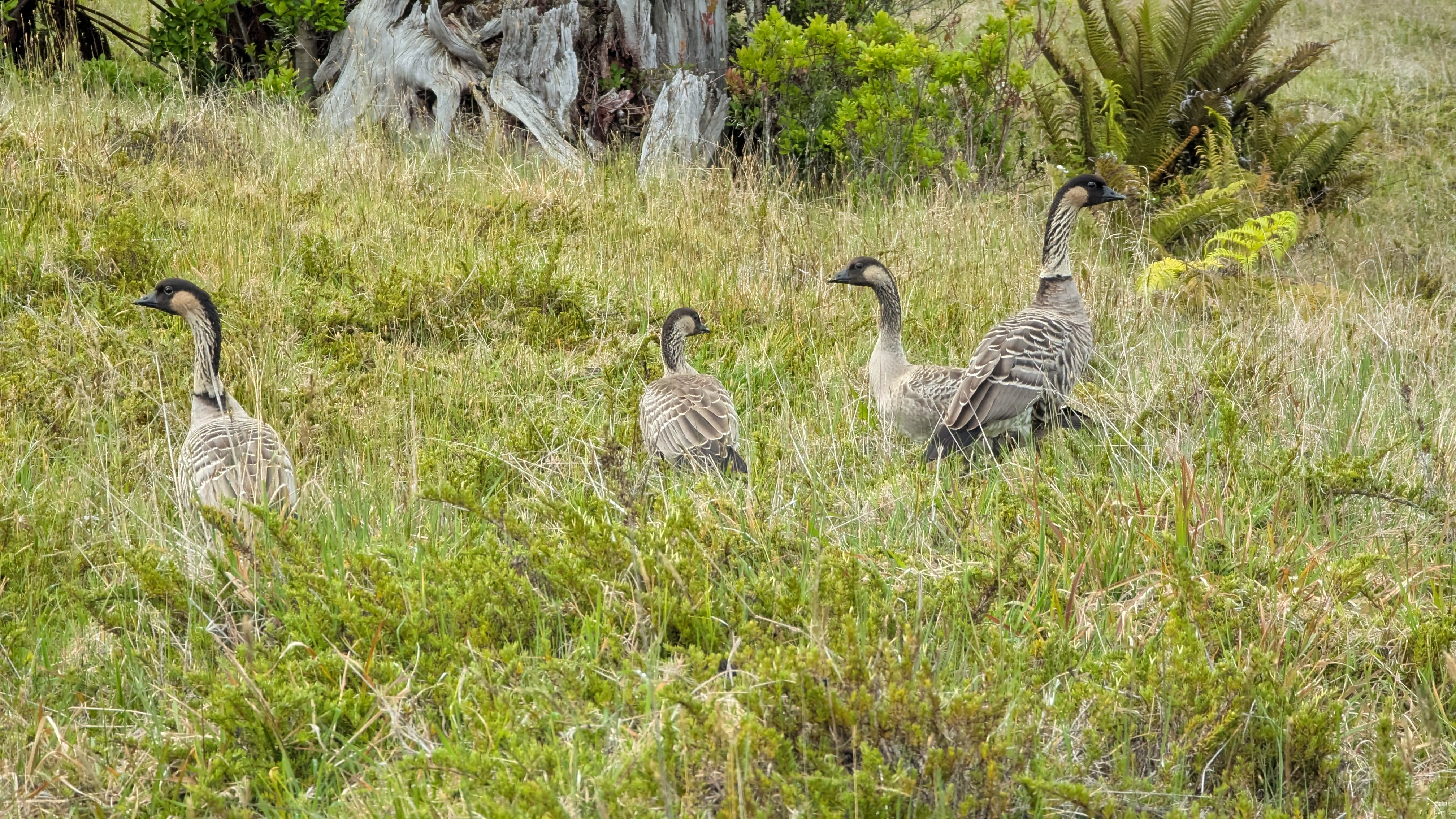
I saw these nēnē fairly close up in one of the areas we wouldn't normally be.


I originally intended to talk about all the protocols in this post but even just the repeating ones turned out to be a fruitful subject. I'll have another post covering our non-periodic protocols soon where we'll wrap up by going over what my field season looked like. A hui hou!

Tuesday, September 30, 2025

Visiting Hakalau Natural Area Reserve

A few weeks ago on September 13 I had the opportunity to attend the annual Find Your Wild open day high on the slopes of Mauna Kea. This event happens only once a year and is limited to 500 people, but it allows members of the public to access the Hakalau Forest National Wildlife Refuge (part of the Natural Area Reserve System, or NARS) and see the rare plants and birds found there. Since we work in a fellow Natural Area Reserve and know many of the people working at Hakalau, most of us from work went as a group.

There were a variety of events going on over the course of the day, with the mains ones being a several-mile-round-trip hike through the woodland in the process of being restored, a tour of the greenhouse where plants are propagated (though we missed out on that), and lots of booths from various conservation organization around the island and state. Judging by the photography equipment a lot of people were there to see the rare native birds, such as the ʻiʻiwi, ʻapapane, ʻakepa, ʻakiapōlāʻau, and ʻelepaio (and others I'm forgetting). We see those birds occasionally in the Puʻu Makaʻala Natural Area Reserve where we work, but on the older slopes of Mauna Kea where the forest has had more time to turn lava rock into nutritious soil the sheer number of birds we saw was incredible. These birds no longer exist at lower elevations (where most of the island's population lives) due to mosquitoes and the deadly avian malaria they carry, so few people get to see or hear them without taking trips to high-elevation woodlands.

Part of the hike. Other than a few trees the entire area was clear-cut just a few decades a go.

Speaking of plants, we also got to see some rare varieties of those. Some of them appear at Puʻu Makaʻala, but again there were some Mauna Kea-specific species which I hadn't seen before. We got to hear from a conservationist there about one particular plant in the mint family, Phyllostegia brevidans, which was first described in 1862 and then disappeared from the record and was thought extinct for around a hundred and fifty years. Sometime earlier this century a single specimen was found by an exploring conservationist. He took some samples, which took six years to be identified from leaf samples in the Bishop Museum collection, after which he was able to return to the same individual plant to try to collect seeds. The plant was half-dead, with a single bunch of moldy fruit, but the seeds he got (remarkably) sprouted, and with some care and attention (and an ungulate-free enclosure to grow in) the plants were returned to the wild and many individuals are now thriving.

However! P. brevidans was previously pollinated by the nectivorous ʻiʻiwi, whose long, curved bills perfectly fit the plant's long, curved flowers. But its numbers had dropped so low for so long that ʻiʻiwi simply passed it by when it was replanted; they likely hadn't seen any in generations, and had completely lost the part of their cultural knowledge that told them it was edible. Thankfully, after some years they eventually figured it out again, and as of a few years ago are once again feeding from (and pollinating) their long-lost symbiotic flora. I can't tell it nearly as well as I heard it, but it was a truly inspiring success story of conservation.

I couldn't get a good photo of the several ʻiʻiwi I saw, so here's a gorgeous 3D-printed one! (Life-size.)

Overall it was a really interesting experience, and was a great way to see some rare and endangered birds and plants. It's a long drive to get there along Mana Road, but it offers some great views that I hadn't seen before. We'll see how often I get to go again (as it requires signing up before slots fill up), but I enjoyed the experience a lot. A hui hou!

Saturday, September 20, 2025

A Hawaiian pie

It has been a very busy month here for me, which is why it's been so long since my last post. Some of the busyness has been pleasant (birthday parties!), some…more neutral (being in a hotel while my apartment building was tented this week), but all of it left me with little downtime or drive to write.

One exciting development is that last week I finally managed to make the pie I've been meaning to since about May! The idea was sparked by a comment from a coworker about how one could theoretically bake a pie using ʻākala (native Hawaiian raspberries) and ʻōhelo (native Hawaiian blueberries). The ʻākala ripen earlier (around May/June), so while I had some in the freezer ready to use for a few months it wasn't until late August/early September than the ʻōhelo really started ripening in significant amounts. Once they did, though, I was able to pick a lot – easily a few cups of berries in a quarter-hour's work. I ended up with so many that I didn't even use them all up making the pie, and will have to find some other use for them…

Thankfully, the pie came out well! I used the recipe I mentioned in my previous post (where I made it with raspberries and blueberries), and only added about a fourth of a cup of additional sugar. It wasn't an especially sweet pie, but it wasn't tart as I had feared the ʻākala would make it. (It's interesting to me how red the filling is – while related to blueberries, ʻōhelo are generally more red or reddish-purple in color.) I ended up making it after a particularly draining day at work (an arduous protocol that involved much tromping through the forest, under a sky that rained off-and-mostly-on all day) so I didn't get too fancy with the crust, but I did scratch the unofficial D20 logo into it. (It was also our last day doing that protocol this year, so it served as a nice celebration for finishing it.)

Anyway, just a quick post today as I'm technically still lodging at the hotel even though my place was cleared for re-entry this morning – the gas company won't come out to turn on the gas until Monday so I don't have any hot water or stove. I've got some interesting photos from visiting the annual Hakalau Natural Area Reserve open day last week, so look forward to those when I finally get a chance to catch my breath (hopefully this week!). A hui hou!

Sunday, May 11, 2025

A new job with NEON

It's been four weeks since I started my new job with NEON, the National Ecological Observatory Network (managed by Battelle), long enough for me to start settling in and having a chance to catch my breath. There's been a lot to learn. The past few weeks have been a blur of trainings on various data-collection protocols, learning to identifying dozens of plant species, and a procession of trips to various pre-established plots in the rainforest for data collection. (Plus a little bit of lab work.)

Being up at altitude near dawn for mosquito collection is rough, but the dewy grass is incredible.

NEON's mission is to provide a decades-long collection of ecological data from a network of locations across the US, so the various protocols are designed to get that data in a standardized format from diverse locations. There are twenty ‘domains’ across the US (of which we are Domain 20), which may have multiple sites where data is collected (though there's only one site in Hawaii). This data is open-source and available for anyone to use, a fact which fits my personal leanings very nicely. (Having an ORCiD already set up from my time in astronomy proved useful as we use them for attaching credit to data collection, so I may be able see data I've collected used and attributed in future papers.)

Some Astelia menziesiana (an endemic lilly) on a log.

Collecting such data isn't necessarily easy, though! In addition to the simple fact of the collections sites being located around 5,000–6,000 ft (~1,500–1,800 m) up the side of Mauna Loa, the nature of many protocols involves strict time sampling restrictions, which might require spending the day working in rain. (We're supposed to evacuate in thunderstorms, but those are rare near Hilo.) Even without rain spending 6+ hours in the field is no joke; some plots may have a lot of hard lava rock underfoot, while others (especially with feral pigs present) may be slippery mudholes. I've been amazed by the number of fallen logs in some of the older sections of the forest, which combined with the undergrowth can make getting around something of a challenge. We work four 10-hour days, and while the three-day weekend is nice there's no denying that working that long can be grueling, especially on field days.

Me recording data in a light drizzle.

Still, it's not without its upsides. While it can be uncomfortably hot, cold, or wet at times, at others it can be fairly pleasant. The work itself is interesting; while I had some experience identifying plants before, I'm learning all kinds of new, native plant species, and finding them for the plant diversity protocol is rather like a treasure hunt. Depending on the plot, we might find trees some 500 years old, or be exploring relatively younger lava flows from Mauna Loa perhaps a mere 250 years old. There's little human presence in the Natural Area Reserve where we work (although it's technically open for hiking), and the still-intact native forests house native birds which are rare elsewhere.

We often see nēnē at the site; I think I saw more my first day than in all my time here previously.

I've also found the labwork, though a far cry from anything I've done before, to be interesting. So far I've sorted leaf-litter from our leaf-litter traps, seeing how the distribution of species varies from plot to plot, and identified beetles from our beetle traps. The particular beetles we're interested in are called carabids, and while most species on the mainland are ground beetles, our native Hawaiian species are arboreal (though we still manage to catch them in our ground traps, somehow). There have actually been two entirely new species found in our traps in years past, which is certainly an exciting prospect.

Leaf litter sorting, into various piles for things like leaves, flower, seeds, twigs, etc.

After four weeks I'm not sure if this is something I want to continue doing indefinitely, but I've got a wonderful group of motivated, clever, and fun coworkers to work with and there are certainly fascinating aspects to the project and sights I wouldn't see otherwise. Perhaps I'll feel differently after a few more months. We'll see! A hui hou!

Tuesday, July 4, 2023

Browsing the bonsai

This past Saturday I went down to the Wailoa center to see a bonsai exhibition which I heard about from a friend (and whom I met there to see it with). It proved a rather eye-opening experience. My impression of bonsai, prior to this, was that it always involved conifers or other evergreen trees, but this exhibition included plenty of bonsai made with broad-leafed plants, including some that I found very creative. For instance, here's a three-year-old bonsai made from an oregano bush:

Having grown oregano in my Farmstand I was very interested in this one, since it seems to be a slightly different variety with smaller leaves, and perhaps more inclined to grow into a woody herb. Another surprise was this bonsai citrus tree, complete with (quite a lot of!) fruit:

This one definitely had me thinking about what other fruit trees might be able to be cultivated indoors as bonsai. When I originally got my Farmstand I had thought a bit about the possibility of growing an indoor fruit tree or two, but had given up the idea on the basis that it would probably require an inconveniently-large pot, and that most fruit trees grow larger than the average room height. But these bonsai trees grow out of what I would cordially characterize as absurdly small pots, and bonsai is all about keeping trees artificially small, so perhaps it's not as impractical as I had assumed. I might need to look into this some more.

Of course, there were plenty of more traditional bonsai there too, including a lot of evergreens. I didn't take too many photos of those (though there were many pleasing and impressive ones), but this larger-than-average twenty-year-old black pine stuck out to me:

And finally, even older than that was this Green Island banyan bonsai, at a venerable twenty-five years old:

I'd show a rather beautiful bougainvillea bonsai in flower, but unfortunately my only photo of it came out blurry. All in all the exhibition only took about three quarters of an hour to see, but it was a fun experience all the same, and definitely opened my eyes to what can be done with bonsai. I don't know that it'll become a new hobby or anything, but I can appreciate it more now (though I wish there were some explanation somewhere of what all the many style names mean). I think it's a yearly thing, so I'll have to see if I can get wind of it again next year and see it again. A hui hou!

Wednesday, May 17, 2023

Going nuts

Another lap around the Sun, one year finished, another begun…that's right, it's birthday time again. A respectable thirty-four this year. One more and I'll be eligible to be president!

Back in April last year I did a fun little Venn diagram on thing which we call berries, things which are botanically berries, and the overlap between them. Recently it was pointed out to me that nuts have a similar situation, so I figured I'd give them the same treatment and see how they compared.

Compared to the berry version, I had to make the top circle a bit larger to hold all the things I found with “nut” in the name at this Wikipedia page. Sometimes the line on what we call a nut is a bit fuzzy; I did include macadamia nuts, even though I've certainly heard them called simply “macadamias” on occasion, because to me the “nut” feels like an important part of the name. Feel free to disagree in the comments, though. That self-imposed restriction that “nut” appear (significantly) in the name means that a lot of things commonly thought of as nuts are absent; pecans, almonds, pistachios, and cashews, for instance, all don't appear. That's because they are not biologically nuts, and we don't tend to include “nut” in their names, so they don't actually fall into any category listed here. (Adding a “generally considered a nut” circle might be interesting, I suppose, but even fuzzier; considered by whom?)

When I did the berry version, my takeaway was that the various groupings were mostly balanced; in fact, the union of the two was the largest group, indicating that things called berries generally mapped to the botanical definition fairly well. Here, it looks like it's instead skewed towards things which are called nuts, but aren't nuts botanically. I also hadn't even heard of several of the nuts in the middle or bottom categories (they tend to come from Africa or Australia/Oceania).

Anyway, that's all for this post. I'm reminded that the original berry version came about due to time freed up from paper-writing last year, and that I still haven't written anything about my thesis…I'll get to it at some point, I really will! I do have some rough outlines for posts milling about in my head. But for now, a hui hou!

Tuesday, April 5, 2022

Berry good!

Now that I'm no longer spending my nights and weekends getting my papers ready, I've once again got time and motivation to dash off silly projects like this Venn diagram comparing things we call berries, and things which are berries according to botanists:

A Venn diagram showing things called berries and things which are berries.
I got the idea for this upon learning this weekend that pumpkins are actually giant berries, botanically speaking. I already knew raspberries and blackberries weren't berries, so I got curious about just how large the overlap is. This is by no means a comprehensive image; I listed everything I could think of with “berry” in the name, then looked at the Wikipedia page on berries for more such things and examples of things that were berries botanically. There are definitely more things that fall into the bottom circle, I'm sure; I left a few controversial ones out, like avocados, because there's apparently some disagreement about whether they're actually berries or not.

On the whole, I was actually slightly surprised at how many things fell into the intersection of the diagram. I was expecting more entries in the top circle, but it looks like possibly a majority of things with “berry” in the name are actually berries, botanically speaking. Though there could very well be more things called berries than I could think of, so if you think of any please leave a comment!

A few things in the bottom circle also surprised me; like, I can see how tomatoes and grapes could be berries, they're similar enough in form to things like blueberries or cranberries that it makes sense. But pumpkins? Eggplants? Bananas?? Bananas definitely surprised me. Guess I've got a fun bit of party trivia for the future.

And speaking of strawberries (which are actually “accessory fruits”), I had my first one from my Farmstand! They're a bit on the slower side to grow (compared to, say, lettuce), since I started the plant at the start of January, but the strawberry I had was deliciously sweet. There's another red one and a few still green that are coming along, so I'm looking forward to having some more perhaps later this week or the next. I'll probably have some more news on the indoor farming front around that time as well. A hui hou! 

Sunday, February 20, 2022

Some thoughts on herbs: oregano and thyme

It's coming up on three months since I first planted seedlings in my Farmstead, and of those original twelve I still have six plants, including oregano and time. When I was first looking into hydroponic gardening, among the many consumer-scale systems out there I saw several fairly small devices, set up for growing just six or seven plants sometimes. Typically, I'd see them advertised primarily for herbs, since they were small enough there wasn't much space for larger plants like lettuces to grow. I didn't think just growing herbs would be very useful, since you can't make a salad out of them, so I ended up going with the Farmstand for more growing space. However, now that I've lived with the ability to pick fresh herbs for a few months, my stance on them has definitely softened a bit.

Oregano at the top, thyme near the bottom.
While I probably still wouldn't get a system for growing exclusively herbs (the ability to pick my own salads daily is just so good!), I've come to appreciate fresh herbs a lot more. Generally herbs, by their nature, work well with the “cut and come again” method of progressive harvesting over time, which I prefer over harvesting a whole plant at once. And they can really do a lot to spice up a dish! I used oregano and thyme to approximate a crude za‘atar for some lamb I cooked last week, and it came out quite well, and reminiscent of the real thing (which usually includes some additional herbs, such as the eponymous za‘atar plant). When making a breakfast omelet I sometimes sprinkle in some thyme or crumbled oregano or sage leaves, or chopped garlic chives. I've used the herbs I grow (including dill and bunched green onions in addition to the ones already listed) in a number of recipes: tuna or egg salad, soups, pasta sauce, even sandwiches. Having fresh herbs at hand is a much more valuable tool in the chef's arsenal than I appreciated before.

Having said that, I wanted to talk about the two herbs in the title, oregano and thyme. You can see them in the photo above (a photo of the Farmstand from the opposite side than in photos in previous posts); oregano is the plant in the center near the top with the hanging stems, though it's somewhat difficult to make out due to being encroached on by sylvetta arugula from the left and celery from the right. Two tiers below it, occupying much of the bottom of the photo, is thyme. Now, these plants superficially seem pretty similar. They're both somewhat bushy, with similar patterns of pairs of leaves branching out along their stems. They have a fairly similar flavor, as well, both somewhat pungent, almost spicy. However, while similar in form, they differ in scale, and that turns out to make a huge difference to how easy they are to harvest.

Oregano, as you can see at the top, has fewer (and slightly thicker) stems and larger leaves. (They're perhaps around the size of a postage stamp when fullly grown.) It has maybe 10–20 stems growing out, which makes it pretty easy to snip one off and pull the leaves off it for use. Thyme, on the other hand…thyme is a monster. A hydra, with dozens, probably well over a hundred stems all clawing their way outwards., and any one you clip off just grows two more stems from the stump. The leaves are perhaps a tenth the size of oregano, and the stems are much thinner, which makes it harder to strip the leaves off—the thin stems often tend to break, and the leaves hold on proportionately better than oregano leaves do. In general, I find stripping thyme leaves much more aggravating than oregano. (I've got an “herb stripper,” a small metal device with differently-sized holes which you can pull stems through, to strip the leaves off, but it's unfortunately not much better than using my hands for thyme.) I do like the taste of thyme—it's especially good paired with meat—but I sigh a bit inwardly whenever I'm clipping more than one or two stems for use. The one good aspect to thyme's increased vigor is that there's so much of it that I can afford to be a lot less efficient in harvesting it—if I lose 30% of the leaves on a stem because I couldn't be bothered picking each tiny leaf off individually after going over it once, no problem, I can just snip another few stems to make up for it.

I'll probably continue growing both oregano and thyme (and other herbs) in the future, as I've quickly grown accustomed to the taste, and I've got enough lettuce varieties already that I can spare some slots for herbs. (They're both prolific enough that I might see about harvesting a bunch of leaves from both plants and drying them for saving, which would be neat and potentially make a nice gift). I've just been musing recently about how two plants, so alike in form otherwise, can be so different simply due to their different size scales. And if you're thinking of trying hydroponic gardening, but can't afford (or fit in) a large system like the Farmstand, maybe give one of those smaller systems a try, even if just for growing herbs. A hui hou!

Wednesday, February 2, 2022

Expanding the Farmstand

This post is almost a month behind the times, but back at the start of January I expanded my Farmstand  with another two levels (out of a possible total of six). I always meant to expand it over time as I figured out how much food it produced and how much I could eat, but there was a promotion in December that resulted in me getting a free level, so I sped up the timeline a little.

Freshly (re)planted.

I also took the opportunity to harvest six of the original plants, leaving just the celery, dill, oregano, thyme, garlic chives, and scarlet cherry tomato from the first planting, which is why it looks so bare again in the above photo. (Thyme, by the way, is like a hydra; it's got dozens of stocks, and every time I cut one off two more sprout from the stump.) Adding two levels to the Farmstand actually had an interesting psychological effect. Before, it came up barely to my waist, and any tending to it required bending over. Now, the top of the highest tier comes up to about the level of my shoulders, making it much more of a peer in height and allowing me to tend to plants in the top levels while standing straight. (The extra grow light levels also light up the living room noticeably more, allowing it to stand double-duty as a floor lamp!) It's quite the change, and I'm curious to see how it'll go with the full six layers, although I'm not in a huge hurry to install them; the amount of food from four layers is pretty impressive compared to just two.

After three weeks' growth.

I took this photo last week, about three weeks since planting. While it's still slow enough to barely notice between days, I remain impressed at the speed plants grow in a hydroponic system. Double the number of plants has increased the weekly water consumption too; whereas before I only needed one trip with the 1.75 gallon watering can, this past week took two and a little bit extra!

With the extra space, I replenished a few plants that are fast becoming favorites (classic butter lettuce, lolla rossa lettuce) while taking the opportunity to try some new things. Lettuce Grow has a huge variety of seedlings available (something like 200 total, although it varies seasonally), so among other things I added a strawberry, some cauliflower and broccoli, and sage. I've discovered I quite like komatsuna for salads, which grow fast and have absolutely gigantic leaves—you can see it in the photo above in the third level, the plant directly facing the camera. (Some of those leaves are bigger than my hand!) I've also discovered I'm not a fan of arugula—unfortunate, since I planted two varieties of it (astro arugula and sylvette arugula), but that's what experimentation is for. Over time I'll figure out the plants I like and want to grow.

I probably won't expand to the final two levels for at least a few months, but come March it'll be three months since I started farming. Lettuce Grow recommends taking the Farmstand apart for a good cleaning about that often to prevent algae build-up, so it might also be a good time to harvest some plants and introduce some new seedlings. They apparently do two seasonal seedlings each month, so we'll just have to wait and see what comes out. A hui hou!

Sunday, May 24, 2020

Flowery Australian Flora

This past Sunday, due to loosening lock-down restrictions, I went over to some friends' to catch our church livestream and have lunch. As I was leaving my house, the surprisingly nice weather caught my eye and caused me to take a few photos of some of the plants in the front yard with rain from the night before still sparkling on them. The Sun was unexpectedly out—it's been rainy or overcast the past few days—and it lit up the raindrops in a really lovely manner.


I haven't been taking too many photos the past few months, so I felt like playing around a bit and experimenting with angles. Here's a bottle-brush still be-speckled with raindrops, with the blue sky in the background. A lot of stuff is blooming out-of-season this year, which is strange: apparently, in the first four months of the year, we've had more rain in Melbourne than in the entirety of 2019, and were even on track for having the wettest such time period ever. And we missed breaking the lowest recorded temperature on May 1st by a single degree (Celsius)! So it's not like it's been unseasonably warm or anything, plants are just blooming at strange times.


I don't know what kind of plant this is, I'm afraid, other than that it's different from the previous one. I was really feeling like pushing the limits of how close I could get a photo, and with the Sun shining brightly on the water droplets this came out pretty nicely I think.


And here's the culmination of my attempts to get up-close-and-personal with the plants. This is, yet again, a different plant from the first two, and I similarly don't know what it's called. (Edit: Whoops! I checked my front yard this morning and realized this is actually part of the same bottle-brush plant from the first photo.) I love the back-lighting of the fine hairs on the leaves, though!

I'm sure for my northern hemisphere readers this flowery foliage is nothing special as you head into summer, but I thought it looked nice, so have a helping of Australian flora! A hui hou!

Saturday, November 14, 2015

Shore Acres State Park Pictures

In the confusion surrounding attending the International Astronomical Union session just a few days after getting home from vacation this summer I only recently realized that I had some pictures lying around on my hard drive that I'd intended to post. I put up some panoramas I'd made soon after getting back from the IAU, but forgot about some other, single pictures I'd taken. So here they are!

These pictures are from Shore Acres State Park in Oregon—once the estate of pioneer lumberman and shipbuilder Louis J. Simpson, now the site of a five-acre formal garden overlooking the Pacific Ocean. Looking over my pictures I don't seem to have been feeling like taking any wide-angle photos, as most of my pictures are more focused on individual things. So nothing showing the large-scale structure of the gardens, sorry.

These aren't real birds, they're just statues—but very nice-looking ones.

 Slightly-wider view of the pond they reside  in.

Do not adjust your monitor! This picture is not upside down—it's a reflection showing the lovely conifers surrounding the park.

The park had a small greenhouse full of various flowers and plants. This particular one caught my eye for its spiral leaf patterns. (The text says “rex begonia 'Escargot'”.)

Another picture of a second plant of the same type, showing off those radical foliage helices.

And that's all for now. A hui hou!

Friday, November 11, 2011

Avocado Adventures

Recently I read a very interesting book called In Defense of Food: An Eater's Manifesto by Michael Pollan. It's about how many of the "diseases" associated with a Western lifestyle appear to be directly linked to the Western diet. (I put diseases in quotes because these are not, strictly speaking, caused by any sort of pathogen: I'm talking about things like heart disease, cancer, late-onset diabetes, obesity, and other similar ailments. And by Western diet I don't mean "someone who lives on Big Macs and milkshakes", but "pretty much anyone in America who buys food from the grocery store and isn't eating some unusual diet".) In Defense of Food  also talks about "nutritionism", the belief that food can be thought of as merely human fuel and reduced to its constituent chemicals. In this mindset it's easy to make food healthier -- simply remove the "bad" nutrients and replace them with "good" ones. This mindset has been the guiding policy of the American food industry for nearly the entire past century.

Now, on the face of it, this position appears reasonable. It has, in fact, had some dramatic victories, such as the discovery of vitamins. The near-eradication of such "diseases" as beriberi and scurvy stands as a monument to its success. Pollan is not saying that nutritionism is necessarily wrong, just incomplete. He makes a good point when he argues that while modern science may be able to identify all the components in a type of food, it is much less able to figure out how all those components work together in the digestive tract. There may very well be important interactions we don't know about between the nutrients in food during the digestive process that help make it healthy, in which case manually tinkering with the balance of those nutrients may not be effective or helpful. Evidence that simply knowing the nutrient value of foods is not enough is not hard to come by. For starters, there's what's known as the French Paradox: the French eat a diet that by nutritionism's standards is wildly unhealth, yet they enjoy far better health on the whole than Americans. And that's not just because Americans are an unhealthily eating lot: according to studies, Americans are the most health-conscious people on the planet, while paradoxically also suffering from some of the highest rates of the aforementioned Western diseases.

The evidence points to the typical Western diet (even of health-conscious people) being the culprit. Again, evidence for this is easy to find: time and again, scientists during the 1900's noticed that when indigenous people switched from their native diets to the Western diet, invariably Western diseases (or "diseases of civilization") soon followed. In a dramatic demonstration of how these effects can be reversed, a group of middle-aged Aborigines in Australia suffering from ailments such as obesity and type 2 diabetes went "back to the bush" for a few months and experienced dramatic improvements to their health. (You can find a link to a quotation from the book detailing this experiment here.)

Now, some of you may be thinking to yourselves, "If the price to pay for the luxuries of modern living is being a bit obese and a higher risk of cancer and heart disease in old age, I think I can live with that." And indeed, I would be inclined to agree with you. Neither Pollan nor I are advocating a return to pre-Industrial Revolution-style conditions in order to escape diseases that, while nothing to sneeze at, are nothing compared to what mankind struggled with prior to modern medicine and agriculture. However, the question is whether there are only two alternatives: live a healthy life without modern conveniences or an unhealthy one with them. According to Pollan there is a third option, namely, living a healthy life by taking advantage of the conveniences of modern life.

Doing so, however, will require a bit a rethink of our approach to food. According to Pollan, more and more of the food found on grocery store shelves isn't so much food as it is "edible foodlike substances". While preserving food (such as by drying, salting, smoking, etc) has been around pretty much forever, much of the processing done to food on the shelves today is much, much, younger, and Pollan argues that we haven't had enough time yet to fully understand what we're doing with out diet. Prior to industrialization every culture on Earth had some sort of traditional diet that they ate and had been eating for hundreds if not thousands of years, and those diets obviously worked, else the culture wouldn't be around to be eating them. In contrast, industrialization and the accompanying changes to our food supply (and they have been dramatic changes) have only been around for 150-200 years, at most. Of interest is the wide variety in those pre-Industrial diets, many of which would not be thought at all healthy according to modern nutritional science. For instance, people have survived and thrived on diets consisting almost entirely of plants, and almost entirely of meat, and ones everywhere in between, often with large amounts of nutrients that are considered extremely dangerous today (various kinds of fat, etc.). This suggests that we ought not be too dogmatic about what we think we know about food.

There are many other things I could expand upon, such as the fact that the majority of nutrients in the Western diet now come from just four species: corn, soybeans, wheat and rice, while the number of species in the world's collective cookbook stands at over eight thousand. Or that the higher incidence of Western diseases is not simply a matter of more people living to older age, but a demonstrable effect based on diet (and lifestyle. Pollan reminds us that the two cannot really be separated). But this post is already long enough, and I'd just be poorly parroting the book, which is well-written and an interesting read. Pollan's advice boils down to seven words: "Eat food. Not too much. Mostly plants" and while I have never been one to pay too much attention to my diet before, I was so intrigued by the ideas in this book that I've decided to try to eat a healthier diet by a) paying even less attention to health claims by food than before, and b) just attempting to eat a balanced diet of real food that has withstood the test of time.

Basically, I decided to start trying out new recipes and such, so the last time I went shopping I got some avocados at the store (so THAT'S what the title is about!). I don't remember eating avocados much as a child, so I decided I'd be bold and try to make something with them. I created some guacamole, and was instantly hooked (I also learned that unripe avocados are not to be trifled with, but that's another story). In fact, I could definitely see this becoming a new favorite food in the very near future. See, Mom, I may still be a picky eater, but I do try new things from time to time. And sometimes I even like them.

Anyway, it occurs to me that I just wrote a two-page essay to describe a new food foray, but I was planning to write something about In Defense of Food anyway, so I killed two birds with one stone there. If you have any other favorite recipes involving avocados, feel free to leave me a comment! (For some reason, I've spent this entire post wanting to write "avocados" as "avodacos".)