In a funny coincidence, when the latest three-month schedule for Astrobites was put together I ended up being scheduled for both Thanksgiving and Christmas Eve. I got my Thanksgiving post up two days ago, and amusingly the title (“Mirach’s Ghost and Mirach’s Goblin: A New Galaxy Found Near the Local Group”) sounds a bit like I mis-scheduled a post intended for Halloween.
I'd actually intended to write this post for the queue and write about a different paper for my scheduled Thanksgiving post, but I ended up being extremely busy this week (details below) and since I'd already started working on this post I ended up using it instead. Oh well. Maybe I'll write the other one up for the queue. The paper I ended up writing about is fascinating in its own right, about the discovery of a new, extremely faint dwarf galaxy just beyond the boundary of the Local Group.
The reason I was so busy this week is that I was attending SciCoder 2018, an intensive week-long workshop in scientific programming. This was, however, an almost-literally last-minute decision, as the course had filled up so quickly upon being announced a few months ago that I only made it on the waiting list (and knew there was at least one other person who was on it ahead of me). Sunday night at about 7:30 PM I got an email from the conference organizer letting me know there was an opening and asking if I wanted to attend, and after half an hour or so of working out just how much that would impact my week I accepted.
And when I say intensive, it was just that; 9 to 5 each day (or 8:30 on the first day), at the University of Melbourne (necessitating an hour of train and tram travel for me each way), and throughout a veritable avalanche of information. I was fortunate to already have some familiarity with some of the concepts presented, and even I left each evening feeling like I'd just spent the day doing the mental equivalent of drinking out of a fire hose. It was good, don't get me wrong, but also quite exhausting.
Somehow during the week I also managed to squeeze out enough time (not that it took much) to work on a little personal project: Astrobites has had an offer, through its parent association the American Astronomical Society, for a logo revamp by a professional design firm. In place of the current logo which uses a photograph of Mars (with a bite taken out of it), one of the concepts they've provided was a stylized representation of Mars (with a bite taken out of it).
I'm a huge sucker for stylized representations of things, and liked the general idea, but there were a few details of the proposal that I wasn't 100% satisfied with so I quickly made a slightly different version of my own based on their template to illustrate the shortcomings I saw…and then had a fanciful idea to make a whole solar system of stylized-planets-with-bites-out for logos. I've got enough experience with Inkscape now that it only took me an hour or two, and I really like how it came out (as did a few fellow students when I showed them).
At this point I've changed Mars enough that the only thing I'm really copying from the proposal is the “bite and crumbs” motif each planet has. I doubt these will show up in an official capacity, so I thought I'd show them off here as a personal project. That's it for today though, I need to go catch up on my sleep now. A hui hou!
Showing posts with label Solar System. Show all posts
Saturday, November 24, 2018
Wednesday, November 29, 2017
Gravitationally Unbound: Interstellar Interloper ʻOumuamua
So I'm pretty late to write about this and you may have already heard about it by now, but in case you haven't, on October 19th the Pan-STARRS telescope in Hawaii discovered the first known object in our solar system that's unquestionably of extrasolar origin. The tiny interstellar wanderer, now known as 1I/2017 ʻOumuamua, was caught forty days after its closest approach to the Sun, and it was quickly realized that its speed—both on approach to and away from the Sun—was far too high for it to be gravitationally bound to the solar system.
This was pretty exciting, as this is the first time we've discovered an asteroid in our solar system that definitely came from outside it. There's been an intermittent stream of papers on ʻOumuamua over the weeks that followed its discovery, speculating on its possible origin, trying to figure out whether it's a comet or an asteroid (the latter seems most likely, given its complete lack of visible coma even after passing within the orbit of Mercury), even calculations on how far the Earth−Moon system would have moved if it were a macroscopic chunk of nuclear-density dark matter! (About ten meters/thirty-three feet was the conclusion, so don't worry about it.)
One of weirdest things about ʻOumuamua so far is its shape. Now, like all known asteroids it's much too small to make out its shape directly (even passing less than a fifth of the distance to the Sun from Earth). However, we can measure how its brightness changes over time (called its light-curve) which can tell us both how fast it rotates and how elongated it is…and that's the strange part. According to the large difference between the maxima and minima of its light-curve, ʻOumuamua must have a length ratio of something like 1:6 or even 1:10. Think cigar-shaped and you've got an idea of what it must look like. This is, needless to say, really, really odd, as nothing we know of in our solar system has a shape approaching anywhere near that ratio. Whatever it's made of must be holding itself together with more than just gravity.
Finally, if you're familiar with my blog, you've probably already guessed that the name ʻOumuamua is of Hawaiian origin. (And if you did, good job!) ʻOu means “to reach for,” while mua has several meanings but is generally associated with the idea of being first, foremost, leader, or senior. “I mua!” means “Forward!”, and ʻoumuamua (with some of that Hawaiian reduplication I've talked about) means scout (in a military sense), one sent on ahead or before. Which is the intended meaning of the name in this case, as ʻOumuamua will likely be only the first of more interstellar objects that we'll detect in the future.
Interesting times we live in! A hui hou!
This was pretty exciting, as this is the first time we've discovered an asteroid in our solar system that definitely came from outside it. There's been an intermittent stream of papers on ʻOumuamua over the weeks that followed its discovery, speculating on its possible origin, trying to figure out whether it's a comet or an asteroid (the latter seems most likely, given its complete lack of visible coma even after passing within the orbit of Mercury), even calculations on how far the Earth−Moon system would have moved if it were a macroscopic chunk of nuclear-density dark matter! (About ten meters/thirty-three feet was the conclusion, so don't worry about it.)
One of weirdest things about ʻOumuamua so far is its shape. Now, like all known asteroids it's much too small to make out its shape directly (even passing less than a fifth of the distance to the Sun from Earth). However, we can measure how its brightness changes over time (called its light-curve) which can tell us both how fast it rotates and how elongated it is…and that's the strange part. According to the large difference between the maxima and minima of its light-curve, ʻOumuamua must have a length ratio of something like 1:6 or even 1:10. Think cigar-shaped and you've got an idea of what it must look like. This is, needless to say, really, really odd, as nothing we know of in our solar system has a shape approaching anywhere near that ratio. Whatever it's made of must be holding itself together with more than just gravity.
Finally, if you're familiar with my blog, you've probably already guessed that the name ʻOumuamua is of Hawaiian origin. (And if you did, good job!) ʻOu means “to reach for,” while mua has several meanings but is generally associated with the idea of being first, foremost, leader, or senior. “I mua!” means “Forward!”, and ʻoumuamua (with some of that Hawaiian reduplication I've talked about) means scout (in a military sense), one sent on ahead or before. Which is the intended meaning of the name in this case, as ʻOumuamua will likely be only the first of more interstellar objects that we'll detect in the future.
Interesting times we live in! A hui hou!
Labels:
asteroids,
astronomy,
Hawai`i,
Hawaiian,
Solar System
Tuesday, September 19, 2017
End of an Era, in More Ways Than One
Last Friday, September 15, was the last day for two things: my employment with ASIAA, and the Cassini–Huygens mission to Saturn.
Cassini was launched in 1997, when I was eight years old and firmly in the grip of my first passionate love of astronomy, focused on the planets in the solar system. It took seven years to reach Saturn so I had plenty of time to find out about it and years to look forward to its arrival at my favorite planet in the far-off future of 2004. When Cassini finally reached Saturn I remember reading all about it, about the Huygens' probe's successful landing on Titan, the first such landing on a solid body in the outer solar system, and the incredible pictures being beamed back from Saturnian orbit. And over the past thirteen years I've watched as any number of amazing discoveries were made and awesome photos taken.
Cassini was originally slated for a four-year mission, from 2004 to 2008, but its outstanding success allowed it a mission extension first to 2010, then an additional seven years beyond that. I was fifteen when it got to Saturn, and it came to feel like a a constant: multiple rovers landed on Mars, Messenger flew by Mercury a few times, New Horizons sped past Pluto, several other missions blazed brightly briefly in the public consciousness like shooting stars but the whole time Cassini was there, quietly taking pictures and measurements and redefining our knowledge of Saturn and its gorgeous system of rings and moons, constant like the cosmic microwave background.
Cassini was launched in 1997, when I was eight years old and firmly in the grip of my first passionate love of astronomy, focused on the planets in the solar system. It took seven years to reach Saturn so I had plenty of time to find out about it and years to look forward to its arrival at my favorite planet in the far-off future of 2004. When Cassini finally reached Saturn I remember reading all about it, about the Huygens' probe's successful landing on Titan, the first such landing on a solid body in the outer solar system, and the incredible pictures being beamed back from Saturnian orbit. And over the past thirteen years I've watched as any number of amazing discoveries were made and awesome photos taken.
![]() |
| Saturn from Cassini in 2016; photo by NASA (public domain). |
Cassini was originally slated for a four-year mission, from 2004 to 2008, but its outstanding success allowed it a mission extension first to 2010, then an additional seven years beyond that. I was fifteen when it got to Saturn, and it came to feel like a a constant: multiple rovers landed on Mars, Messenger flew by Mercury a few times, New Horizons sped past Pluto, several other missions blazed brightly briefly in the public consciousness like shooting stars but the whole time Cassini was there, quietly taking pictures and measurements and redefining our knowledge of Saturn and its gorgeous system of rings and moons, constant like the cosmic microwave background.
This video gives a brief overview of the mission.
To me, having grown up with Cassini it's strange to think that it's finally gone; no more news stories with the latest eye-catching pictures, or amazing discoveries it made (although I don't think we've exhausted the scientific value of the data it sent back yet, not by a long shot). I didn't keep particularly close tabs on it as the years went by (partly due to that perception of permanance)—and only found out about the end of the mission a few days ago in fact—but I generally kept up with the major discoveries, and all in all I'm going to miss that intrepid probe.
But fuel, and NASA's budget allowance, eventually come to an end, and so too did Cassini's incredible mission. And coincidentally it happened on my last day of work with ASIAA, where I've been a telescope operator for AMiBA for the past six months (exactly!). It feels like the end of an era, in more ways than one, as I'm now busy preparing to move to Australia to start graduate school in just over a week.
People keep asking me if I'm excited, or telling me how excited I must be. Being free of work has left me free to face the reality of moving and all the many things still remaining to be done in the next far-too-few days. My internal emotional state seems to be a quantum superposition of many confusing and conflicting feelings, and observing it usually yields a value best approximated by “abject terror,” so I try not to do that too often.
For some reason people seem to ascribe to me a confidence and adventurousness I can only dream of possessing in reality. The truth is I am a man who finds blessed comfort in routines and the thought of breaking all of them—simultaneously—terrifying in the extreme. I find travel (especially alone) highly stressful, necessitating as it does the disruption of so many comforting patterns, though at least for the past eight years it's only been between my current and my childhood homes; now I face the looming specter of leaving everything I know behind to travel somewhere I know no one. Perhaps some people would find that exciting? All I know is that it doesn't feel like excitement to me.
Sorry, that got a bit philosophical towards the end didn't it? It's not all so doom-and-gloom as this probably makes it sound. I should get back to preparations—I've got a lot to do before next Wednesday! A hui hou!
![]() |
| My final picture of the YTLA, taken a day before on the 14th. |
For some reason people seem to ascribe to me a confidence and adventurousness I can only dream of possessing in reality. The truth is I am a man who finds blessed comfort in routines and the thought of breaking all of them—simultaneously—terrifying in the extreme. I find travel (especially alone) highly stressful, necessitating as it does the disruption of so many comforting patterns, though at least for the past eight years it's only been between my current and my childhood homes; now I face the looming specter of leaving everything I know behind to travel somewhere I know no one. Perhaps some people would find that exciting? All I know is that it doesn't feel like excitement to me.
Sorry, that got a bit philosophical towards the end didn't it? It's not all so doom-and-gloom as this probably makes it sound. I should get back to preparations—I've got a lot to do before next Wednesday! A hui hou!
Labels:
astronomy,
Australia,
Mauna Kea,
Mauna Loa,
photos,
Saturn,
Solar System,
telescopes,
YTLA
Monday, September 14, 2015
Saturn's Rings and the Earth-Moon Distance
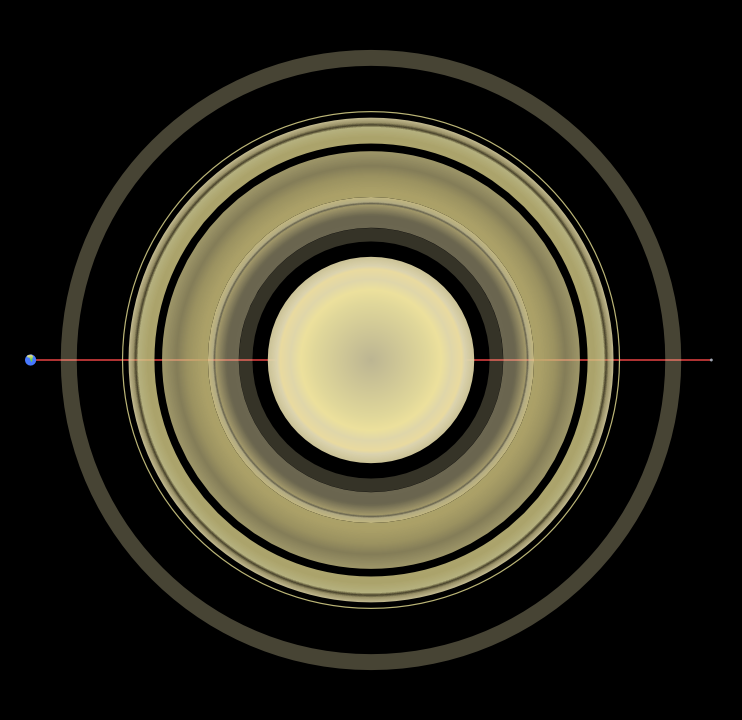
A few weeks ago I happened to hear offhand that Saturn and its rings would fit nicely in the space between the Earth and Moon. Being the visual-oriented person I am, I decided to go ahead and make a picture to put them in perspective, and figured I'd share.
First of all, a quick primer on the nomenclature of Saturn's rings. The rings are labeled alphabetically in order of discovery, although the A, B, and C rings were all discovered basically at the same time and the decision to name them working outward in towards the planet was pretty much arbitrary.
Technically the F ring is too thin to be shown here; it's only about 30–500 km thick which means it's about 40–400 times thinner than shown here. The relative brightnesses of the rings is also only approximate; the G ring (and even D ring) are also fainter than shown here, and aren't visible to the naked eye. They were only discovered with photography from various interplanetary probes after 1979 (as was the F ring). The F ring is the outermost of the “discrete” rings; beyond it, the rings are diffuse and may have moons orbiting embedded within them.
The astute among you might have noticed that there is a distinct lack of an E ring in the above image. Don't worry, we'll come back to that. Anyway, let's see how these rings stack up against the average Earth-Moon distance:
With an average separation distance between them of about 358,000 km, we can see that the Earth and the Moon nicely frame Saturn and its main rings there. It also gives a good idea of the size of Saturn relative to Earth.
But what about that E ring I glossed over a paragraph ago? Turns out the E ring is outside the G ring and extremely large, but like the G ring it's also extremely faint and diffuse.
Anyway, here's the E ring in all its glory (I've left the Earth, Moon, and the line between them in place):
Yeah, the E ring's pretty wide (and again, it's so diffuse that it's not visible to the naked eye). Its outer edge is just within the orbit of Saturn's largest moon, Titan. As you can see (or maybe not), the E ring's diameter is around twice as large as the average Earth-Moon distance.
But believe it or not, that's not all of Saturn's rings! There are a few more ringlets between the G and E ring that are too thin to show here, but there's another ring outside the E ring that's even larger and even more diffuse. This ring was only discovered in October 2009, and is known as the Phoebe ring after Saturn's unusual moon Phoebe which orbits just outside of it in a retrograde orbit. Here it is, with the rest of the ring system for comparison:
Yep, that little disc in the center is the E ring we just saw in the last picture—with the inner ring system and Saturn within that. This ring is really large. In fact, unlike the other rings which have a maximum thickness on the order of tens to maybe hundreds of meters, the Phoebe ring has a thickness around forty times greater than the radius of Saturn itself. In other words, this ring is thicker than the entire diameter of the E ring.
So there you have it! Saturn and its fascinating ring system, and how it compares to the distance between the Earth and the Moon. Hope you found it as interesting as I did putting these images together. A hui hou!
First of all, a quick primer on the nomenclature of Saturn's rings. The rings are labeled alphabetically in order of discovery, although the A, B, and C rings were all discovered basically at the same time and the decision to name them working outward in towards the planet was pretty much arbitrary.
Technically the F ring is too thin to be shown here; it's only about 30–500 km thick which means it's about 40–400 times thinner than shown here. The relative brightnesses of the rings is also only approximate; the G ring (and even D ring) are also fainter than shown here, and aren't visible to the naked eye. They were only discovered with photography from various interplanetary probes after 1979 (as was the F ring). The F ring is the outermost of the “discrete” rings; beyond it, the rings are diffuse and may have moons orbiting embedded within them.
The astute among you might have noticed that there is a distinct lack of an E ring in the above image. Don't worry, we'll come back to that. Anyway, let's see how these rings stack up against the average Earth-Moon distance:
With an average separation distance between them of about 358,000 km, we can see that the Earth and the Moon nicely frame Saturn and its main rings there. It also gives a good idea of the size of Saturn relative to Earth.
But what about that E ring I glossed over a paragraph ago? Turns out the E ring is outside the G ring and extremely large, but like the G ring it's also extremely faint and diffuse.
Anyway, here's the E ring in all its glory (I've left the Earth, Moon, and the line between them in place):

Yeah, the E ring's pretty wide (and again, it's so diffuse that it's not visible to the naked eye). Its outer edge is just within the orbit of Saturn's largest moon, Titan. As you can see (or maybe not), the E ring's diameter is around twice as large as the average Earth-Moon distance.
But believe it or not, that's not all of Saturn's rings! There are a few more ringlets between the G and E ring that are too thin to show here, but there's another ring outside the E ring that's even larger and even more diffuse. This ring was only discovered in October 2009, and is known as the Phoebe ring after Saturn's unusual moon Phoebe which orbits just outside of it in a retrograde orbit. Here it is, with the rest of the ring system for comparison:
Yep, that little disc in the center is the E ring we just saw in the last picture—with the inner ring system and Saturn within that. This ring is really large. In fact, unlike the other rings which have a maximum thickness on the order of tens to maybe hundreds of meters, the Phoebe ring has a thickness around forty times greater than the radius of Saturn itself. In other words, this ring is thicker than the entire diameter of the E ring.
So there you have it! Saturn and its fascinating ring system, and how it compares to the distance between the Earth and the Moon. Hope you found it as interesting as I did putting these images together. A hui hou!
Wednesday, July 15, 2015
Why New Horizons Can See Pluto, and Hubble Can't
About a day ago the New Horizons space probe finally reached the end of its nine-year journey through space and accomplished its mission: a fly-by of Pluto, marking the first time humanity has gotten to see the surface of this mysterious minor planet.
And what a surface it is!
Just look at all those surface features! There's a large icy vaguely heart-shaped region in the middle (which reminds me of Antarctica for some reason). It's flanked on two sides by extremely dark patches. On the right side of the picture long shadows betray the presence of fierce mountain ranges jutting from the smooth plains around them. What looks like a long canyon sits on the left side of the image, while vast smooth plains fill the top half. Speaking of which, there's a noticeable dearth of obvious impact craters—I can spot a few, but it's nothing like, say, Mercury, or our Moon.
When I was growing up in the 90's, from as early as I could remember I was fascinated by other planets. This was the beginning of my lifelong journey to become an astronomer, as I devoured every bit of reading material I could get my hands on pertaining to the solar system. This was right after the two Voyager probes had completed their missions to the outer planets (Voyager 2 flew by Neptune the year I was born, 1989), so there was an eclectic mixture of information in the books I read, depending on how old they were and how up-to-date their information was. (Looking back, I realize this was excellent training for my young self in sifting multiple conflicting sources of information and piecing together a coherent narrative from them. Huh.)
The newer books had pictures of the outer planets and their moons from the Voyager probes that were of resoundingly better quality than the ones before it. Those two probes taught us so much about the planets that we simply couldn't see from our vantage point on Earth. The point to this rather rambling divergence is that I know now what people must have felt like when those first pictures of each new planet were coming back. If you're not familiar with our previous best images of Pluto, let me show you one (courtesy of the Hubble Space Telescope):
To be clear, the actual photos of Pluto are those two small pictures at the top; the larger ones are computer models extrapolating from those pictures. These were among the best images of Pluto we had until yesterday. And yes, that's a photo from 1996, but we didn't really get any better ones in the intervening time period; here's another one from 2012:
The letters WFC3 at the top of this image stand for Wide Field Camera 3, the last and most technologically advanced camera installed on the Hubble Space Telescope, so this is as good it's possible for Hubble to get. With that in mind it's easier to appreciate just how amazing the pictures from New Horizons are.
“But hang on,” you may be saying, “why can't Hubble get better pictures of Pluto? It gets all those amazing pictures of galaxies, and they're a lot further away than Pluto is!”
If you're asking this, then you're in luck, because I asked myself the same thing driving home from work today. The apparent discrepancy comes about due to us humans not having a good intuitive sense about sizes and distances so far outside our everyday experiences. To really get a feel for why things are the way they are, we need to use math.
My idea for this was find the diameters and distances to Pluto and a nice galaxy that Hubble had photographed, take their ratios, and see just how much bigger the galaxy would appear on the sky. Then while researching these bits of information in order to write this post I discovered that an astronomer named Emily Lakdawalla had already done exactly that. So rather than write up another post that would say pretty much the exact same thing, you get to go read her blog post. (She also already has an excellent image showing the relative sizes of a lot of Pluto-sized bodies in the solar system using the newest images of Pluto and Charon!)
I had an idea to take a picture of a galaxy and a picture of Pluto and shrink the Pluto picture down and stick it on the galaxy picture to see how they compare, but I did a quick back-of-the-envelope calculation with a galaxy picture I picked out and discovered that Pluto would be about two pixels across (which agrees quite well with the conclusion in Emily's blog post that Pluto would theoretically cover less than two pixels of Hubble's WFC3). I tried sticking a little 2×2 bright green square into the image, and could barely make it out at 100% resolution even knowing where to look. So I figured it wouldn't be especially interesting to show given that putting the picture up on this blog would further shrink it. Sorry.
But to come back to the point I was trying to convey originally, this is a historic day (well, yesterday technically) for planetary science, unmanned space probes, and Pluto. If you come across any of the doubtlessly many more images to come back from New Horizons I hope you now better appreciate them for just what a huge leap forward they represent for our understanding of this fascinating little ice-and-rock-ball out on the outskirts of our solar system. A hui hou!
P.S. Also, New Horizons' mission isn't quite as over as made it sound in the opening sentence. It will continue to observe Pluto and its moons for about another month or so as it whips on past, and will probably continue to send back observations about anything else it can see way out there for a long time to come after that. Exciting!
And what a surface it is!
| Pluto, as imaged by New Horizons. Credit: NASA/JHUAPL/SWRI |
When I was growing up in the 90's, from as early as I could remember I was fascinated by other planets. This was the beginning of my lifelong journey to become an astronomer, as I devoured every bit of reading material I could get my hands on pertaining to the solar system. This was right after the two Voyager probes had completed their missions to the outer planets (Voyager 2 flew by Neptune the year I was born, 1989), so there was an eclectic mixture of information in the books I read, depending on how old they were and how up-to-date their information was. (Looking back, I realize this was excellent training for my young self in sifting multiple conflicting sources of information and piecing together a coherent narrative from them. Huh.)
The newer books had pictures of the outer planets and their moons from the Voyager probes that were of resoundingly better quality than the ones before it. Those two probes taught us so much about the planets that we simply couldn't see from our vantage point on Earth. The point to this rather rambling divergence is that I know now what people must have felt like when those first pictures of each new planet were coming back. If you're not familiar with our previous best images of Pluto, let me show you one (courtesy of the Hubble Space Telescope):
| Credit: NASA/STScI |
| Credit: NASA/STScI |
“But hang on,” you may be saying, “why can't Hubble get better pictures of Pluto? It gets all those amazing pictures of galaxies, and they're a lot further away than Pluto is!”
If you're asking this, then you're in luck, because I asked myself the same thing driving home from work today. The apparent discrepancy comes about due to us humans not having a good intuitive sense about sizes and distances so far outside our everyday experiences. To really get a feel for why things are the way they are, we need to use math.
My idea for this was find the diameters and distances to Pluto and a nice galaxy that Hubble had photographed, take their ratios, and see just how much bigger the galaxy would appear on the sky. Then while researching these bits of information in order to write this post I discovered that an astronomer named Emily Lakdawalla had already done exactly that. So rather than write up another post that would say pretty much the exact same thing, you get to go read her blog post. (She also already has an excellent image showing the relative sizes of a lot of Pluto-sized bodies in the solar system using the newest images of Pluto and Charon!)
I had an idea to take a picture of a galaxy and a picture of Pluto and shrink the Pluto picture down and stick it on the galaxy picture to see how they compare, but I did a quick back-of-the-envelope calculation with a galaxy picture I picked out and discovered that Pluto would be about two pixels across (which agrees quite well with the conclusion in Emily's blog post that Pluto would theoretically cover less than two pixels of Hubble's WFC3). I tried sticking a little 2×2 bright green square into the image, and could barely make it out at 100% resolution even knowing where to look. So I figured it wouldn't be especially interesting to show given that putting the picture up on this blog would further shrink it. Sorry.
But to come back to the point I was trying to convey originally, this is a historic day (well, yesterday technically) for planetary science, unmanned space probes, and Pluto. If you come across any of the doubtlessly many more images to come back from New Horizons I hope you now better appreciate them for just what a huge leap forward they represent for our understanding of this fascinating little ice-and-rock-ball out on the outskirts of our solar system. A hui hou!
P.S. Also, New Horizons' mission isn't quite as over as made it sound in the opening sentence. It will continue to observe Pluto and its moons for about another month or so as it whips on past, and will probably continue to send back observations about anything else it can see way out there for a long time to come after that. Exciting!
Monday, October 27, 2014
Slice of the Sun
Wow, has it really been nearly a month since I posted last? Part of the reason for this is that the project I've got for this post took me quite a while a do. Two years ago, on a whim, I decided to create a scale model of the earth's interior for myself, and posted it. I got a lot of positive responses to it, and this month I decided to undertake a similar project I've had in mind for some time: doing the same thing, but with the sun.
When I first looked up the sun to do research for this project, I noticed the serendipitous fact that the sun's radius is about 109 times larger than the earth's. This immediately suggested that I decrease the scale by a hundred times, so that one pixel would represent one hundred kilometers instead of a single one. Once again, I've broken the image up into pieces so Blogger would accept them (you can paste them back together seamlessly if you want to), and written most of my commentary in the body of the image itself. Anyway, without further ado, here it is:
I hope you found that as interesting a trip as I did. I'm sorry it took so long for me to get this out there; I was actually all ready to release it over a week ago, only to discover that I'd accidentally used the sun's radius as its diameter and made the whole thing half as large as it should be. Expanding it and finding more facts to fill up all the new space took some time, but I think it's been worth it. Anyway, now that's finally done I can move on to some other projects I have in mind. A hui hou!
When I first looked up the sun to do research for this project, I noticed the serendipitous fact that the sun's radius is about 109 times larger than the earth's. This immediately suggested that I decrease the scale by a hundred times, so that one pixel would represent one hundred kilometers instead of a single one. Once again, I've broken the image up into pieces so Blogger would accept them (you can paste them back together seamlessly if you want to), and written most of my commentary in the body of the image itself. Anyway, without further ado, here it is:
I hope you found that as interesting a trip as I did. I'm sorry it took so long for me to get this out there; I was actually all ready to release it over a week ago, only to discover that I'd accidentally used the sun's radius as its diameter and made the whole thing half as large as it should be. Expanding it and finding more facts to fill up all the new space took some time, but I think it's been worth it. Anyway, now that's finally done I can move on to some other projects I have in mind. A hui hou!
Labels:
art,
astronomy,
gamma rays,
Inkscape,
Solar System,
the Sun,
white dwarfs,
X-rays
Sunday, March 16, 2014
Journey through the Universe
This past week I participated, for the first time, in the annual Journey through the Universe science outreach program, which is where scientists of every stripe volunteer to go into classrooms around Hilo (and nine other places throughout the nation) and try to inspire kids with science.
This is the tenth anniversary of the program, and living in Hilo for the past several years I was vaguely aware of its presence, but this is the first time I participated. Each presenter is given a choice as to how they want to participate: what days they're free, what grades they're interested in speaking to, etc. These are then coordinated by Gemini Observatory with the various schools to match people to what they selected.
I elected for younger children and ended up with five classes of 2nd-graders to visit. For my subject I decided to talk about the scale of outer space (a topic that I greatly enjoy and find very mind-stimulating), and specifically the scale of our solar system (a subject a little more familiar at that age). For that I used a simple model, put together in the following manner.
When measuring distances in the solar system, astronomer often find it convenient to use the Astronomical Unit, or AU. This actually has a very specific definition, but for all intents and purposes it can be thought of as the average distance between the earth and the sun. Earth, by definition, is 1 AU from the sun; Mercury and Venus are less than a single AU from the sun, while the other planets are more than 1 AU, all the way out to Neptune at an average distance of 30 AU.
For the model I used, I equated one sheet of letter paper to one AU, then taped 30 sheets of paper together to represent the distance out to Neptune. I then stuck pictures of the planets at the appropriate distances along the model (sizes not to scale, but at that scale they'd have been invisible). For the pictures I printed out a bunch of black-and-white pictures of the planets meant to be colored in and had the kids do the coloring (saving me work, and giving them something to do to fill up time and keep their attention. It turned out to be much more popular than I had expected).
After the first two runs where I ironed out a few bugs, it went quite well for the remaining three classes. It was a bit nerve-wracking, I must admit. I've been public speaking for over ten years, and giving a talk in front of an attentive audience doesn't faze me, whether it's a prepared talk or extemporaneous. But it's a little harder to maintain composure and flow when the audience is quite comfortable with expressing its own opinions or interjecting its own comments from time to time. Apparently I was interesting enough that they were too absorbed to interrupt most of the time, and I always ended with ten to fifteen minutes of question-and-answer, so that probably helped. It was really gratifying to see the majority of the kids asking questions rather than just a few.
Overall it was a very interesting experience. A little nerve-wracking and a little stressful beforehand, but quite exhilarating to see the looks on kids' faces when they realized that Neptune is really, really, far out there. I got some very nice comments from the teachers of the various classes and the kids seemed to really enjoy it as well. I don't know if I'll do it again, but I'm certainly glad I got the chance to do it this time.
(If anyone wants to make their own solar system model, the average distances to the planet in AU are 0.4, 0.7, 1, 1.5, 5.2, 9.5, 19.2, and 30 for Mercury, Venus, Earth, Mars, Jupiter, Saturn, Uranus, and Neptune, respectively.)
This is the tenth anniversary of the program, and living in Hilo for the past several years I was vaguely aware of its presence, but this is the first time I participated. Each presenter is given a choice as to how they want to participate: what days they're free, what grades they're interested in speaking to, etc. These are then coordinated by Gemini Observatory with the various schools to match people to what they selected.
I elected for younger children and ended up with five classes of 2nd-graders to visit. For my subject I decided to talk about the scale of outer space (a topic that I greatly enjoy and find very mind-stimulating), and specifically the scale of our solar system (a subject a little more familiar at that age). For that I used a simple model, put together in the following manner.
When measuring distances in the solar system, astronomer often find it convenient to use the Astronomical Unit, or AU. This actually has a very specific definition, but for all intents and purposes it can be thought of as the average distance between the earth and the sun. Earth, by definition, is 1 AU from the sun; Mercury and Venus are less than a single AU from the sun, while the other planets are more than 1 AU, all the way out to Neptune at an average distance of 30 AU.
For the model I used, I equated one sheet of letter paper to one AU, then taped 30 sheets of paper together to represent the distance out to Neptune. I then stuck pictures of the planets at the appropriate distances along the model (sizes not to scale, but at that scale they'd have been invisible). For the pictures I printed out a bunch of black-and-white pictures of the planets meant to be colored in and had the kids do the coloring (saving me work, and giving them something to do to fill up time and keep their attention. It turned out to be much more popular than I had expected).
After the first two runs where I ironed out a few bugs, it went quite well for the remaining three classes. It was a bit nerve-wracking, I must admit. I've been public speaking for over ten years, and giving a talk in front of an attentive audience doesn't faze me, whether it's a prepared talk or extemporaneous. But it's a little harder to maintain composure and flow when the audience is quite comfortable with expressing its own opinions or interjecting its own comments from time to time. Apparently I was interesting enough that they were too absorbed to interrupt most of the time, and I always ended with ten to fifteen minutes of question-and-answer, so that probably helped. It was really gratifying to see the majority of the kids asking questions rather than just a few.
Overall it was a very interesting experience. A little nerve-wracking and a little stressful beforehand, but quite exhilarating to see the looks on kids' faces when they realized that Neptune is really, really, far out there. I got some very nice comments from the teachers of the various classes and the kids seemed to really enjoy it as well. I don't know if I'll do it again, but I'm certainly glad I got the chance to do it this time.
(If anyone wants to make their own solar system model, the average distances to the planet in AU are 0.4, 0.7, 1, 1.5, 5.2, 9.5, 19.2, and 30 for Mercury, Venus, Earth, Mars, Jupiter, Saturn, Uranus, and Neptune, respectively.)
Sunday, June 30, 2013
Science Clock Series: Part III
Today we turn to the field of cosmology for our number, which happens to be three, and is given by:
\[\approx\ \text{background radiation of space (K)}\] The “background radiation of space” refers to the Cosmic Microwave Background Radiation, usually abbreviated “CMBR,” or just “CMB.” The CMBR is a diffuse ocean of electromagnetic radiation which pervades space evenly from every direction and which has its peak energy in the microwave portion of the spectrum. It has an almost uniformly frigid temperature of \(2.72548\pm0.00057\) K (about \(-270.42^\circ\)C, or \(-454.76^\circ\)F).
Because the CMBR pervades all of space, as far as we can tell, it defines the coldest temperature you can find naturally in the universe (at the current epoch). This is what people usually have in mind when they think about the temperature of space. If you were to travel to the intergalactic void in the incomprehensibly large bubbles of empty space between the faintly glimmering gossamer filaments of galaxy clusters, far away from any stars or sources of heat, this is the temperature you would measure. That's what I mean when I say that the SCUBA-2 instrument on the James Clerk Maxwell Telescope is currently the coldest place in the known universe, because its sensor arrays operate at a temperature of a mere \(0.07\) K (about \(-273.08^\circ\)C or \(-459.54^\circ\)F), 70 millikelvin above absolute zero.
Now, although the CMBR is incredibly uniform in all direction, it's not perfectly uniform. It is, however, pretty close, having no variations larger than 1 part in 10,000. For comparison, according to the regulations of the World Pool-Billiard Assocation, pool balls need only be smooth to 1 part in 500. To put that in perspective, the CMBR is twenty times smoother than a pool ball.
Analysis of the variations in the CMBR is a very active area in cosmology. In the last 24 years there have been no fewer than three satellites (COBE, WMAP, and Planck) dedicated to measuring and mapping the minute variations found across the sky in the CMBR. On a more personal note, it also holds a bit of a special place in my heart because it's partly responsible for me going into astrophysics.
You see, I've always been interested in astronomy as long as I can remember, but when I was young I was interested only in the planets and moons of our Solar System. Stars, galaxies, and the wider universe held no interest for me. It wasn't until I came across a book on cosmology sometime around the age of eleven that I became interested in the universe in general.
You see, any modern theory of cosmology needs to explain the existence of the CMBR. It is generally taken as evidence of the Big Bang theory of the universe's formation, and is explained as light from diffuse, homogeneous clouds of (primarily) hydrogen from early in the universe's history that has been highly redshifted over time by the expansion of the universe down to the energies found today. It is extremely difficult (if not impossible) to explain in the Steady State model of the universe (a competing theory during the early 20th century which was generally considered to be dis-proven upon the discovery of the CMBR), and is generally taken as proof of a finite age (and thus a beginning) of the universe.
There are, however, some problems with this particular interpretation. For one, the CMBR is too smooth; for it to be as smooth as it is today in the Big Bang theory, it would have required various parts of it to exchange heat energy between themselves and equalize their temperatures. However, if we pick two areas of the sky on opposites sides from us, there hasn't been time for them to have exchanged energy. This led to the postulation of inflation, a period of greatly-accelerated expansion of the universe, providing time beforehand for everything to equalize; however, there has yet to be any concrete evidence for such a period of rapid expansion. There's also the problem of galaxy clusters not casting as much of a “shadow” on the CMBR through the Sunyaev-Zel’dovich effect as they should, on average, and the anomalously weak quadrupole moment in the distribution of variations in the CMBR.
The point of the above is not necessarily to show that the Big Bang theory is wrong, per se, merely to point out that there remain unsolved problems with it (as there do in pretty much every area of science. It wouldn't be the “search for knowledge” if we already knew everything, would it?). As scientists we must always keep in mind the possibility that there may exist alternatives that fit the data as well or better, and it would be prudent to keep an open mind.
I encountered one such alternative as a young lad in the previously-mentioned book Starlight and Time, by Russell Humphreys, which contained an alternate cosmological theory consistent with the book of Genesis, General Relativity, and everything known about the CMBR up to 1994 when it was published. I remember that as a child the equations of General Relativity scattered liberally throughout the text were incomprehensible to me – I'm not sure I had even begun algebra at that point – but the accompanying text explained fascinating concepts like time dilation, gravitational red-shifts, and the expansion of the universe in language that I could grasp. It was, in all honesty, a pivotal point in my life. I was hooked on physics, and knew that, someday, I too wanted to spend my life studying the fundamental mysteries of the universe.
(If you're curious, in Humphrey's theory the CMBR is the primeval light created on the first day of creation, just stretched and red-shifted into the microwave region. If you're curious and not afraid of math [though as mentioned the writing stands on its own], you can find the book on Amazon.com, as I discovered while writing this post. I never owned a copy myself and it's been years since I read it, so I now have the Kindle edition to look forward to re-reading on my phone.)
Anyway, you now know what the cosmic microwave background is, and that where it comes from depends on your starting assumptions. Regardless, it's a fascinating topic and I could say a lot more about it, but this post is long enough already. Tune in next time for a very important number from biology! Click here to jump directly to it.
\[\approx\ \text{background radiation of space (K)}\] The “background radiation of space” refers to the Cosmic Microwave Background Radiation, usually abbreviated “CMBR,” or just “CMB.” The CMBR is a diffuse ocean of electromagnetic radiation which pervades space evenly from every direction and which has its peak energy in the microwave portion of the spectrum. It has an almost uniformly frigid temperature of \(2.72548\pm0.00057\) K (about \(-270.42^\circ\)C, or \(-454.76^\circ\)F).
Because the CMBR pervades all of space, as far as we can tell, it defines the coldest temperature you can find naturally in the universe (at the current epoch). This is what people usually have in mind when they think about the temperature of space. If you were to travel to the intergalactic void in the incomprehensibly large bubbles of empty space between the faintly glimmering gossamer filaments of galaxy clusters, far away from any stars or sources of heat, this is the temperature you would measure. That's what I mean when I say that the SCUBA-2 instrument on the James Clerk Maxwell Telescope is currently the coldest place in the known universe, because its sensor arrays operate at a temperature of a mere \(0.07\) K (about \(-273.08^\circ\)C or \(-459.54^\circ\)F), 70 millikelvin above absolute zero.
Now, although the CMBR is incredibly uniform in all direction, it's not perfectly uniform. It is, however, pretty close, having no variations larger than 1 part in 10,000. For comparison, according to the regulations of the World Pool-Billiard Assocation, pool balls need only be smooth to 1 part in 500. To put that in perspective, the CMBR is twenty times smoother than a pool ball.
Analysis of the variations in the CMBR is a very active area in cosmology. In the last 24 years there have been no fewer than three satellites (COBE, WMAP, and Planck) dedicated to measuring and mapping the minute variations found across the sky in the CMBR. On a more personal note, it also holds a bit of a special place in my heart because it's partly responsible for me going into astrophysics.
You see, I've always been interested in astronomy as long as I can remember, but when I was young I was interested only in the planets and moons of our Solar System. Stars, galaxies, and the wider universe held no interest for me. It wasn't until I came across a book on cosmology sometime around the age of eleven that I became interested in the universe in general.
You see, any modern theory of cosmology needs to explain the existence of the CMBR. It is generally taken as evidence of the Big Bang theory of the universe's formation, and is explained as light from diffuse, homogeneous clouds of (primarily) hydrogen from early in the universe's history that has been highly redshifted over time by the expansion of the universe down to the energies found today. It is extremely difficult (if not impossible) to explain in the Steady State model of the universe (a competing theory during the early 20th century which was generally considered to be dis-proven upon the discovery of the CMBR), and is generally taken as proof of a finite age (and thus a beginning) of the universe.
There are, however, some problems with this particular interpretation. For one, the CMBR is too smooth; for it to be as smooth as it is today in the Big Bang theory, it would have required various parts of it to exchange heat energy between themselves and equalize their temperatures. However, if we pick two areas of the sky on opposites sides from us, there hasn't been time for them to have exchanged energy. This led to the postulation of inflation, a period of greatly-accelerated expansion of the universe, providing time beforehand for everything to equalize; however, there has yet to be any concrete evidence for such a period of rapid expansion. There's also the problem of galaxy clusters not casting as much of a “shadow” on the CMBR through the Sunyaev-Zel’dovich effect as they should, on average, and the anomalously weak quadrupole moment in the distribution of variations in the CMBR.
The point of the above is not necessarily to show that the Big Bang theory is wrong, per se, merely to point out that there remain unsolved problems with it (as there do in pretty much every area of science. It wouldn't be the “search for knowledge” if we already knew everything, would it?). As scientists we must always keep in mind the possibility that there may exist alternatives that fit the data as well or better, and it would be prudent to keep an open mind.
I encountered one such alternative as a young lad in the previously-mentioned book Starlight and Time, by Russell Humphreys, which contained an alternate cosmological theory consistent with the book of Genesis, General Relativity, and everything known about the CMBR up to 1994 when it was published. I remember that as a child the equations of General Relativity scattered liberally throughout the text were incomprehensible to me – I'm not sure I had even begun algebra at that point – but the accompanying text explained fascinating concepts like time dilation, gravitational red-shifts, and the expansion of the universe in language that I could grasp. It was, in all honesty, a pivotal point in my life. I was hooked on physics, and knew that, someday, I too wanted to spend my life studying the fundamental mysteries of the universe.
(If you're curious, in Humphrey's theory the CMBR is the primeval light created on the first day of creation, just stretched and red-shifted into the microwave region. If you're curious and not afraid of math [though as mentioned the writing stands on its own], you can find the book on Amazon.com, as I discovered while writing this post. I never owned a copy myself and it's been years since I read it, so I now have the Kindle edition to look forward to re-reading on my phone.)
Anyway, you now know what the cosmic microwave background is, and that where it comes from depends on your starting assumptions. Regardless, it's a fascinating topic and I could say a lot more about it, but this post is long enough already. Tune in next time for a very important number from biology! Click here to jump directly to it.
Labels:
cosmology,
electromagnetism,
galaxies,
General Relativity,
Solar System,
spacetime,
time
Thursday, June 20, 2013
Science Clock Series: Part II
In part two of this series, we look at a subject from nuclear physics. Or chemistry. It's kind of at the point where the two overlap.
Today's number is two, and it is approximately equal to:
\[2\approx\text{T}_{1/2}\,^{237}\text{Np}\,(\times10^6\,\text{y})\] T\(_{1/2}\) refers to the half-life of a substance, which means the amount of time, on average, that it takes for half of a sample of a radioactive substance to decay into something else. \(^{237}\)Np is the chemical symbol for the element neptunium (specifically, the isotope neptunium-237), and “\(\times10^6\)” is scientific notation for “multiply this number by 1,000,000”. So the whole expression means “approximately equal to the half-life of neptunium-237 when multiplied by two million years,” referring to two.
Neptunium is the element with atomic number 93 and the first transuranic element. This means it is the first element after uranium (atomic number 92), and is thus only found in nature in extremely tiny amounts (after uranium no element is found in nature in anything other than trace amounts). Neptunium has at least nineteen known isotopes, of which the most stable is neptunium-237 (also written \(^{237}\)Np) with 93 protons, 144 neutrons, and a half-life of 2.144 million years.
So the full expression can be read as “two (million years) is approximately equal to the half-life of neptunium-237.” And now you know where it comes from. Check back next time for something from cosmology! Click here to jump directly to it.
As an aside, the name neptunium comes from the planet Neptune which follows the planet Uranus out from the Sun, just as neptunium follows uranium in the periodic table. (Plutonium also follows neptunium just as Pluto follows Neptune [most of the time, anyway].) Uranium was named after the seventh planet from the Sun, which is now known as Uranus, but which was not always the case. When it (the planet) was originally discovered there was some controversy over what it should called: Herschel, the discoverer, wanted “Georgium Sidus” (“George's Star” in Latin), after his patron King George III of England. Astronomers from other countries were (understandably) a bit miffed at a celestial object bearing the name of a foreign monarch, and several alternate names were proposed, including "Uranus" by the German astronomer Johann Bode, who first determined Uranus' orbit. A few years later when Bode's colleague Martin Klaproth discovered a new metal (in 1789) he named it uranium in support of Bode's proposed name (which eventually beat the competition to become the standard today). By the time neptunium was discovered (officially in 1940) the name Uranus was long the standard, so neptunium and later plutonium were simply nice additions.
Today's number is two, and it is approximately equal to:
\[2\approx\text{T}_{1/2}\,^{237}\text{Np}\,(\times10^6\,\text{y})\] T\(_{1/2}\) refers to the half-life of a substance, which means the amount of time, on average, that it takes for half of a sample of a radioactive substance to decay into something else. \(^{237}\)Np is the chemical symbol for the element neptunium (specifically, the isotope neptunium-237), and “\(\times10^6\)” is scientific notation for “multiply this number by 1,000,000”. So the whole expression means “approximately equal to the half-life of neptunium-237 when multiplied by two million years,” referring to two.
Neptunium is the element with atomic number 93 and the first transuranic element. This means it is the first element after uranium (atomic number 92), and is thus only found in nature in extremely tiny amounts (after uranium no element is found in nature in anything other than trace amounts). Neptunium has at least nineteen known isotopes, of which the most stable is neptunium-237 (also written \(^{237}\)Np) with 93 protons, 144 neutrons, and a half-life of 2.144 million years.
So the full expression can be read as “two (million years) is approximately equal to the half-life of neptunium-237.” And now you know where it comes from. Check back next time for something from cosmology! Click here to jump directly to it.
As an aside, the name neptunium comes from the planet Neptune which follows the planet Uranus out from the Sun, just as neptunium follows uranium in the periodic table. (Plutonium also follows neptunium just as Pluto follows Neptune [most of the time, anyway].) Uranium was named after the seventh planet from the Sun, which is now known as Uranus, but which was not always the case. When it (the planet) was originally discovered there was some controversy over what it should called: Herschel, the discoverer, wanted “Georgium Sidus” (“George's Star” in Latin), after his patron King George III of England. Astronomers from other countries were (understandably) a bit miffed at a celestial object bearing the name of a foreign monarch, and several alternate names were proposed, including "Uranus" by the German astronomer Johann Bode, who first determined Uranus' orbit. A few years later when Bode's colleague Martin Klaproth discovered a new metal (in 1789) he named it uranium in support of Bode's proposed name (which eventually beat the competition to become the standard today). By the time neptunium was discovered (officially in 1940) the name Uranus was long the standard, so neptunium and later plutonium were simply nice additions.
Sunday, May 5, 2013
Moons and Months
It's probably not a big surprise to most of you to learn that the words for "moon" and "month" are related in English (and some other languages as well). Our Moon's orbital period of 27 days, 7 hours, and 41.1 minutes comes very close to the number of days you get when you divide the Earth's orbital period by twelve, and makes a nice natural division of time.
But have you ever thought about the moons of other planets? For example Mars' two moons, Phobos and Deimos, orbit their parent planet in just 7 hours 40 minutes and 30.3 hours respectively. Many of Jupiter and Saturn's close-in moons likewise orbit in less than an Earth day. In fact, there are dozens of moons with a shorter orbital period than our Moon.
On the flip side of the scale, there are also dozens of moons with longer orbital periods than our Moon. Jupiter and Saturn both also have lots of small, irregular moons that orbit far from their parent body, which can take months or even years to complete one orbit. Saturn's moon Phoebe, for instance, takes 550.3 days to make a complete circuit, nearly two Earth years. Prior to last week, I knew of a few Jovian moons with orbital periods measured in days in the 600's and 700's. Given Jupiter's humongous mass, you'd expect that it would be able to hold onto satellites further out than other planets, which would have correspondingly long orbital periods.
So you can imagine my surprise when I, on a whim, looked up the satellite with the longest orbital period and discovered it belonged to...Neptune?? And not just by a few days or even a few months – we're talking years here.
In fact, it turns out the four longest orbital-period moons all belong to Neptune. The two inner ones, Sao and Laomedia, have orbital periods of 7.97 and 8.68 years respectively. The two outer ones, Psamathe and Neso, take 24.84 and 26.67 years to orbit Neptune once, respectively.
I found this revelation absolutely mind-boggling. Neither of these moons has completed an orbit since I've been born. They have longer orbital periods than the first five inner planets. They orbit Neptune at a mean distance of around 48-49 billion kilometers (about 30 million miles), which is nearly a third of the distance from the Earth to Sun. At its furthest point, Neso can be further from Neptune than Mercury ever gets from the Sun!
If you wondered, like me, how Neptune and not Jupiter can have the furthest-out and longest-orbiting satellites, it has to do with something called the Hill sphere (named after 19th-century American astronomer and mathematician George William Hill). The Hill sphere is basically the region of space in which an object's gravitational pull dominates the attraction from other objects in the region. For a moon to remain in orbit about a planet, it must remain entirely inside the planet's Hill sphere, or it will eventually be pulled loose by the gravitational perturbations of other planets. This limits how long of an orbital period a moon (or other satellite) can have before it is no longer stably bound to its parent planet. For instance, the mathematics suggests that it is impossible for the Earth to have a satellite with an orbital period of longer than about seven months.
To get to the point, a planet's Hill sphere depends both on its mass, and its distance from the Sun (and other massive sources of gravitational perturbation). Jupiter, of course, is many times more massive than Neptune (and all the other planets combined), but Neptune is several times further from the Sun. Add in the inverse-square nature of gravity, and Neptune manages to eke out a victory in the "largest planetary Hill sphere" competition. (Interestingly, of the four outer planets, Jupiter has the smallest Hill sphere; it increases slightly but steadily in size from Jupiter through Saturn and Uranus on to Neptune. Turns out increased distance from the Sun is more important than decreasing mass.) Neso and Psamathe are orbiting nearly at the outer limit of Neptune's Hill sphere, so they are likely to remain the moons with the longest orbital periods for the foreseeable future.
Of course, they were only discovered in 2002 and 2003, respectively, so who knows what else could be out there! It's an exciting time for us lovers of planetary science and Solar System dynamics.
Anyway, I hope you found that as interesting as I did. If you're interested in other comparisons between the moons of the Solar System, this page on Wikipedia has a nice table that you can sort by various categories.
But have you ever thought about the moons of other planets? For example Mars' two moons, Phobos and Deimos, orbit their parent planet in just 7 hours 40 minutes and 30.3 hours respectively. Many of Jupiter and Saturn's close-in moons likewise orbit in less than an Earth day. In fact, there are dozens of moons with a shorter orbital period than our Moon.
On the flip side of the scale, there are also dozens of moons with longer orbital periods than our Moon. Jupiter and Saturn both also have lots of small, irregular moons that orbit far from their parent body, which can take months or even years to complete one orbit. Saturn's moon Phoebe, for instance, takes 550.3 days to make a complete circuit, nearly two Earth years. Prior to last week, I knew of a few Jovian moons with orbital periods measured in days in the 600's and 700's. Given Jupiter's humongous mass, you'd expect that it would be able to hold onto satellites further out than other planets, which would have correspondingly long orbital periods.
So you can imagine my surprise when I, on a whim, looked up the satellite with the longest orbital period and discovered it belonged to...Neptune?? And not just by a few days or even a few months – we're talking years here.
In fact, it turns out the four longest orbital-period moons all belong to Neptune. The two inner ones, Sao and Laomedia, have orbital periods of 7.97 and 8.68 years respectively. The two outer ones, Psamathe and Neso, take 24.84 and 26.67 years to orbit Neptune once, respectively.
I found this revelation absolutely mind-boggling. Neither of these moons has completed an orbit since I've been born. They have longer orbital periods than the first five inner planets. They orbit Neptune at a mean distance of around 48-49 billion kilometers (about 30 million miles), which is nearly a third of the distance from the Earth to Sun. At its furthest point, Neso can be further from Neptune than Mercury ever gets from the Sun!
If you wondered, like me, how Neptune and not Jupiter can have the furthest-out and longest-orbiting satellites, it has to do with something called the Hill sphere (named after 19th-century American astronomer and mathematician George William Hill). The Hill sphere is basically the region of space in which an object's gravitational pull dominates the attraction from other objects in the region. For a moon to remain in orbit about a planet, it must remain entirely inside the planet's Hill sphere, or it will eventually be pulled loose by the gravitational perturbations of other planets. This limits how long of an orbital period a moon (or other satellite) can have before it is no longer stably bound to its parent planet. For instance, the mathematics suggests that it is impossible for the Earth to have a satellite with an orbital period of longer than about seven months.
To get to the point, a planet's Hill sphere depends both on its mass, and its distance from the Sun (and other massive sources of gravitational perturbation). Jupiter, of course, is many times more massive than Neptune (and all the other planets combined), but Neptune is several times further from the Sun. Add in the inverse-square nature of gravity, and Neptune manages to eke out a victory in the "largest planetary Hill sphere" competition. (Interestingly, of the four outer planets, Jupiter has the smallest Hill sphere; it increases slightly but steadily in size from Jupiter through Saturn and Uranus on to Neptune. Turns out increased distance from the Sun is more important than decreasing mass.) Neso and Psamathe are orbiting nearly at the outer limit of Neptune's Hill sphere, so they are likely to remain the moons with the longest orbital periods for the foreseeable future.
Of course, they were only discovered in 2002 and 2003, respectively, so who knows what else could be out there! It's an exciting time for us lovers of planetary science and Solar System dynamics.
Anyway, I hope you found that as interesting as I did. If you're interested in other comparisons between the moons of the Solar System, this page on Wikipedia has a nice table that you can sort by various categories.
Sunday, August 5, 2012
Globular Cluster Photo Series (Part 19): M9
The last globular cluster I showed a picture of, Messier 64, was quite far away from the galactic center. Today I'm going to go in the opposite direction with a picture of Messier 9. This cluster is moderately far from Earth at a distance of about 25,800 light-years, but that's because it happens to be one of the closest globular clusters to the galactic core. The distance between M9 and the core is only about 5,500 light-years, which is pretty small when you remember that the Galaxy is about 100,000 light-years across. (For comparison, our Solar System is about 23,000 light-years from the core.) M9 is a average-sized cluster about 90 light-years across, which at its distance translates to a size of about 12.0 arcminutes (about a third as large as the full Moon).
Partly as a result of being so close to the center of the Galaxy Messier 9 is retreating from us quite quickly, at a rate of 224 kilometers per second (just a hair over half a million miles per hour). It is also located close to the dark nebula Barnard 64, which you can see as the region to the upper-left of the cluster that appears to be devoid of stars. This dark molecular cloud (made up of interstellar gas and dust) is probably something like what the Orion Nebula and the Lagoon Nebula would look like from the other side.
![]() |
| Messier 9 in Ophiuchus. |
Partly as a result of being so close to the center of the Galaxy Messier 9 is retreating from us quite quickly, at a rate of 224 kilometers per second (just a hair over half a million miles per hour). It is also located close to the dark nebula Barnard 64, which you can see as the region to the upper-left of the cluster that appears to be devoid of stars. This dark molecular cloud (made up of interstellar gas and dust) is probably something like what the Orion Nebula and the Lagoon Nebula would look like from the other side.
Labels:
globular clusters,
imaging,
Messier,
Milky Way,
Ophiuchus,
Solar System
Tuesday, November 15, 2011
Our Star
Have you stopped to ponder just how mind-blowingly huge the Sun is lately?
Last week while volunteering up at the Vis I took a picture of the Sun through the solar telescope on a whim. I noticed a large sunspot group on it, but didn't think anything else of it until this week when I learned that said sunspot group (called Active Region 1339) is one of the larger ones on record. I'd also heard somewhere along the line that it was larger than Earth, so I decided to do some visual comparing of my own. After seeing how Earth and Jupiter looked against the Sun, I decided to go all the way and add the rest of the planets. This image is the result. It shows the 8 planets of our Solar System against the Sun with AR 1339, all of them correctly sized relative to each other. (The distances between the planets are not to scale, due to the way I set up the picture.)
Look at this image, and let it sink in for bit. The Sun accounts for a whopping 99.86% of all matter in the Solar System. It's big. For fun, see how many other sunspots you can spot in this picture that are larger than Earth.
Edit (11/25/11): One other thing I like about this picture that I forgot to mention the first time is the sense of security it gives, when you really think about it. Stable orbits, despite their ubiquity in nature, are still nothing to take for granted, and it's sort of comforting seeing just how huge the Sun is compared to the Earth, and just how firmly we're caught in its gravitational embrace.
“Tremble before Him, all the Earth; indeed, the world is firmly established, it will not be moved. Let the heavens be glad, and let the Earth rejoice” -- 1 Chronicles 16:30-31a
Last week while volunteering up at the Vis I took a picture of the Sun through the solar telescope on a whim. I noticed a large sunspot group on it, but didn't think anything else of it until this week when I learned that said sunspot group (called Active Region 1339) is one of the larger ones on record. I'd also heard somewhere along the line that it was larger than Earth, so I decided to do some visual comparing of my own. After seeing how Earth and Jupiter looked against the Sun, I decided to go all the way and add the rest of the planets. This image is the result. It shows the 8 planets of our Solar System against the Sun with AR 1339, all of them correctly sized relative to each other. (The distances between the planets are not to scale, due to the way I set up the picture.)
![]() |
| Our Solar System. |
Edit (11/25/11): One other thing I like about this picture that I forgot to mention the first time is the sense of security it gives, when you really think about it. Stable orbits, despite their ubiquity in nature, are still nothing to take for granted, and it's sort of comforting seeing just how huge the Sun is compared to the Earth, and just how firmly we're caught in its gravitational embrace.
“Tremble before Him, all the Earth; indeed, the world is firmly established, it will not be moved. Let the heavens be glad, and let the Earth rejoice” -- 1 Chronicles 16:30-31a
Sunday, July 10, 2011
Happy Anniversary, Neptune!
According to the calculations presented in this blog post, Neptune will complete its first orbit around the Sun since it was discovered in 1846 on Monday July 11 at about 1:50 PM in the afternoon Pacific Daylight Time (21:48 UTC, plus or minus 15 minutes). There are actually several dates floating around, the most common being July 12. However, that date is calculated based on Neptune's position around the Sun, while the July 11 date is calculated based on Neptune's position relative to the Solar System's center of mass, or barycenter. Normally the barycenter can be approximated as being within the Sun, but when you're calculating orbits that range over dozens of decades you need to take into account the fact that it actually is periodically outside the Sun, which was surprising for me. The blog post I linked to has a nifty picture that shows how the barycenter moved relative to the Sun over the last half-century or so. The post itself is a bit long, but not too technical, and the author does an excellent job of explaining his decisions and calculations which is why I'm going with his date for the event. In any case, even if it turns out to be incorrect, what's a day or two off in a orbit lasting 164.79 Earth-years?
Subscribe to:
Posts (Atom)