Showing posts with label telescopes. Show all posts

Monday, October 31, 2022

A new tour of the Gemini telescope

On Friday I got to go on a tour of the Gemini telescope building at the summit of Maunakea. In pre-COVID-19 times this would be something all new employees would get at some (not-too-long) point after joining, but since tours haven't happened since early 2020 there were something like fifteen of us who'd joined in the last two years who went along. Gemini North is in shutdown at the moment for recoating the primary mirror (for the first time in nine years!), which afforded a very rare opportunity to see an 8 meter-class telescope without its mirror installed.

I actually went on a tour of Gemini (plus some other telescopes) a decade ago back in 2012 while I was an undergraduate at UH Hilo, so for comparison, here's a photo I took then of the telescope with mirror in place and instruments mounted on it:

It's hard to capture the telescope from within the dome because it's just so huge, but the blue-painted parts are the telescope structure, with the various boxy things beneath it being the instruments, which are bigger than refrigerators. The silvery struts above hold the secondary mirror, which can be seen near the top of the image. Now, compare this with the panorama I took on Friday:

The panorama distorts some of the angles slightly, but you can clearly see where the mirror goes inside the telescope structure in this image. The flap covering the aperture there is half of the mirror cover, which folds up accordion-style over the mirror when it's in place. The blue circular thing behind the telescope on the temporary scaffolding holds the mirror from beneath; here's a photo of it I took from from up on the platform running around the telescope:

Here you can see the actuators (the white disks) which sit beneath (or behind) the mirror and help change its shape as it deforms under its own gravity as the telescope changes its orientation. As a reminder, the primary mirror for both Gemini telescopes is 8.1 m (26.6 ft) in diameter, so this is a big piece of equipment. While I did get to see the mirror, it's down on the floor below this one where the mirror coating chamber is, and was hard to get a good photo of as it's on a stand with a cover on top. I did get a photo of the mirror-coating vacuum chamber itself, which is pretty neat:

This flying-saucer-looking thing is the mirror-coating chamber. It wasn't in operation while we were there, but we got to hear a bit about how it works. Unlike most of the mirrors on the mountain which use aluminum, Gemini's mirror is coated with silver, which gives it a better infrared reflectivity. Silver, however, is more chemically reactive than aluminum, and would tend to tarnish quickly over time. To help prevent this, the silver is deposited as part of a sequence of several thin layers of various metals (which I can't recall now unfortunately) to help keep it from tarnishing too quickly.

Overall it was a great experience where I learned a lot about the telescope, marred only by me forgetting my coat and spending the entire time rather chilly. (Thankfully a coworker lent me a jacket.) It's easy to forget just how humongous the various telescope enclosures on the mountain are until you're inside them, at which point the cavernous volume becomes somewhat awe-inspiring. We left Hilo at 8:30 in the morning and didn't get back until 5:30 in the afternoon, so it was a long and intense day due to the altitude, but it was definitely a really cool experience that I'm thankful I got to go on. Though next time, I plan to remember to bring my coat…

Tuesday, April 14, 2020

Forget Princess, I Want to Be an Astrophysicist

Back in January I showed off the picture below of a Christmas present from my mother. I've finally finished painting it, and it came out quite well if I do say so myself. Here's the original canvas:


And here's the finished version:


I really, really like how this came out. There's a few minor blemishes—mostly invisible in the photo—where I over-painted the boundaries and need touch them up when I get access to the Midnight Blue I used for the background again, but on the whole this gives me joy every time I see it. You might notice that the stars are all colored as if their sizes correspond to their relative masses, with the smallest being reddish, then orange, yellow, etc. I had to get creative with some of the colors since I finished it at home in quarantine without my full range of pigments, but I think it looks good. I decided that what looked like a ringed planet with a star coming out of it was actually a black hole with accretion disk devouring a star, and since I happened to have my Black 2.0 at home I was able to make it work. I'm glad to finally be able to show this off, it's been an interesting exercise in constraints painting it. While I've gone for very simple, solid shading much of the time I've also gone for more subtle and realistic shading in places, but I've stayed within the lines everywhere without adding anything. (I thought about stretching the accretion disk into photon rings around the black hole, but decided to stick to the lines.) Anyway, I now have this hanging behind me at my computer desk at home to continually remind me of my vocational aspirations. A hui hou!

Thursday, January 31, 2019

Personal Panoramic History, Part 9: 2016

I originally wrote this post to go up at the end of December, and had it all ready to go, then forgot to actually post it. Then January flew by in a whirl with my family around, and I've finally got enough time to see about properly posting it.

In the previous post in this series, 2015 was a pretty slow year for me regarding panoramas, having only made a total of six and concentrating them into two months of the year. 2016 was a more varied year, where I still only made seven panoramas but spread them out more evenly to about one a month.

February


Mauna Kea summit, from the entrance of the JCMT.
February's panorama is a common theme, the summit of Mauna Kea. This is taken from just outside the entrance of the James Clerk Maxwell Telescope, looking from north to east. You can see all the telescopes on the mountain at the time except for the Submillimetre Array (off to the left), the JCMT (behind me), and the Very Long Baseline Array radio dish further down the mountain.

March


West end of Puʻu Huluhulu.
I'm pretty sure this is a panorama, based on the file size and perspective effects. (It's definitely not one I assembled out of multiple photos, so I'm thinking it's from my phone camera.) I posted almost this exact picture, except cropped, in a post from 2016. This is the west end of Puʻu Huluhulu, a small eruptive cinder cone near the start of the Mauna Kea and Mauna Loa access roads. I took this picture because I was interested in seeing how the overlying volcanic “crust” had been thrust up by the explosion that created the puʻu, which I talk about more in the linked post.

May


I never uploaded this panorama before because it didn't turn out all that great—the Sun's flaring on the left and it's pretty dark in places otherwise. It's from a park pretty close to my house in Hilo, where what I think is a little offshoot of the Wailuku river flows serenely by. Some of the foliage, especially in the center foreground, is captured pretty nicely at least, even if the overall contrast range didn't work out too well.

June


Experimenting with getting a good contrast range was the theme for June, as I took three panoramas with my phone camera, all from atop Puʻu Kalepeamoa looking up towards Mauna Kea at sunset:

The first one came out way too dark, as the camera focused on exposing the white clouds and blue sky.

The second one came out better. The clouds are blown out now, but you can still see a bit of blue in the sky while simultaneously being able to make out details in the shadowed areas.

The third one swung a bit too far into overblown territory, though at least the detail in the shadowed areas can be seen quite clearly now!

While writing this post I had an idea to see if I could somehow merge the three together to get an image with high dynamic range, but unfortunately the perspective shifts enough between them that it's impossible to get them to line up correctly.

July


In July I took a trip to a night market down in Puna the name of which I've unfortunately forgotten (“Uncle Roberts,” maybe?). It was located down by the beach, which allowed to get this…very strange looking panorama at sunset. No, that's not some distant tsunami causing the water on the horizon to bulge up like that, it's just what my phone camera made of it. Wish I'd been able to get a better panorama, as it was a nice rocky beach and a beautiful time of day, with the water all foamy on the strand.

September


In September I took another trip to Volcanoes National Park and hiked the Kīlauea Iki trail for the third time. As per tradition, I took a few panoramas while I was there:

The first is from my phone camera, and illustrates a problem I've often had trying to get pictures within the Kīlauea Iki crater. Namely, the lava rock is so dark black that it's really difficult to expose both it and the sky at once. I'm sure it's possible, but my phone camera wasn't able to pull it off. I never posted this panorama as I wasn't happy about it for that reason, but looking at it now I find I rather like it. Sure the sky's blown out, but the rest of it's actually a pretty good representation of Kīlauea Iki from the eastern end.

The other panorama is one of the more rare vertical ones, and this one is hand-created from a few photos I took with my DSLR. (I've found Hugin doesn't necessarily handle these vertical ones that well.) This area is at the foot of the mountain of cinder and rock on the south-western edge of the crater, where the lava erupted from. I'm not sure why it's so much greener than the rest of the crater floor; perhaps water channels or pools here better? Or since it's more cinder and less unbroken rock, it's easier for plants to get a roothold? Whatever the reason, it's a little oasis of green in the black rocky desert.

And that's it for 2016 panoramas! In 2017 I get my second job working at over a mile high, so there will be some really nice panoramas, though it'll still be about the same number overall. A hui hou!

Saturday, May 26, 2018

May Astrobite, or “How Is a Pixel Like a Bucket?”

Just a quick post tonight to point out my most recent Astrobites article which came out on the 22nd. This one was very interesting to write. It's about a paper which I read when it first came out back in February on the arXiv. (It's pronounced “archive,” and it's a website where most papers in physics and astronomy and several over sciences are hosted freely available; it's undoubtedly revolutionized the areas it serves by making it easier to communicate results, and I can't imagine trying to do research without it.) I'd been stockpiling recent papers that looked interesting for a week or two before sitting down to write, but none of them really seemed to call to me, till I finally remembered this interesting paper I'd read about CCD systematics.

CCD stands for charge-coupled device, which is the technology behind most digital cameras nowadays. Astronomers adopted them very rapidly back in the 1970s soon after they were invented, and they're responsible for a very wide variety of astronomical research since then. Despite coming up on fifty years old, the authors of the paper I wrote about managed to find a new, never-before-seen form of subtle systematic errors in sixteen out of twenty-two instruments they investigated. The thing that really blew my mind while browsing the abstract and got me to read the paper? They noticed an effect that was proportional to the number of 1's in the binary representation of the value of various pixels in the image.

If you just said “What‽” out loud like I did upon reading that, check out the paper! It's really well written and does a good job of explaining their findings with some really good, high-quality graphs. If you don't know what that means or why it sounds so weird, maybe check out my astrobite—I spent several hours wrestling with an analogy involving grids of buckets and sprinklers in an attempt to render the technical details more approachable, so hopefully I've explained it there in a way that makes sense.

Basically, the top part should be a flat line at zero, not…this.
The results of this paper, while not necessarily highly problematic, are likely to be very far reaching and will affect a lot of people and their science, so now that it's been officially published as of May 11th I expect we'll start seeing some more papers popping up on arXiv related to the issue it reveals. (arXiv allows people to upload “preprints” of papers that have been submitted to journals and are in the process of peer review, which is how I was able to read it back in February.) That's it from me for now though, a hui hou!

Monday, May 14, 2018

An Arty Astronomical Exhibition

Well, the art exhibition opening on Saturday was a great success! I got to talk to quite a few people who came through over the course of the multi-hour event and ended up being put on the spot as soon as I showed up (I was the first of the PhD students involved to arrive) to say a few words about the process, so I'm glad I dressed up a bit. This was also my first opportunity to see much of Carolyn and Pam's work and to see everything professionally arranged and lit, so it was quite impressive.


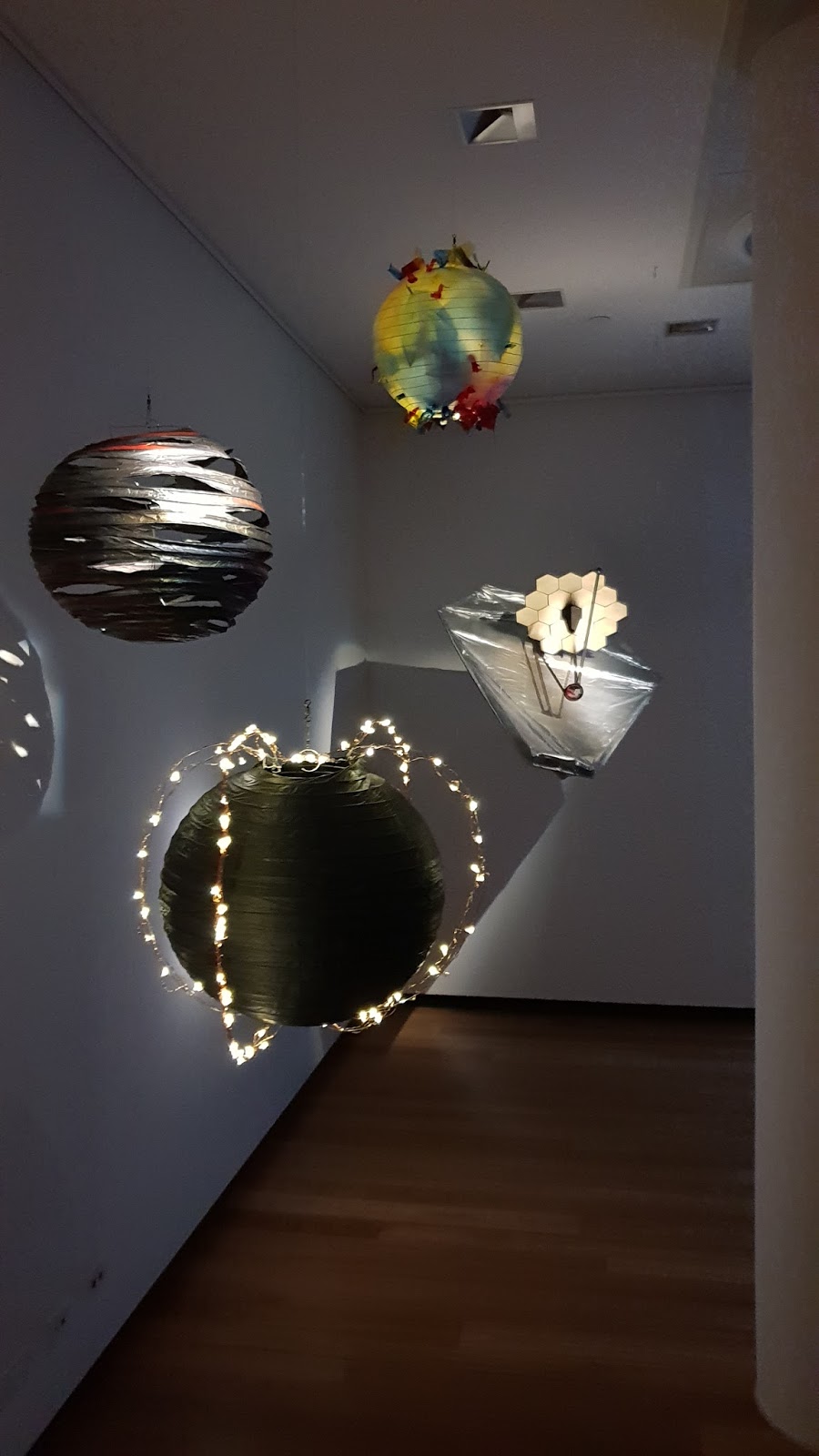
This picture shows two of my friends' projects, a black hole (bottom), brown dwarf (left), white hole (top), and the James Webb Space Telescope (right). The JWST model is I believe 1/12 scale, and it's still over a meter long! I spent an hour and a half on Thursday helping hang it from the ceiling which was quite an experience. They're in a darkened room where there's an animation about the Deeper Wider Faster project that inspired this exhibition playing, and they look amazing in the darkness.


Another friend of mine made this imaginative representation of a spiral galaxy being red- and blue-shifted by rotation. She planned it all out in code and matplotlib before making it and it came out very impressive (and fragile unfortunately, though that's true more or less of all our work!). We were all pleasantly surprised on Saturday to discover that the spiral structure, which didn't show up much from the side, was silhouetted on the wall behind it due to the lighting.


And here's me with my model! I got it to a point where I could both continue to add detail to it but could also call it finished at any point, and I'm pretty happy with where it ended up. (The only thing I'm not pleased with is that the cardboard platform in the middle developed a significant bow to it [probably due to absorbing water from the paint], but by the time I'd noticed it it was too late to really do much about it.)

There's also a lot of other nifty artworks, but I don't want to spoil all the surprises for people who can still go see it! (Plus I was so absorbed in admiring them that I forgot to get pictures of a lot of them.) I'm almost certainly going to visit again while the exhibition is open, so perhaps closer to the end I can put up a few more pictures. A hui hou!

Tuesday, May 8, 2018

Arty Astros

For anyone who's going to be in Melbourne between May 12th and July 1st, there's going to be an art exhibition happening in Hawthorn, and I'm going to be in it!

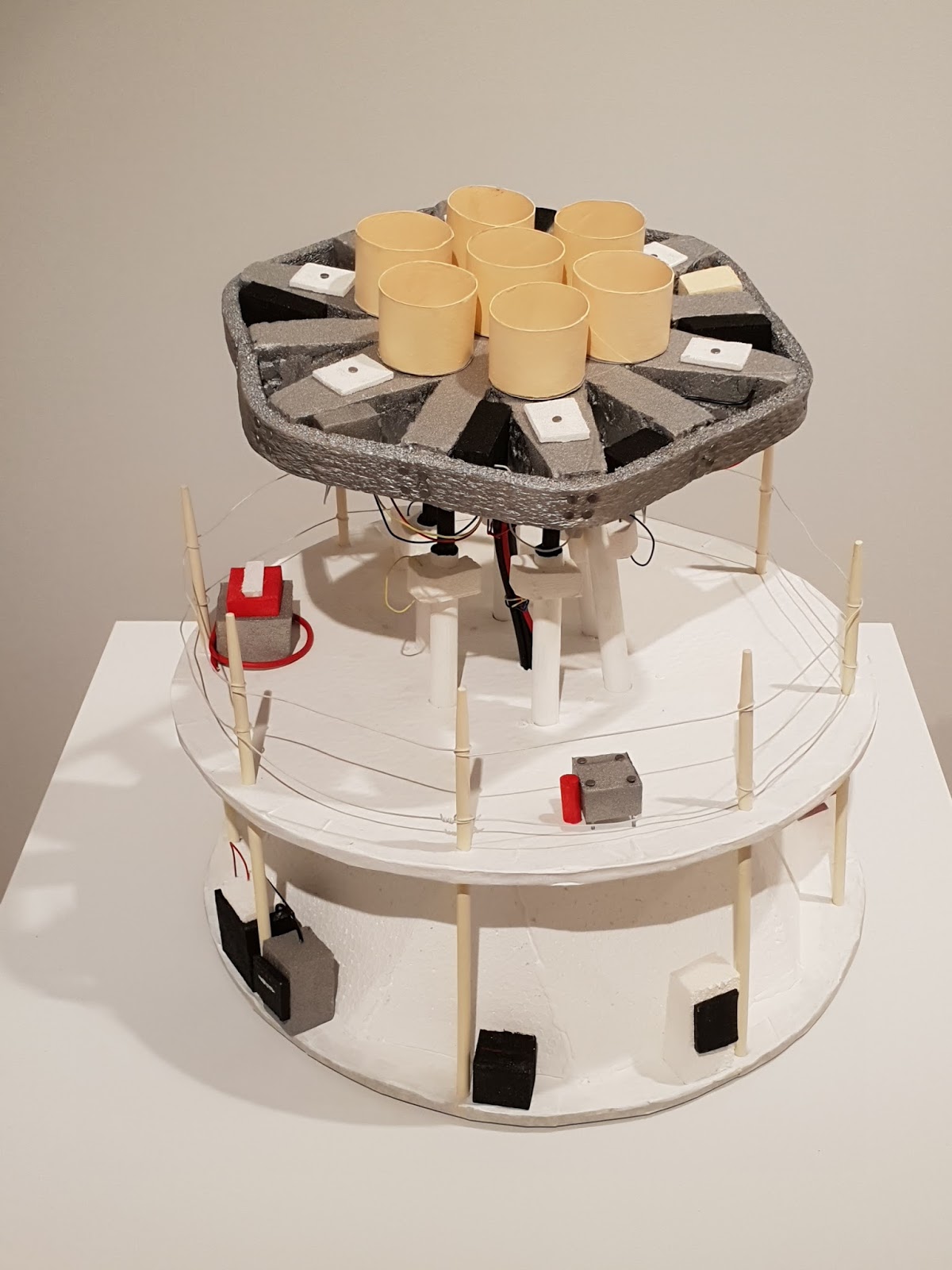
Yes, I haven't mentioned it here before, but for the past three months I've been working on a model of the Yuan-Tseh Lee Array where I worked last year to exhibit in DEEPER DARKER BRIGHTER, an exhibition of astronomically-inspired artwork. It's opening on May 12, from 2–4 PM, and it's free (and includes free food and drinks!); anyone's welcome to attend, the gallery merely asks that you reserve a spot (at the link above) so they can get an idea of refreshments needed. I'll be there along with several of the other artists to talk about our various projects.

To explain how this came about, I have to go back to last year. Several of the faculty and students here at the College of Astrophysics and Supercomputing (CAS) at Swinburne are involved in a project called Deeper Wider Faster, where telescopes around the world coordinate to observe a selected patch of sky for a few nights in an attempt to catch the transient events that occur in astronomy. Perhaps a star in its death throes, exploding as a supernova millions of light-years away. Or maybe a fast radio burst, an enigmatic phenomenon lasting mere milliseconds whose origins are still shrouded in mystery. Or maybe just a previously undiscovered asteroid! (They find a lot of those.) These collaborative multi-night sessions have been happening every couple of months for over a year now. (I attended one myself for a few hours earlier this year, though my schedule unfortunately precluded me from staying longer that time.)

Now, CAS also has two in-house artists, two wonderfully creative ladies by the names of Carolyn and Pam. They attended a Deeper Wider Faster session last year and were impressed with the sheer amount of incoming data and all the technology and work that went into making it happen, and soon after, by chance, were able to secure an exhibition slot with an art gallery literally across the street from Swinburne. This was around the end of the year, so with only a few scant months to get ready they put out a call for any astronomers in Swinburne who wanted to contribute some form of astronomically-inspired artwork with themselves as mentors.

I and several other students answered the call, so since the middle of February we've been working at weekly Wednesday night sessions on projects ranging from prosaic (models of several different telescopes) to the more fanciful (models of black and white holes, or a mobile representing the red/blue shifts seen in a rotating galaxy, or painting representing explosions in space). Other students made models of some rather famous telescopes (I'm actually really impressed by the models of the James Webb Space Telescope and the two Keck telescopes that people made), but I decided to make something a little smaller and closer to my heart: a model of the Yuan-Tseh Lee Array where I worked last year as a telescope operator. It's quite different from what people think of when they think of telescopes, so I figured it'd make for a great model. I also took pictures along the way, so you can experience the process of creation with me!


I started off with a pretty clear vision of what I wanted to do, and you can see a lot of what would make it into the final model in this picture from the second session in February. I had an idea of using sections of toilet-paper tubes for the baffles around the dishes right from the start, and while picking up supplies from the art store next to Swinburne campus I picked up some balsa wood rods (in two diameters) for the legs, a block of Styrofoam for the base, and a sheet of some kind of foam-board for the dish platform. I knew I wanted to get just the telescope and its base, not the canopy or any of the surrounding structure, which was a good choice in retrospect—finishing the telescope itself took long enough. In the picture above you can see the seven future radio dishes, and the half-painted telescope legs drying.


In March I cut the platform out of the foam board and learned how to draw a hexagon with nothing but a compass (another student made a model of the JWST with its many hexagonal mirror segments, and became something of an expert at constructing them over this time period). That was actually really cool—practical geometry! You can also see the legs fully painted drying next to my elbow.


I then cut out some wedges to represent the fact that the platform isn't a monolithic slab, but instead has a lot of negative space to cut down on weight. This was a slow and finicky process, as whatever material the foam is made of it pretty bad at being cut with a razor blade. This problem was solved, however, at the next session…


…where Carolyn introduced me to a tool I affectionately call “The Lightsaber.” It's an incredibly simple design—I think she got it for $2—and I was completely skeptical of its utility at first, but after the first few seconds of trying it I became an instant convert. The design is simple: the two arms hold a thin wire between them, a C battery is inserted, and pushing a thumb button closes the loop and heats up the wire, allowing it to slice through Styrofoam like hot butter. Seriously, there's no discernible resistance when cutting Styrofoam with a fresh battery in the thing, which is a freaky feeling. The foam of the foam board proved slightly slower to cut, but still melts incredibly quickly. This made it really, really easy for me to cut foam to shape, and ended up being responsible for a surprising amount of the final model.


I also painted the platform and used a strip of flexible foam around the outside to make the outer edge. I was constantly surprised how much a difference the proper color made to my brain's acceptance of the model's fidelity…though in this case I realized a few days ago while looking at photos for reference that contrary to my memory the platform's actually white, not gray. Oh well, I think it looks better this way. (You can see a whole bunch of golden hexagons in the background that were part of the JWST model design process.)


One big issue I struggled with throughout March was how to make the conic base of the YTLA. I bought a large block of Styrofoam back at the beginning intending to cut out a cone and use that, but realized that would be very difficult to pull off. By April however Carolyn (the mentor for those of us doing models) had the idea to use a simple rectangular cube for the base, which I then decided to disguise with panels to make a low-resolution approximation to a circular cone. I realized that it didn't matter that much if the model were perfectly, 100% accurate, and settled for an octagonal cone in the end. (You can just see the Styrofoam block peeking out in this photo.)


By the end of April I'd added some support sticks around the outside and the safety fence around the working platform (though I haven't added the access stairs it has in reality), and you can see the beginnings of the panels around the base, not yet glued in place or fitted. Also, the exhibition was starting in less than two weeks and I was only starting to get finished!


Luckily, in our final weekly workshop I was able to get the structure finished, by carefully slicing the panels around the base to fit and gluing them in. Then it was just a matter of detail, so for several nights last week I stayed at uni far into the night, adding bits of machinery and equipment and wires and cables and all the little symmetry-breaking details that the real thing has.


And here it is, set up on its own little plinth in the gallery awaiting the opening day! I'm not 100% done with it yet—I'm planning to go in at lunch later this week and add a few more machinery bits and wires to the underside—but I'm basically happy with it now. It's at the point where it's essentially finished, there's just always more detail to add. Adding details is my favorite part of building things, and I wish I'd had a few more weeks to indulge in it, but still, it came out pretty well for the remarkably short time (according to Carolyn and Pam) that we had to put things together.


Here's a shot from the side, showing my attempts to mimic the chaotic vortex of cables of wires on the real thing. I didn't capture it by a long shot, but what's there definitely makes the whole thing seem so much more…well, maybe “alive” is the wrong word, but it definitely makes it look better.

So yeah, I'm going to be an actual exhibited artist in an exhibition and everything! (I should put this on my CV.) Not bad for an astrophysics grad student. It's almost like doing a mini-PhD in a way: working on a project under the guidance of a mentor, except I can envision the whole thing at once in my head, know where to go at all stages and what to work on next, make tangible progress each week…okay, so it's basically nothing like doing a PhD!

Pam and Carolyn have tossed around the idea of making the weekly art workshops a regular but more open-ended thing after the exhibition for those who want to attend, and it's quite an appealing idea. It's a great stress-reliever to be working on an art project along with other people, and those of us who stuck with it to the end have forged a real bond through helping each other out with supplies, knowledge, or just a helping hand. I've discovered a serious love of painting over the course of putting this model together, so maybe I'll try my hand at just doing that if this happens…

Anyway, if you'd like to come down to see my model, or the seriously impressive models and paintings of my fellow “arty astros” (as Carolyn was fond of calling us), stop by the Town Hall Gallery in Hawthorn for the DEEPER DARKER BRIGHTER exhibition before the end of June!

Wednesday, April 25, 2018

Personal Panoramic History, Part 5: 2012

The previous post in this series (covering 2011) had quite a lot pictures, but for whatever reason 2012 was a pretty slow year in the panorama department. I think part of it was that I was working at the Visitor Information Station on Mauna Kea for most of that year, which was also the year the transit of Venus happened. I was pretty quite preparing for it and then recovering from it afterwards, and it seems to have translated into fewer photo opportunities.

In January 2012 I got my first smartphone (a Samsung Galaxy S2), and with it my first automatic panorama creation ability. I didn't actually use it much because it was still pretty poor in those early Android versions, but I've got a few panoramas made using it from this year and we'll see more in the future.

April


My first panoramas of the year don't come until April, but they come from the one time (so far…) that I've hiked Mauna Loa. And just as while hiking Mauna Kea I got pictures of Mauna Loa, so while hiking the latter I turned north to get pictures of the former.

Mauna Kea from the south.

Hualālai and Mauna Kea
 These two pictures are both from where the trailhead starts, just outside of the Mauna Loa Observatory entrance at 11,141 ft (3,397 m). The first one is a zoom-in on Mauna Kea, while the second is a much wider field view covering a bit less than ~180°, showing the Mauna Loa access road on the right and the start of the trail on the left.


Mauna Loa summit caldera.
Mauna Loa is so flat that while climbing it there isn't much to get panoramas of other than Mauna Kea, until you reach the summit caldera, Moku‘aweoweo. This panorama is still pretty cool to me, even if we didn't make it to Mauna Loa's summit that day, as it's technically the only time in my life I've been inside the caldera of an active volcano! (Even if it did last erupt in 1984…) You can see the sides of the caldera on the sides of the photo, as I climbed down just inside the rim (which was maybe three meters deep). I don't think this is a particularly great panorama, but it's special to me due to the circumstances surrounding its creation.

June


Venus transiting before the Sun.
In June the latest transit of Venus (last one until 2117!) happened. This panorama is hand-made, as I couldn't get Hugin to make one for me using my photos. It's not really meant for astronomical panoramas and the photos aren't particularly well-focused either, so it's understandable that it failed to make anything of them.

August


I didn't get around to making any more panoramas until August due to recuperating after the transit of Venus, and when I did I ended up taking my first auto-generated panoramas with my phone due to (as usual) my camera battery turning out to be dead. I was able to get a tour (I think with the University Astrophysics Club) of the Very Long Baseline Array dish on Mauna Kea, and it turned out to be a great panorama subject.

These early auto-generated panoramas are really ugly however, so I'm only going to show one to give an idea. I've got a few more, but I just don't feel like displaying them here; that early panorama creation software was pretty rough and the resulting images are not easy on the eyes. I did put two additional panoramas from this trip up in my original post about it, so you can follow the link if you really want to see more early auto-panorama creation eye-sores.


This is the dish of the VLBA telescope, from near it's rim. Which is about ten stories above the ground, by the way. I'm actually amazed the camera was able to get such a good contrast, considering the blinding whiteness of the dish.


And that's actually it for panoramas from 2012! In October I did lava tube spelunking for the first time and got some cool pictures, but lava tubes unfortunately don't make great panorama vistas. As the end of the year approached I was starting to get pretty burnt out at my job as the Visitor Information Station; I discovered that there's a vast difference between doing something as a volunteer because you love it, and doing it because you get paid to do it. On a whim I applied to a job with the James Clerk Maxwell Telescope that only required a Bachelor's degree, and near the end of November got a call saying I was being offered the job, which opened up a whole new chapter of my life. But that's for the next post! A hui hou!

Friday, March 30, 2018

Personal Panoramic History, Part 3: 2010

In the previous post in this series we looked at 2009 and a couple of my first attempts at taking panoramas of certain volcanoes. In 2010 I refined my technique a bit by taking panoramas of the same volcanoes—several times—but also experimented with some new things as well.

May


My first panorama of the year comes from May, when the University Astrophysics Club at UH Hilo was given a tour of the Subaru telescope. I had the chance to do a little hiking around Hale Pōhaku while we were waiting to acclimatize which I used to take the following panorama from the top of Puʻu Kelepeamoa (a popular sunset-viewing spot nearby):

Mauna Loa and Mauna Kea.
This was my first full 360° panorama. Actually, it went slightly more than a full turn around and when I first stitched a panorama together from the photos I refused to drop any of them, leading to a rather weird image with Mauna Kea in the center and the summit of Mauna Loa showing up twice, on either side. Hugin luckily can work out a full rotation and stop there, and also allows you to rotate your endpoints around, so I've made it a bit nicer looking by scooting Mauna Kea over to the side and no longer splitting Mauna Loa in twain. If you follow the link above you can see the original version by mousing over the panorama (which is now this new one) in the original post it came from.

June


Mauna Kea summit area.
In June I had another opportunity to visit Mauna Kea's summit (probably helping with a summit tour) and used it to snap this panorama. This one is taken from a totally different perspective than the one in part 2 which was taken from in front of the Keck building, which is the two identical domes near the center of the image. From left to right, you can see UKIRT, CSO (just barely), JCMT, SMA, Subarua, Keck I and II, IRTF, CFHT, and Gemini North.

July


In July I created this, my first and so far only astronomical panorama. This one's another hand-made image, as Hugin couldn't manage it. This is because the image is made up of twelve different images, each of which was a thirty second exposure in order to collect enough light. While thirty seconds is short enough that the star trails induced by the earth's rotation aren't too noticeable in each individual image, the entire sky would have moved pretty appreciably between the start and end of the series of exposures. I'm not entirely sure how I managed to wrangle this into a panorama myself—with a lot of effort, I suspect—and looking at it now I sometimes think I see some duplicate bits, but I'm still pretty happy with this view of the northern hemisphere summer Milky Way from the area near the Visitor Information Station on Mauna Kea. (You can see the glow from Hilo in the center of the image.)

August


In August 2010 while I was back home for vacation during the summer my family went on a two-day road trip around some parts of northern California, including the coast and through the redwood forests. This let me experiment with a vertical panorama:

The Chandelier Tree in Leggett, California.

This is a hand-made panorama, as I just couldn't get Hugin to make a good looking result. It probably has to do with the unusual way the perspective changes from standing on the ground and rotating the camera up to get pictures. It's an interesting challenge though; maybe I should try more vertical panoramas in the future.

November


In November 2010 I had my first chance to observe on Mauna Kea at Subaru while working as a student research assistant. Since we spent a day and a night at Hale Pōhaku acclimatizing before going up I had some time to hike a round and take a few panoramas:

Mauna Loa, Hualālai, and Mauna Kea.
You'd be forgiven for thinking I'd accidentally posted the same panorama from May again here. While writing this post I had to carefully double-check to make sure that I hadn't, as they both look pretty similar in the tiny preview thumbnails (this one has more cloud cover on the left, at least). While they do look very similar (and were taken from locations very close to each other on the top of Puʻu Kalepeamoa), the layout seen in both of them was created in this one and retroactively used for the May version when I was remaking both with Hugin. I like this layout a lot better, and I like to think it shows that I was getting a bit better at framing panoramas by this point.

Mauna Loa.
The previous panorama was taken from the summit of Puʻu Kalepeamoa, which is the hill in the foreground on the left of this image, which was taken from a cinder cone (or puʻu) slightly higher up Mauna Kea's flank. (Well, technically, “ka lepe a moa” means “the comb of the chicken”, and Puʻu Kelepeamoa is so named because it's a range of three or four rusty-red cinder cones that could be seen as a cock's comb, and I was technically still on [another part of] it while taking these pictures. The name is typically mostly used to refer to the hill lowest on the mountain and closest to the VIS, though.)

Mauna Loa and Hualālai.
This panorama was taken from a bit further up the flank of Mauna Kea again. In the foreground on the left you can see the summit of Puʻu Kalepeamoa again as well which helps give a sense of the movement between pictures. On the right side of this image you can see some more of the gigantic cinder cones (or puʻu) near the Visitor Information Station. These final two panoramas I'd never even created until writing this post so they're both completely new, which is a shame because I really like the last one—going through and creating these huge panoramas of gorgeous landscapes I just keep thinking “This would make a great picture to get printed and hang on my wall where I could actually enjoy it all at once, at full size.” Maybe in another decade or two when I can start to think about settling down and not moving every few years.


And that's it for 2010! I spent some time refining my panorama technique with the same choice of targets that year (you're probably sick of Mauan Loa panoramas from the north by now), but for the next part covering 2011 I'll have a few unique panoramas which, for various reasons, I've never repeated. A hui hou!

Friday, October 20, 2017

A Day in the Life of a Telescope Operator at AMiBA

So this is a bit delayed, but while I was working at the YTLA I took a bunch of video clips of various things related to the telescope over a period of multiple months with the intention of weaving them into a sort of “day in the life of a telescope operator” video. In the two weeks between leaving my job there and moving to Australia I didn't have time to actually work on it, but now that I've got my computer set up again I finally had time to get to it. And boy does it feel good to be back to video editing again!

This video (very) roughly show the process of a day on the job while I was there, as it was near the end when our observing targets were up in the afternoon and evening:

  • leaving Hilo around noon.
  • driving the hour-and-a-half to the observatory (clips were taken on different days which is why the weather changes so drastically, although it would not be at all unusual to see all that on a single drive).
  • opening the enclosure (as seen in my previous video on the subject).
  • pointing the telescope and observing.
  • shutting down at the end of a day's observing, though it's rare that we closed when it was still light enough to record it happening; I think that day we might have had a problem that forced us to close early, so I grabbed the chance to record, though I wish I'd lain down and stabilized my phone better!
  • then driving back down to Hilo, though I couldn't actually record any of that due to low light levels.

My fellow operator, Kristen, was a huge help for this project, supporting it all the way even when I never produced any visible results of all that filming. So here it (finally) is Kristen, hope you like it!

(Fun fact: I didn't set out originally to use the William Tell Overture. I got all the clips edited and arranged then went looking for music to set it to, and while playing around with various pieces tried Rossini's William Tell Overture on a whim. I quickly realized it fit with the madcap pace of the video really well, and even fit the timings quite closely already. Another few hours of syncing everything up, and I'm pleased as punch with how it turned out.)

Edit: now with properly embedded video!

Tuesday, September 19, 2017

End of an Era, in More Ways Than One

Last Friday, September 15, was the last day for two things: my employment with ASIAA, and the Cassini–Huygens mission to Saturn.

Cassini was launched in 1997, when I was eight years old and firmly in the grip of my first passionate love of astronomy, focused on the planets in the solar system. It took seven years to reach Saturn so I had plenty of time to find out about it and years to look forward to its arrival at my favorite planet in the far-off future of 2004. When Cassini finally reached Saturn I remember reading all about it, about the Huygens' probe's successful landing on Titan, the first such landing on a solid body in the outer solar system, and the incredible pictures being beamed back from Saturnian orbit. And over the past thirteen years I've watched as any number of amazing discoveries were made and awesome photos taken.

Saturn from Cassini in 2016; photo by NASA (public domain).

Cassini was originally slated for a four-year mission, from 2004 to 2008, but its outstanding success allowed it a mission extension first to 2010, then an additional seven years beyond that. I was fifteen when it got to Saturn, and it came to feel like a a constant: multiple rovers landed on Mars, Messenger flew by Mercury a few times, New Horizons sped past Pluto, several other missions blazed brightly briefly in the public consciousness like shooting stars but the whole time Cassini was there, quietly taking pictures and measurements and redefining our knowledge of Saturn and its gorgeous system of rings and moons, constant like the cosmic microwave background.

This video gives a brief overview of the mission.

To me, having grown up with Cassini it's strange to think that it's finally gone; no more news stories with the latest eye-catching pictures, or amazing discoveries it made (although I don't think we've exhausted the scientific value of the data it sent back yet, not by a long shot). I didn't keep particularly close tabs on it as the years went by (partly due to that perception of permanance)—and only found out about the end of the mission a few days ago in fact—but I generally kept up with the major discoveries, and all in all I'm going to miss that intrepid probe.

But fuel, and NASA's budget allowance, eventually come to an end, and so too did Cassini's incredible mission. And coincidentally it happened on my last day of work with ASIAA, where I've been a telescope operator for AMiBA for the past six months (exactly!). It feels like the end of an era, in more ways than one, as I'm now busy preparing to move to Australia to start graduate school in just over a week.

My final picture of the YTLA, taken a day before on the 14th. 
People keep asking me if I'm excited, or telling me how excited I must be. Being free of work has left me free to face the reality of moving and all the many things still remaining to be done in the next far-too-few days. My internal emotional state seems to be a quantum superposition of many confusing and conflicting feelings, and observing it usually yields a value best approximated by “abject terror,” so I try not to do that too often.

For some reason people seem to ascribe to me a confidence and adventurousness I can only dream of possessing in reality. The truth is I am a man who finds blessed comfort in routines and the thought of breaking all of them—simultaneously—terrifying in the extreme. I find travel (especially alone) highly stressful, necessitating as it does the disruption of so many comforting patterns, though at least for the past eight years it's only been between my current and my childhood homes; now I face the looming specter of leaving everything I know behind to travel somewhere I know no one. Perhaps some people would find that exciting? All I know is that it doesn't feel like excitement to me.

Sorry, that got a bit philosophical towards the end didn't it? It's not all so doom-and-gloom as this probably makes it sound. I should get back to preparations—I've got a lot to do before next Wednesday! A hui hou!

Sunday, September 10, 2017

A Moving Day Approaches!

Well, things are getting pretty busy for me over here! I've finally got my airplane tickets, for the 27th—which is just over two and a half weeks at this point, a fact I'm alternately trying to forget, and remembering and freaking out about. I've got one more week of work with ASIAA, and have been busy cleaning, organizing, and making preparations for the past few weeks. I'll probably be even more busy for the next couple of weeks and I don't know how much I'll be able to post, so have a pretty picture of the YTLA open with Mauna Kea in the background.

We were probably looking at Jupiter when this photo was taken.
(Fun fact: I put this picture up on Google Maps for the YTLA and it's proved surprisingly popular, with almost 4,000 views in under a month!)

Friday, June 23, 2017

Some Solstice News, 2017 Edition; Also Lava Tube Pictures

First of all, yes, I missed the solstice by two days (like I always do), but that was the original inspiration for this post. Then, having pointed out that, hey, it was the summer solstice for the northern hemisphere two days ago, I realize that there isn't much else to say to about it, so have a few pictures from my Kamehameha Day trip in addition.

I took a couple friends up to the Mauna Loa Observatory where I work on June 11, Kamehameha Day (a state holiday here in Hawaii) for a tour of the YTLA and some exploration of various lava tubes and geological features. For a state holiday, it was the busiest I've ever seen it up there, with both a tour group from South Korea on a tour and people around from both the eponymous atmospheric observatory and the Mauna Loa Solar Observatory, which I'd never actually noticed being open before (though I discovered they were likely the car we'd meet driving up at 4:00 AM as we were driving down after a night of observing!).

The telescope at the MLSO, observing the sun.
The weather unfortunately didn't coöperate for us in our attempt at spelunking on the way down, being wet and misty below 10,000 feet or so. It wasn't too bad at the first lava tube we stopped at on the way down, just below the 9,000 foot mark, so we explored it for a bit.

My friend Mark provides scale for the opening to this particular tube.
This lava tube has its opening right beside the road…and I do mean right beside the road. There's maybe a foot (if that) between the edge of the tarmac and the lip of the skylight into this tube. I have to admire the sheer indifference of the original road builders to stick to their plans and ignore this gaping hole right beside their work.

Once inside, I was pleasantly surprised to find that there were several large skylights at irregular intervals for some way, lighting it up to the point where a flashlight was hardly necessary at all.

A little hard to make out, but this is looking down the tube.
In a pattern that really shouldn't surprise me at this point, this lava tube was both similar and yet quite different from the others I've been in. This one is tall, often rising 20 feet or more to the roof, even with the copious collapse covering the floor. And yet, it wasn't difficult to navigate, having little slope and being wide open with plenty of room to maneuver; Kaumana Caves is much harder in many places due to its low ceilings. All the lava tubes I've been in have had white material (which I believe is crystallized gypsum) on their walls, but this tube was positively overflowing with the stuff.

Gypsum-coated walls reflect enough light that this picture actually worked.
In this picture, you can see Graham taking a picture of the incredibly white walls. Normally lava tube wall are pretty dark—sure, there's some reds and other colors, but a lot of the walls are plain black. Taking a picture with my phone's flash alone wouldn't have worked in most of the other tubes I've been in, but this one just has so much white gypsum reflecting light that it actually kinda works. (The light from a skylight just ahead, seen just in front of Graham in the middle, probably helped too.) I don't know why this particular tube should have so much more than others I've seen; I guess maybe the flow that made it was just especially gypsum-rich?

A skylight with a natural bridge crossing the tube.
This last picture is neat, though I don't know how easy it is to make out. At the top you have light from a skylight falling in, while in the middle is a sort of 'bridge' in the lava tube, a short arch in the middle of the tube that suggests this lava tube had a very interesting history, perhaps with multiple levels at some point. Even the bottom of that arch would be well above my head (6” 1’, 1.85 m), to give you an idea of the scale here

Despite what these pictures might make you think, we actually didn't get to fully explore the tube to my satisfaction; after a while the skylights stopped while the tube continued on, but as it was still crummy weather and starting to get a bit late we didn't continue on (I've heard the cave continues on a bit further before ending). I definitely plan to return, however! It's a really cool cave, and I plan to go back with my camera and a proper flashlight to plumb it to its end (we originally just planned to pop in and take a quick look due to the weather, which turned out to be closer to half an hour). A hui hou!

Wednesday, May 31, 2017

Opening the Shelter for the Yuan-Tseh Lee Array, a Belated Birthday Video!

So it turns out my birthday came and went on the 17th this year without me ever mentioning it here. Turns out, like several years ago with the JCMT, I was observing at a telescope! The YTLA this time, though. Altitude often makes me forgetful however, and I completely forgot to mention it at the time.

However, the day after my birthday a co-worker of mine by the name of Johnson Han who was out from ASIAA in Taiwan working in Hilo for a few weeks brought his high-end 4K-video-camera-equipped drone up to the site hoping to get some aerial footage of the telescope enclosure being opened, as we were planning to do some daytime observing in the late afternoon. Unfortunately, the weather was cloudy and misty until well after sunset, and we weren't able to even open the shelter until almost 9 o’ clock. This didn't deter him, however and he got some great shots of the Mauna Loa Observatory area during the day and then some footage of the telescope opening at night.

I was enthusing over the video he got and mentioned I was into video editing, and Johnson graciously offered to send me the footage to play with. After several days  two weeks working to edit it down to a comfortable length without having to cut too much, I've got a neat video of the area where I work and some of the things I do which you can see below (in a whopping 4K [2160p] resolution if you have a screen big enough, which I don't)!


As mentioned in the video, Johnson exhausted his last back-up battery getting that footage so he wasn't able to capture the telescope rearing to its full height and moving around while observing, so I still have a goal to shoot for myself. In the meantime, enjoy this belated birthday video, and if you have any questions feel free to ask down in the comments!

Johnson also has his own YouTube channel where he's been slowly uploading his own movies of various parts of the Big Island of Hawaii, like flying his drone out to where the lava was entering the sea, or up the Wailuku river, or even getting some nice aerial shots of ʻImiloa and the various astronomical buildings in Hilo, and I'd encourage you to check them out. Also a big 'thanks' is in order to him for letting me use his amazing footage in the first place. A hui hou!

Monday, April 17, 2017

Working on Mauna Loa

It has been a while since I last posted, hasn't it? I think this break of nearly a month is my longest interval yet between posts. Suffice it to say that I've been really busy with work, and too busy recuperating in between to find time to post. I say this not to complain, but merely to point out that being awake long nights at high altitude is really quite physically exhausting, especially since my schedule is still very much in flux and I can't really settle into a routine yet.

At least I get to work in some of the most gorgeous surroundings on earth, assuming you find bare lava rock beautiful! Mauna Kea in the late afternoon can be particularly striking with the low angle of illumination:


Or in the evening (different day):


Of course, the mountains aren't the only interesting things around! I took a panorama of the array of dishes while up on the telescope platform. You can see the cherry picker we're learning to drive in the background.

The panorama distorts it, but these are arranged in a hexagon around the center one.

Also, we finally opened the enclosure structure before dark, allowing me to pose in front of the telescope! This is the parked position; for actual operation those legs stretch up to at least twice as tall. I have a burning desire to get a video/timelapse of the process of opening the structure and engaging the telescope sometime, as it looks incredibly cool.


Finally, one thing I noticed in the Mauna Loa Observatories building the other day is this neat card autographed by quite a few of the original astronauts who came to train in 1965 (several of whom later went on to walk on the moon). It's quite cool to be walking in the footsteps of these historic figures!


Well, hopefully I'll be faster at getting another post out in the future, but seeing how it took a long Easter weekend for me to feel rested enough to write this, we'll see! Hopefully I'm starting to get acclimated to the altitude and long nights and will be better able to function like a normal person when I'm awake during the day.