Showing posts with label black holes. Show all posts

Tuesday, April 14, 2020

Forget Princess, I Want to Be an Astrophysicist

Back in January I showed off the picture below of a Christmas present from my mother. I've finally finished painting it, and it came out quite well if I do say so myself. Here's the original canvas:


And here's the finished version:


I really, really like how this came out. There's a few minor blemishes—mostly invisible in the photo—where I over-painted the boundaries and need touch them up when I get access to the Midnight Blue I used for the background again, but on the whole this gives me joy every time I see it. You might notice that the stars are all colored as if their sizes correspond to their relative masses, with the smallest being reddish, then orange, yellow, etc. I had to get creative with some of the colors since I finished it at home in quarantine without my full range of pigments, but I think it looks good. I decided that what looked like a ringed planet with a star coming out of it was actually a black hole with accretion disk devouring a star, and since I happened to have my Black 2.0 at home I was able to make it work. I'm glad to finally be able to show this off, it's been an interesting exercise in constraints painting it. While I've gone for very simple, solid shading much of the time I've also gone for more subtle and realistic shading in places, but I've stayed within the lines everywhere without adding anything. (I thought about stretching the accretion disk into photon rings around the black hole, but decided to stick to the lines.) Anyway, I now have this hanging behind me at my computer desk at home to continually remind me of my vocational aspirations. A hui hou!

Wednesday, December 18, 2019

Binary Black Holes: Painting “The Abyssal Dance”

It's been a busy two weeks here for me as we come to the end of the year, but I'm now on vacation for the rest of December and can actually relax a bit. This past week I finished the other large-scale painting project I've been working on since September, and can finally show it off! (Before flying back to California tomorrow to see family for a few weeks.)

Sometime around the start of this year, when I was helping back the production of Black 3.0 on Kickstarter, I had the idea of using it to paint the black holes in a binary black hole system (two black holes orbiting each other). I picked up a canvas and painted it black (with standard black gesso, nothing special), then got distracted by other projects for about six months. (This was right around the time I was starting lots of different projects, including my Main Sequence star series.) I never forgot the idea, though, and finally came back to it sometime in September with some more experience under my belt, some Black 3.0 in my possession, and some fresh ideas.

One of those ideas was to film the entire process and make a time lapse video out of it, which I finished just today! It was a lot of work to make, but I think it came out pretty well. Here's the completed painting:

“The Abyssal Dance,” 70×50 cm, acrylic on canvas.
The accretion disks around the black holes were the last parts to be added, and I think they turned out really well and add a certain je ne sais quoi to the entire composition. I'd have more to say about it but I'm flying out tomorrow morning and need to keep this short. For more information on the painting process, you can watch this video:


I talked about it a bit more in the video description, but the name came to me in a poetic mood; abyss comes from the Greek words for “without bottom,” or bottomless, which struck me as a good description for a black hole from the point of view of an observer outside one (i.e., us). And the dance part comes from the slow but steadily-increasing inspiral of the two dancers, as they radiate away gravitational radiation, until they finally come together with incredible celerity and merge into one. And that's all for now. A hui hou!

Monday, May 14, 2018

An Arty Astronomical Exhibition

Well, the art exhibition opening on Saturday was a great success! I got to talk to quite a few people who came through over the course of the multi-hour event and ended up being put on the spot as soon as I showed up (I was the first of the PhD students involved to arrive) to say a few words about the process, so I'm glad I dressed up a bit. This was also my first opportunity to see much of Carolyn and Pam's work and to see everything professionally arranged and lit, so it was quite impressive.


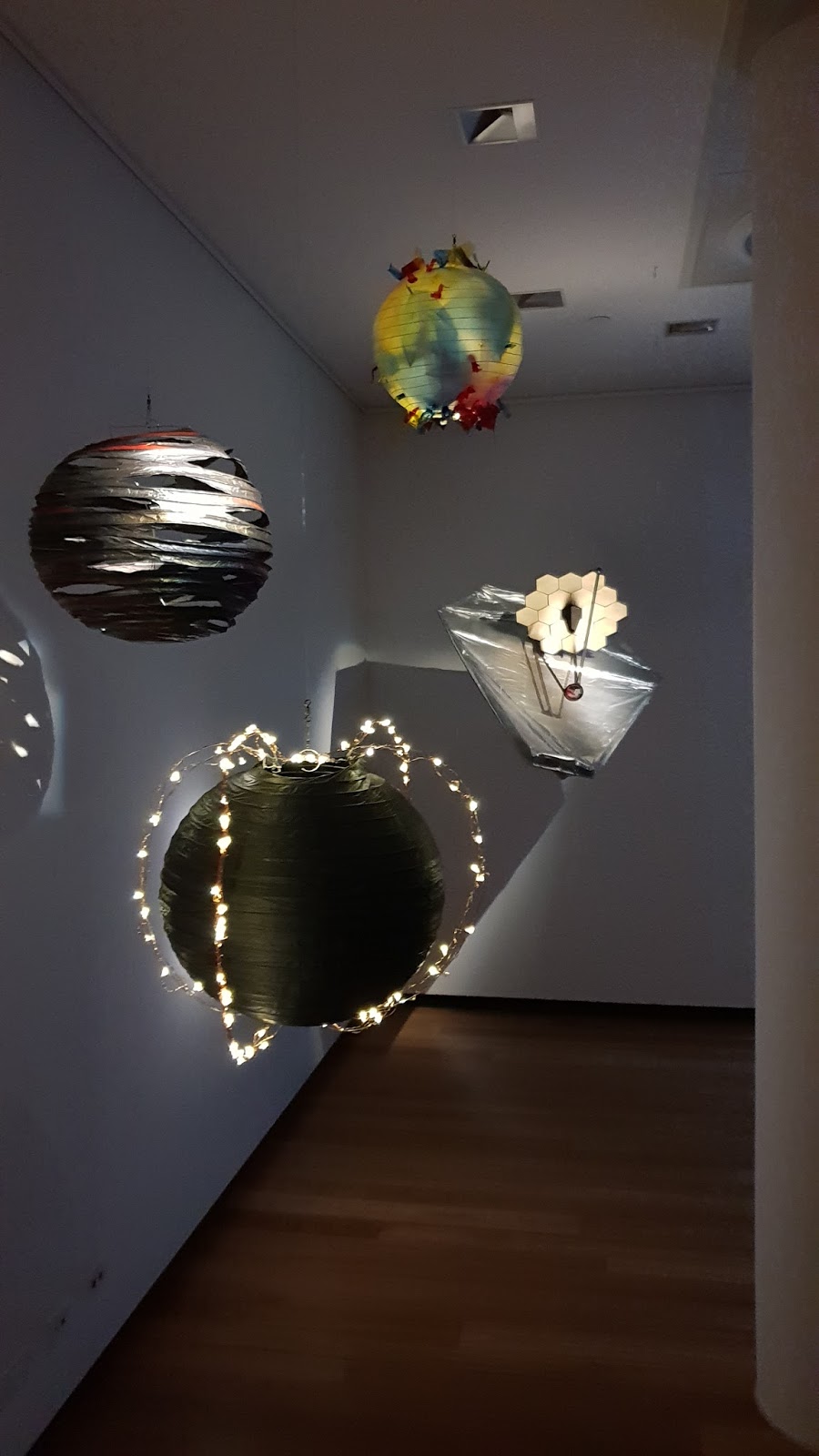
This picture shows two of my friends' projects, a black hole (bottom), brown dwarf (left), white hole (top), and the James Webb Space Telescope (right). The JWST model is I believe 1/12 scale, and it's still over a meter long! I spent an hour and a half on Thursday helping hang it from the ceiling which was quite an experience. They're in a darkened room where there's an animation about the Deeper Wider Faster project that inspired this exhibition playing, and they look amazing in the darkness.


Another friend of mine made this imaginative representation of a spiral galaxy being red- and blue-shifted by rotation. She planned it all out in code and matplotlib before making it and it came out very impressive (and fragile unfortunately, though that's true more or less of all our work!). We were all pleasantly surprised on Saturday to discover that the spiral structure, which didn't show up much from the side, was silhouetted on the wall behind it due to the lighting.


And here's me with my model! I got it to a point where I could both continue to add detail to it but could also call it finished at any point, and I'm pretty happy with where it ended up. (The only thing I'm not pleased with is that the cardboard platform in the middle developed a significant bow to it [probably due to absorbing water from the paint], but by the time I'd noticed it it was too late to really do much about it.)

There's also a lot of other nifty artworks, but I don't want to spoil all the surprises for people who can still go see it! (Plus I was so absorbed in admiring them that I forgot to get pictures of a lot of them.) I'm almost certainly going to visit again while the exhibition is open, so perhaps closer to the end I can put up a few more pictures. A hui hou!

Saturday, July 28, 2012

Closest Quasar

Today I have a picture of a very unique object to show you: the first quasar ever discovered. I had meant to take this picture before the transit of Venus, but the combination of poor weather and a heavy workload made it impossible. Luckily for me, Virgo was still high in the sky when I took this picture on the 11th of July.

A short note about quasars: quasars (short for quasi-stellar objects) are believed to be comparatively small accretion disks around supermassive black holes in distant galaxies. They are known as quasi-stellar objects because they appear star-like to all but the most powerful telescope due to their extremely great distances. They give off tremendous amounts of light all across the electromagnetic spectrum, from X-rays to infrared. Some also give off copious amounts of gamma rays and radio waves.

The quasar below is thought to be the closest quasar to us at 2.44 billion light-years away. Yes, that's billion with a "b". Our Milky Way galaxy is about 100,00 light-years across, so nearly 25,000 galaxies like the Milky Way could fit between this quasar and our galaxy. And that's the closest quasar to us. Most quasars are much further away, and due to their extreme luminosity are some of the farthest objects visible in the universe. This quasar, though, is likely the farthest object you could reasonably expect to see through an amateur-sized telescope.

Anyway, enough explanation. Here it is, entry 273 in the Third Cambridge Catalog of Radio Sources, 3C 273 itself!

3C 274, the closest quasar to us. Located 2.44 billion light years away in the constellation Virgo.

Kindly hold all applause until the end of the blog post. I know it's not much to look at, but it's remarkable because of what it represents. With a 4-inch telescope and a CCD camera you and I can see the light from the mind-bogglingly intense region of warped space-time around a black hole with more than 800 million times the Sun's mass from over 2,440,000,000 light-years away. It's staggering to me that such a thing is even possible. Hopefully you can see why this is such an amazing picture, even if it isn't as showy as some of the ones I put up here.

3C 273 is an interesting object because it was the first quasar to have its spectrum taken (due to the fact that it is the brightest quasar in the visible light range), which helped show that it wasn't a star and was in fact very much further away than previously thought. Although we know more about quasars now than ever before, they continue to remain mysterious objects and there are many questions about them yet to be answered.

Saturday, August 6, 2011

Globular Cluster Photo Series (Part 9): M15

Today I have a picture of the globular cluster Messier 15 for you to enjoy. M15 is a large cluster at approximately 170 light years across. It appears about two-thirds the size of the full Moon on the sky (18.0 arcminutes), and would appear larger were it not for the fact that it is nearly 33,600 light years away (or about as far from us as we are from the galactic core).

Messier 15 in Pegasus.
M15 is one of the most densely packed globular clusters in the Milky Way, due to its core having undergone something called "core collapse". This is a simple process whereby kinetic energy is transferred from the stars in the core to the stars on the periphery, causing the outer layers to "puff up" while the stars in the center contract and pull in closer to each other. M15 has over a hundred thousand stars, though, so there are plenty to go around.

In fact, that enormous number of stars includes some interesting things, including 112 variable stars, 8 pulsars, and a planetary nebula. This was the first planetary nebula (which have nothing to do with planets besides appearance in small instruments) found in a globular cluster, and one of only four located in globular clusters found to this point. It is also thought that there may be a massive black hole in the center of this cluster. So all in all, a bit more interesting than some of the clusters I've focused on recently.

Sunday, July 31, 2011

Centaurus A, Wild and Wonderful Galaxy

Today I've got a picture of an amazing galaxy for you to enjoy, Centarus A. I took this picture a little over a year ago. Centaurus A is a really strange beast in a universe full of exotic galaxies. You know, you'd think I wouldn't be continually surprised at the fact that the pictures I take look like the ones I see that other people have taken, but for some reason I'm always pleasantly surprised that my pictures look just the way I expect an object to look.


Centaurus A
Centaurus A, an unusual elliptical galaxy, in Centaurus.


If it weren't for that highly unusual dust lane running across it, Centaurus A would appear to be a fairly normal elliptical (or possibly lenticular) galaxy. But that dust lane immediately transforms it into a galaxy of much interest to astronomers. That dust is there because Centaurus A is actually two galaxies undergoing a collision; an elliptical galaxy, and a spiral galaxy like our Milky Way. The dust acts as a highly efficient blocker of light, causing the dark stripe you see in the image.


A closer look at the galaxy itself.


Centaurus A lights up the sky in radio wavelengths due to two humongous radio-producing lobes coming from both ends (the upper left and lower right in this orientation). These lobes come from bits of gas accelerated to about half the speed of light by a supermassive black hole that resides in the center of the composite galaxy and extend for hundreds of thousands of light years in space. If we could see these lobes with our eyes, each of them would appear several times larger than the full Moon on the sky (Centarus A itself is about ⅔ the size of the full Moon).


Centaurus A is a relatively nearby galaxy, somewhere between 10-16 million light-years away (that's about 60-86 quadrillion miles, or 60-86,000,000,000,000,000,000 miles [Edit 6/22/25: it's now been tightened up to 11-13 million light-years]). It's also one of the brighter galaxies on the sky, which is one reason I was able to get such a good shot of it. All in all it's a fascinating galaxy, and one that I'm highly pleased I was able to get a picture of.

Saturday, April 3, 2010

Forrays into movie criticism.

Although I neglected to mention it in my last post, I spent part of yesterday evening watching the latest Star Trek movie (mostly because Josh and Jonathan put it on while I was doing homework). I am not a movie critic, so I will not critique the movie (although it had way too much lens flare for my liking), but I am a physicist, so I will critique the physics. And let me tell you, if the level of astrophysical knowledge displayed in the movie was in any way indicative of the general populace's knowledge of the subject, I will suddenly understand where some of the odd questions we get at the Vis now and then come from.
Let's start with the big one: General Relativity. Where is it? I'm not going to critique such things as faster-than-light travel because that's part of the willing suspension of disbelief, and I'm willing accept it. But the black holes were completely unrealistic! In reality, you would never see something fall into a black hole like that. This is because, in GR, curved space time causes time dilation, and infinitely curved space (a.k.a. a singularity) causes infinite time dilation. If you watched something fall into a black hole, you would never see it hit the event horizon and pass beyond -- it would simply become dimmer and redder, forever. In addition, gravitational tidal forces would stretch it into spaghetti long before it reached the event horizon, especially with a small black hole (counter-intuitively, large black hole have small tidal forces and vice-versa).
And all that part about the singularity consuming a planet in a matter of seconds. Come on! If the planet had any amount of rotational motion when it happened (virtually certain), the Conservation of Angular Momentum would spin it up into a rapidly rotating accretion disk which would take a very long time to lose its angular momentum through frictional heating before it could pass beyond the event horizon (admittedly, still not optimal for the inhabitants).
Plus, you have to worry about Hawking radiation. In essence, the intense gravitational energy around a black hole constantly switches between being energy and matter, creating virtual particle/antiparticle pairs in the vicinity of the black hole. If one of the pair happens to fall into the black hole, the other can escape, taking with it a tiny amount of the black hole's mass. Over time (tens of billions of years for a typical few-solar-mass black hole) the black hole would evaporate if it received no additional matter. But the picture is very different for smaller black holes. In fact, if you were to create a black hole with the mass of a massive atom, it would evaporate in such a short time you'd never even know it was there. The Large Hadron Collider may have already created such tiny black holes, and we wouldn't be able to tell (so now you know how to refute those people who think it's going to create a black hole that will engulf the world).
And then there's the whole matter of the supernova engulfing the Romulan planet. Where to begin with that? For a supernova to actually engulf and destroy a planet like that, it would have to be the star that the planet was orbiting in the first place (barring some weird globular cluster configuration, which didn't seem to be the case). And yet they have no idea that the star is going to go supernova? Stars undergo enormous changes in temperature and physical size before the end of their life, changes that make it quite obvious that they're going to blow. We know of several stars in the Milky Way that are candidates for popping off at any time (Betelguese and Eta Carina are two I can think of off the top of my head). Granted that we can't predict exactly when, it certainly doesn't happen overnight. You'd think the Romulans would have evacuated their planet at the first sign of their sun going supernova. There are certainly very real dangers from supernovae, even at great distances, such as gamma ray bursts, but this obviously wasn't such an event.
I should probably stop speaking my mind and picking nits like this, and point you to the Bad Movie Physics entry for the movie, which brought up a bunch of points I hadn't considered. I hope, that if you enjoyed the movie, this doesn't decrease your enjoyment of it. Though the physics may be bad, I find it a subject more for laughter than anything else (and I did break into laughter a few times at odd points).
A hui hou! (until next time)