I can't wait to someday own a home with a battery back-up and solar panels and laugh in the face of power outages, but today is not yet that day. Though even cold and miserable as I was on Thursday, I still made use of the lack of electricity to run an experiment I never would have otherwise to see how much a hot shower would warm up the bathroom in the absence of any other heat. The answer, unfortunately for me, turned out to be an unnoticeable 0.5 °C (0.9 °F), up to 14.5 °C (58.1 °F). (Though I guess should be grateful our water heater must use a continuous gas pilot light or something—I didn't really think about it until after the shower and realized it might very easily have been electric!) Still, power's back now, I am once again warm, and I hope to have some paintings to show off before too much longer, including my banana slug which is definitely nearing completion. That's all for now, though. A hui hou!
Saturday, June 12, 2021
Brumal Melbourne weather
Well it is most definitely winter here in the southern hemisphere, as Melbourne had its first severe storm of the year come through this past week. And what a storm it was! An estimated 290,000 homes (including mine) lost power from 100 kph (60 mph) winds and the local Ringwood–Lilydale train line still isn't running due to “tree damage to infrastructure.” The power went out for me Wednesday night about 9:40 PM and was out for almost exactly 24 hours, but there are apparently people in Victoria projected not to get power back until Sunday (still in the future as I write this Saturday evening). I spent a highly unpleasant Thursday sans heat, the thermometer in my room hovering between 14 and 15 °C [57.2 to 59 °F], but the temperature outside dropped Thursday night down to 6 °C (42.8 °F) overnight, so I really feel for any poor people still without power. In a twist of irony, we do have a natural gas heater at my place…which requires electricity to light, so no heat for us on Thursday. Our internet's still out as I write for whatever reason. (Luckily I can use my phone as a Wi-Fi hotspot, or you wouldn't be getting this post!)

Sunday, May 30, 2021
Lunar eclipse of May 26, 2021
Thursday night we had a total lunar eclipse which turned out, quite surprisingly after a cloudy day, to be visible for most of its duration in the early evening. I'd been expecting to be clouded out so I had to scramble a bit, but I managed to set up my GoPro and take a video of nearly the entirety of the central, umbral portion. Taking an exposure every ten seconds for three hours got me thirty-six seconds of footage, which I've put into the video below (with a little zoom in afterwards on the Moon during totality).
I continue to be impressed at how good the quality of night footage a GoPro HERO 9 can get, especially with its comparatively minuscule aperture. While the full Moon is wildly overexposed at the beginning and end of the eclipse (which is to be expected with how bright it is), it actually works out pretty well during totality when it's darkest. I was amazed that you could even glimpse the dust lanes of the Milky Way at that point—I went out to look at it around then, and I definitely couldn't see a trace of them by eye. I'm glad I got the chance to try filming it, and thankfully the clouds only came in after totality and didn't block the main event. As the center of the Milky Way rises higher overhead in the weeks to come, I might try filming it around a new Moon if I get another clear night like tonight to see how well it comes out. Depends on the weather, of course, so we'll see! A hui hou!
Friday, May 28, 2021
Mercury: Birthday #133
Finally, rounding out this month of birthdays, it's Mercury's turn! And wow, 133! Over twice as high as Venus. Getting three Mercury birthdays per Earth year really puts in perspective just how fast it goes around the Sun (every 87.97 Earth days). There's an option, when setting up the planetary birthdays calendar, to skip every so many Venus and Mercury birthdays, but I don't want that. Being 133 on Mercury doesn't make me older—or feel any older—than I am, and I want to see just how many birthdays I can rack up there.
Much like Venus, Mercury has a rotational period much longer than an Earth day. It also exists in a 3:2 spin-orbit resonance with the Sun. This fact in particular makes figuring out how long my birthday has actually been happening on Mercury…complicated. A solar day on Mercury is 176 Earth days—even longer than Venus' 116.75—so in theory my Mercury!birthday has been going since mid-March (coincidentally around the time my current Venus birthday started, though it will outlast that one by going till almost mid-August…just in time for Mercury to make another lap around the Sun on August 24th). The whole concept of a birthday really kind of breaks down on Mercury, since laps around the Sun are twice as common as sunrises, so I think I'll end this speculation here.
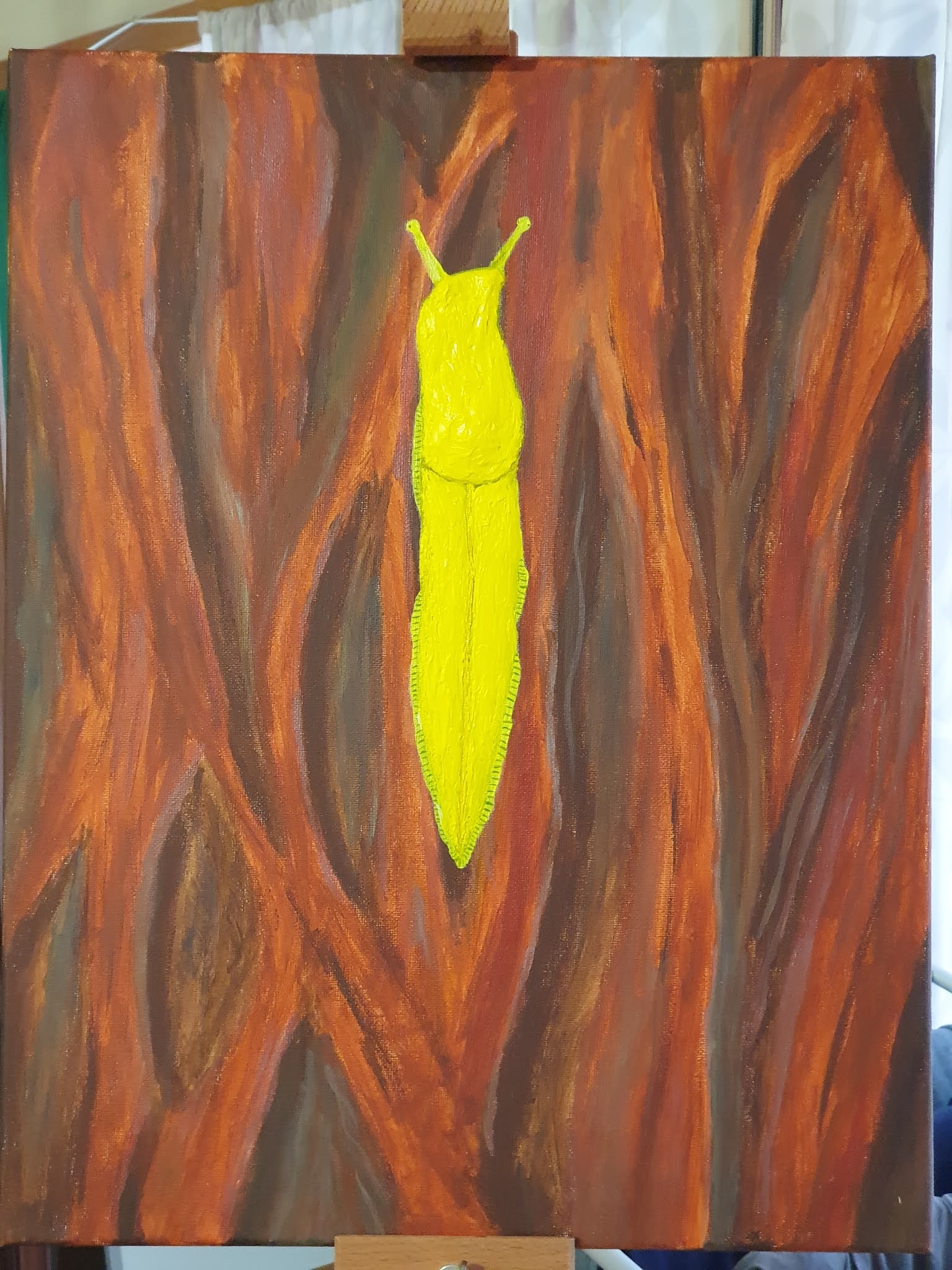
Instead, let's get back to slugs! Er, slug paintings. If you remember from last time, I'd decided to build up the slug with some flexible modeling paste. I've done just that in this next photo…

…though it's admittedly hard to see a difference from the previous photo. Just trust me when I say that I've built up the body a bit, and also closed the gap between the front and rear parts. It now feels much more like a real presence on the canvas.
I felt that the modeling paste buildup was complete, so I moved on to painting. You might wonder why I'd need to do any painting, since I've been mixing some yellow paint in the modeling paste as I go along, but there are two reasons for it. For one thing, the modeling paste is very, very, viscous. You can see in the photo above that it preserves individual brushstrokes in incredible detail. Each session working with it requires a lot of time very carefully flattening its surface, trying to keep the most egregious ridges down. But this is a slug, and should be more smooth-looking! (Though banana slugs do actually have some mild texture on their latter two-thirds, which I still need to figure out how to represent.)
The second reason has to do with reflections. When dry, modeling paste is quite a matte material, meaning it doesn't reflect light in concentrated spots; it has diffuse, rather than specular reflection. It's the opposite of glossy, which is more like how we expect a slug to look. So the purpose of painting the modeling paste is two-fold: to smooth out some of the texture caught in the paste, and to give it a more glossy reflection.

And here it is after the first coat of glossy paint. This light isn't the best illustration (especially because, in the previous photo, the still-wet modeling paste also shows some weak specular reflection), but you can kind of see how it looks smoother and more glossy. Most paints are somewhere between glossy and matte, and I've got some gloss gel and some matte gel that can be added to tip the balance one way or the other. I used matte gel in the paint for the bark background, which should make the contrast with the glossy slug all the more obvious.
It's definitely coming along quite well and looking mighty nice, but I'm not done yet! I still have a few last little touches in mind, so there'll be (at least) one more post finishing up this journey. I also unexpectedly* managed to get a video of the total lunar eclipse last night, so expect that soon as well. A hui hou!
*It'd been all or partly cloudy from a big weather front all day so I really didn't have much hope for the evening, but then it cleared up about an hour before the umbral portion of the eclipse began.
Sunday, May 16, 2021
Earth: Birthday #32
Yes that's right, it's time for the big binarily-significant \(2^5\) birthday! Here on Earth anyway. Now there's just my Mercury birthday to wait for later this month. I don't have much more to say about it—you've heard the song and dance by now—so let's get back to talking about…
…this painting. If you remember from the previous post, I'd tried painting the shading of the slug from a picture, and decided I really didn't like the outcome. I then had the thought that perhaps this was a job for my favorite trick of putting some dimensionality into a painting by extruding it into the third dimension. It's unfortunately a little hard to tell due to the face-on angle of the above photo, but I've painted over the slug's body with some flexible modeling paste mixed with a little yellow paint. I immediately liked where this was going much better, so this'll be the new direction for this painting. I did another painting session adding more modeling paste to the posterior two-thirds of the slug's body, and tried to get a photo from a different angle that would show the topology a bit better:

It's still not the best lighting, but hopefully you can see how I've built up a kind of crest ridge along the back (as the real slugs indeed have). I need to go back over it and even it out with the front a bit, but I'm really enjoying this sort of…reverse-sculpting? The modeling paste is apparently marble dust in acrylic, so it's almost like the reverse of sculpting something out of a block of marble. One tricky aspect of the paste is that it's very plastic and easily retains brush strokes, so it's a very delicate process and when I've got it built out to where I want it I'll have to give it all a layer of paint to smooth it out a bit. Still, I suppose the little imperfections keep it from looking too perfect and give it some character. This photo's from the latest painting session a few days ago, so I'll have to get back to it to have something to show…for my next birthday! A hui hou!
Thursday, May 13, 2021
Venus: Birthday #52
Today I have my 52nd birthday on Venus! Well, this Earth day. Days on Venus are a lot longer due to its slow rotation, and then when I looked it up I had to wrap my head around the difference between a sidereal day and a solar day again. On Earth, with its fast rotation, the difference between the two is only about 4 minutes. On Venus, with its slow retrograde rotation, the difference is about 126 Earth days.
Given that we generally mean solar day (the time between when the Sun reaches its highest point in the sky) rather than sidereal day (the time when a planet makes a full rotation with respect to the background stars) here on Earth, I'll do the same for Venus, which has a solar day of 116.75 Earth days. By that metric, it's been my birth“day” for almost two months (~58 days, so since mid-March) and will continue to be until early July. Which is pretty cool I suppose!
Anyway, continuing on with my in-progress painting, I'd left it with the beginnings of a bark texture. As mentioned, I didn't follow the color of my tree model, and that's because this is supposed to be a redwood tree. And on that redwood tree will be a majestic banana slug. I somewhat dislike giving away the final vision this early on, but as I started painting it in I can't show off more photos without revealing it. Nothing for it but let you all in on the process, I suppose!

Here, the big change from last time is actually not the beginnings of the slug I've started painting in, but the extra detail in the bark. I went over it again with a few colors, including gray. This turned out to be a much more important color than I'd anticipated, at it helped tone down the colors a bit and make them feel a bit more muted and natural, while making the saturated colors pop more.
Of course, the rough sketch of the slug is pretty eye-catching. I used some bismuth yellow to fill in an underlayer, and it turned out pretty fluorescent. A bit too fluorescent, so I painted it over with…

…this. I was attempting to do some shading from a photo, but A) I'm bad at shading, and B) it didn't exactly fit with the shadows from the bark. Almost every part of the slug here except for the outer fringe of its foot will be covered over…in the next post! Yes, I'll leave it here, and do some more work on it over the weekend. (Also, you might be able to see that I replaced the light bulb in my room with a brighter one in between the two photos.) Anyway, see you for my next birthday! A hui hou!
Thursday, May 6, 2021
Mars: Birthday #17
In the first of this month's birthdays, today I have my 17th birthday on Mars. That'll be the lowest number we see this month, since Mars orbits the Sun the slowest.
To give me something to talk about in these posts, I've decided to do something I don't normally do and post some photos of a painting in progress. I started this one in March, and it's not finished as of today, so this will be some good motivation to keep working on it. It was actually directly inspired by my previous painting, though I expect the link will not be obvious; I'll reveal it when the painting's done, and leave it to your imagination in the meantime.
Anyway, for this painting, I needed a background looking like bark, so I decided to try something new and do some plein air painting. En plein air is a French term meaning “outdoors,” and plein air painting is the act of painting outdoors, as opposed to inside a studio. While I could simply look up bark textures online, I decided I wanted to paint one from life, so I packed up some supplies and headed out to the nearest tree.
 |
| Setting up the easel and canvas next to my model. |
Turns out plein air painting, especially with acrylics, is a very different beast to painting indoors. I picked a moderately sunny day, and my acrylic paint—already known for drying quickly—was drying even faster both on the palette and the canvas. I made liberal use of the spray bottle I brought with me, furiously misting everything in an attempt to keep everything damp enough to work with, but still ended up rushing to capture the texture as quickly as I could (I sketched it out roughly on the canvas first). While this generated a unique sort of pressure to the painting, I don't think it was negative, exactly; I ended up using some very fast, loose brush strokes, which gave it a somewhat freer quality than normal for me, I think. Anyway, here's a shot I got of myself with the finished product:
 |
| The Sun came out from behind the clouds after a while. |
…and here's a closeup of the canvas:
 |
| Sort of looks like bark, if you squint? |
As you can see, I only used the tree as a reference for the texture, not the color. As to why I chose the particular colors I did, well, that's part of the composition…which I'll reveal on my next birthday! For now, I'll leave you with the fruit of my first experiment in plein air painting, while I get back to work. A hui hou!
Sunday, May 2, 2021
Birthday month extravaganza
Back in 2019, some people (including a friend of mine from Swinburne) got together and created a website at a Python in Astronomy hackathon. This website, https://cakedays.space/, allows you to input your birthday (on Earth), and it will output a calendar which you can add to e.g. Google Calendar which will tell you when you'd have birthdays on each of the other planets in our solar system. It's quite a cute idea, and I've been meaning to write about it for a while now. I've finally gotten around to it because, while checking my calendar for this month, I discovered that I have four birthdays this month, one each week on all four of the terrestrial planets!
Hence the title of this post, as I'll be putting up a post on each birthday as it comes around this month. Not sure what I'll do for them yet. We'll find out…later this week. (Also, if you want to set up your own birthday calendar using the website, there are two boxes called “Skip Mercury/Venus Birthdays by” which skip as many as you specify. If you, like me, want to see every birthday, just put a 0 in those boxes. Putting a 1 would cause every other one to be shown, etc..)
On a more somber astronomically-related note, I saw that Michael Collins, the command module pilot for Apollo 11, passed away last week. As the guy who stayed in orbit, he's been called "the loneliest man in history" for his time spent on the far side of the Moon during each lunar orbit, out of radio contact with anyone. He himself described it as relaxing (which I can totally relate to as an introvert), and that he felt a mixture of emotions including "awareness, anticipation, satisfaction, confidence, almost exultation." A fond farewell to an oft-overlooked man whose presence was as integral to Apollo 11's mission as the other two.
Anyway, I'll end this post here, with the promise of several more to come this month. A hui hou!
Tuesday, April 27, 2021
A tendril of fire
Last year I painted a scene of a star and planet which I showed off in this post, the same one that appears below. I left it at my desk when I started working from home in March, not anticipating that I wouldn't see it again until November. At the time I think I still had some ideas for changes to it, but as it was mostly done I decided to show it off anyway.
Around the start of this year I brought it home, with a hazy idea of “finishing” it. I realized, however, that I'd ended up forgetting what ideas I had in mind in the intervening time, so I decided to simply sign it (and make a few last little touches) and declare it finished. I also don't remember if I ever had a name in mind for it, so I had to come up with a new one: “Tendril of Fire.”
 |
| “Tendril of Fire,” 14×18", acrylic and glass beads on canvas. |
Monday, April 12, 2021
Musical musings: Charles-Valentin Alkan
In my continuing search for new composers and music, I recently stumbled upon an obscure French composer of Jewish descent from the 19th century named Charles-Valentin (or Valentine) Alkan. He was a pretty amazing piano player who was friends with both Liszt and Chopin, and his musical output reflects this: most of his music involves the piano (though he also wrote for other instruments, including a full symphony which has sadly been lost).
I decided to write about him because I've found some of his music to be profoundly moving and novel, and think he deserves greater recognition. I'll illustrate with some select pieces, so you have something listen to while reading. For instance, Alkan's Opus 27. “Le chemin de fer” (“the railway” or “the railroad”) published in 1844 is the first known depiction of a train in music, and it is absolutely incredible—a breakneck perpetuum mobile that keeps up its pace nearly to the end. (Opus numbers are not sequential for Alkan, just FYI.)
Contrasting with the perpetual driving rhythm is a lovely second melody (the “happy passengers” theme), and the whole thing will have you feeling a bit breathless at the end of its five minute duration. This is, perhaps, not a great work of music, but it's certainly an interesting and different one.
Alkan was a virtuoso on the piano and it comes through in some his work, which includes some of the hardest piano writing of the 19th century. Of course, mere difficulty does not equate to goodness or greatness, but I don't get the feeling he was writing hard music for the sake of difficulty—he also published plenty of easier music—rather, the ideas he wanted to express just required that level of skill sometimes. The results are well-worth it, though, I think. Here's another piece I quite like, Opus 34, Scherzo-focoso in B-minor.
Now there are plenty more pieces I like which I could share here, but rather than risk providing too much I'll focus on what is undoubtedly Alkan's magnum opus, Opus 39, Douze études dans les tons mineurs (Twelve Etudes [or studies] in the Minor Keys). Nearly every one of its constituent pieces is a masterpiece in its own right and I would highly recommend listening to the entire thing (recorded by English pianist Jack Gibbons, who's made a special study of Alkan's music), but I'll pick out the best of the best to highlight here. It's an unusual collection in some ways: among its twelve pieces are a four-movement Symphony for solo piano, and a monumental three-movement Concerto for solo piano which follows it, where Alkan masterfully makes use of the piano's range of expressiveness to mimic or suggest other instruments or even whole orchestral sections in some really interesting ways.
This concerto (pieces 8–10 of the collection) is…there's no other word for it than epic, and I do not use that word lightly. The first movement (Allegro assai in G-Sharp Minor) takes nearly half an hour to perform, and contains more bars than the entirety of Beethoven's (justifiably) famous Hammerklavier sonata. The other two movements (Adagio in C-Sharp Minor and Allegretto alla barbaresca in F-Sharp Minor) are no slouches either at about 8–10 minutes long each, making the entire concerto a test of stamina for the player. The first and third movement especially are very fast, filled with incredibly challenging music (such as performing trills with the third and fourth fingers while simultaneously playing the melody). I personally think these three movements are the absolute pinnacle of the collection, so I've linked them all below. (Fun fact: Gibbons made his concert debut playing this work [among other things] at the age of 17!) If you don't want to listen to an hour of music, I do have one more shorter suggestion at the end.
I could gush at length about all the amazing feeling in these three pieces, but in the interests of brevity, the last piece in the collection is a remarkable set of variations called Le festin d'Ésope, or Aesop's Feast (referencing a particular legend about Aesop, but the music also seems to nod towards the many animals in Aesop's fables). Here Alkan takes a simple 8-bar theme and puts it through the wringer in 25 variations which span the gamut of human emotion. If you watch only one video in this post, watch this one. I think it shows off a bit of Alkan's sense of humor: some of the variations are downright funny, such as the twenty-second where the right hand resolutely plays the theme while the left hand jumps back and forth on the piano playing short motifs marked “barking,” as if it were a dog joyfully unaware of the “serious” music going on (the right hand very much does not know what the left is doing in this case, or is at least trying to steadfastly ignore it).
There are plenty of other pieces I could have shared here, but hopefully this will suffice to give you taste of this remarkable musical genius. There's some really powerful and evocative music here which I could wax lyrical about for hours—I find themes and melodies in my head at all hours for days after listening to some of these pieces—but half the fun is discovering things for yourself. Let me know in the comments if you enjoyed any of these pieces, or were inspired to seek out more of Alkan's output! A hui hou!
Sunday, March 21, 2021
Birds of Melbourne: rainbow lorikeets
I've finally gotten around to editing some footage I shot in January of some rainbow lorikeets feeding. If you thought the crimson rosellas were gorgeous, take a look at these beauties! You might even be familiar with them already from advertising; I feel like they're the go-to birds to display whenever TV makers want to tout their latest screens. They do make a fantastic test of color ability with those rainbow hues, to be fair!
I see these around once or twice a week on average, so they're relatively common. As you can hear in the video, they're quite vocal little parrots, almost constantly chirruping and squawking quietly. But of course, what you're going to mainly notice is that jaw-dropping plumage, going from deep blue or purple, to lighter blue, to bright green, then through yellow, orange, and even a deep reddish-orange hue. (Fun fact: I made the gradient in the words “Rainbow lorikeets” in the video thumbnail by sampling from different parts of the bird in the image, with some slight tweaks.)
I think that's all the footage of birds feeding I've recorded so far; I really need to get around to trying out that motion-sensing setup idea I had now that GoPro's come out with the GoPro Labs firmware for the Hero 9, which allows you to, say, only record while a (user-settable) level of motion is detected. I've tried it out once or twice but still need to play with it to find a good level of motion detection for feeding birds (and of course, have some interesting birds come by while I'm filming!). We'll have to see how that goes in the future. A hui hou!
Subscribe to:
Posts (Atom)