This week on my way home from work I decided to stop at Rainbow Falls on a whim. Since I moved last year the falls are a lot closer to my house, so it's not very far out of my way. About four days earlier we'd had a powerful thunderstorm all day, and while we get many days of rain here in Hilo thunderstorms are pretty rare—perhaps ten or fewer a year. The large amount of rain from upstream had swelled the falls to a thunderous roar, and with the sun going down but still above the horizon I decided to shoot some photos in the picturesque light.
This one's from the outlook spot just a short walk from the parking lot:
And this is from the path that climbs up to above the waterfall's head—if you look you can see someone silhouetted in the previous picture, standing very close to where I took this next one:
Fun fact: my profile photo up there was actually taken at Rainbow Falls! Though it's been cropped so you can't actually see the falls in it. And it's about six years old at this point...maybe it's time for me to think about updating it (not that I look vastly different or anything).
Yesterday I went to see The Martian with my friend Graham from work. Overall I had a pretty good time with it, and I liked the happy ending. I can't really talk about what I want to without spoiling the plot, so consider the rest of this post one big spoiler warning.
If you saw a trailer for The Martian, you probably already got the gist of the movie. The Ares III mission (third in a series of five manned mission to Mars) encounters a mission-scrubbing sandstorm only twelve days into their mission. During the emergency evacuation one crew member (Mark Watney) gets lost in the sandstorm after getting hit by a flying communications antenna and is (quite reasonably) presumed dead after his suit reports a suit breach, leading the rest of the crew to abandon Mars and head back to Earth. Mark turns out to be alive, amazingly (the blood from where he got impaled having sealed the small hole in his suit), and most of the rest of the movie deals with his attempts to survive until he can be rescued. Luckily, as this was a series of planned missions, Ares IV is already set to land 3800 kilometers from his position in a few years, leading to the idea of getting there to meet it when it arrives. The rations left behind in the evacuation won't stretch that long, but a serendipitous discovery of viable potatoes among the rations leads to him growing them and giving hope that he can survive long enough to modify the rover (also left behind) to be capable of traveling to the landing site.
It takes a few months for anyone to notice he's still alive based on satellite photos of Mars, but when they do they manage to get communications up and running between NASA and Mark. NASA fast-tracks sending the scheduled pre-delivery of food for the Ares IV mission in order to get it to Mark faster, especially after a freak explosion blows up his growing habitat and destroys his potato crop, leaving him with the unenviable prospect of running out of food in a very definite amount of time.
Meanwhile, the rest of the crew of the Ares III are still on their several-month journey back to Earth in the Hermes crew vessel. An astrodynamicist at NASA realizes that the Hermes could potentially slingshot around Earth and get back to Mars fast enough to save Mark as a backup in case the food shipment doesn't make it. (Turns out the Ares IV ascent vehicle has already been landed at the proposed landing site on Mars, since it could be launched ahead of time and means the actual Ares IV mission doesn't need to bother with bringing it along; Mark could take it up and rendezvous with the Hermes as it slingshots again around Mars on its way back to Earth.) This idea is floated in a secret meeting, but is rejected for putting the rest of the crew in additional danger (not to mention several more months of spaceflight time). However, when the rocket carrying the food package explodes during launch the Ares III mission director secretly sends the crew details of the maneuver, whereupon they unanimously vote to mutiny and perform the maneuver against NASA's orders.
Ultimately, the Hermes makes it back to Mars in time for Mark to make it to the Ares IV ascent vehicle before starving, where he strips a frankly ludicrous amount of material out of the ascent vehicle in order to make it light enough to reach the speed necessary to rendezvous with the Hermes (as in, he strips out all of the manual controls leaving it controlled remotely from the Hermes, and even the windows and airlock, performing the ascent in his spacesuit with a tarp over the windows). After a climactic rescue scene Mark is saved, and in the epilogue it's shown that everyone made it back to Earth safely and Mark has taken up teaching future astronauts.
Think Apollo 13 meets Robinson Crusoe.
Now, most of the time, the science was quite good, as you would hope for a movie where almost all of the tension comes from butting up against the laws of nature. Things like burning hydrogen to get water (and causing an explosion due to unaccounted-for excess oxygen), space scenes shot in zero-g conditions (although the Hermes also has rotating sections where people can walk around normally due to centrifugal force), and a homemade bomb made of sugar mentioned as being “four times more powerful than a stick of dynamite” (which is entirely believable, given the vast amounts of energy in food; thankfully, it doesn't easily burn fast enough to explode under normal conditions). The shots of Mars were also particularly gorgeous, especially in the 3D version I saw, which worked well; the 3D was used to good effect rather than being a mere gimmick, and was never used to “in your face” type things.
As an astronomer, however, several details stuck out to me while watching. At least twice, the Martian night sky is shown with a small crescent moon hanging in space. While pretty, it's also unrealistic because Mars' two moons Phobos and Deimos are both tiny, and far too small to be seen as anything other than star-like points (they're also irregularly shaped like asteroids, so they wouldn't have a nice crescent like the Moon does here on Earth). There was also a beautiful shot of a Martian sunset…which looked suspiciously like a sunset on Earth, with a blue sky fading to red around the Sun. Interestingly, it's almost the exact opposite on Mars: the sky is normally red due to ever-present dust in the atmosphere, while fading to blue around the Sun at sunset and sunrise. The atmosphere on Mars is only about 1% as thick as Earth's at ground level, so it's usually too thin for there to be enough Rayleigh scattering to produce the blue skies here on Earth. However, at sunrise or sunset the Sun's light passes through enough of the Martian atmosphere to create a pale blue color, as seen in the picture below. (On Earth the extra atmosphere at those time scatters so much blue light out that what's left appears red or orange.)
Another thing I noticed is that the movie tries to have it both ways with regards to how thick Mars' atmosphere is. In the first few minutes of the movie, the sandstorm that kicks everything off both rips off a communication dish and takes out Mark with it, and presents a credible threat of blowing over the ascent vehicle. Yet near the end of the film as Mark is preparing to ride an Ares IV ascent vehicle that has had even its windows and airlock removed in order to lighten it, it's pointed out that the Martian atmosphere is thin enough that you could feasibly pull such a thing off due to air resistance being essentially non-existent. I'm not familiar enough with the fluid dynamics of the Martian atmosphere to say anything myself, but I've read that in reality even a fierce sandstorm on Mars would feel like a light breeze and wouldn't be able to tip over a large metal ship. The highest atmospheric density on Mars is only 0.6% that of Earth's, so I believe it. Mars' famous planet-wide sandstorms work because of the lower Martian gravity, not because the wind is so strong. And speaking of gravity…
…as a physicist, I couldn't help but notice how Mars has Earth gravity the whole time. The surface gravity on Mars is just 3.7 m/s², a mere 37.6% of Earth's 9.8 m/s². Obviously the movie was filmed on Earth (Wadi Rum in Jordan standing in for Mars), and it'd be to impossible to change something like that, so this isn't a fault of the movie in any way—it just wouldn't be possible to make it look realistic. The fact that something so minor is what I kept noticing really says something about how good the rest of the science was.
Interestingly, during the part where the crew on board the Hermes votes to mutiny and perform the maneuver to return to Mars against NASA's orders to save Mark, the commander says something to the effect of “if we do this, none of us are likely to ever fly again.” This may sound like mere dramatic oratory (although it's justified in the context), but it turns out this has actually happened: in at least two cases crews of astronauts (on Apollo 7 and Skylab 4) have mutinied while in space, and both times no one on the crew ever flew in space again, as eloquently explained in the videos below.
Overall, as I said, I found it a pretty good film, though I couldn't watch the early scene where Mark performs self-surgery to remove a bit of metal from his abdomen from where a spike on the communication array impaled him with nothing but local anesthetic (queasiness is why I'm an astronomer and not a doctor!). I laughed at the part where, in the secret meeting to explain the maneuver for the Hermes, the guy who came up with the maneuver calls it “Project Elrond” and while one of the people in the meeting is trying to figure out what “Elrond” means the normally staid and stoic director of NASA pipes up from the background to say “If this is the council of Elrond, I want my code name to be Glorfindel.” And I especially winced in sympathy at Mark's line “I ran out of ketchup seven days ago” said while eating a potato. Surely that would have to be the worst thing about being stranded on Mars: running out of ketchup. A hui hou!
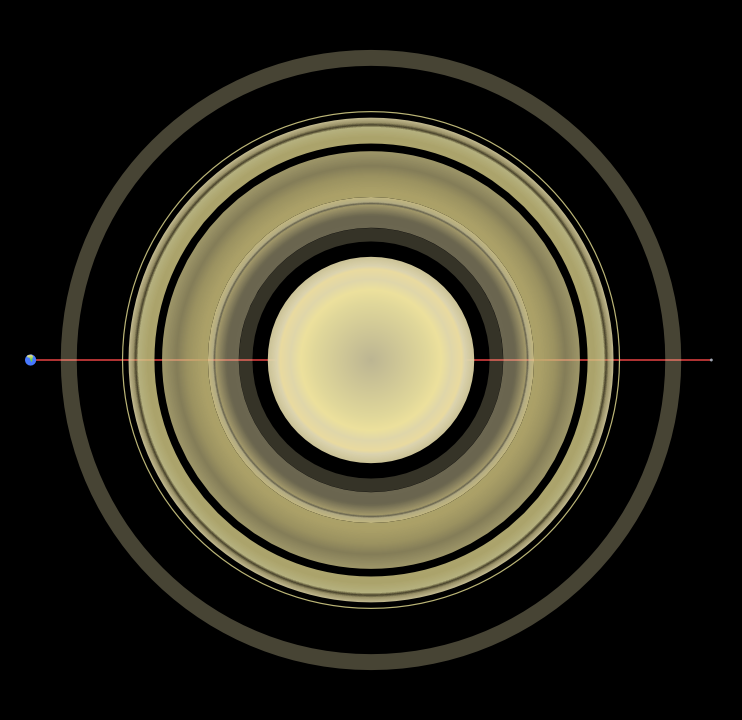
When I put together those pictures of Saturn I used to illustrate the scale of Saturn's ring system last month I went to a lot of trouble to make all the rings consist of two mirrored halves, with the intention of using them to make the illustration in perspective (by hiding one set behind Saturn, then squashing both sets symmetrically inwards vertically, if you're curious). Along the way I decided I liked the straight-on overhead view better and ended up not doing it, but the capability remained, so today I decided to blow the virtual dust off the file and see what I could make of it. I had to make a new radial gradient for Saturn, but I think it came out looking pretty nice:
(Despite the title, this is just a plain old PNG image, as Blogger unfortunately doesn't take SVG images directly. But the original is SVG, anyway. See how many of the rings mentioned in my previous post you can spot here!)
I came across a neat video on YouTube the other day, showing visually the discovery of all the asteroids found since 1970 up to the present.
In this video the Sun is at the center, with the inner planets (and occasionally Jupiter) seen rotating around it from a position above the plane of the solar system (so looking down on the Earth's North Pole). The planets aren't labeled, but it's easy to count outwards from the Sun to find Earth. At the start of the video in 1970 all of the 4,422 asteroids known at that point are marked with tiny dots. (It's best to watch on the highest resolution you can, otherwise they're hard to see.) As time unfolds, asteroid discoveries are marked with bright white dots, before fading to a fainter color. Yellow and red dots (I'm guessing) are asteroids that come close to Earth, or Near-Earth Objects (NEOs).
Later in the video you might notice asteroids in the same orbit as Jupiter. These are known as the Trojan asteroids. These asteroids orbit the Sun in roughly the same orbit as Jupiter, but 60° either ahead or behind of it. The name comes from the fact that early on the first few discovered were given names from the Trojan War (starting with 588 Achilles), and it was proposed to continue with the naming scheme and give them all such names. The naming scheme even extends to location: asteroids ahead of Jupiter are given names from the Greek side of the war, while those trailing it are given names from the Trojan side. (Though amusingly, there are two out-of-place names from before this particular convention was adopted: Patroclus is found among the Trojans, and Hektor among the Greeks.)
The term Trojan asteroid originally referred to just the asteroids in the orbit of Jupiter, but when other asteroids sharing similar orbits with other planets were found the term expanded to encompass them as well. Currently Trojan asteroids are known for Earth (1), Mars (7), Jupiter (6,000+), Uranus (1), and Neptune (13).
As for why Trojan asteroids are generally found around 60° in front of or behind the planets they share an orbit with, that has to do with gravity, the three-body problem, and Lagrange points, and really deserves a blog post to itself sometime.
And finally, while watching these nifty visualizations, just keep in mind the fact that sizes are not to scale. In reality, while it looks like the asteroid belt is a swirling maelstrom of space debris, there are typically millions of miles (or kilometers!) between any two asteroids. There may be a lot of rocks out there, but there's an even larger volume of space to hold them. A hui hou!
A few weeks ago I happened to hear offhand that Saturn and its rings would fit nicely in the space between the Earth and Moon. Being the visual-oriented person I am, I decided to go ahead and make a picture to put them in perspective, and figured I'd share.
First of all, a quick primer on the nomenclature of Saturn's rings. The rings are labeled alphabetically in order of discovery, although the A, B, and C rings were all discovered basically at the same time and the decision to name them working outward in towards the planet was pretty much arbitrary.
Technically the F ring is too thin to be shown here; it's only about 30–500 km thick which means it's about 40–400 times thinner than shown here. The relative brightnesses of the rings is also only approximate; the G ring (and even D ring) are also fainter than shown here, and aren't visible to the naked eye. They were only discovered with photography from various interplanetary probes after 1979 (as was the F ring). The F ring is the outermost of the “discrete” rings; beyond it, the rings are diffuse and may have moons orbiting embedded within them.
The astute among you might have noticed that there is a distinct lack of an E ring in the above image. Don't worry, we'll come back to that. Anyway, let's see how these rings stack up against the average Earth-Moon distance:
With an average separation distance between them of about 358,000 km, we can see that the Earth and the Moon nicely frame Saturn and its main rings there. It also gives a good idea of the size of Saturn relative to Earth.
But what about that E ring I glossed over a paragraph ago? Turns out the E ring is outside the G ring and extremely large, but like the G ring it's also extremely faint and diffuse.
Anyway, here's the E ring in all its glory (I've left the Earth, Moon, and the line between them in place):
Yeah, the E ring's pretty wide (and again, it's so diffuse that it's not visible to the naked eye). Its outer edge is just within the orbit of Saturn's largest moon, Titan. As you can see (or maybe not), the E ring's diameter is around twice as large as the average Earth-Moon distance.
But believe it or not, that's not all of Saturn's rings! There are a few more ringlets between the G and E ring that are too thin to show here, but there's another ring outside the E ring that's even larger and even more diffuse. This ring was only discovered in October 2009, and is known as the Phoebe ring after Saturn's unusual moon Phoebe which orbits just outside of it in a retrograde orbit. Here it is, with the rest of the ring system for comparison:
Yep, that little disc in the center is the E ring we just saw in the last picture—with the inner ring system and Saturn within that. This ring is really large. In fact, unlike the other rings which have a maximum thickness on the order of tens to maybe hundreds of meters, the Phoebe ring has a thickness around forty times greater than the radius of Saturn itself. In other words, this ring is thicker than the entire diameter of the E ring.
So there you have it! Saturn and its fascinating ring system, and how it compares to the distance between the Earth and the Moon. Hope you found it as interesting as I did putting these images together. A hui hou!
While attending the family reunion I was on vacation for in Oregon in July I got the chance to take a trip up the Oregon coast. There's some really gorgeous scenery up there, and I took the opportunity to take some pictures for panoramas. I finally got around to putting them together this weekend and thought I'd share them.
First off here's a panorama of Simpson Reef, a small reef off the Oregon coast.
Edit (3/19/18): This panorama now is the version made using Hugin, but you can mouse over it to see the original version!
Mouse over for original, click for larger version.
The largest island visible near the center of the image is Shell Island, and while you can't see it at this resolution the beach at its base was absolutely covered in sea lions. From my location at the overlook spot I could hear a constant faint cacophony of cries from the mass of pinnipeds sunning themselves on the strand. The reef is part of the Oregon Islands National Wildlife Refuge and Oregon Islands Wilderness, and its constituent islands are also important breeding grounds for lots of seabirds.
This panorama isn't of anywhere particular (it's just a bit up the coast from Shore Acres State Park), but I loved the landscape.
Edit (3/19/18): Again, this is the new version made with Hugin, mouse over it to see the original hand-made one!
Mouse over for original, click for larger version.
It's hard to see at this resolution, but there are some neat concretions visible down close to the shoreline. Concretions are masses of matter harder than the surrounding sedimentary layers formed by precipitations of mineral cement, and look like roughly spherical lumps protruding from the softer stone around them as it erodes faster. The whole coastline here shows some interesting weathering and erosion features.
It occurred to me while making these panoramas just how much work goes into making them, and I'm considering possibly doing a little walkthrough/tutorial on what I do to put these together in the future. Anyway, enjoy the landscapes. A hui hou!
It's been a little bit quiet around here as I spent pretty much the last two weeks of July and the first week of August away, first back on the west coast for a family reunion then in Honolulu for a business trip. The triennial IAU (International Astronomical Union) conference was back in the U.S. for the first time in twenty-five years, and as a new organization EAO wanted to have a booth there to help get our name out. Which is why I got to spend a fun week in Honolulu talking to people about the JCMT!
Despite flying through the Honolulu airport twice a year on average for the past six years this was my first time actually outside the airport. It was a bit of a shock just how different it was from Hilo. O‘ahu has a lot of basically flat area, something that is in short supply on Hawai‘i, and it was discombobulating to drive for miles with essentially no elevation change. Though the half-mile walk to the convention center from my hotel was flat rather than uphill, so I'm not complaining.
Check out our nifty booth!
That fantastic diorama of the summit of Mauna Kea on the left there belongs to Subaru with whom we were sharing a booth, and boy, was it popular throughout the conference. It was really nice to be able to point out to people exactly where the JCMT (and everything else) on the summit was.
While I was there, I got to do something most people don't associate with Hawaii: ice skating! My co-worker and friend from college that I went over with, Will, suggested it, so one night after the convention was over we took the bus over the skating rink. I even took a really poor picture as proof!
Yeah, that picture didn't really come out well. I blame my slightly deranged expression on the fact that I was standing on ice skates and concentrating on not falling over. It was a lot of work, and there was much comedic flailing as I rounded the rink a few times, but at least I managed not to fall down over the course of the hour I spent on the ice. All in all, a fun experience. Look forward to some pictures from my time in Oregon soon!
In my Bible-reading this morning I ran across Matthew 6:27 where Jesus says “And who of you by worrying can add a single πῆχυν to his ἡλικίαν?” This is an interesting verse to translate, because ἡλικίαν (pronounced heylikian, with the i's sounding like the i in machine) is usually translated as something like ‘lifespan,’ but πῆχυν (pronounced peychoon, where the ‘ch’ sounds like it does in German ‘Bach’ or Scottish ‘loch’) is a very straightforward word meaning ‘cubit.’
On the face of it, this doesn't make grammatical sense; how do you add a cubit to your lifespan? This has lead to two divergent translations I've seen: one involves translating πῆχυν as ‘hour’ (despite there being another definite word for hour, ὥρα [hora]), while the other translates ἡλικίαν as ‘height.’
Neither of these translations sound really good to my ear, so I when I came to the passage this morning I decided to go back to the literal meaning of both words and incorporate insights from relativity theory. Relativity tells us that time is simply another dimension like the three dimensions of space (which are inextricably linked in a four-dimensional spacetime), and that by using the speed of light as a conversion factor we can use units of measurement for space to measure time, and vice versa. What does a ‘second of distance’ mean? It's the distance light travels in one seconds, approximately 186,000 miles or 300,000 kilometers. And similarly, one ‘meter of time’ is the amount of time it takes light to travel one meter, approximately three nanoseconds.
A cubit, by the way, is very close to half a meter, so what Jesus is basically saying here is that you can't add even a nanosecond and a half to your life by worrying—so don't worry, because your Heavenly Father is in control. A hui hou!
I learned to diagram sentences from my mother (a Linguistics major in college), but didn't appreciate it much at the time (to be fair, my mother didn't appreciate it either until she began teaching me and my sister). Until, that is, I ran across a sentence in the local newspaper that made me want to diagram it.
The sentence in question was “This is not an administrative license revocation matter.” (It has to do with the ongoing investigation into whether the mayor of Hilo inappropriately used government funds for personal benefit.) It's not particularly long—no complicated compound sentence or anything—it was merely the noun phrase in the predicate that attracted me. It took me quite a bit of research, though, to figure out what all those nouns near the end are.
The ending noun phrase “administrative license revocation matter” has what looks like a couple of nested noun adjuncts, which is where a noun modifies another noun the way an adjective normally would. “Administrative” is an adjective modifying “license,” which is itself serving as a noun adjunct modifying “revocation,” which entire phrase is modifying “matter” at the end.
And yet, nowhere could I find how to diagram something like that. One website helpfully told me that noun adjuncts are diagrammed like adjectives—on a diagonal line beneath the noun they modify—but I couldn't see any way to chain multiple noun adjuncts together.
After some time pondering the matter and scratching my head, I decided to pull a mathematician trick reformulate the sentence into something with a prepositional phrase: “This is not a matter of administrative license revocation.” Written this way, I can just about diagram it, though I'm not 100% sure about “administrative.” I ended up diagramming it as you would an adverb modifying an adjective because it looked nice and seemed similar, but I've no idea if that's correct. Anyway, here's what I eventually ended up with:
If any of you out there are more familiar with sentence diagramming and would like to point out how it should actually be done, feel free to sound off in the comments! A hui hou!
About a day ago the New Horizons space probe finally reached the end of its nine-year journey through space and accomplished its mission: a fly-by of Pluto, marking the first time humanity has gotten to see the surface of this mysterious minor planet.
And what a surface it is!
Pluto, as imaged by New Horizons. Credit: NASA/JHUAPL/SWRI
Just look at all those surface features! There's a large icy vaguely heart-shaped region in the middle (which reminds me of Antarctica for some reason). It's flanked on two sides by extremely dark patches. On the right side of the picture long shadows betray the presence of fierce mountain ranges jutting from the smooth plains around them. What looks like a long canyon sits on the left side of the image, while vast smooth plains fill the top half. Speaking of which, there's a noticeable dearth of obvious impact craters—I can spot a few, but it's nothing like, say, Mercury, or our Moon.
When I was growing up in the 90's, from as early as I could remember I was fascinated by other planets. This was the beginning of my lifelong journey to become an astronomer, as I devoured every bit of reading material I could get my hands on pertaining to the solar system. This was right after the two Voyager probes had completed their missions to the outer planets (Voyager 2 flew by Neptune the year I was born, 1989), so there was an eclectic mixture of information in the books I read, depending on how old they were and how up-to-date their information was. (Looking back, I realize this was excellent training for my young self in sifting multiple conflicting sources of information and piecing together a coherent narrative from them. Huh.)
The newer books had pictures of the outer planets and their moons from the Voyager probes that were of resoundingly better quality than the ones before it. Those two probes taught us so much about the planets that we simply couldn't see from our vantage point on Earth. The point to this rather rambling divergence is that I know now what people must have felt like when those first pictures of each new planet were coming back. If you're not familiar with our previous best images of Pluto, let me show you one (courtesy of the Hubble Space Telescope):
Credit: NASA/STScI
To be clear, the actual photos of Pluto are those two small pictures at the top; the larger ones are computer models extrapolating from those pictures. These were among the best images of Pluto we had until yesterday. And yes, that's a photo from 1996, but we didn't really get any better ones in the intervening time period; here's another one from 2012:
Credit: NASA/STScI
The letters WFC3 at the top of this image stand for Wide Field Camera 3, the last and most technologically advanced camera installed on the Hubble Space Telescope, so this is as good it's possible for Hubble to get. With that in mind it's easier to appreciate just how amazing the pictures from New Horizons are.
“But hang on,” you may be saying, “why can't Hubble get better pictures of Pluto? It gets all those amazing pictures of galaxies, and they're a lot further away than Pluto is!”
If you're asking this, then you're in luck, because I asked myself the same thing driving home from work today. The apparent discrepancy comes about due to us humans not having a good intuitive sense about sizes and distances so far outside our everyday experiences. To really get a feel for why things are the way they are, we need to use math.
My idea for this was find the diameters and distances to Pluto and a nice galaxy that Hubble had photographed, take their ratios, and see just how much bigger the galaxy would appear on the sky. Then while researching these bits of information in order to write this post I discovered that an astronomer named Emily Lakdawalla had already done exactly that. So rather than write up another post that would say pretty much the exact same thing, you get to go read her blog post. (She also already has an excellent image showing the relative sizes of a lot of Pluto-sized bodies in the solar system using the newest images of Pluto and Charon!)
I had an idea to take a picture of a galaxy and a picture of Pluto and shrink the Pluto picture down and stick it on the galaxy picture to see how they compare, but I did a quick back-of-the-envelope calculation with a galaxy picture I picked out and discovered that Pluto would be about two pixels across (which agrees quite well with the conclusion in Emily's blog post that Pluto would theoretically cover less than two pixels of Hubble's WFC3). I tried sticking a little 2×2 bright green square into the image, and could barely make it out at 100% resolution even knowing where to look. So I figured it wouldn't be especially interesting to show given that putting the picture up on this blog would further shrink it. Sorry.
But to come back to the point I was trying to convey originally, this is a historic day (well, yesterday technically) for planetary science, unmanned space probes, and Pluto. If you come across any of the doubtlessly many more images to come back from New Horizons I hope you now better appreciate them for just what a huge leap forward they represent for our understanding of this fascinating little ice-and-rock-ball out on the outskirts of our solar system. A hui hou!
P.S. Also, New Horizons' mission isn't quite as over as made it sound in the opening sentence. It will continue to observe Pluto and its moons for about another month or so as it whips on past, and will probably continue to send back observations about anything else it can see way out there for a long time to come after that. Exciting!