I think this is the longest time I've been between posts on this blog so far, for a number of reasons: since my last post, I have a) moved houses, and b) gone on vacation for a week with nearly zero Internet access. I also finally got the Internet hooked up in my new place just yesterday.
I also, just yesterday, finally had enough free time (and all the parts) to construct the new computer for which I've been collecting parts for two months (I got the final part - the processor - in on Thursday). It was a lengthy process - the build alone took almost three hours, and I then spent three and a half more trying and failing to get Linux installed on it. I was finally able to accomplish that with assistance from a more knowledgeable friend and another five hours of work this afternoon, so yes, I'm writing this post on my new computer. Yay!
I had the presence of mind to take some pictures during the build, so when I have some time I'd like to write a post going over the process in detail. But for now it's getting late, so a hui hou!
Saturday, July 12, 2014

Saturday, June 28, 2014
Moving House
I haven't said anything about it yet here on my blog, but I've been looking for a new house to call home since the beginning of the month. This is part of why I haven't had many posts recently, as I've been busy researching potential places. Last week I found one, this week I signed the new lease, and as of today (Saturday) I'm moving in. I'm not a very fast mover, so the move will be completed tomorrow, but so far I've got most of the important stuff (like furniture), and enough amenities to actually spend tonight there.
The place is a nice little upstairs duplex unit, higher up in elevation than where I've been living. I can see the ocean (through some houses and telephone wires), and it should have a nice unimpeded access to any trade wind breezes blowing from out across the deep blue Pacific. It's actually on somewhat of a slope, which marks my first time living up on an incline in my memory (I have the haziest of memories of living in a house on a slant in Israel, when I was merely four or five, but that doesn't really count).
One downside of moving is that the cable company apparently can't get the Internet hooked up until the 11th, so I may be somewhat quiet these next two weeks. I can always get online other ways, but blog-writing may not be high on my priority list at those times!
We'll see, I suppose. This is my first time moving on my own – it was with some shock that I realized I've lived in this place for longer than I've had this blog (I moved to Hilo from home in August 2009 to attend UHHilo, about 5 months before I started writing this blog). Anyway, it's been a long day of moving heavy furniture up and down stairs, and I have a lot of cleaning and little more moving to do tomorrow. A hui hou!
 |
| The chaos of moving. Pretty much all of that furniture has been moved elsewhere by now. |
One downside of moving is that the cable company apparently can't get the Internet hooked up until the 11th, so I may be somewhat quiet these next two weeks. I can always get online other ways, but blog-writing may not be high on my priority list at those times!
We'll see, I suppose. This is my first time moving on my own – it was with some shock that I realized I've lived in this place for longer than I've had this blog (I moved to Hilo from home in August 2009 to attend UHHilo, about 5 months before I started writing this blog). Anyway, it's been a long day of moving heavy furniture up and down stairs, and I have a lot of cleaning and little more moving to do tomorrow. A hui hou!
Monday, June 23, 2014
More Lei Crochet
Boy, once you get the hang of it these simple crochet projects are really easy! In less than a week I've finished a second lei (it helped that I had several long meetings and presentations to sit through this week). This one is supposed to resemble a lei made of flowers from the ginger that grows wild around here, or ʻawapuhi to give it its Hawaiian name.

I can confidently state that I've learned a lot in the process of making these two lei. After the first one, I realized I'd been making it wrong; rather than producing the coiled structure by rolling the lei lengthwise, I'd actually physically attached each petal further around the central stem chain. I fixed that mistake on this lei, only to realize after I'd finished that I'd been doing my double crochet loops all wrong, and that my connection of the two ends could be vastly improved. I've got another meeting tomorrow and I'm looking forward to starting another lei, correcting those shortcomings, and putting my new end-connection plan into action. A hui hou!
I can confidently state that I've learned a lot in the process of making these two lei. After the first one, I realized I'd been making it wrong; rather than producing the coiled structure by rolling the lei lengthwise, I'd actually physically attached each petal further around the central stem chain. I fixed that mistake on this lei, only to realize after I'd finished that I'd been doing my double crochet loops all wrong, and that my connection of the two ends could be vastly improved. I've got another meeting tomorrow and I'm looking forward to starting another lei, correcting those shortcomings, and putting my new end-connection plan into action. A hui hou!
Friday, June 13, 2014
Lei Crochet
I've never mentioned it on this blog because it happened a few years before I started writing it, but in my teens I asked my mother to teach me how to crochet, which she graciously did. My actual output never amounted to more than a doily and a couple of simple scarves, and I slowly petered out of doing it as I went through college, but I enjoyed doing it, and occasionally thought about taking it up again.
Around the time I stopped I put a book on my wishlist called “Hawaiian Lei in Crochet” by Roberta E. Wong (I think I had just moved or was about to move to Hawaii at the time and was interested in all kinds of island things). I'd pretty much forgotten all about it after a few years until it showed up at my door a few weeks ago, a birthday gift from my dear aunt Susan.
Having been thinking about taking up crochet again, a book full of neat but relatively simple pattterns was just the impetus I needed. I picked what looked like an easy recipe, went out and bought some hooks and yarn, and set to work. I found it to be a wonderful activity during long meetings at work – having something to occupy my hands with actually lets me pay more attention to the proceedings than otherwise.
Anyway, fast forward a few weeks, and I've just completed my first lei.

This particular lei is meant to imitate the ʻākulikuli flower, one I'm not personally familiar with (I chose it because it looked like a nice easy recipe to start out with, as indeed it proved). A little searching on my part reveals that there are multiple different plants in the Hawaiian isles with that name, with accordingly varied pictures available, but I found some pictures of lei that look pretty similar (if a bit more vividly pink).
Anyway, I'm pretty excited to have completed my first crochet project in several years, and one that looks so good to boot. I'm not entirely sure I followed all the instructions correctly, but I got something good-looking out of it so I'm happy. There are about twenty recipes in the book, many of which I'd like to try at some point, so I'll probably have some more pictures of crochet lei up eventually. A hui hou!
Around the time I stopped I put a book on my wishlist called “Hawaiian Lei in Crochet” by Roberta E. Wong (I think I had just moved or was about to move to Hawaii at the time and was interested in all kinds of island things). I'd pretty much forgotten all about it after a few years until it showed up at my door a few weeks ago, a birthday gift from my dear aunt Susan.
Having been thinking about taking up crochet again, a book full of neat but relatively simple pattterns was just the impetus I needed. I picked what looked like an easy recipe, went out and bought some hooks and yarn, and set to work. I found it to be a wonderful activity during long meetings at work – having something to occupy my hands with actually lets me pay more attention to the proceedings than otherwise.
Anyway, fast forward a few weeks, and I've just completed my first lei.
This particular lei is meant to imitate the ʻākulikuli flower, one I'm not personally familiar with (I chose it because it looked like a nice easy recipe to start out with, as indeed it proved). A little searching on my part reveals that there are multiple different plants in the Hawaiian isles with that name, with accordingly varied pictures available, but I found some pictures of lei that look pretty similar (if a bit more vividly pink).
Anyway, I'm pretty excited to have completed my first crochet project in several years, and one that looks so good to boot. I'm not entirely sure I followed all the instructions correctly, but I got something good-looking out of it so I'm happy. There are about twenty recipes in the book, many of which I'd like to try at some point, so I'll probably have some more pictures of crochet lei up eventually. A hui hou!
Sunday, June 8, 2014
Building a Computer
I've finally done my research, picked out parts for my new computer, and started ordering them, and this past week I had a few parts come in, namely the case, keyboard, and speakers.
The case I settled on is the Rosewill "Thor" V2-W, seen below. It's a large case, as they come; it's just under 23 inches tall, a little over 9 inches wide, and a hair under 22 inches front to back. This spaciousness helps ensure there's lots of room for air to flow through and keep things cool – a necessity for me here in Hawai‘i with no air conditioning. The white fins along the top of it can be opened (as in the picture) to increase air-flow, and those black patches along the side are mesh-covered openings to let the cooling zephyrs in.
On the front you can see the usual connectors you might expect to find – USP 2.0, USB 3.0 (a nice feature), headphone and microphone jacks, an eSATA jack for plugging in external hard drives, and to the sides, two fan-speed control knobs.
Below, in this side shot, you can see one of the huge 230 mm fans that moves air through this thing. Believe it or not, there are actually three of those gargantuan fans in this behemoth of a case; the one seen there, one in the front panel at the bottom, and a third in the top panel at the top (not to mention a comparatively dinky but still large 140 mm fan in the back panel near the top). I was pleased to discover that the mesh on the sides allows a decent view of the interior; I'm thinking of putting in a few LEDs which could be turned on to illuminate the inside while the computer is running.

I didn't get a picture of my new speakers as I went for the cheapest pair I could find that still got great reviews, and while they certainly sound good they aren't anything special to look at. My new keyboard, on the other hand, is well worth looking at:

This is the Corsair Vengeance K70 mechanical keyboard with Cherry MX Brown switches. The picture doesn't do it justice, but this thing is gorgeous. It's got a nice adjustable red backlight which you can just see in the picture, an elegant black anodized aluminum body (no cheap plastic here!), and some really enjoyable mechanical switches.
Mechanical keyboards, if you don't know, utilize mechanical switches for the keys, instead of the membrane, dome-switch, or scissors-switch found in most laptops and cheaper keyboards today. Mechanical switches use little springs in each individual key, which makes them more expensive to produce, but after using one for a few days I can see why people rave about them so much.
Mechanical switches today predominately come from one company, Cherry MX, which makes color-coded switches with different feels and sound-levels. After some research into the various types available, I settled on the Browns, which are an excellent choice for typing. Each key activates after a mere 2 millimeters of travel after which it can depress another 4 millimeters before bottoming out, while the activation is accompanied by a distinct tactile ‘bump.’ After some practice this has allowed me to type extremely fast because I don't need to bottom out each key like on my laptop's scissors-switch keyboard; I can stop pressing as soon as I feel the ‘bump,’ which helps me type faster. I'm using the keyboard (plugged into my laptop) to write this post, in fact.
It's a little hard to see in the face-on picture I took, but one striking feature of this keyboard is that the keys aren't embedded in the faceplate, instead appearing to float a few millimeters above it. It's a neat design choice that may also be rather practical: I read a few reviews that mentioned that this feature made it easier to clean under the keys (always a good thing for a keyboard).
Anyway, I should stop gushing over my new toys and get to bed. I probably won't go in detail over the rest of my components, as I doubt people would be as interested in the RAM or hard drive I chose compared to the more visually interesting things. I'll almost certainly do a post on the completed project, though don't expect it for a few weeks – I've been ordering parts in batches, watching for any good sales or discounts I can get, so I don't know exactly when I'll have everything. A hui hou!
The case I settled on is the Rosewill "Thor" V2-W, seen below. It's a large case, as they come; it's just under 23 inches tall, a little over 9 inches wide, and a hair under 22 inches front to back. This spaciousness helps ensure there's lots of room for air to flow through and keep things cool – a necessity for me here in Hawai‘i with no air conditioning. The white fins along the top of it can be opened (as in the picture) to increase air-flow, and those black patches along the side are mesh-covered openings to let the cooling zephyrs in.
 |
| The Rosewill Thor V2-W. |
On the front you can see the usual connectors you might expect to find – USP 2.0, USB 3.0 (a nice feature), headphone and microphone jacks, an eSATA jack for plugging in external hard drives, and to the sides, two fan-speed control knobs.
Below, in this side shot, you can see one of the huge 230 mm fans that moves air through this thing. Believe it or not, there are actually three of those gargantuan fans in this behemoth of a case; the one seen there, one in the front panel at the bottom, and a third in the top panel at the top (not to mention a comparatively dinky but still large 140 mm fan in the back panel near the top). I was pleased to discover that the mesh on the sides allows a decent view of the interior; I'm thinking of putting in a few LEDs which could be turned on to illuminate the inside while the computer is running.
I didn't get a picture of my new speakers as I went for the cheapest pair I could find that still got great reviews, and while they certainly sound good they aren't anything special to look at. My new keyboard, on the other hand, is well worth looking at:
This is the Corsair Vengeance K70 mechanical keyboard with Cherry MX Brown switches. The picture doesn't do it justice, but this thing is gorgeous. It's got a nice adjustable red backlight which you can just see in the picture, an elegant black anodized aluminum body (no cheap plastic here!), and some really enjoyable mechanical switches.
Mechanical keyboards, if you don't know, utilize mechanical switches for the keys, instead of the membrane, dome-switch, or scissors-switch found in most laptops and cheaper keyboards today. Mechanical switches use little springs in each individual key, which makes them more expensive to produce, but after using one for a few days I can see why people rave about them so much.
Mechanical switches today predominately come from one company, Cherry MX, which makes color-coded switches with different feels and sound-levels. After some research into the various types available, I settled on the Browns, which are an excellent choice for typing. Each key activates after a mere 2 millimeters of travel after which it can depress another 4 millimeters before bottoming out, while the activation is accompanied by a distinct tactile ‘bump.’ After some practice this has allowed me to type extremely fast because I don't need to bottom out each key like on my laptop's scissors-switch keyboard; I can stop pressing as soon as I feel the ‘bump,’ which helps me type faster. I'm using the keyboard (plugged into my laptop) to write this post, in fact.
It's a little hard to see in the face-on picture I took, but one striking feature of this keyboard is that the keys aren't embedded in the faceplate, instead appearing to float a few millimeters above it. It's a neat design choice that may also be rather practical: I read a few reviews that mentioned that this feature made it easier to clean under the keys (always a good thing for a keyboard).
Anyway, I should stop gushing over my new toys and get to bed. I probably won't go in detail over the rest of my components, as I doubt people would be as interested in the RAM or hard drive I chose compared to the more visually interesting things. I'll almost certainly do a post on the completed project, though don't expect it for a few weeks – I've been ordering parts in batches, watching for any good sales or discounts I can get, so I don't know exactly when I'll have everything. A hui hou!
Monday, May 26, 2014
Camelopardalids Dissapointment
Last time I mentioned I and friend from work were heading up to Mauna Loa to try to catch a possible new meteor shower, the Camelopardalids. The reason I decided on Mauna Loa rather than Mauna Kea is because the radiant of the Camelopardalids was going to be in the constellation of Camelopardalus (the Giraffe), which is right up close to the north celestial pole. The Visitor Information Station on Mauna Kea, however, is on the south side of the mountain, meaning the mountain would block out most of our view to the north. Thus, I decided to head up to 11,000 feet on Mauna Loa to the observatories there, which are on the south side.
Getting up to Mauna Loa is an arduous process. Unlike Mauna Kea, with its two-lane paved road to 9,000 feet, Mauna Loa has only a single lane road (though as of two years ago, it is at least paved its entire way). It's over twice as long as its Mauna Kea cousin and winds like a roller coaster for most of its length, so that although the grade is on average much less, you just can't get any speed up with all the twists and turns. Thus it took us almost a full hour to get from Saddle Road to 11,000 feet where we set up just a few minutes before 8 PM when the shower was projected to begin.
Unfortunately, the meteor shower didn't happen. We stayed up for nearly two full hours (the projected time for the shower), and in that entire time I saw three meteors, all of which were random and unrelated to the shower. In my time working at the Visitor Information Center I spent many an evening outside, and three meteors is an entirely typical number to see in that time. From what I've read, no one else really saw anything either. There was one report of people seeing a larger number of meteors than normal, but nothing that would really stand out, and they were offset by the large number of reports similar to mine: nothing out of the ordinary.
Oh, well. In science a null result can often be just as interesting – if not more so – than a positive one. We've learned something, and the theorists will have to go back to the drawing board and figure out what. It wasn't the spectacular shower I was hoping for, but if I'm honest it's much closer to what I was expecting (though I was expecting at least a few meteors). It may not have been “the great meteor shower of ‘14,” but there's always next time. Speaking of which, a hui hou!
Getting up to Mauna Loa is an arduous process. Unlike Mauna Kea, with its two-lane paved road to 9,000 feet, Mauna Loa has only a single lane road (though as of two years ago, it is at least paved its entire way). It's over twice as long as its Mauna Kea cousin and winds like a roller coaster for most of its length, so that although the grade is on average much less, you just can't get any speed up with all the twists and turns. Thus it took us almost a full hour to get from Saddle Road to 11,000 feet where we set up just a few minutes before 8 PM when the shower was projected to begin.
Unfortunately, the meteor shower didn't happen. We stayed up for nearly two full hours (the projected time for the shower), and in that entire time I saw three meteors, all of which were random and unrelated to the shower. In my time working at the Visitor Information Center I spent many an evening outside, and three meteors is an entirely typical number to see in that time. From what I've read, no one else really saw anything either. There was one report of people seeing a larger number of meteors than normal, but nothing that would really stand out, and they were offset by the large number of reports similar to mine: nothing out of the ordinary.
Oh, well. In science a null result can often be just as interesting – if not more so – than a positive one. We've learned something, and the theorists will have to go back to the drawing board and figure out what. It wasn't the spectacular shower I was hoping for, but if I'm honest it's much closer to what I was expecting (though I was expecting at least a few meteors). It may not have been “the great meteor shower of ‘14,” but there's always next time. Speaking of which, a hui hou!
Friday, May 23, 2014
(Shooting) Star Warnings: A New Shower
I've been asked a few times this week about "the big meteor shower on Friday," but truth be told, I hadn't paid it much attention. I don't usually pay much attention to meteor showers, partly because they've always felt like an established part of the cycle of things – if I miss the Perseids this year, I can always catch them again next year, after all.
I changed my tune a bit when I came across an article this morning describing tonight's shower as a new shower. It's supposed to come about from the comet 209P/LINEAR, and will be supposedly the first time the earth will come in contact with the cast-off streams of debris this old comet sloughed off on every trip around between 1803 and 1924. (The comet has an orbital period of 5.09 years, which suggests it took about 24.8 trips around this sun in that time.)
Anyway, the salient point is that according to calculations there should be a shower of meteors from 209P/LINEAR between 6 and 8 UTC May 24th. This works out to be a very nice 8-10PM the previous (Friday) night here in Hawai'i; for the West Coast it'll be 11PM Friday night through 1AM Saturday morning; and for the East Coast it'll be 2-4AM.
The interesting thing is that this shower is calculated to be visible almost exclusively from North America and Hawai'i. This is partly due to the fact that its radiant – the location on the sky which all the meteor trails trace back to, and from which they all appear to radiate from – is in the far-northern constellation Camelopardalis. Following the tradition for naming meteor showers, the new showed has thus been termed the Camelopardalids.
Camelopardalis (meaning "giraffe") is a fairly modern constellation (created in 1612 or 1613) made up of a number of faint stars very close to the north celestial pole. It borders upon Ursa Minor, which contains Polaris, the North Star. Finding Camelopardalis will be rather difficult if you have any kind of light pollution system, but luckily since the radiant is so close to Polaris you can locate it to a good approximation by simply facing north. Although, it should be noted, sometimes it's better to watch a meteor shower by facing away from the radiant so that you catch the meteors that glance through the atmosphere (and thus produce long impressive trails) rather than the ones that punch into it head on (and thus make only short trails). So you might have more luck facing south, then lying down and looking up.
I don't know if this post will give enough time for you to prepare to watch the shower, but I thought I'd put it up quick in case it helps someone. I'm planning on heading up Mauna Loa to try to catch it and maybe even get some pictures, if it turns out to be good. That's the excitement of a new shower; no one knows how good it'll be. The best meteor showers, currently, are the Leonids in November and the Perseids in August, which can have up to 80 meteors per hours. This new shower has been predicted to have anywhere from 30 per hour (fairly weak, but noticeable) to a stunning 1,000 per hour. Given how these predictions tend to go, it will probably be a decent shower, but nothing spectacular (personally I doubt it'll be more than ~80 per hour or so) – but there's always that chance, that tiny chance that it will turn out to be something spectacular. And given that I don't need to get up at 2 o'clock in the morning to see it, I'm going to take that chance and see what happens. I'll have another post up soon detailing how it turned out. A hui hou!
I changed my tune a bit when I came across an article this morning describing tonight's shower as a new shower. It's supposed to come about from the comet 209P/LINEAR, and will be supposedly the first time the earth will come in contact with the cast-off streams of debris this old comet sloughed off on every trip around between 1803 and 1924. (The comet has an orbital period of 5.09 years, which suggests it took about 24.8 trips around this sun in that time.)
Anyway, the salient point is that according to calculations there should be a shower of meteors from 209P/LINEAR between 6 and 8 UTC May 24th. This works out to be a very nice 8-10PM the previous (Friday) night here in Hawai'i; for the West Coast it'll be 11PM Friday night through 1AM Saturday morning; and for the East Coast it'll be 2-4AM.
The interesting thing is that this shower is calculated to be visible almost exclusively from North America and Hawai'i. This is partly due to the fact that its radiant – the location on the sky which all the meteor trails trace back to, and from which they all appear to radiate from – is in the far-northern constellation Camelopardalis. Following the tradition for naming meteor showers, the new showed has thus been termed the Camelopardalids.
Camelopardalis (meaning "giraffe") is a fairly modern constellation (created in 1612 or 1613) made up of a number of faint stars very close to the north celestial pole. It borders upon Ursa Minor, which contains Polaris, the North Star. Finding Camelopardalis will be rather difficult if you have any kind of light pollution system, but luckily since the radiant is so close to Polaris you can locate it to a good approximation by simply facing north. Although, it should be noted, sometimes it's better to watch a meteor shower by facing away from the radiant so that you catch the meteors that glance through the atmosphere (and thus produce long impressive trails) rather than the ones that punch into it head on (and thus make only short trails). So you might have more luck facing south, then lying down and looking up.
I don't know if this post will give enough time for you to prepare to watch the shower, but I thought I'd put it up quick in case it helps someone. I'm planning on heading up Mauna Loa to try to catch it and maybe even get some pictures, if it turns out to be good. That's the excitement of a new shower; no one knows how good it'll be. The best meteor showers, currently, are the Leonids in November and the Perseids in August, which can have up to 80 meteors per hours. This new shower has been predicted to have anywhere from 30 per hour (fairly weak, but noticeable) to a stunning 1,000 per hour. Given how these predictions tend to go, it will probably be a decent shower, but nothing spectacular (personally I doubt it'll be more than ~80 per hour or so) – but there's always that chance, that tiny chance that it will turn out to be something spectacular. And given that I don't need to get up at 2 o'clock in the morning to see it, I'm going to take that chance and see what happens. I'll have another post up soon detailing how it turned out. A hui hou!
Sunday, May 18, 2014
Observing Run Report. Also a Birthday.
Well, I decided against doing a second “live from the control room” post on my second night primarily because the second night was quiet, with even less to blog about (if possible) than the first night. Thankfully, two days of staying awake over twenty-one hours pretty effectively flipped my sleep schedule and after coming down Friday morning I slept like a log until it was time to get dinner and go up again. I was thus wide awake the entire second night, and didn't even need a single cup of coffee.
I wasn't thinking that well up there due to a combination of lack of sleep and low oxygen, so I didn't take as many pictures as I would have liked (in particular, I would have liked one of me in the control room). I did take a few though, so I thought I'd share them.

I did at least remember to get a picture of the most exciting thing to happen, the flat tire on the way up Thursday night. That's my friend from college Will, the telescope operator that night, busy fixing our flat. Will loves cars, so I actually learned some things about brakes and how they work and what they look like while we were switching wheels.

This is just a shot back down the road from where we were, with Mauna Loa in the background and clouds at about the 6,000 foot level.
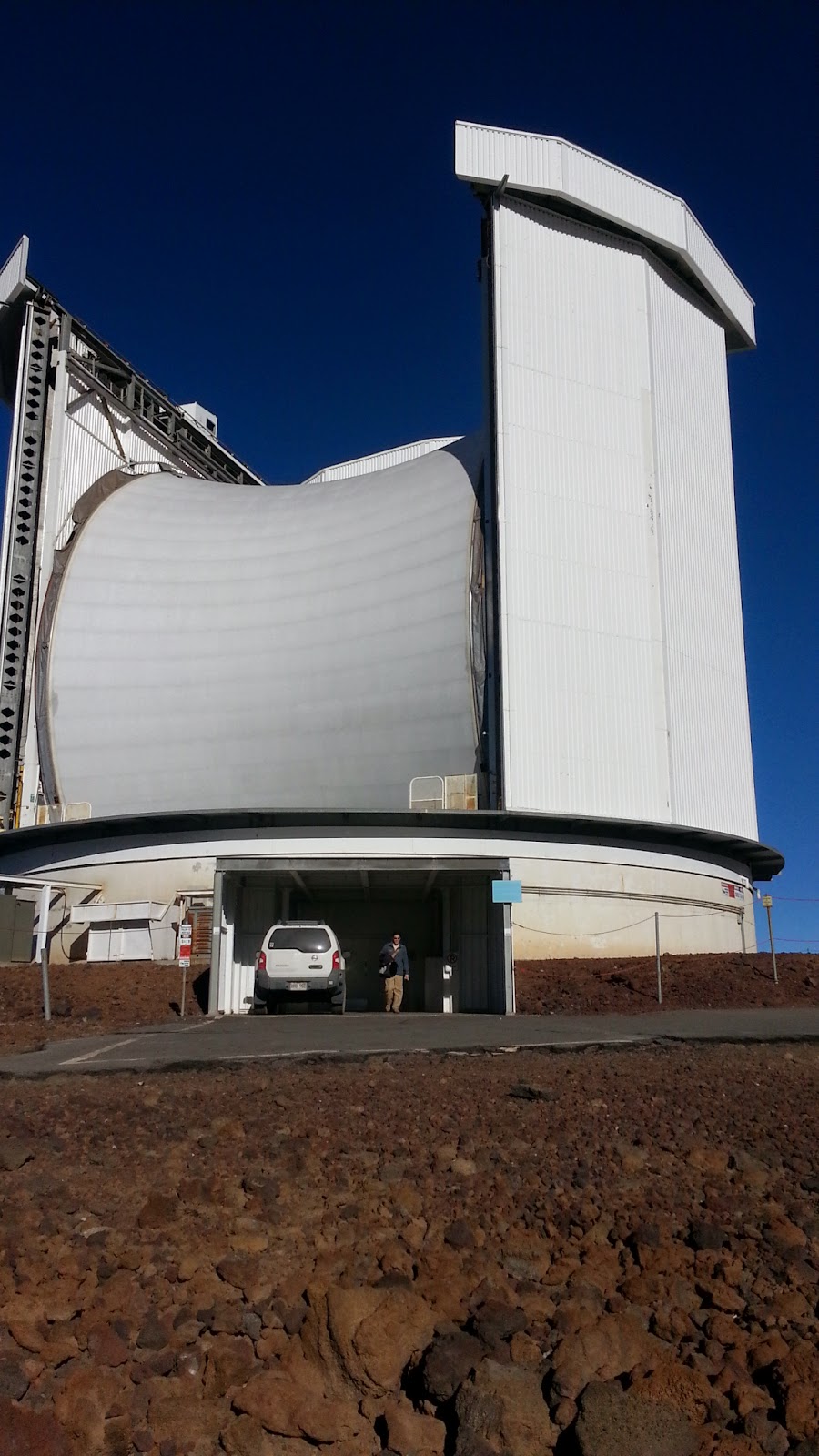
I forgot to get a picture inside the control room, but I did at least remember to take this picture on the way out Friday morning. Sorry it's not quite centered; I had to get off the road over some rough footing to be able to get even this much of the telescope in the frame, and as I had been up for over 21 hours at that point I wasn't sure enough of my footing to risk going further out. Also it's sometimes hard to tell if you've framed something right on your phone screen.
You can see Will next to the vehicle in the car port there, which should give you some idea of the scale. The telescope is actually open and observing in this picture, as we had just turned over control to the remote operator down in Hilo who continued observing till noon that day. That big expanse inside the building is the Gore-Tex membrane (largest in the world) that protects the dish from the elements.
And finally, this last picture is not related to my observing run, but to the other thing that happened this weekend: my birthday! Yes, I specifically picked Friday night to observe so that I could turn 25 up at JCMT on Mauna Kea. It was a really great experience. A quarter century! Wow!
And as a birthday present, my younger brothers sent me the following picture from Minecraft.

I was so taken with it that it's now my wallpaper, as you can see. Thanks guys! Actually, I should explain that monitor: I've decided, instead of buying a new computer, to build one myself. I'm still finalizing the parts for it, but I decided to go ahead and order a monitor first because I can use it (as seen here) as a second monitor for my laptop. Having a dual-monitor setup at work has really spoiled me, as it's just so handy for getting things done and being productive. Thus I intend to get another one of these monitors when I eventually get the computer built and use them together, but in the meantime this one can sit by my laptop and act as extra screen estate.
The only problem with the wallpaper is that every time I turn my computer on for the next few days I'm going to think I'm falling into lava in Minecraft and freak out, but I'm sure I'll get over it sooner or later.
I wasn't thinking that well up there due to a combination of lack of sleep and low oxygen, so I didn't take as many pictures as I would have liked (in particular, I would have liked one of me in the control room). I did take a few though, so I thought I'd share them.
I did at least remember to get a picture of the most exciting thing to happen, the flat tire on the way up Thursday night. That's my friend from college Will, the telescope operator that night, busy fixing our flat. Will loves cars, so I actually learned some things about brakes and how they work and what they look like while we were switching wheels.
This is just a shot back down the road from where we were, with Mauna Loa in the background and clouds at about the 6,000 foot level.
I forgot to get a picture inside the control room, but I did at least remember to take this picture on the way out Friday morning. Sorry it's not quite centered; I had to get off the road over some rough footing to be able to get even this much of the telescope in the frame, and as I had been up for over 21 hours at that point I wasn't sure enough of my footing to risk going further out. Also it's sometimes hard to tell if you've framed something right on your phone screen.
You can see Will next to the vehicle in the car port there, which should give you some idea of the scale. The telescope is actually open and observing in this picture, as we had just turned over control to the remote operator down in Hilo who continued observing till noon that day. That big expanse inside the building is the Gore-Tex membrane (largest in the world) that protects the dish from the elements.
And finally, this last picture is not related to my observing run, but to the other thing that happened this weekend: my birthday! Yes, I specifically picked Friday night to observe so that I could turn 25 up at JCMT on Mauna Kea. It was a really great experience. A quarter century! Wow!
And as a birthday present, my younger brothers sent me the following picture from Minecraft.
I was so taken with it that it's now my wallpaper, as you can see. Thanks guys! Actually, I should explain that monitor: I've decided, instead of buying a new computer, to build one myself. I'm still finalizing the parts for it, but I decided to go ahead and order a monitor first because I can use it (as seen here) as a second monitor for my laptop. Having a dual-monitor setup at work has really spoiled me, as it's just so handy for getting things done and being productive. Thus I intend to get another one of these monitors when I eventually get the computer built and use them together, but in the meantime this one can sit by my laptop and act as extra screen estate.
The only problem with the wallpaper is that every time I turn my computer on for the next few days I'm going to think I'm falling into lava in Minecraft and freak out, but I'm sure I'll get over it sooner or later.
Friday, May 16, 2014
Observing Blog, Live from the JCMT
And now, live from the JCMT control room...
8:30 PM: We left Hale Pohaku at 6 o'clock, only to have a flat tire as we ascended the access road. The took a while to fix, so we didn't get up to JCMT until almost 7 PM. Once there we had a few small faults before we were able to get started observing, but we've been running problem-free for about an hour now. Up here at 4,120 meters (13,517 feet) the pressure is a mere 627 millibars at the moment, only about 61.9% of the mean sea-level pressure of 1,013.25 millibars.
This low pressure typically makes me tired, but I took the extreme step of drinking a cup of coffee before I came up today -- I say extreme because in the past a single cup of coffee at any time of day has been enough to keep me forcibly awake until 4 in the morning. (In fact, I had one yesterday to keep me up as late as possible so that I could sleep in today and be ready to stay up tonight. It worked well.)
10:10 AM: Not much to report. Things have been going fairly smoothly. I'm definitely starting to feel the dryness in my nose and eyes. Normally I feel it even down at Hale Pohaku, but it was a bit more humid than normal down there the last few days. Am now sipping a large mug of tea, which is keeping my throat from drying out at least.
4:00 AM: Pretty quiet night tonight (not a bad thing after our initial adventure!). Just a few minor issues so far (which is pretty normal). I've been fighting off sleep for the last few hours with the help of a second cup of coffee (drastic measures!). Just four more hours to go before I can sleep! I am not cut out to be an observational astronomer. But that's fine, because I always knew I wanted to be more theoretical, anyway.
6:30 AM: Still nothing much happening. It's been a pretty quiet night where the biggest difficulty has been forcing myself to stay awake. Even two cups of coffee wasn't a guarantee. I've managed, though, and am looking forward to going down and getting some sleep so I can do it all again tomorrow night!
8:30 PM: We left Hale Pohaku at 6 o'clock, only to have a flat tire as we ascended the access road. The took a while to fix, so we didn't get up to JCMT until almost 7 PM. Once there we had a few small faults before we were able to get started observing, but we've been running problem-free for about an hour now. Up here at 4,120 meters (13,517 feet) the pressure is a mere 627 millibars at the moment, only about 61.9% of the mean sea-level pressure of 1,013.25 millibars.
This low pressure typically makes me tired, but I took the extreme step of drinking a cup of coffee before I came up today -- I say extreme because in the past a single cup of coffee at any time of day has been enough to keep me forcibly awake until 4 in the morning. (In fact, I had one yesterday to keep me up as late as possible so that I could sleep in today and be ready to stay up tonight. It worked well.)
10:10 AM: Not much to report. Things have been going fairly smoothly. I'm definitely starting to feel the dryness in my nose and eyes. Normally I feel it even down at Hale Pohaku, but it was a bit more humid than normal down there the last few days. Am now sipping a large mug of tea, which is keeping my throat from drying out at least.
4:00 AM: Pretty quiet night tonight (not a bad thing after our initial adventure!). Just a few minor issues so far (which is pretty normal). I've been fighting off sleep for the last few hours with the help of a second cup of coffee (drastic measures!). Just four more hours to go before I can sleep! I am not cut out to be an observational astronomer. But that's fine, because I always knew I wanted to be more theoretical, anyway.
6:30 AM: Still nothing much happening. It's been a pretty quiet night where the biggest difficulty has been forcing myself to stay awake. Even two cups of coffee wasn't a guarantee. I've managed, though, and am looking forward to going down and getting some sleep so I can do it all again tomorrow night!
Monday, May 12, 2014
Observing at the JCMT
Later this week I'll be heading up Mauna Kea for a few nights of observing at the telescope I work for, the James Clerk Maxwell Telescope. Safety protocols specify that there must always be a least two people up at the telescope due to the possibility of severe health problems in the low-pressure atmosphere, and most of the time the role of the second person (after the telescope operator) is played by a visiting astronomer. This particular week, for whatever reason, we ended up with a four-day hole in the schedule with no one scheduled to come, so a few of us at work were asked if we wanted to observe. I was (and am) quite excited to spend two nights watching the telescope in action, so I jumped at the chance. I expect it'll be a useful learning opportunity for me to see how the data I monitor for quality each day gets made the night before.
I'll be going up on Wednesday to acclimate, then observing Thursday and Friday nights. I'd like to do what I did before and write a blog post throughout one or possibly both nights as a log of my observing, so hopefully that (or those) will be up by the end of the week. Very exciting! A hui hou!
I'll be going up on Wednesday to acclimate, then observing Thursday and Friday nights. I'd like to do what I did before and write a blog post throughout one or possibly both nights as a log of my observing, so hopefully that (or those) will be up by the end of the week. Very exciting! A hui hou!
Subscribe to:
Posts (Atom)