Tuesday, April 30, 2024

A review of “Hānau ka ua: Hawaiian rain names”

It's something of a journalistic cliché that Inuit languages have a very large number of words for snow (at least compared to English). The question of many words exactly isn't very meaningful, however, because in a sense it's comparing apples to oranges. Ultimately, reconstructed Proto-Inuit-Yupik has just three unique root words for types of snow, but Inuit languages, due to being more on the synthetic side of the analytic-synthetic spectrum than English is, can produce a practically unlimited number of words describing snow (or any other topic) in increasing detail. But these wouldn't be analogous to words as we'd think of them in English, but more like descriptive phrases.

While the Inuit may not actually have that many root words for snow, the indigenous Hawaiian people did have many different names for rain. Anyone who's lived in the Hawaiian islands for a while will be familiar with how the varied geography creates microclimates, and will understand how the rain can be very different from place to place, or even in the same place at different times or under different conditions. No surprise, then, that people who depended on the rain for water noticed those patterns and came up with names for different kinds of rain.

Last month I picked up the book Hānau ka ua: Hawaiian rain names, by Collette Leimomi Akana and Kiele Gonzalez. It contains over four hundred painstakingly-compiled names for different rains found in the islands, based on written accounts from the 19th and 20th centuries (including newspapers and letters). It's a pretty hefty book, as you can see below.

A photo of the book Hānau ka ua: Hawaiian rain names
At 327 pages, this is not a small book.

The title “hānau ka ua” comes from a birth chant for Queen Emma that goes, “Hānau ke aliʻi, hānau ka ua me ka makani” (“The chiefess was born, the rain and wind, too, were born”). The introduction explains how important reading the weather was to ancient Hawaiians; some rains would be associated with particular seasons, which in turn might let people know that a particular kind of fish was available to catch. Some rains share the same name across islands, while other are tied to a specific location. A place might be known for a single type of rain found there, or it might have multiple rains associated with it; my favorite quote from the introduction is:

One place can have several rains. Hilo is home to at least fifty rains.

(Which, if you're keeping track, means around one-in-eight named rains are associated with Hilo.) The book is fantastic for someone like me with a grounding in (but not a mastery of) Hawaiian language, as it reproduces for each rain the original Hawaiian text where it was mentioned along with an English translation. This combination makes it fantastic for practicing one's Hawaiian reading comprehension, and I keep surprising myself with how much I remember from my year in undergrad.

When I bought this book, I had envisaged it something like a birding guide, a way to identify the many rains of Hilo and start checking them off some mental checklist. In this I have been disappointed, but I want to be very clear that that is not the fault of the book or the authors. It's a bit more depressing than that; you see, most of the references to rain names comes from 19th century writings, and many of them (at least as far as I've gotten in the book, though I see no reason to expect otherwise) are from popular sayings, mele (songs/chants), or other poetic utterances. They're not descriptions of what the rain is like, because the speaker/writer could be confident that the listener/reader would know what they were referring to; they didn't bother describing the rains because people already knew what they meant.

And that's a huge cache of cultural knowledge that has probably been lost to time! I'm not suggesting that everyone in the islands knew every name in the book; probably people knew the rains relevant to where they lived, plus probably some famous ones by reputation from other islands or places around their island. But such knowledge was primarily passed on orally, and with things like the suppression of the Hawaiian language in the late 19th and early 20th century, probably a lot of that knowledge was lost. Which is a real shame.

It's made even worse by the few descriptions of rains that do survive in the book, from things like letters or newspaper reports. I'm going to quote the English translation of one such description here, to give an idea of the specificity and detail that was involved. This is for the Alanilehua rain, which was associated with Hilo, Panaʻewa, and Puna:

Alanilehua Rain. This rain is sometimes called Wailehua. It is associated with the nectar of lehua blossoms. When this rain starts to come from the water's edge at Hāʻena and from above the upper heavens of that place, it will travel to the west, sprinkling the buds of Puna's hīnano blossoms and pouring down over the clusters of Panaʻewa's lehua trees. It won't ever come close to town, but these raindrops will appear outside of the western border of Panaʻewa. Then it turns and circles to the south, ascending the uplands of Pāʻieʻie, and disappearing within the watery mists of the forest. It has a delicate nature, is rarely seen, and is visible only between the hours of 10 and 12 in the morning.

From a description of rains by Lilia H. Richards and company, who traveled to the uplands of Puna in 1876. Hawaiian source: Richards et al. English trans. by author.

I adore this description for how much it says about the observation skills of the people who named it. The last sentence, in particular, really contextualizes it: it is “rarely seen,” and is only visible in a two-hour span, yet people noted it recurring enough times to sense a pattern and give it a name. I love the details of where it comes from, how it doesn't rain within the town but just outside it, and eventually turns and disappears up the slopes of Mauna Loa. It's a sheer delight to read about (especially in the original Hawaiian), and I can only imagine the similar descriptions that people must have shared in centuries past for all the other rains which are now no more than a memory of a name.

Still, I'm still less than halfway through the book at this point, and there are still many names to discover, and hopefully more descriptions that might start letting me put a name to the many rains I encounter here in Hilo (and elsewhere). Hānau ka ua won't necessarily serve as a birder's guide to rain, but it is still precious as a repository of what cultural knowledge remains about rain names, much of it poetic and beautiful in nature. If all that's piqued your interest, you can get a copy from Kamehameha Publishing here. And from an interview with the authors that I read, I'm looking forward to their next project, tentatively titled Hānau ka makani, a book of wind names; apparently they've already collected over six hundred of them. A hui hou!

Tuesday, April 2, 2024

Reforesting Mauna Kea

Last week I took the opportunity for a new experience: helping plant trees with the Mauna Kea Forest Restoration Project. For background, much of the high-elevation slopes of Mauna Kea was originally upland forest. A lot of that forest was later cleared for grazing cattle or as a result of grazing by invasive ungulate species; I don't know the exact details, but the point is that a lot of former upland forests is now upland grasslands. Montane prairie? (It does tend to remind me of the prairies of Nebraska when I'm up there, and a co-worker mentioned it reminded him of Scotland.) I'm sure there's a term for it.

Anyway, the location this time was the Kaʻohe Restoration Area on the west side of Mauna Kea about 6,000 feet (~1,800 meters) up. The area is part of the habitat range of the endangered palila, of which only a few hundred individuals remain (mostly in the wild, though there's also a captive breeding program). The hope is that, by restoring the forests that originally blanketed the mountain slopes, palila and other various endangered native birds will have more habitat available and able to expand their ranges. The area we were planting in was directly along the highway running between Saddle Road and Waimea, so it'll be easy to spot the trees growing in future while driving by.

Drone view from above Puʻu Ahumoa, a cinder cone up mauka (uphill) of where we were planting.

This time we were planting koa seedlings, a tree in the Acacia genus endemic to Hawaii famed as a hardwood for making canoes, surfboards, and other things (and unusual for being a thornless Acacia). The seedlings were either one or two years old (I think the latter), and already a few feet tall. We started with 800 seedlings, and despite having only about half the number of people who'd signed up we managed to plant 765 of them over the course of about five hours. (And only stopped because we ran out of gas for the portable hole drillers and didn't have a means to manually dig holes!)

My first tree planted!
Interestingly, I learned that koa have “baby” and “mature” leaves, though the mature type are not true leaves, but actually phyllodes – enlarged and flattened petioles (the leaf “stalk”) which take on the function of leaves. The photo below shows one of a few koa that had been planted in the same location last year to test how well they would grow, and shows both types of leaves on the same plant.

A ~3 year-old sapling showing different leaf types.

The weather was also interesting, being clear and sunny throughout the morning before a cloud rolled in over lunch turning everything misty and foggy (which was pretty typical, I learned from people who'd been there for a lot of plantings). Last year's archaeology experience gave me a good idea of how to prepare, though being well above rather than below sea level meant the sun was completely unforgiving. (I missed a patch of sunscreen just below one eye, with the resulting sunburn Wednesday morning looking humorously like I had a black eye.)

Me with seedlings after lunch, to get an idea of the scale.
All in all it was a fun experience, though my knees are still sore a week later from all the up-down-up-down involved. I'd definitely like to go again (after some time to recuperate), though probably not very often as the days it happens are unfortunately mostly during the week (though this occasion was on Prince Kuhio Day, a holiday, so I'll keep an eye out for opportunities). It feels nice to be part of regrowing forests, and knowing that the trees I planted could potentially be seen by people driving by for decades or even centuries to come. We'll see what comes of it in future! A hui hou!

Sunday, March 31, 2024

Local sculpture

Two weeks ago I was invited by my friend Ken (whom I've gone on excursions with before) to come along with a local photography club to visit the sculpture garden of a local sculptor, Mike Shewmaker. While I only found out during the visit, I've been passing by one of his sculptures in downtown Hilo for years; it's located near the corner of Kilauea Avenue and Keawe Street, by the Subway. I'd never actually paid much attention to it, but when I saw some of Mike's other work and someone reminded me of the one downtown it instantly clicked.

The sculpture downtown; a plaque mentions that the primary meaning of “hilo” is to braid or twist. 

Mike's sculptures tend towards the abstract primarily, with a number playing on this theme of curving, looping structures seemingly frozen in motion. He was there to meet us and talked about the creation process at some length; interestingly, he designs them in miniature, then has them constructed, and hasn't yet found a design his construction team couldn't handle (even when he was deliberately pushing the limits!).

I quite like this one with the single curly tendril.

Another similar to the one downtown, with some others in the background.
Altogether he has quite a few; with his permission I got the aerial shot below with my drone, and I think I count upwards of forty! Plus the one in Hilo, and he mentioned he has another one going up somewhere in Volcano soon. It was a very interesting visit and chat that lasted over two hours, though the clouds and intermittent light rain made me completely forget about sun protection, resulting in a mild sunburn(!).


Overall it was a fun excursion, and interesting to meet the artist behind a sculpture I go by pretty much every week. Happy Easter! A hui hou!

Saturday, March 23, 2024

Electric gas-mileage equivalents

A few days ago I came across a video from a group called Out of Spec Studios who do reviews of various electric vehicles, where did a range test on four electric pickup trucks, the Tesla Cybertruck Cyberbeast, Rivian R1T Dual-Motor Large Pack, Chevy Silverado EV 4WT,  and Ford F-150 Lightning Extended Range. It's a fairly entertaining watch with the editing and personalities involved; they charged each truck up to 100%, then drove them around (simultaneously) on the freeways at 70 miles per hour around Colorado/Wyoming/Nebraska until they ran out of charge to test their range in real-world conditions. (Along with a trailer-mounted diesel generator-powered fast charger for rescuing each one when they ran out of charge!) But what caught my attention was the efficiencies they calculated at the end of the test (and shared up-front in the video, which is pretty awesome).

The efficiencies came out in miles per kilowatt hour (mi/kWh), which I found interesting as I didn't know how to compare it to what I'm more familiar with, miles per gallon (mpg). It turns out there's a value for this, called miles per gallon gasoline equivalent, or MPGe. It's also a very simple conversion: one (U.S.) gallon of gasoline is considered to have 33.7 kWh of energy (though this is only for a theoretical 100% efficient conversion of the chemical potential energy to heat and work; in reality it's always lower). 

The four vehicles tested got 2.0 to 2.6 mi/kWh, which (multiplying by 33.7 hWh/gallon) translates to 67.4 to 87.6 MPGe. My 2018 Nissan Rogue has what I'd consider pretty good gas mileage (despite the hilly terrain of Hilo doing it no favors), and it's only rated at 25 mpg in city driving, or 32 mpg on the highway. (Though it informs me that the last few drives have been closer to 20 mpg, in practice.) That's quite a difference in energy efficiency!

For a different perspective, I looked at comparative costs. By inverting the mileage values and multiplying by the costs of electricity and gasoline, the four electric trucks would theoretically have costs in dollars per mile of $0.19/mile to $0.25/mile (based on the average price of $0.50/kWh for residential electricity). My Rogue, arbitrarily using the cost of gas of $4.88/gallon I saw a few days ago where I usually fill up, would vary from $0.15/mile to $0.18/mile for its highway and city ratings, respectively, so pretty comparable, overall.

I don't have a point to make from all this, I just got curious enough I thought it'd be fun to do some math. Personally, I'd love to have an EV; the allure of being able to charge at home and basically never having to stop at a gas station again is very strong. I didn't get one in 2021 after moving back to Hawaii for a few reasons, primarily the inventory shortage and lack of options at the time, but also the uncertainty in where I would end up living; and since I live in an apartment complex with no place to charge, my Rogue turned out to be for the best for now. It's in good condition and I hope to be able to get plenty more years of use out of it, but hopefully it can also be the last internal-combustion engine vehicle I own. Who knows what the future holds! A hui hou!

Thursday, February 29, 2024

Honoliʻi beach at dawn

It's been a busy few weeks here, with several people from my team at work who are normally remote being in town last week for a series of team meetings, socializing, and planning sessions. It was nice to see people in person (and we got a tour of the telescope!), but possibly as a result of all that close contact I came down with a cold on Sunday (which I'm finally mostly over today, thankfully).

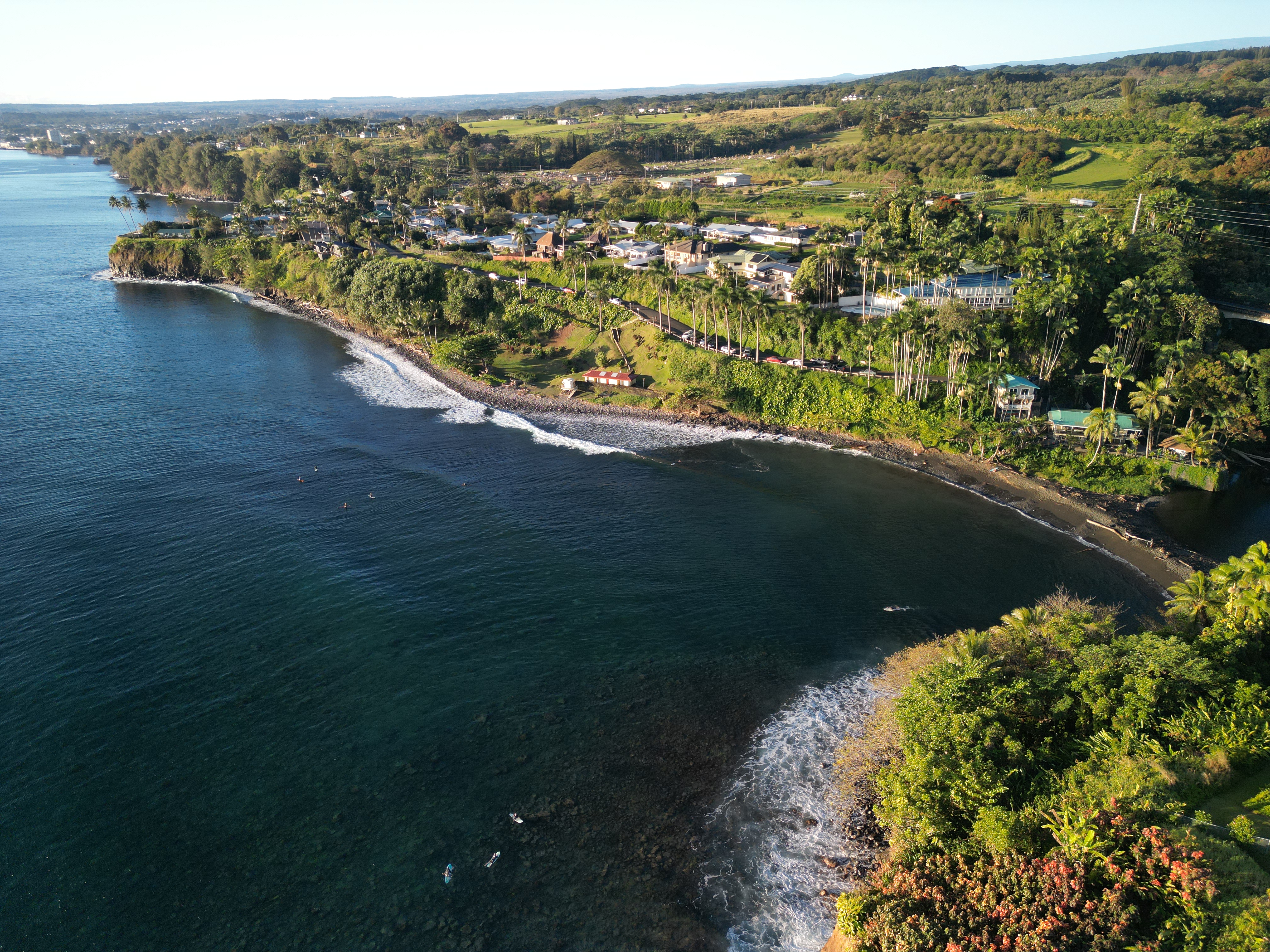
However, the week before all that, I drove a short way up the coast around sunrise to Honoliʻi beach, one of the few beaches on this side of the island considered to have any waves worth surfing. It's at the mouth of the Honoliʻi stream, and is one of the relatively rare places along the Hāmākua coast where its usual sea cliffs give way to a beach and have a slope shallow enough to permit walking to the shore. (Honoliʻi means “little valley” in Hawaiian, if you were wondering, which is both descriptive and rather cute.)

An aerial view of Honoliʻi beach, with a bridge over the mouth of the stream.
Honoliʻi beach and the mouth of the stream.
The morning was bright and clear, and I saw something my housemate Jonathan and I chased several times in vain over a decade ago: a horizon free of clouds for the sunrise! I had begun to think it didn't happen. But the sunlight was dazzling reflecting off the water, which led me to an interesting discovery.

You see, I've got some circularly-polarized lens covers on my drones, one benefit of which is that they block glare from linearly-polarized light reflecting off flat surfaces like water. It partially depends on the angle of the Sun, and while I was conceptually aware of what they did, this flight was the first time I really noticed. With the ocean as smooth as it was, you can see the ocean floor in the image above for quite a ways out from shore. And the water definitely wasn't this transparent to the naked eye by any means, so I was really a bit shocked at how well I could see through it with the filter. Here's another shot from a slightly different angle looking back along the coast towards Hilo; notice how clearly the rocks on the ocean floor are visible near the bottom of the image:

The beach from a different angle.
It was really quite eye-opening, no pun intended. I've always found water too deep to see the bottom of unnerving (one reason I don't spend much time in the ocean), and tend to assume the land drops off quickly. Whereas, from what I could see during this flight, it's actually fairly shallow even a ways from the shore, and slopes down gently. (Which isn't too surprising, given it's a shield volcano with very gentle slope, but our minds fill in assumptions for what we cannot see.)

One last bonus photo, if you follow Honoliʻi stream back from the ocean you come to a nice plunge pool and Makaila falls, surmounted by a bridge carrying the original road up the coast (the current highway uses the bridge seen in the first photo). The name of the falls means “young shoot, as for transplanting,” apparently. It's a lovely, serene place that isn't easily reachable by land. Which I'm beginning to realize is true of many of the waterfalls on the Hāmākua coast, the more I explore with my drone. For every Akaka falls and Rainbow falls, there's another set of falls that can't be easily reached or seen, perhaps not quite as spectacular or breathtaking, but beautiful in its own way. I've started planning out trips based on where I can see falls on Google Maps, trying to find new spectacles to enjoy and share. So you can expect more waterfall photos from me in the future.

Makailo falls.
Having flown up the stream with the Sun at my back lighting the way, I had a bit of a nasty surprise when I tried to turn around and return: the Sun was still so low in the sky that it was shining almost directly down the valley, and the backlighting of leaves and lens flare made it a dicey proposition to try to fly back out. Fortunately, this was actually my second time flying around Makailo falls (the first was back in July of ʻ22 when I stopped near the bridge in the photo), and I knew the pool itself had a clear view of the sky. Combined with the Mini 3 Pro's ability to look upwards better than a lot of drones, I was able to fly straight up out of the jungle and safely back above the trees. All's well that ends well, as they say! A hui hou! And happy leap year!

Saturday, February 17, 2024

High surf days in Hilo

In February of last year, I don't think I saw the Sun for the entire month. This year has had nicer weather in comparison, but where last winter saw us receiving torrential rain, this year's theme has been “high winds.” I'm not sure of the exact number, but we've lost probably in the range of a week or two of observing nights due to winds exceeding 50 mph on the summit over the course of January and February to date. While the winds don't get that high in Hilo (outside of hurricanes), they've definitely been noticeably stronger on numerous days this past month.

One effect of that has been a lot of high surf warnings, and that led me on the 2nd to fly my drone out to the Hilo bay breakwater to capture the waves rolling over it majestically one late afternoon. Serendipitously, a hole in the clouds opened to the west, letting the Sun shine in a bit and cast an unusual illumination over the scene. But enough talk, here's the video!


Normally the bay is much more placid (and ‘pacific’), so it's both a shock and a treat to see the waves crashing over the breakwater like that. There's just something about that motion, and the rippling of the sea's surface in general, that I find mesmerizing. Anyway, hope you enjoy the video! A hui hou!


Tuesday, January 30, 2024

Air and Space goodies

As part of my trip to Arizona, I visited the Pima Air and Space Museum twice, once as part of the ADASS conference dinner and once with my family. I'd never visited before, so it was pretty neat to see all the various things on display. I took too many photos to share them all, but wanted to share a few highlights:

A reproduction of the original Wright flyer, from the first December 17, 1903 flight.

The Bumblebee, officially the smallest plane ever flown. I'm not sure I'd fit inside, honestly.
SOFIA, the Stratospheric Observatory For Infrared Astronomy, a flying observatory.
As part of the ADASS dinner we got an exclusive tour of SOFIA, which was retired in 2022 after twelve years of operation. (Fun fact: Bill Vacca, SOFIA's head of operations for around twenty years, moved from there to become my current boss at Gemini.) This photo is from my second visit, however, as by the time my group got to visit the interior it was dark outside.

SOFIA interior.

I couldn't get the best photos inside due to the dim lighting, but here you can see the modified interior with the seats for the mission directors. The blue thing in the background is the interior side of the telescope mount, which observed through a hatch cut in the side of the airplane. I believe the intention is to eventually open it to the public, and with ADASS we were basically given a sneak peak.

There were so many more planes that I saw, and even more that I only barely got to see; the number they have on the grounds outside the hangers is truly incredible. If you visit Tucson, the Air and Space Museum is definitely worth a visit – though it's probably worth bringing sun protection if you want to spend time looking at all the planes outside. There really are a lot of them. A hui hou!

Monday, January 1, 2024

New year, new beginnings

I've been sitting on this for a few weeks now, but with the turn of the new year I finally feel up to writing about it. Near the beginning of December, I learned that my three-year contract with Gemini, which ends in October, is not going to be renewed. As usual with me, funding seems to be the issue; I started on a fixed-term contract because that was all that my team could get funding for, with the hope that perhaps it could be extended in the future. The Powers That Be don't seem inclined to fund data reduction for Gemini, however, so as of October I'll have finished my employment there (unless something changes between now and then, of course).

Objectively speaking, I don't think bringing someone in to work on your highly specialized software for three years and then letting them and all their acquired institutional knowledge go is a particularly far-thinking move, but them's the breaks. Personally speaking, I had been hoping to finally be able to work at a job for more than three years, but that remains an accomplishment beyond my grasp. (Graduate school is similar-to-but-not-really a job, though it does remain the longest I've worked at a single place, at four years.)

So, as I write this on the first of January 2024, I have no idea where I'll be or what I'll be doing a year from now. Time to start polishing my résumé and checking the job market again. (I do, at least, appreciate being given a ten-month advance warning.) We'll just have to see where I end up in twelve months. A hui hou!

Friday, December 22, 2023

An Arizona trip highlights video

I'm in the middle of a two-week vacation, which has provided me some much-needed time to rest and recuperate. I can tell I really needed this time off; normally, after two days of rest I've recovered my creative spark, but this time it's taken nearly five days to start to feel like doing much of anything. I say this by way of explanation for why updates have been so sparse around here, and hopefully I'll be able to get around to a few of the many projects I've got tucked away in my brain in the remainder of the year.

For this post, have a little video with some drone footage from my trip to Arizona. I took a motley collection of clips from a variety of locations, and have interwoven them in what seemed like an interesting fashion.

One location that shows up a few times is Cochise Stronghold (named for a famous Apache chieftain who held out and was eventually buried in the area). It's a large rock formation in the Dragoon Mountains, with a hiking path going up to it.

Cochise Stronghold (taken from the air with my Mini 3 Pro).

Another thing which shows up in the video a few times is the migration stop (or overwintering site, I'm not sure which) for sandhill cranes. As seen, there were a lot of them there; they're quite common and not endangered (estimated population in North America in the hundreds of thousands), and didn't seem to be all that bothered by my drone beyond a little unease, so I felt comfortable flying fairly close. It was incredible seeing what must've been thousands together like that; we don't really see anything like that here in Hawaii (or maybe I'm just not looking in the right places!).

A tiny fraction of the sandhill cranes present. They're fairly large birds, think “flamingo-sized.”

Also appearing a few times is the town of Pearce where I stayed. It's intertwined with a golf course built around half a century ago, which ultimately didn't prove successful. (I can only imagine the water bill to keep it green during the summer!) The holes meandered about through the town, and traces of them can still be seen all over the place, including the water hazard now being used as a reservoir for the vineyard seen at about 1:20 in the video.

Anyway, that's all for this post. I still have a few locations where I took enough photos to get another post or two out, but I wanted to get this video out to show off some of the bits and bobs of footage I got. A hui hou!

Friday, December 8, 2023

Happy half-birthday, Halley's comet!

I'm typing this on my lunch break at work so this'll be short, but this week I learned that Halley's comet will reach aphelion, the farthest point in its orbit from the Sun, at 3 PM HST (when this post goes out). At that point it'll be momentarily traveling at its slowest speed (relative to the Sun), a mere 0.91 km/s, or 2,035 mph. After that, it begins the long accelerating fall back in towards the inner Solar System. And yes, aphelion is only a "half-birthday" if you count its "birthday" as being perihelion, but it's as good a time as any and makes for a catchy title, so I went with it.

Halley's comet (or 1P/Halley to give it its official designation, the "P" meaning "periodic" and the "1" meaning it's the first to be recognized as such) is currently far too faint to be observed from Earth with even the largest telescopes, having last been imaged twenty years ago in 2003. (It might be possible to observe with the Hubble or JWST, but no one is looking – there wouldn't be much to learn from it.) Presumably that means it'll take about another twenty years to be imaged again, so look forward to that sometime around 2043, unless the ELT decides to try for it earlier or something.

Having been born three years after its most recent perihelion in 1986 I've never seen Halley's comet myself, but this is a nice reminder that it's still out there, and on its way back in again. Hopefully I'll get to see it at its next perihelion in July 2061! A hui hou!