I've been asked a few times this week about "the big meteor shower on Friday," but truth be told, I hadn't paid it much attention. I don't usually pay much attention to meteor showers, partly because they've always felt like an established part of the cycle of things – if I miss the Perseids this year, I can always catch them again next year, after all.
I changed my tune a bit when I came across an article this morning describing tonight's shower as a new shower. It's supposed to come about from the comet 209P/LINEAR, and will be supposedly the first time the earth will come in contact with the cast-off streams of debris this old comet sloughed off on every trip around between 1803 and 1924. (The comet has an orbital period of 5.09 years, which suggests it took about 24.8 trips around this sun in that time.)
Anyway, the salient point is that according to calculations there should be a shower of meteors from 209P/LINEAR between 6 and 8 UTC May 24th. This works out to be a very nice 8-10PM the previous (Friday) night here in Hawai'i; for the West Coast it'll be 11PM Friday night through 1AM Saturday morning; and for the East Coast it'll be 2-4AM.
The interesting thing is that this shower is calculated to be visible almost exclusively from North America and Hawai'i. This is partly due to the fact that its radiant – the location on the sky which all the meteor trails trace back to, and from which they all appear to radiate from – is in the far-northern constellation Camelopardalis. Following the tradition for naming meteor showers, the new showed has thus been termed the Camelopardalids.
Camelopardalis (meaning "giraffe") is a fairly modern constellation (created in 1612 or 1613) made up of a number of faint stars very close to the north celestial pole. It borders upon Ursa Minor, which contains Polaris, the North Star. Finding Camelopardalis will be rather difficult if you have any kind of light pollution system, but luckily since the radiant is so close to Polaris you can locate it to a good approximation by simply facing north. Although, it should be noted, sometimes it's better to watch a meteor shower by facing away from the radiant so that you catch the meteors that glance through the atmosphere (and thus produce long impressive trails) rather than the ones that punch into it head on (and thus make only short trails). So you might have more luck facing south, then lying down and looking up.
I don't know if this post will give enough time for you to prepare to watch the shower, but I thought I'd put it up quick in case it helps someone. I'm planning on heading up Mauna Loa to try to catch it and maybe even get some pictures, if it turns out to be good. That's the excitement of a new shower; no one knows how good it'll be. The best meteor showers, currently, are the Leonids in November and the Perseids in August, which can have up to 80 meteors per hours. This new shower has been predicted to have anywhere from 30 per hour (fairly weak, but noticeable) to a stunning 1,000 per hour. Given how these predictions tend to go, it will probably be a decent shower, but nothing spectacular (personally I doubt it'll be more than ~80 per hour or so) – but there's always that chance, that tiny chance that it will turn out to be something spectacular. And given that I don't need to get up at 2 o'clock in the morning to see it, I'm going to take that chance and see what happens. I'll have another post up soon detailing how it turned out. A hui hou!
Friday, May 23, 2014

Sunday, May 18, 2014
Observing Run Report. Also a Birthday.
Well, I decided against doing a second “live from the control room” post on my second night primarily because the second night was quiet, with even less to blog about (if possible) than the first night. Thankfully, two days of staying awake over twenty-one hours pretty effectively flipped my sleep schedule and after coming down Friday morning I slept like a log until it was time to get dinner and go up again. I was thus wide awake the entire second night, and didn't even need a single cup of coffee.
I wasn't thinking that well up there due to a combination of lack of sleep and low oxygen, so I didn't take as many pictures as I would have liked (in particular, I would have liked one of me in the control room). I did take a few though, so I thought I'd share them.

I did at least remember to get a picture of the most exciting thing to happen, the flat tire on the way up Thursday night. That's my friend from college Will, the telescope operator that night, busy fixing our flat. Will loves cars, so I actually learned some things about brakes and how they work and what they look like while we were switching wheels.

This is just a shot back down the road from where we were, with Mauna Loa in the background and clouds at about the 6,000 foot level.
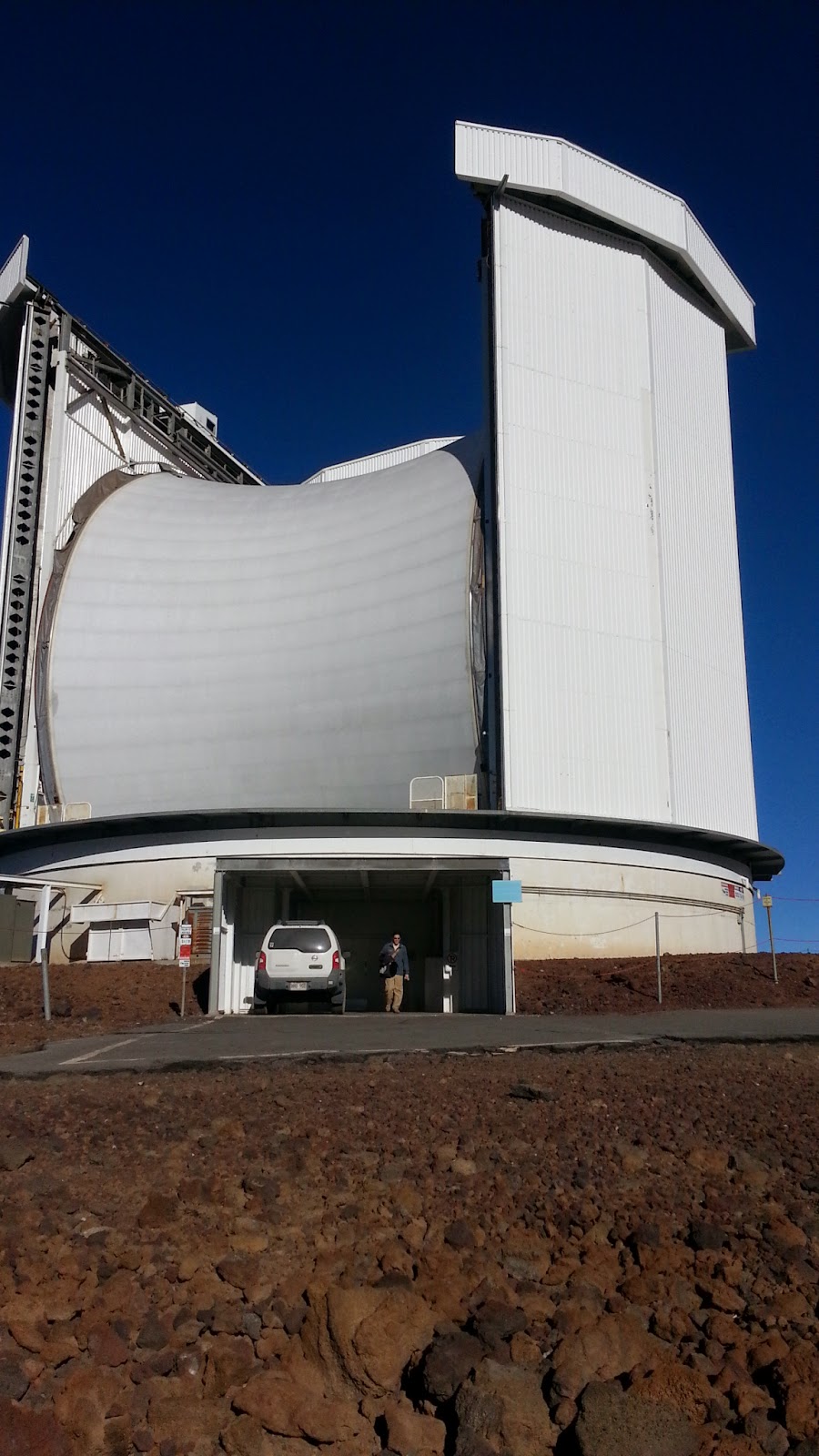
I forgot to get a picture inside the control room, but I did at least remember to take this picture on the way out Friday morning. Sorry it's not quite centered; I had to get off the road over some rough footing to be able to get even this much of the telescope in the frame, and as I had been up for over 21 hours at that point I wasn't sure enough of my footing to risk going further out. Also it's sometimes hard to tell if you've framed something right on your phone screen.
You can see Will next to the vehicle in the car port there, which should give you some idea of the scale. The telescope is actually open and observing in this picture, as we had just turned over control to the remote operator down in Hilo who continued observing till noon that day. That big expanse inside the building is the Gore-Tex membrane (largest in the world) that protects the dish from the elements.
And finally, this last picture is not related to my observing run, but to the other thing that happened this weekend: my birthday! Yes, I specifically picked Friday night to observe so that I could turn 25 up at JCMT on Mauna Kea. It was a really great experience. A quarter century! Wow!
And as a birthday present, my younger brothers sent me the following picture from Minecraft.

I was so taken with it that it's now my wallpaper, as you can see. Thanks guys! Actually, I should explain that monitor: I've decided, instead of buying a new computer, to build one myself. I'm still finalizing the parts for it, but I decided to go ahead and order a monitor first because I can use it (as seen here) as a second monitor for my laptop. Having a dual-monitor setup at work has really spoiled me, as it's just so handy for getting things done and being productive. Thus I intend to get another one of these monitors when I eventually get the computer built and use them together, but in the meantime this one can sit by my laptop and act as extra screen estate.
The only problem with the wallpaper is that every time I turn my computer on for the next few days I'm going to think I'm falling into lava in Minecraft and freak out, but I'm sure I'll get over it sooner or later.
I wasn't thinking that well up there due to a combination of lack of sleep and low oxygen, so I didn't take as many pictures as I would have liked (in particular, I would have liked one of me in the control room). I did take a few though, so I thought I'd share them.
I did at least remember to get a picture of the most exciting thing to happen, the flat tire on the way up Thursday night. That's my friend from college Will, the telescope operator that night, busy fixing our flat. Will loves cars, so I actually learned some things about brakes and how they work and what they look like while we were switching wheels.
This is just a shot back down the road from where we were, with Mauna Loa in the background and clouds at about the 6,000 foot level.
I forgot to get a picture inside the control room, but I did at least remember to take this picture on the way out Friday morning. Sorry it's not quite centered; I had to get off the road over some rough footing to be able to get even this much of the telescope in the frame, and as I had been up for over 21 hours at that point I wasn't sure enough of my footing to risk going further out. Also it's sometimes hard to tell if you've framed something right on your phone screen.
You can see Will next to the vehicle in the car port there, which should give you some idea of the scale. The telescope is actually open and observing in this picture, as we had just turned over control to the remote operator down in Hilo who continued observing till noon that day. That big expanse inside the building is the Gore-Tex membrane (largest in the world) that protects the dish from the elements.
And finally, this last picture is not related to my observing run, but to the other thing that happened this weekend: my birthday! Yes, I specifically picked Friday night to observe so that I could turn 25 up at JCMT on Mauna Kea. It was a really great experience. A quarter century! Wow!
And as a birthday present, my younger brothers sent me the following picture from Minecraft.
I was so taken with it that it's now my wallpaper, as you can see. Thanks guys! Actually, I should explain that monitor: I've decided, instead of buying a new computer, to build one myself. I'm still finalizing the parts for it, but I decided to go ahead and order a monitor first because I can use it (as seen here) as a second monitor for my laptop. Having a dual-monitor setup at work has really spoiled me, as it's just so handy for getting things done and being productive. Thus I intend to get another one of these monitors when I eventually get the computer built and use them together, but in the meantime this one can sit by my laptop and act as extra screen estate.
The only problem with the wallpaper is that every time I turn my computer on for the next few days I'm going to think I'm falling into lava in Minecraft and freak out, but I'm sure I'll get over it sooner or later.
Friday, May 16, 2014
Observing Blog, Live from the JCMT
And now, live from the JCMT control room...
8:30 PM: We left Hale Pohaku at 6 o'clock, only to have a flat tire as we ascended the access road. The took a while to fix, so we didn't get up to JCMT until almost 7 PM. Once there we had a few small faults before we were able to get started observing, but we've been running problem-free for about an hour now. Up here at 4,120 meters (13,517 feet) the pressure is a mere 627 millibars at the moment, only about 61.9% of the mean sea-level pressure of 1,013.25 millibars.
This low pressure typically makes me tired, but I took the extreme step of drinking a cup of coffee before I came up today -- I say extreme because in the past a single cup of coffee at any time of day has been enough to keep me forcibly awake until 4 in the morning. (In fact, I had one yesterday to keep me up as late as possible so that I could sleep in today and be ready to stay up tonight. It worked well.)
10:10 AM: Not much to report. Things have been going fairly smoothly. I'm definitely starting to feel the dryness in my nose and eyes. Normally I feel it even down at Hale Pohaku, but it was a bit more humid than normal down there the last few days. Am now sipping a large mug of tea, which is keeping my throat from drying out at least.
4:00 AM: Pretty quiet night tonight (not a bad thing after our initial adventure!). Just a few minor issues so far (which is pretty normal). I've been fighting off sleep for the last few hours with the help of a second cup of coffee (drastic measures!). Just four more hours to go before I can sleep! I am not cut out to be an observational astronomer. But that's fine, because I always knew I wanted to be more theoretical, anyway.
6:30 AM: Still nothing much happening. It's been a pretty quiet night where the biggest difficulty has been forcing myself to stay awake. Even two cups of coffee wasn't a guarantee. I've managed, though, and am looking forward to going down and getting some sleep so I can do it all again tomorrow night!
Monday, May 12, 2014
Observing at the JCMT
Later this week I'll be heading up Mauna Kea for a few nights of observing at the telescope I work for, the James Clerk Maxwell Telescope. Safety protocols specify that there must always be a least two people up at the telescope due to the possibility of severe health problems in the low-pressure atmosphere, and most of the time the role of the second person (after the telescope operator) is played by a visiting astronomer. This particular week, for whatever reason, we ended up with a four-day hole in the schedule with no one scheduled to come, so a few of us at work were asked if we wanted to observe. I was (and am) quite excited to spend two nights watching the telescope in action, so I jumped at the chance. I expect it'll be a useful learning opportunity for me to see how the data I monitor for quality each day gets made the night before.
I'll be going up on Wednesday to acclimate, then observing Thursday and Friday nights. I'd like to do what I did before and write a blog post throughout one or possibly both nights as a log of my observing, so hopefully that (or those) will be up by the end of the week. Very exciting! A hui hou!
I'll be going up on Wednesday to acclimate, then observing Thursday and Friday nights. I'd like to do what I did before and write a blog post throughout one or possibly both nights as a log of my observing, so hopefully that (or those) will be up by the end of the week. Very exciting! A hui hou!
Sunday, May 4, 2014
May the Fourth Be With You, and AstroDay
Not exactly related to the pun in the title, but on Saturday I helped out at the Joint Astronomy Centre table for AstroDay down at the mall. I think I've mentioned AstroDay before, but for a refresher, it's an event each year where all the various observatories and other astronomy groups around the island (such as the UH Astronomy department) set up tables down at the mall as part of an astronomy outreach push. It's quite a big event with tables spread throughout the mall, all of which have their own little diversions and demonstrations. At our table we had build-your-own paper-models of the JCMT to giveaway (which were quite a hit), along with various other things such as a robotic arm which we had kids grab themselves a piece of candy from a bowl with (also a big hit).
It's always great seeing kids getting excited about astronomy and science in general, and I was completely floored by one thing in particular: one of the kids who came to our table recognized me from when I came and spoke to his class as part of Journey Through the Universe. That was over a month ago, and I'm amazed and humbled that he remembered me. There isn't really any follow-up in Journey Through the Universe so it can be hard to judge the impact you have, and easy to discount it because you don't see what impact there is, but an incident like this gives me hope that perhaps, just perhaps, I had more of an impact than I thought. Maybe I've helped inspire someone to go into astronomy. I'll likely never know, but it's a thought simultaneously uplifting and humbling.
It's always great seeing kids getting excited about astronomy and science in general, and I was completely floored by one thing in particular: one of the kids who came to our table recognized me from when I came and spoke to his class as part of Journey Through the Universe. That was over a month ago, and I'm amazed and humbled that he remembered me. There isn't really any follow-up in Journey Through the Universe so it can be hard to judge the impact you have, and easy to discount it because you don't see what impact there is, but an incident like this gives me hope that perhaps, just perhaps, I had more of an impact than I thought. Maybe I've helped inspire someone to go into astronomy. I'll likely never know, but it's a thought simultaneously uplifting and humbling.
Wednesday, April 23, 2014
News from the Joint Astronomy Centre
You probably haven't heard unless you're one of a small number of radio astronomer associated with the JCMT, but the JCMT has been closed since last Thursday with a busted wheel. Specifically, it's one of the massive wheels that the entire telescope rests and turns on (called “bogies,” for what reason no one could tell me). According to Engineering we've got a replacement part being fabricated which should be ready by Thursday, though it might take a little while to get installed even if all goes according to schedule.
On the UKIRT front, it's been an open secret for some months now that UKIRT is going to be taken over by new owners. The legal process involved has taken a long time to resolve, so while it has been virtually certain that the management of UKIRT was going to be taken over by a consortium between Lockheed Martin and the University of Arizona, we haven't been at liberty to officially announce it. This morning the local Hilo paper, The Hawaii Tribune, ran a story about it, so while it's still not been officially announced, it is out in the wild and I now have permission to talk about it. Which I've just done, so there you have it.
Just because JCMT is closed doesn't mean I have nothing to do, as I still have several projects I'm working on. A week without new observations coming in has helped me get caught up on the task I've recently taken over of monitoring the flow of observation files from JCMT to the Canadian Astronomy Data Centre (CADC) where all our data is archived (along with the data from many other telescopes). Plenty to keep me busy around here!
Edit (4/24/2014): And here's a link to the Hawaii Tribune article I mentioned earlier.
Friday, April 18, 2014
Lunar Eclipse Cycle
Monday night the moon underwent a beautiful total lunar eclipse. Sitting at my computer in front of my east-facing window I was able to watch the moon as it rose over the course of two hours while the earth's shadow slowly crept over it (when it was visible between the scattered clouds, that is!).
Lunar eclipses aren't as flashy as solar eclipses are, but while the majority of people will never see (or have the opportunity to see) a solar eclipse without traveling out of their way, lunar eclipses are visible to the entire night side of the world. I'm sorry that I didn't realize this one was coming up soon enough to advertise it ahead of the fact – I'll try to remember to do so for the next one, as it's a really cool experience to see one. This one was especially cool because the moon passed very close to Mars as it was at full coverage, making for quite the spectacle.
This eclipse was also interesting because it was the first in a cycle of four such total eclipses. The interactions between the earth and the moon are complex, and usually you get a mixture of partial and total lunar eclipses, but every so often we get these neat cycles of four total lunar eclipses in a row. The remaining three eclipses are set to take place on October 8 2014, April 4 2015, and September 28 2015. A hui hou!
Wednesday, April 9, 2014
Farewell, Windows XP
Yesterday, if you weren't aware, marks the day Microsoft announced two years ago when it stops providing support for Windows XP. It's no exaggeration to say that Windows XP is the most popular operating system in history, as shown by the fact that almost 30% of computers accessing the Internet last month were running it twelve years after it came out in late 2001. (Not to mention the countless other unconnected computers that are running it. Most ATMs, for example, are still running XP.)
In some ways Microsoft has been the victim of their own success with XP, as shown by the fact that such a significant number of people haven't moved on yet and bought more up-to-date versions of Windows yet. There's another more charitable reason to want people to upgrade; Windows XP was designed long before many of the advanced and dangerous malware threats of today were even conceived of, and while Microsoft has dutifully patched it all these years there comes a point when it's in everyone's best interests to move on. It's a simpler operating system for a simpler time.
Now that Microsoft has pushed its last patch for XP (at least for those who aren't paying exorbitant amounts for an extended service plan such as the British government), any vulnerabilities found in the future will remain un-patched and, well, vulnerable. If any of you out there are reading this on XP, I'd definitely suggest thinking about getting off it quickly. There are a number of good alternative operating systems out there that are much more secure and up-to-date. From personal experience I can say that Windows 7 is much like XP, and if you happen to feel like shaking things up there are any number of free Linux versions to choose from that will work just as well (such as some that I wrote about a few weeks ago).
I'll definitely hold fond memories of Windows XP because that was the operating system of my first computer, but unlike the 30% of the population still running it I moved on years ago (a little over four years ago, to be precise, when I bought my current laptop with Windows 7). Rather than attempting to grasp something that is by nature ephemeral, I look at changing operating systems as an opportunity to change, grow, and try and try something new. At some point in the future I'll need to move on from Windows 7, and you know what? I'm rather looking forward to it.
Wednesday, April 2, 2014
Water Warnings
Yesterday (April 1st) we had enough rain in Hilo to trigger a flash-flood warning for much of the afternoon (I believe the airport got something like three inches in one hour). We also got a tsunami advisory from the magnitude-8.2 earthquake off of Chile. Thankfully, neither caused too much damage (that I've heard). Hilo drains pretty well (and my house is on a slight rise compared to the surroundings), and the tsunami caused only a few feet of sea level change in the harbor. It didn't trigger the sirens and full-scale evacuation we've had in past years. Of course, I also heard there was a powerful aftershock near Chile today, so it's still possible we could get a tsunami. Nothing to do but wait and see.
As I like to say, life's never dull when you live near sea level on an active volcano in the middle of the Ring of Fire!
As I like to say, life's never dull when you live near sea level on an active volcano in the middle of the Ring of Fire!
Sunday, March 23, 2014
Mauna Kea: One Word or Two?
The local newspaper, the Hawaii Tribune Herald, ran an article back on February 13 talking about a recent meeting by the Mauna Kea Management Board (MKMB). The article spent most of its time talking about the progress of the Thirty Meter Telescope, which was interesting enough, but what I found really fascinating was buried in the last sentence relating some of the other proceedings of the meeting. I've reproduced the sentence in question below and underlined the part I found so arresting:
So this isn't quite as frivolous at it might as first appear, but it's at best neutral. Those other names have been long standardized in the form they appear, but just so “Mauna Kea” has been standard for quite a while. Which brings me to my second point: practically, Mauna Kea has been spelled that way for a long time now. Even if you could make a compelling case, linguistically, for spelling it as one word (which I don't think you can, although I do admit I'm not an expert in Hawaiian), the fact of the matter is that there's a lot of printed material out there calling it Mauna Kea. This should give serious pause to any consideration of name-changing, no matter what. It's just strange to me that the subject was even brought up for discussion.
To be fair, there isn't any indication in the article about what was actually decided in the matter or even how much time they spent discussing it. I haven't heard anything official since, but if I do I'll be sure to report on it. Until next time, a hui hou!
“The MKMB also discussed the installation of a photovoltaic system at the Hale Pohaku Mid-Level Astronomy Facilities, its volunteer efforts, and the decision to change the spelling of Mauna Kea to one word instead of two.”I find that a surprising topic of discussion for two reasons. Linguistically, “Maunakea” isn't really more or less valid than “Mauna Kea.” In Hawaiian “mauna” means “mountain” and “kea” means “white,” and “mauna kea” translates really well into English as “white mountain.” Of course, by this point it's become a proper name, and just as “Whitemountain” would be a perfectly valid (if a little odd) name in English, “Maunakea” would be a valid name in Hawaiian (and there are a lot of precedents for names in Hawaiian made up of multiple words being written as one, which is where the occasional name longer than twenty letters comes from). This form of name is actually somewhat common in European languages: the name “Montenegro” (the country in south-east Europe) means simply “Black Mountain.” The early Baroque composer Claudio Monteverdi's last name I believe means “green mountain.” And there are cities in both France and Spain with the name Montblanc, which I think would translate to “white mountain.” I suspect such things probably also appear in other languages that I don't know around the world.
So this isn't quite as frivolous at it might as first appear, but it's at best neutral. Those other names have been long standardized in the form they appear, but just so “Mauna Kea” has been standard for quite a while. Which brings me to my second point: practically, Mauna Kea has been spelled that way for a long time now. Even if you could make a compelling case, linguistically, for spelling it as one word (which I don't think you can, although I do admit I'm not an expert in Hawaiian), the fact of the matter is that there's a lot of printed material out there calling it Mauna Kea. This should give serious pause to any consideration of name-changing, no matter what. It's just strange to me that the subject was even brought up for discussion.
To be fair, there isn't any indication in the article about what was actually decided in the matter or even how much time they spent discussing it. I haven't heard anything official since, but if I do I'll be sure to report on it. Until next time, a hui hou!
Subscribe to:
Posts (Atom)